À la mi-juin 2026, la CAAM et l'Alliance pour l'innovation de l'industrie chinoise des batteries de puissance ont successivement publié les données relatives aux marchés de l'automobile et des batteries de puissance pour mai 2026. La CAAM a indiqué qu'en mai, la production et les ventes d'automobiles ont augmenté en glissement mensuel mais légèrement diminué en glissement annuel. Affectés par de multiples facteurs, notamment les ajustements de politique, l'évolution de la structure du marché et un environnement macroéconomique sous pression, le marché chinois a continué d'afficher une baisse à deux chiffres en glissement annuel ; parallèlement, les exportations sont restées vigoureuses et ont soutenu une croissance rapide........ SMM a compilé les données pertinentes sur les marchés de l'automobile et des batteries de puissance pour mai 2026, à titre de référence pour les lecteurs.
Automobile
CAAM : la production et les ventes d'automobiles en mai ont atteint 2,616 millions et 2,629 millions d'unités, toutes deux en hausse mensuelle
En mai, la production et les ventes d'automobiles ont atteint 2,616 millions et 2,629 millions d'unités, en hausse de 1,6 % et 4,1 % en glissement mensuel respectivement, et en baisse de 1,2 % et 2,1 % en glissement annuel respectivement. De janvier à mai, la production et les ventes d'automobiles ont totalisé 12,235 millions et 12,207 millions d'unités, en baisse de 4,6 % et 4,2 % en glissement annuel respectivement, les baisses se resserrant davantage par rapport aux quatre premiers mois.
CAAM : la production et les ventes de VEN en mai ont augmenté respectivement de 22,4 % et 14,4 % en glissement annuel ; les ventes de VEN représentaient 47,5 % des ventes totales de véhicules neufs
En mai, la production et les ventes de VEN ont atteint 1,554 million et 1,496 million d'unités, en hausse de 22,4 % et 14,4 % en glissement annuel respectivement. Les ventes de VEN représentaient 56,9 % des ventes totales de véhicules neufs. De janvier à mai, la production et les ventes de VEN ont atteint 5,841 millions et 5,802 millions d'unités, en hausse de 2,5 % et 3,5 % en glissement annuel respectivement, et les ventes de VEN représentaient 47,5 % des ventes totales de véhicules neufs.
CAAM : les exportations de VEN ont plus que doublé en mai et sur la période janvier-mai
En mai, les exportations de VEN ont atteint 446 000 unités, en hausse de 3,8 % en glissement mensuel et de 110 % en glissement annuel. Parmi celles-ci, les exportations de VEN de tourisme se sont élevées à 435 000 unités, en hausse de 3,4 % en glissement mensuel et de 110 % en glissement annuel ; les exportations de VEN commerciaux ont atteint 12 000 unités, en hausse de 21 % en glissement mensuel et de 48,1 % en glissement annuel. De janvier à mai, les exportations de VEN ont totalisé 1,833 million d'unités, en hausse de 110 % en glissement annuel. Parmi celles-ci, les exportations de VEN de tourisme se sont élevées à 1,792 million d'unités, en hausse de 120 % en glissement annuel ; les exportations de VEN commerciaux étaient de 41 000 unités, en hausse de 0,6 % en glissement annuel.
La CAAM a commenté qu'en mai, la production et les ventes automobiles ont augmenté en glissement mensuel mais légèrement baissé en glissement annuel. Affecté par de multiples facteurs tels que les ajustements politiques, les changements de structure du marché et un environnement macroéconomique sous pression, le marché chinois a continué de connaître une baisse à deux chiffres en glissement annuel ; les exportations se sont développées vigoureusement, maintenant une trajectoire de croissance rapide. Par modèle, les ventes de véhicules particuliers ont légèrement baissé en glissement annuel, les ventes de véhicules utilitaires ont maintenu leur croissance, et le marché des véhicules à énergie nouvelle (VNE) s'est stabilisé et a rebondi. Depuis le début de l'année, le marché automobile se caractérise clairement par une « demande intérieure sous pression, commerce extérieur fort ». L'industrie a fait face à de multiples défis : demande intérieure insuffisante, coûts élevés et chocs externes. Côté demande finale, il convient de stabiliser les politiques et les anticipations du marché, d'approfondir la gouvernance sectorielle, d'introduire avec prudence des mesures restrictives et de consolider la base de consommation ; côté commerce extérieur, il faut approfondir le développement international, relever efficacement divers risques et défis, et renforcer le rôle stabilisateur du cycle international.
Parallèlement, la CPCA a publié les données du marché des véhicules particuliers pour mai. Du 1er au 31 mai, les ventes au détail de véhicules particuliers en Chine ont atteint 1,51 million d'unités, en baisse de 22,1 % en glissement annuel mais en hausse de 9,2 % en glissement mensuel ; les ventes au détail cumulées depuis le début de l'année s'élèvent à 7,099 millions d'unités, en baisse de 19,5 % en glissement annuel.
Dans le segment des VNE, les ventes au détail en mai ont chuté de 7 % en glissement annuel, les marques nationales reculant de 10 %, les coentreprises grand public augmentant de 51 % et les marques de luxe de 8 %. Les ventes au détail nationales de véhicules électriques économiques ont été fortement pénalisées par la chute brutale des subventions. En raison des généreuses subventions pour les véhicules utilitaires VNE, le segment des monospaces d'entrée et milieu de gamme a subi un repli relativement prononcé.
À l'exportation, les ventes de VNE particuliers ont atteint 424 000 unités en mai, en hausse de 112,6 % en glissement annuel et de 4,4 % en glissement mensuel.Elles représentent 54,1 % du total des exportations de véhicules particuliers, soit une progression de 9,5 points de pourcentage par rapport à la même période l'an dernier. Parmi elles, les véhicules électriques à batterie (VEB) comptaient pour 59,3 % des exportations de VNE (contre 66,1 % l'an dernier), les VEB de classe A00+A0, segment clé, pesant 53,8 % des exportations de VEB (contre 50,7 %). Parallèlement aux avantages d'échelle émergents des véhicules à énergies nouvelles chinois et à la demande d'expansion du marché, un nombre croissant de produits de marque VNE fabriqués en Chine s'exportent, leur reconnaissance à l'étranger ne cessant de s'améliorer. Parmi les exportations de VNE, les véhicules hybrides rechargeables à carrosserie étroite représentaient 36,2 % (contre 31,9 % à la même période l'année précédente), et les véhicules électriques à autonomie étendue 4,4 % (contre 2,0 %). Bien que des interférences extérieures de la part de certains pays soient récemment apparues, l'exportation d'hybrides rechargeables domestiques à carrosserie étroite vers les pays en développement a connu une croissance rapide et présente de belles perspectives.
L'Association chinoise des voitures particulières (CPCA) a indiqué que le marché intérieur des véhicules particuliers en mai 2026 a présenté une dynamique opérationnelle de volume global sous pression, de renforcement d'un mois sur l'autre et de différenciation structurelle extrême, sans parvenir à une reprise substantielle dans l'ensemble. La légère reprise du marché automobile en mai est principalement attribuée à l'efficacité manifeste des efforts de « lutte contre l'involution » de l'industrie, qui ont stabilisé les promotions des constructeurs et affaibli l'attente des consommateurs quant à des baisses de prix. Cela, conjugué à l'effet d'animation du Salon de l'auto de Pékin, a libéré une demande d'achat de voitures jusque-là contenue, formant un rebond progressif des ventes au détail.
Elle a indiqué que les caractéristiques principales du marché automobile en mai étaient l'effondrement des ventes intérieures de véhicules à moteur thermique, la forte domination des véhicules à énergies nouvelles et la croissance à contre-courant des exportations. La cause principale de la baisse du marché automobile intérieur a été la forte contraction des ventes de véhicules thermiques sous l'effet des prix élevés du carburant. En mai, les véhicules thermiques représentaient une part de 37,1 %, mais leur baisse en glissement annuel a contribué à 82 % de la baisse totale des véhicules particuliers, plombant la tendance générale du marché. Des facteurs tels que les prix élevés du pétrole et la transformation de la consommation ont accéléré le processus de « substitution du thermique par l'électrique ». Ce mois-ci, le taux de pénétration au détail des véhicules à énergies nouvelles a continué de dépasser 60 %, atteignant un niveau record de 62,9 %. La transformation vers l'électrification des marques de coentreprises s'est accélérée. En mai, les ventes de modèles de voitures à énergies nouvelles des coentreprises ont augmenté de 51 % en glissement annuel, tandis que les ventes de véhicules thermiques ont chuté de 41 % sur un an. Les exportations sont restées le moteur de croissance principal du secteur. En mai, la part des énergies nouvelles dans les exportations a atteint un nouveau sommet de 54 %, mais les exportations de véhicules thermiques ont également affiché une performance solide avec une croissance de 46 %, formant une performance exceptionnelle de la croissance tous azimuts des exportations chinoises.
Caractéristiques du marché des véhicules particuliers en mai 2026 : 1. Le volume global était sous pression, avec une divergence structurelle majeure, et « froid pour les carburants, chaud pour les nouvelles énergies » est devenu le principal point focal. La raison centrale du repli des ventes au détail nationales a été l’« effondrement des carburants », qui a porté le taux de pénétration des véhicules à énergies nouvelles à 62,9 % (un record), le rythme de substitution par électrification dépassant les attentes. 2. La transition électrique des marques de coentreprises s’est accélérée. En mai, les ventes au détail nationales de véhicules à énergies nouvelles des coentreprises grand public ont progressé de 51 % sur un an, tandis que la croissance globale des véhicules à énergies nouvelles nationaux a ralenti de 10 %. Des marques comme Buick (dont les énergies nouvelles représentent 45 % de ses ventes) ont commencé à enregistrer des premiers résultats dans leur virage électrique. 3. Les exportations ont connu une croissance explosive, les énergies nouvelles représentant 54 % (un record) des exportations, portées à la fois par ces dernières et par les marques nationales, faisant de l’internationalisation le moteur de croissance principal. 4. On observe un net déstockage passif et une baisse relativement rapide des stocks des réseaux. Les concessionnaires cotés ont globalement subi des pertes et la pression sur leur survie n’a cessé de croître. 5. Les marques indépendantes ont réalisé des percées notables sur le segment haut de gamme, les ventes au détail de véhicules particuliers dans les tranches de prix 200 000 à 300 000 yuans, 300 000 à 400 000 yuans et plus de 400 000 yuans dépassant toutes 50 %. 6. Les micro-VE étaient sous pression, les voitures du segment A se sont contractées, la consommation d’entrée de gamme avait un besoin urgent de soutien, et le lancement de normes pour les VE économiques était très attendu.
Point sur les batteries de puissance
En avril, les ventes de batteries de puissance et de stockage d’énergie ont augmenté de 47,4 % sur un an. Le cumul de janvier à mai a progressé de 48,5 % sur un an.
En mai, les ventes chinoises de batteries de puissance et de stockage d’énergie ont atteint 182,2 GWh, en hausse de 11,0 % par rapport au mois précédent et de 47,4 % sur un an. Parmi elles, les ventes de batteries de puissance se sont élevées à 127,0 GWh, représentant 69,7 % du total, en progression de 16,6 % sur un mois et de 45,2 % sur un an ; les ventes de batteries de stockage se sont établies à 55,2 GWh, soit 30,3 % du total, en recul de 0,1 % sur un mois mais en hausse de 52,7 % sur un an.
De janvier à mai, le cumul des ventes chinoises de batteries de puissance et de stockage a atteint 783,4 GWh, en hausse de 48,5 % sur un an. Parmi celles-ci, les ventes cumulées de batteries de puissance ont atteint 527,9 GWh, représentant 67,4 % des ventes totales, en hausse de 34,9 % sur un an ; les ventes cumulées de batteries de stockage d'énergie (ESS) ont atteint 255,5 GWh, soit 32,6 % du total, en hausse de 87,7 % sur un an.
En mai, les installations de batteries de puissance en Chine ont augmenté de 25,9 % sur un an, la part des batteries LFP atteignant 81,2 %
En mai, les installations de batteries de puissance en Chine ont atteint 71,9 GWh, en hausse de 15,2 % par rapport au mois précédent et de 25,9 % sur un an. Les installations de batteries ternaires ont atteint 13,4 GWh, représentant 18,6 % du total des installations, en hausse de 15,9 % par rapport au mois précédent et de 27,3 % sur un an ; les installations de batteries LFP ont atteint 58,4 GWh, soit 81,2 % du total, en hausse de 14,9 % par rapport au mois précédent et de 25,4 % sur un an.
De janvier à mai, les installations cumulées de batteries de puissance en Chine ont atteint 259,1 GWh, en hausse de 7,3 % sur un an. Les installations cumulées de batteries ternaires se sont élevées à 50,8 GWh, représentant 19,6 % du total des installations, en hausse de 13,3 % sur un an ; les installations cumulées de batteries LFP ont atteint 208,2 GWh, soit 80,4 % du total, en hausse de 6,0 % sur un an.
Mai : Leap Motor domine les startups de véhicules à énergies nouvelles (NEV) ; la croissance des exportations de BYD impressionne
Début juin, les chiffres de ventes/livraisons de NEV domestiques pour mai ont été publiés. BYD a continué de dominer le marché mondial des NEV avec des ventes dépassant les 380 000 unités. Parmi les startups chinoises de NEV, la performance exceptionnelle de Leap Motor a de nouveau enflammé l'enthousiasme du marché, établissant un nouveau record de livraisons mensuelles avec plus de 80 000 unités !
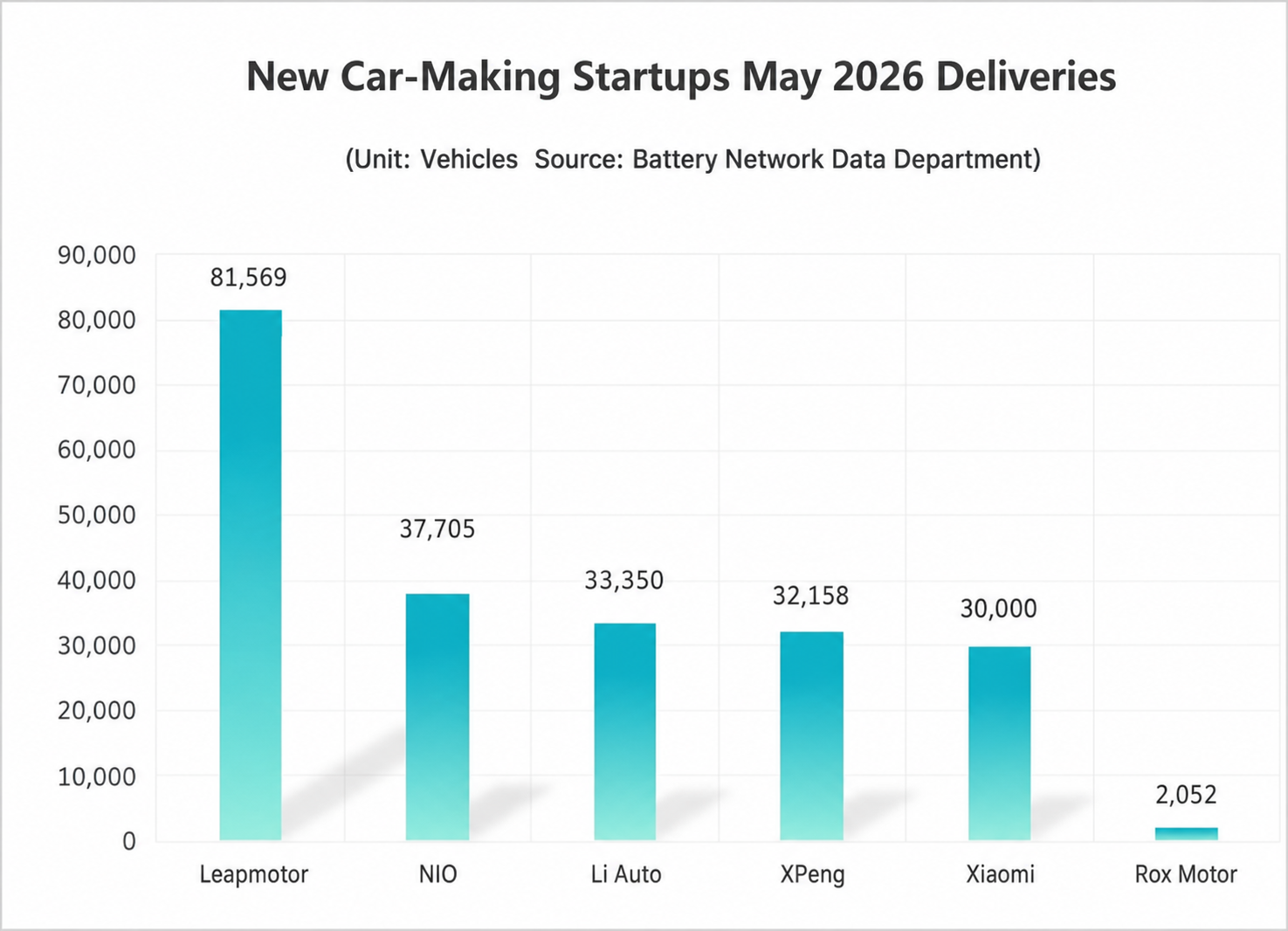
Les détails sont les suivants :
BYD : Selon son annonce, BYD a vendu un total de 383 453 véhicules en mai, dont 376 990 voitures particulières. Par marque : la gamme Dynasty/Ocean a vendu 330 215 unités ; Fang Cheng Bao a vendu 30 186 unités ; Denza a vendu 16 303 unités ; Yangwang a vendu 286 unités. De janvier à mai, les ventes cumulées de BYD ont atteint 1 405 039 unités. Les ventes cumulées de NEV de l'entreprise ont dépassé les 16,5 millions d'unités. La reprise des ventes de BYD a été principalement soutenue par les exportations. Les données montrent qu'en mai, les ventes à l'étranger de BYD ont atteint 161 000 unités, en hausse de 80,4 % sur un an.
Startups NEV : En mai, Leap Motor a livré 81 569 véhicules sur l'ensemble de sa gamme, en hausse de 81 % sur un an, établissant un nouveau record historique de livraisons mensuelles. Les ventes de véhicules à énergie nouvelle (NEV) de l'entreprise ont augmenté régulièrement, conservant son avance. Leap Motor a également réalisé d’excellentes performances sur le marché italien des véhicules électriques purs, avec des immatriculations mensuelles atteignant 4 765 unités, en hausse de 1 278 % sur un an, et sa part de marché dans l’électrique pur a atteint un niveau record de 34,5 %.
NIO a livré un total de 37 705 véhicules neufs en mai, en hausse de 62,3 % sur un an et de 28,4 % par rapport au mois précédent. Précisément, les livraisons de la marque NIO ont atteint 20 013 unités, en hausse de 50,8 % sur un an ; la marque Ledao a livré 12 029 unités, en hausse de 91,5 % sur un an et de 124,8 % par rapport au mois précédent ; et la marque Firefly a livré 5 663 unités, en hausse de 53,9 % sur un an et de 13,7 % par rapport au mois précédent. Au cours des cinq premiers mois de cette année, NIO a livré un total de 150 526 véhicules neufs, soit une hausse de 68,7 % sur un an. À ce jour, les livraisons cumulées de NIO ont atteint 1 148 118 unités.
Li Auto s'est classé troisième parmi les startups NEV avec des livraisons mensuelles de 33 350 unités ce mois-ci. Au 31 mai 2026, les livraisons cumulées de Li Auto ont atteint 1 702 792 unités. Li Xiang, président-directeur général de Li Auto, a déclaré que depuis le premier trimestre de cette année, les livraisons de Li Auto sont entrées dans une trajectoire de croissance, reprenant la première place parmi les marques chinoises sur le marché des NEV à plus de 200 000 yuans. Au 31 mai 2026, Li Auto comptait 498 centres de vente à travers la Chine, couvrant 160 villes, ainsi que 543 centres de réparation après-vente et centres de service agréés, couvrant 222 villes. Li Auto a mis en service 4 088 stations de supercharge Li Auto à l'échelle nationale, équipées de 22 563 bornes de recharge.
XPeng Motors a livré 32 158 véhicules neufs en mai. Le 20 mai, le nouveau porte-étendard technologique XPeng GX a été officiellement lancé et les livraisons ont commencé. Dans les 12 heures suivant le lancement, les commandes fermes ont atteint 24 863 unités, la version Ultra représentant plus de 80 % des commandes. L'affluence dans les showrooms et le volume d'essais routiers ont atteint un niveau record pour la même période de tout lancement de nouveau véhicule, ce qui en fait l'un des produits les plus populaires parmi les utilisateurs sur le marché des voitures de luxe haut de gamme et une étape clé dans la montée en gamme de la marque XPeng Group. Sur le marché mondial, XPeng a maintenu une forte dynamique. En avril, les livraisons à l'étranger du P7+ ont commencé, et les ventes mensuelles à l'étranger ont dépassé 6 000 unités pour la première fois. À la fin du premier trimestre, XPeng était présent dans plus de 60 pays et régions dans le monde, avec 393 points de vente à l'étranger. À partir du deuxième trimestre, la contribution des activités internationales au chiffre d'affaires devrait dépasser 20 %. Au second semestre de cette année, XPeng prévoit de livrer quatre modèles mondiaux, avec l'objectif de dépasser durablement 10 000 unités vendues mensuellement à l'étranger au quatrième trimestre et de plus que doubler ses ventes annuelles à l'international.
En mai, les livraisons mensuelles de Xiaomi Auto ont de nouveau dépassé 30 000 unités, portant le cumul des livraisons de janvier à mai à plus de 139 000 unités. Le 13 juin, Lei Jun, président de Xiaomi Group, a déclaré sur Weibo que Xiaomi Auto accorde une grande importance aux essais, avec des investissements et une envergure massifs. L'équipe d'essais compte désormais plus de 800 membres, dont plus de 45 % sont des experts ayant plus de 10 ans d'expérience. Cette équipe a conduit des tests dans plus de 300 villes et totalisé plus de 35 millions de kilomètres d'essais cumulés. Xiaomi Auto dispose de 126 laboratoires répartis dans quatre villes — Pékin, Nankin, Shanghai et Wuhan — couvrant une superficie totale de plus de 65 600 m². Le constructeur a également loué deux pistes d'essai complètes pour véhicules à Yancheng (Jiangsu) et Guangde (Anhui). Une équipe dédiée d'environ 500 personnes est affectée aux tests en conditions extrêmes, répartie en unités d'essais estivaux et hivernaux, principalement chargée de quatre grands environnements extrêmes : Heihe (froid extrême), Turpan (chaleur extrême), les monts Kunlun (haute altitude) et Hainan (humidité élevée).
Dans l'ensemble, selon Cui Dongshu, secrétaire général de la CPCA, le marché automobile de mai s'est caractérisé par « des ventes intérieures de véhicules thermiques atones, une forte domination des véhicules à énergie nouvelle et une croissance des exportations en glissement annuel dans un contexte difficile ». Compte tenu de la situation actuelle du secteur, la CPCA a révisé ses prévisions, ramenant la baisse des ventes au détail de voitures particulières en Chine pour l'année entière à 11 %, contre un recul de 1 % anticipé en début d'année. Cui Dongshu a indiqué que le marché automobile se stabilisera et s'améliorera progressivement au troisième trimestre, retrouvera le chemin de la croissance au quatrième trimestre, et que la baisse annuelle des ventes au détail devrait se réduire à 11 %, le marché conservant un potentiel de reprise. Si la situation mondiale se stabilise, que les prix des matières premières et du pétrole reviennent à des niveaux raisonnables et que les coûts de transport refluent, la confiance des consommateurs chinois dans l'achat de voitures se rétablira progressivement, et le marché de la vente au détail automobile connaîtra une reprise durable.
Pour le mois de juin, la CPCA prévoit que le marché chinois des voitures particulières en juin 2026 présentera une reprise timide, avec une amélioration d'un mois sur l'autre mais une pression en glissement annuel, le marché se reconstituant lentement sur la base de ses fondamentaux propres. En juin, période de fin de semestre, les constructeurs automobiles s’emploient à atteindre leurs objectifs de ventes semestriels, les équipementiers et les magasins de détail intensifiant leurs efforts de réapprovisionnement des commandes, un facteur positif clé soutenant la reprise en glissement mensuel. On comptera 21 jours ouvrés ce mois-ci, soit un jour ouvré de plus qu’en juin de l’année dernière (20 jours), ce qui donne un coup de pouce à la production et aux ventes globales. Toutefois, l’expérience montre que lors des mois de Coupe du Monde, la performance séquentielle du marché automobile a tendance à être plus faible : baisse de 7 % en glissement mensuel en juin 2018, et de 4 % en juin 2010 et juin 2014.
Les impacts négatifs de la précédente réduction des subventions à la reprise des véhicules particuliers et de l’apaisement de la guerre des prix du secteur ont été en grande partie absorbés, marquant la fin des facteurs politiques négatifs et jetant les bases d’une reprise du marché. Côté demande finale, le marché automobile a affiché une tendance « chargée en début de mois puis stabilisée ». Combiné à l’effet de poussée des ventes de fin de mois pour le semestre, le rythme mensuel global est resté relativement stable. Il est à noter que le congé de la fête des Bateaux-Dragons est tombé le 19 juin cette année, sensiblement plus tard que le 31 mai l’an dernier. La perturbation concentrée liée à l’affluence touristique et à la diversion des dépenses des consommateurs a pesé sur le marché, freinant légèrement l’enthousiasme pour les commandes automobiles en milieu de mois et annulant en partie les bénéfices de la poussée de fin de mois du semestre et des jours ouvrés supplémentaires. Ceci est apparu comme un facteur saisonnier clé influençant la tendance mensuelle.
Il convient de noter que les conflits géopolitiques ont maintenu les prix internationaux du pétrole à des niveaux élevés et fluctuants, entraînant une hausse continue du coût d’utilisation des véhicules thermiques en Chine. Cela freine directement la volonté d’acheter des véhicules à carburant, accentue la pression sur les dépenses des ménages et affaiblit encore le pouvoir d’achat automobile global, devenant un facteur central limitant une croissance significative en glissement annuel du marché. Dans le même temps, cependant, les prix élevés du pétrole accélèrent continûment la transition vers l’électrification. Portés par l’élan des objectifs semestriels à la fin juin, les constructeurs ont déployé des politiques de concession conformes, comme des subventions d’intérêts et des packs cadeaux à l’achat pour les modèles à énergies nouvelles. La livraison concentrée de plusieurs nouveaux modèles NEV a également permis d’améliorer continuellement le portefeuille de produits du secteur, et la force du côté de l’offre s’est sensiblement renforcée. Actuellement, les stocks de l'industrie se résorbent progressivement et de manière ordonnée, la guerre des prix féroce s'est largement calmée et les points de vente écoulent leurs stocks par des promotions douces, faisant évoluer la concurrence vers un état plus sain. Porté par de multiples facteurs favorables, le taux de pénétration des véhicules à énergies nouvelles (NEV) pour les voitures particulières devrait se maintenir solidement au-dessus de 60 %, le processus d'électrification continuant de s'accélérer pour devenir le pilier central de la résilience du marché automobile.
Dans un contexte de demande intérieure atone, les exportations automobiles sont devenues le pilier central de la croissance du secteur, créant une configuration de « demande intérieure faible, demande extérieure motrice ». Les constructeurs automobiles chinois continuent d'approfondir leur présence sur les marchés étrangers, en se concentrant sur des marchés diversifiés comme l'Amérique latine et l'Europe, compensant ainsi efficacement l'impact du déclin de la demande au Moyen-Orient, et les ventes à l'exportation maintiennent une forte croissance. S'appuyant sur une chaîne industrielle nationale mature des énergies nouvelles et sur des produits de haute qualité, les exportations automobiles continuent de monter en gamme et de se moderniser dans toutes les catégories, compensant efficacement la pression de la croissance sur le marché chinois et soutenant le fonctionnement stable global du secteur. Dans l'ensemble, l'Association des véhicules de tourisme estime que la dynamique de reprise du marché automobile en juin sera limitée, que le potentiel structurel reste important et que la tendance à une faible reprise persistera.
![[Automobile : CATL et le groupe de transport public de Luzhou signent une coopération stratégique]](https://imgqn.smm.cn/usercenter/fPEkk20251217171658.jpg)
![[Automobile : Le premier véhicule d'essai ET de Chunen Auto sort de la chaîne de production]](https://imgqn.smm.cn/usercenter/yoaGG20251217171657.jpg)