SMM April 29:
Metals market:
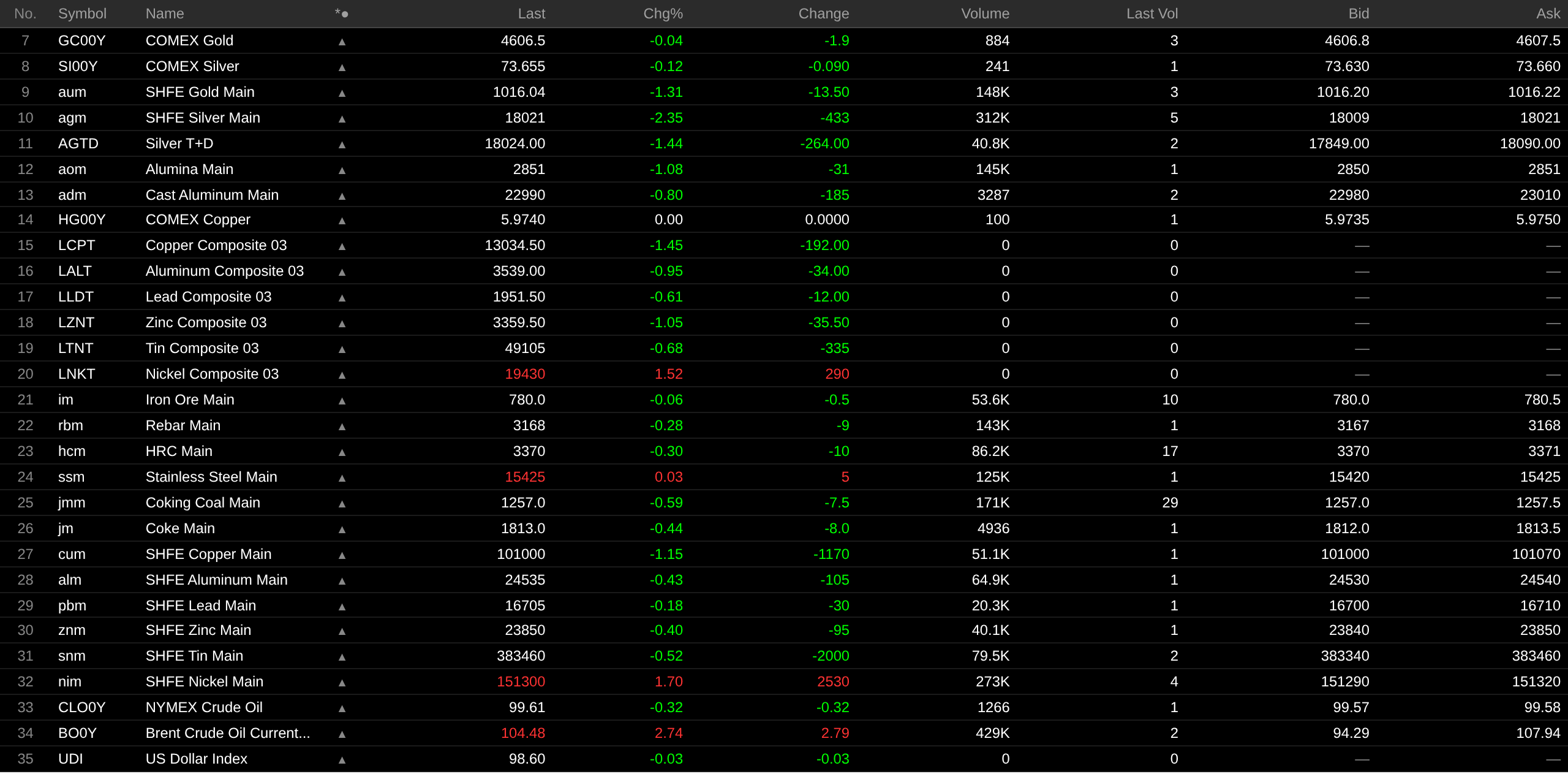
Overnight, domestic market base metals fell nearly across the board. SHFE copper fell 1.15%. SHFE aluminum fell 0.43%, SHFE lead rose 0.18%. SHFE zinc fell 0.4%. SHFE tin fell 0.52%. SHFE nickel rose 1.7%. In addition, the most-traded alumina futures fell 1.08%, and the most-traded casting aluminum futures fell 0.8%.
Overnight, ferrous metals mostly fell. Iron ore fell 0.06%, stainless steel edged up slightly, rebar fell 0.28%, and hot-rolled coil fell 0.3%. Coking coal and coke: coking coal fell 0.59%, coke fell 0.44%.
Overnight overseas market metals, LME base metals generally fell. LME copper fell 1.45%. LME aluminum fell 0.95%, LME lead fell 0.61%. LME zinc fell 1.05%. LME tin fell 0.68%. LME nickel rose 1.52%.
Overnight precious metals:COMEX gold fell 1.79%, COMEX silver fell 2.59%. Overnight SHFE gold fell 1.31%, SHFE silver fell 2.35%.
As of 7:07 AM on April 29, overnight closing prices:
Macro front
China:
[China to Implement Zero Tariffs on All African Countries with Diplomatic Relations Starting May 1, 2026] The Tariff Commission of the State Council issued an announcement that from May 1, 2026 to April 30, 2028, zero tariffs would be implemented in the form of preferential tax rates for 20 African countries that have established diplomatic relations with China but are not classified as least developed countries. For tariff-quota products, only the in-quota tariff rates would be reduced to zero, while out-of-quota tariff rates would remain unchanged. During the 2-year implementation period, China will continue to promote the negotiation and signing of common development economic partnership agreements with relevant African countries.
[MIIT: Next Step Will Be to Launch "AI + Software" Special Action]Ke Jixin, Vice Minister of MIIT, stated at a State Council routine policy briefing on the 28th that MIIT will next promote the extension of producer services toward specialization and the high-end of the value chain, and accelerate innovation and development in the software and information technology services industry. In particular, regarding AI empowerment of the information services industry, MIIT will launch an "AI + Software" special action, accelerate R&D and application of intelligent programming, and foster new business models such as Model-as-a-Service and Agent-as-a-Service. MIIT will further strengthen open-source ecosystem development and promote intelligent upgrades of basic software and industrial software.
US dollar:
Overnight, the US dollar index rose 0.14%, closing at 98.63. This week is most likely the last monetary policy meeting chaired by Powell, and rates are expected to remain unchanged. The market's focus was on the policy statement wording and Powell's characterization of war-induced energy inflation at the press conference. (Wall Street Jianzhi)
Former US Fed Vice Chairman and economist Roger Ferguson stated, "In terms of the dual mandate, the Fed will say the labour market is roughly in a stable state right now. On the inflation mandate, there is still a lot of work to do (as inflation remains elevated at 3%)." He expected the Fed to say: "We will stay put for now and see how this all plays out." Similarly, Goldman Sachs economist David Mericle expected the post-meeting statement to acknowledge improved employment market conditions and rising inflation data, but maintain existing policy guidance unchanged. We expect a majority will still support keeping rates unchanged, with only one dissent, same as in March. According to CME "FedWatch": the probability of the US Fed holding rates unchanged in April was 100%. The probability of a cumulative 25 basis point interest rate cut by June was 2.6%, while the probability of holding rates unchanged was 97.4%. (Jin Shi Data)
John Luke Tyner, head of fixed income at Aptus Capital Advisors, stated in a report that this week's Fed meeting would provide clues as to which officials lean toward reacting to energy-related inflation and which view it as transitory. He said the meeting's mild tone, with no dot plot and most likely no policy action, "paves the way for a heated June," when Kevin Warsh will likely chair the meeting. Tyner noted that June will bring a new dot plot and more time to assess the Middle East situation and its impact on the economy and inflation. (Jin Shi Data)
Other currencies:
Eurozone consumers' inflation expectations rose across the board in March, a worrying signal for the ECB as it assesses the ripple effects of the Iran conflict. According to the ECB's monthly consumer survey released Tuesday, prices over the next 12 months were expected to rise 4%, up from 2.5% in February. Three-year inflation expectations rose from 2.5% to 3.0%, slightly below the 3.1% peak reached during the last price surge in October 2022. Five-year inflation expectations edged up from 2.3% to 2.4%, drifting further from the ECB's 2% medium-term inflation target. The ECB is closely monitoring whether elevated energy costs will prompt workers to demand pay raises and lead enterprises to raise selling prices. Second-round inflation effects beyond commodities such as gasoline could trigger rate hikes, although Thursday's policy meeting is expected to keep rates unchanged. (Wall Street Insights)
On the macro front:
Data to be released today include Australia's March non-seasonally adjusted CPI YoY, Switzerland's April ZEW Investor Confidence Index, Eurozone April Industrial Confidence Index, Eurozone April Economic Sentiment Index, Germany's preliminary April CPI MoM, US March annualized total housing starts, US March durable goods orders MoM, US March total building permits, and the Bank of Canada interest rate decision as of April 29. Also noteworthy: the Bank of Canada will release its interest rate decision and monetary policy report; the US Senate Banking Committee will vote on advancing Waller's nomination as Fed Chairman, and if passed, the full Senate will hold a confirmation vote; Bank of Canada Governor Macklem and Senior Deputy Governor Rogers will hold a monetary policy press conference.
Crude oil:
Overnight, both oil futures extended their rally, with WTI up 3.37% and Brent up 2.74%. Trump stated on social media that Iran had requested the US to lift its naval blockade on the critical shipping route and reopen it as soon as possible. Reports indicated that Pakistani mediators expected Tehran to submit a revised proposal within days. However, Trump subsequently expressed dissatisfaction with Iran's latest peace proposal, citing that it would delay nuclear negotiations, significantly dampening market expectations for a near-term resolution of the conflict. Iran claimed it could "outlast Trump," suggesting the situation could fall into a prolonged stalemate. Wall Street Insights noted that the UAE announced its withdrawal from OPEC and OPEC+ effective May 1, and would gradually increase oil production. The announcement briefly caused oil prices to pull back before quickly recovering. (Wall Street Insights)
On April 28 local time, the UAE announced its withdrawal from OPEC and OPEC+ effective May 1, 2026. UAE Energy Minister Suhail Al Mazrouei told media on April 28 that the UAE chose to exit OPEC at this time primarily considering factors such as current restrictions on passage through the Strait of Hormuz, and believed the decision would have limited impact on the global oil market. Al Mazrouei told CNN reporters that the UAE's announcement came at the "right time" and would not significantly affect the oil market or prices, as passage through the Strait of Hormuz was restricted, including for the UAE. This decision would help ease pressure on prices. (Jin10 Data)
Ole Hansen, Head of Commodity Strategy at Saxo Bank, stated that in the short to medium term, given that global inventory has been depleted and reserves need to be rebuilt, the market should be able to absorb the increased production from the UAE. However, over time, this exit raised a broader strategic question: if other producing countries began to prioritize market share over quota discipline, OPEC's ability to manage an orderly market through coordinated supply adjustments could face increasing scrutiny.
HSBC said in a research note on Tuesday that the UAE's exit from OPEC+ would have a relatively small short-term impact on the oil market, but over time could undermine the organization's supply discipline and price management capability. HSBC expected little change in global oil supply in the near term, as crude oil exports from the Gulf region had remained restricted since the end of February. During the period of constrained shipping routes, the UAE had limited room to increase production. The Abu Dhabi crude oil pipeline had a daily transport capacity of approximately 1.8 million barrels and was most likely already operating at full capacity. Once the Strait of Hormuz shipping lane resumed navigation, the UAE would no longer be bound by OPEC+ production quotas and could gradually increase production. The bank estimated that Abu Dhabi National Oil Company (ADNOC) daily production is expected to rise to over 4.5 million barrels, while the OPEC+ quota during May 2026 was approximately 3.4 million barrels per day. HSBC said any supply increments are expected to be released in phases over 12 to 18 months, rather than immediately.
![Sluggish Month-End Purchasing as Holders Hold Back from Selling; Tight Supply of Cargoes with Invoices Dated This Month Pushes Up SHFE Copper Premium [SMM Shanghai Spot Copper]](https://imgqn.smm.cn/usercenter/XTMPt20251217171713.jpeg)
![Metals Generally Rose, SHFE Nickel Hit Three-Month High, LME Tin and Silicon Metal Up Over 1%, SHFE Gold and SHFE Silver Down Over 1% [SMM Midday Review]](https://imgqn.smm.cn/usercenter/BVoXk20251217171736.jpg)
![Rising Futures Center Suppressed Buying, Trading Cooled Today After Partial Demand Release Yesterday [SMM Tin Midday Review]](https://imgqn.smm.cn/usercenter/JnZMp20251217171752.jpg)