2023 Motive Power Battery Overseas Market Share Battle: CATL in Pursuit, BYD Surges Ahead

Publié: Feb 19, 2024 15:48
According to data from South Korean research firm SNE Research, the global (excluding China) sales of electric vehicle (EV) batteries totaled approximately 319.4 GWh in 2023, marking a 43.2% increase compared to the same period in 2022. Notably, in the global (excluding China) ranking of electric vehicle battery installations, LG Energy Solution (LGES) maintained its top position, experiencing a growth of 32.9% compared to the same period in 2022, with installations reaching 88.6 GWh and a market share of 27.8%.

Recently, data from South Korean research institution SNE Research revealed that in 2023, the global (excluding China) sales of electric vehicle batteries amounted to approximately 319.4 GWh, marking a 43.2% increase compared to the same period in 2022.
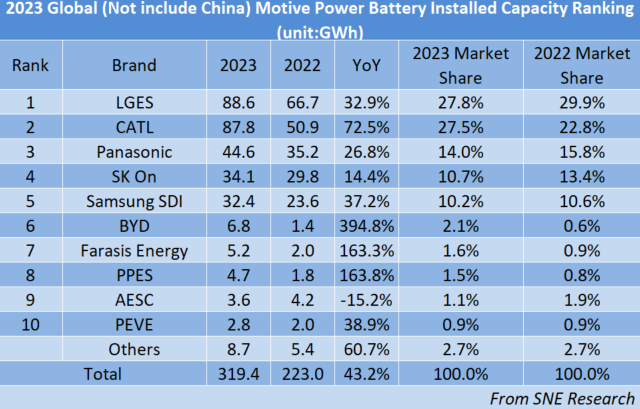
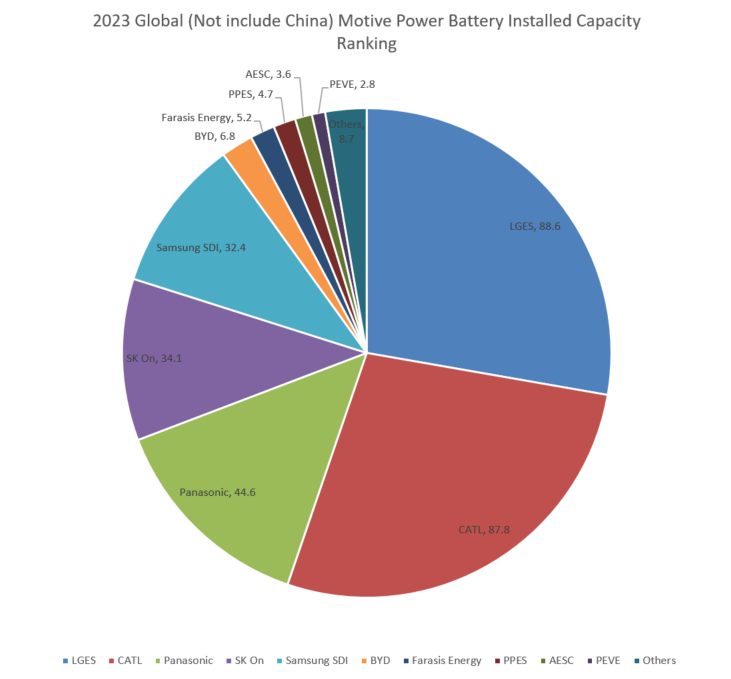
Worth noting is the ranking of electric vehicle battery installations globally (excluding China), with LG Energy Solution (LGES) maintaining the top spot. Compared to the same period in 2022, LGES experienced a growth of 32.9%, achieving an installation volume of 88.6 GWh and a market share of 27.8%.

In the global electric battery market outside of China, CATL follows closely behind LGES, securing the second position with a total installation volume of 87.8 GWh. CATL demonstrated continuous high growth of 72.5%, posing a significant threat to LGES's leading position with a market share of 27.5%.

SNE indicates that Chinese companies, including CATL, are experiencing higher growth rates in the global electric vehicle battery market than in the domestic market, rapidly expanding their global market share. CATL's batteries are installed in vehicles from major manufacturers such as BMW, MG, Mercedes-Benz, and Volvo, including Tesla Model 3/Y manufactured in China for export to Europe, North America, and Asia. Recently, CATL's batteries have been installed in Hyundai's new Kona and Kia Ray electric vehicles, further expanding the influence of Chinese companies in the domestic market.

Panasonic holds the third position in the rankings, with an installation volume of 44.6 GWh, showing a growth rate of 26.8% compared to the same period in 2022. In the global electric battery market (outside China) in 2023, Panasonic achieved a market share of 14%. As one of Tesla's main battery suppliers, Panasonic produces improved 2170 and 4680 batteries, aiming to increase its market share centered around Tesla in the future.

South Korean battery companies SK On and Samsung SDI rank fourth and fifth, with installation volumes of 34.1 GWh and 32.4 GWh, respectively. They experienced growth rates of 14.4% and 37.2% YoY, with market shares of 10.7% and 10.2%, respectively. SNE's analysis suggests that the growth of the three major South Korean battery companies is mainly attributed to strong sales of vehicles equipped with their respective batteries.

Chinese battery supplier BYD holds the sixth position, increasing its market share from 0.6% in 2022 to 2.1% in 2023, with overseas installation volume rising to 6.8 GWh, a remarkable 394.8% YoY increase. BYD is the company with the largest growth among the TOP 10 companies in the global new energy vehicle power battery market (excluding China).

Additionally, Chinese battery company EVE Energy rapidly increased its overseas battery market installations, achieving a growth rate of 163.3%. With an installation volume of 5.2 GWh, EVE Energy secured the seventh position with a market share of 1.6%.

Farasis Energy, with an installation volume of 3.6 GWh, also made it to the TOP 10 in the global market outside China in 2023, ranking ninth with a market share of 1.1%.

Toyota and Panasonic's joint ventures PPES and PEVE rank eighth and tenth, with installation volumes of 4.7 GWh and 2.8 GWh, respectively. Their market shares are 1.5% and 0.9%, with PPES experiencing a significant 163.8% YoY growth and PEVE growing by 38.9% in 2023 in the global electric battery market (outside China).
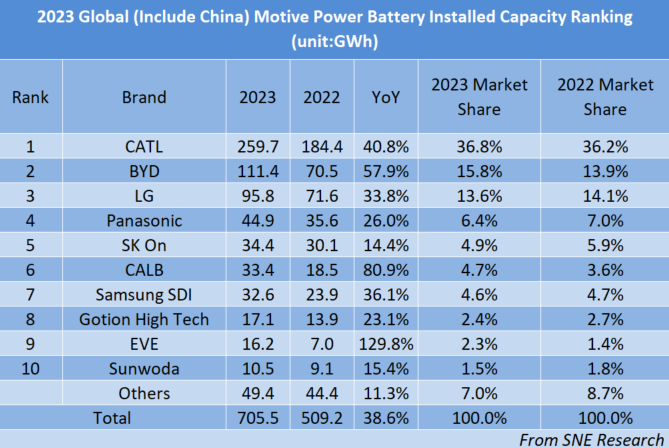
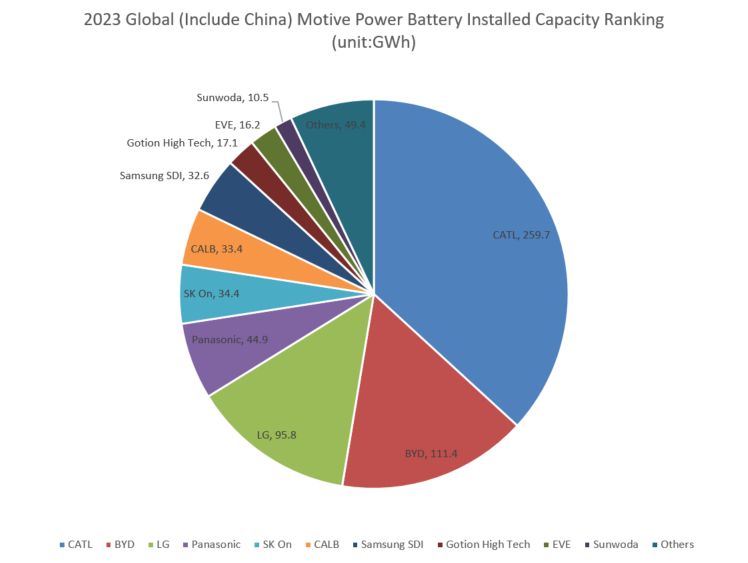
n addition to overseas electric vehicle (EV) battery installation data, SNE recently released the 2023 global (including the Chinese market) new energy vehicle power battery installation data. In 2023, the registered electric vehicle (EV, PHEV, HEV) battery installations worldwide reached approximately 705.5 GWh, a YoY increase of 38.6%. Examining the TOP 10 global power battery installers, Chinese companies secured 6 positions, with a market share of 63.5%, up from 59.6% in 2022. CATL and BYD combined still account for over half, reaching 52.6% market share.

SNE analysis indicates a significant slowdown in the growth rate of the global electric vehicle market in 2023, impacting the downstream secondary battery industry. Factors such as early adopters completing initial purchase demands, economic contraction due to high interest rates and prices, and a lack of charging infrastructure are identified as reasons slowing electric vehicle market demand growth. Although the slowdown in the electric vehicle market is expected to persist for some time, SNE anticipates that regulatory enforcement of IRA subsidies will strengthen from 2024, the number of models eligible for tax credits will decrease, and the maintenance of tax credits will depend on the results of the U.S. presidential election. Uncertainties have negatively impacted the demand for electric vehicles.

SNE believes that the electric vehicle market will shift towards a price-centric approach this year, intensifying competition among automakers to survive through price reductions. Attention is expected to be focused on battery technology development, competition, and strategies to stabilize the critical mineral supply chain.

If you have any questions regarding the industry data, or the news (e.g. how this can affect your business). Please feel free to reach out to me:

Robin He

SMM Li-ion Battery Materials Department

E: robinhe@smm.cn | T: +86-21-51595884

Déclaration sur la source des données : À l'exception des informations publiques, toutes les autres données sont traitées par SMM sur la base d'informations publiques, d'échanges avec le marché et en s'appuyant sur le modèle de base de données interne de SMM. Ils sont fournis à titre indicatif uniquement et ne constituent pas des recommandations décisionnelles.

Pour toute demande d'information ou pour en savoir plus, veuillez contacter : lemonzhao@smm.cn
Pour plus d'informations sur l'accès à nos rapports de recherche, veuillez contacter :service.en@smm.cn
Actualités Connexes
[SMM Analysis] Zimbabwe's Rise Reshapes Lithium Market: Prices Near 15-Month Highs, Supply Focus Shifts to Africa
il y a 29 minutes
[SMM Analysis] Zimbabwe's Rise Reshapes Lithium Market: Prices Near 15-Month Highs, Supply Focus Shifts to Africa
Lire la suite
[SMM Analysis] Zimbabwe's Rise Reshapes Lithium Market: Prices Near 15-Month Highs, Supply Focus Shifts to Africa
[SMM Analysis] Zimbabwe's Rise Reshapes Lithium Market: Prices Near 15-Month Highs, Supply Focus Shifts to Africa
Over the next decade (2026-2035), the combined market share of the three traditional major lithium producers Australia, China and Chile is expected to keep declining as emerging suppliers scale up, with Zimbabwe and Argentina identified as the key sources of new supply. Zimbabwe, in particular, is likely to lead a new round of African lithium expansion, according to a latest research report. Strong H1 momentum, supported by storage demand. China's battery-grade lithium carbonate spot price stood at around 153,950 yuan/mt (approx. USD 21,500/mt) on August 17, after a rally of more than 130% from the June 2025 low of 58,400 yuan/mt. The 2026 forecast for China lithium carbonate has been revised up to USD 20,100/t and lithium hydroxide monohydrate to USD 19,600/t, reflecting that H1 momentum. Prices are expected to ease in H2 as smelter maintenance ends and supply returns, but storage demand is limiting the downside market balances now point to month-on-month destocking through H2 2026, with some analysts projecting the year's price peak in late Q3/early Q4. From ore exporter to processor enforced by policy. Zimbabwe’s rise is no longer just a forecast. On February 25, 2026, Zimbabwe's mining ministry banned all exports of lithium raw ore and concentrates with immediate effect, forcing miners to build local processing capacity. Zimbabwe's output was expected to reach ~200,000 t LCE in 2026 (up over 15% year on year), equal to ~10% of global primary lithium supply and ~17% of global spodumene supply before the ban; the restriction is estimated to affect around 12,000 t LCE of monthly supply. Key projects include: 1) Huayou Cobalt's Arcadia ~70,000-80,000 t LCE of mine output expected in 2026, with its 50,000 t/yr lithium sulphate plant commissioned in Q1 2026 and now ramping up; 2) Sinomine's Bikita ~60,000-70,000 t LCE expected in 2026, with a 30,000 t/yr lithium sulphate plant slated for 2027; 3) Chengxin's Sabi Star (~35,000 t LCE) and Yahua's Kamativi (~50,000 t LCE) rounding out a Chinese-invested project portfolio totaling roughly 230,000 t LCE. 4) In 2025, Zimbabwe shipped over 1.2 million tonnes of spodumene to China about 15% of China's total imports making it a supply source Beijing's supply chain cannot easily replace. 2026 is the last investment peak of this cycle global lithium supply is projected to rise ~30% year on year to over 2.1 million t LCE in 2026, concentrated in China and Africa (Africa alone adding ~140,000 t to reach ~380,000 t LCE). Chinese output hit 970,000 t of lithium carbonate in 2025, with new additions this year from Qinghai/Tibet salt lakes, Sichuan spodumene and Jianxiawo's expected restart in H2. Australia shipped 158,000 t of spodumene to China in the week of August 10-16 alone. But few new projects are lined up beyond 2027 a key reason sentiment has flipped from glut to deficit: Morgan Stanley now forecasts an 80,000 t LCE global deficit for 2026, UBS sees a 22,000 t shortfall, versus a 61,000 t surplus in 2025. EVs slow, storage takes the wheel. Global lithium demand growth is expected to slow to 5.8% in 2026 (from 18.5% in 2025), with passenger EV sales growth falling to 3.9% (vs 22.8% in 2025 and 24% in 2024) as China's trade-in subsidies end and the US IRA rollback bites. Energy storage is now the core demand pillar: storage-sector lithium demand is forecast to jump ~55-74% in 2026, lifting its share of total lithium demand from 23% to ~31%. LFP batteries account for over 90% of battery storage applications and more than half of global EV battery installations; China's LFP cell makers reported hot August orders with output up ~5% month on month. China's NEV penetration hit 58.5% in June above 50% for the third straight month. Battery manufacturing investment in China grew 23% in January-July 2026. Risks. Lithium remains in a "tug-of-war" between supply-release concerns and storage-driven demand support, with risks skewed to the downside: a sustained price recovery could trigger rapid restarts (curtailed capacity covering 750,000+ t of concentrate sits near a ~USD 1,200/t restart cost line), sodium-ion substitution becomes economic if cell prices stay above ~0.4 yuan/Wh, and rising energy costs plus a potential sulfur shortage could squeeze miners' margins. Longer term, battery chemistry innovation and recycling could cut lithium intensity and expand secondary supply reshaping the opportunity window for emerging producers like Zimbabwe. SMM View: Zimbabwe's February export ban has turned the "move down the value chain" story from intention into policy reality Chinese invested projects at Arcadia and Bikita are now the country's only guaranteed export channels via lithium sulphate, and the roughly 12,000 t LCE/month of disrupted supply was a direct catalyst in this year's price rally above 150,000 yuan/mt. The report's core thesis a declining share for Australia, China and Chile, with Africa gaining is being validated in real time, Africa adds ~140,000 t LCE of supply in 2026, the largest increment after China. But Zimbabwe's ramp-up pace, its ability to keep sulphate exports flowing, and downstream pricing power remain the key variables determining whether it can fully deliver on its market-share ambitions
il y a 29 minutes
[SMM Flash] Prévisions de prix du lithium pour 2026 revues à la hausse ; la demande de stockage soutient la résilience, la croissance de l'offre limite le potentiel de hausse
il y a 30 minutes
[SMM Flash] Prévisions de prix du lithium pour 2026 revues à la hausse ; la demande de stockage soutient la résilience, la croissance de l'offre limite le potentiel de hausse
Lire la suite
[SMM Flash] Prévisions de prix du lithium pour 2026 revues à la hausse ; la demande de stockage soutient la résilience, la croissance de l'offre limite le potentiel de hausse
[SMM Flash] Prévisions de prix du lithium pour 2026 revues à la hausse ; la demande de stockage soutient la résilience, la croissance de l'offre limite le potentiel de hausse
Les prévisions de prix moyen du carbonate de lithium et de l’hydroxyde de lithium monohydraté en Chine continentale pour 2026 ont été revues à la hausse à 20 100 $/t et 19 600 $/t respectivement, reflétant la vigueur des prix au premier semestre. Les prix devraient s’assouplir au second semestre, mais la demande solide de stockage d’énergie devrait limiter la baisse, l’incertitude sur le redémarrage de la mine Jianxiawo de CATL freinant également les velléités baissières. La croissance de la demande mondiale de lithium devrait ralentir à 5,8 % en glissement annuel en 2026, contre 18,5 % en 2025, parallèlement au ralentissement de la croissance des ventes mondiales de voitures électriques particulières (BEV+PHEV) à 3,9 % en glissement annuel, contre 22,8 % en 2025. La Chine reste le principal moteur de la demande : les ventes intérieures de véhicules à énergies nouvelles (NEV) ont augmenté de 23,6 % en glissement annuel pour atteindre 1,6 million d’unités en juin, le taux de pénétration des NEV demeurant à un niveau record de 58,5 % des ventes de véhicules neufs pour le troisième mois consécutif, le retrait des incitations et les pressions structurelles faisant entrer le marché dans une phase de croissance plus mature. Les prix élevés des carburants liés au conflit au Moyen-Orient soutiennent progressivement la demande de motorisations électrifiées et hybrides. Côté offre, la production mondiale de lithium devrait croître de 13,2 % en glissement annuel en 2026, tirée par l’Australie et la Chine, le redressement des prix favorisant le redémarrage des capacités australiennes à coûts plus élevés malgré la pression des coûts due aux prix de l’énergie et à une possible pénurie de soufre. La part cumulée des trois premiers producteurs – Australie, Chine et Chili – devrait décliner jusqu’en 2035, l’Argentine et le Zimbabwe montant en puissance, le Zimbabwe étant considéré comme un moteur clé du développement minier du lithium en Afrique dans les prochaines années. La prime du carbonate sur l’hydroxyde devrait perdurer avec l’adoption continue des batteries LFP, qui représentent désormais plus de la moitié des installations de batteries de véhicules électriques dans le monde et plus de 90 % de la capacité de stockage d’énergie par batteries. À plus long terme, les chimies de batteries sans lithium ou à teneur réduite en lithium, ainsi que les progrès du recyclage des batteries, constituent des risques baissiers structurels pour les prix. Point de vue SMM : La révision confirme la résilience des prix au premier semestre plutôt qu’un changement fondamental – les prix actuels restent jugés élevés par rapport aux fondamentaux, avec un risque orienté à la baisse au second semestre. Pour l’offre africaine, le rôle du Zimbabwe dans la recomposition à venir face aux trois premiers producteurs traditionnels s’inscrit dans son intégration continue des filières sulfate/hydroxyde ; une poursuite de cette dynamique renforcerait la position de l’Afrique dans la structure mondiale de l’offre de lithium.
il y a 30 minutes
[SMM Flash] Nasarawa signe un accord supplémentaire de 2 M$ sur le lithium avec Diamond New Energy
il y a 36 minutes
[SMM Flash] Nasarawa signe un accord supplémentaire de 2 M$ sur le lithium avec Diamond New Energy
Lire la suite
[SMM Flash] Nasarawa signe un accord supplémentaire de 2 M$ sur le lithium avec Diamond New Energy
[SMM Flash] Nasarawa signe un accord supplémentaire de 2 M$ sur le lithium avec Diamond New Energy
L'accord supplémentaire de 2 millions de dollars de l'État de Nasarawa avec Diamond New Energy garantit la fourniture continue de minerai de lithium du bloc minier de l'État vers la raffinerie de lithium Endo (~3 millions de t/an, 6 000 t/j, la plus grande installation de traitement du lithium d'Afrique de l'Ouest). Un acte concomitant a transféré les droits miniers sur 3,5 unités cadastrales à Endo de la Nasarawa Mining Company à Ganfeng Lithium, donnant à Ganfeng le contrôle direct de l'approvisionnement en spodumène en amont, réduisant la dépendance au minerai provenant de tiers/artisans, et raccourcissant la chaîne logistique du minerai à la raffinerie pour soutenir des volumes de production de sels de lithium plus stables. Avis de SMM : La véritable importance de cet accord réside dans la sécurité de la matière première pour la capacité de conversion du lithium, non dans le paiement lui-même. La consolidation des droits miniers sur le spodumène sous l'opérateur de la raffinerie réduit la volatilité de l'approvisionnement en minerai et confère une plus grande prévisibilité à la production de concentré de lithium et de sels en aval. Cela reflète l'approche verticalement intégrée de Ganfeng à Goulamina au Mali, ancrant davantage les chaînes d'approvisionnement en lithium de la mine à la raffinerie contrôlées par la Chine en Afrique de l'Ouest et s'ajoutant aux volumes croissants de lithium transformé de la région destinés au marché chinois.
il y a 36 minutes