The New Development Era of Secondary Aluminium under China’s Carbon Strategy

Publié: Oct 13, 2021 14:56
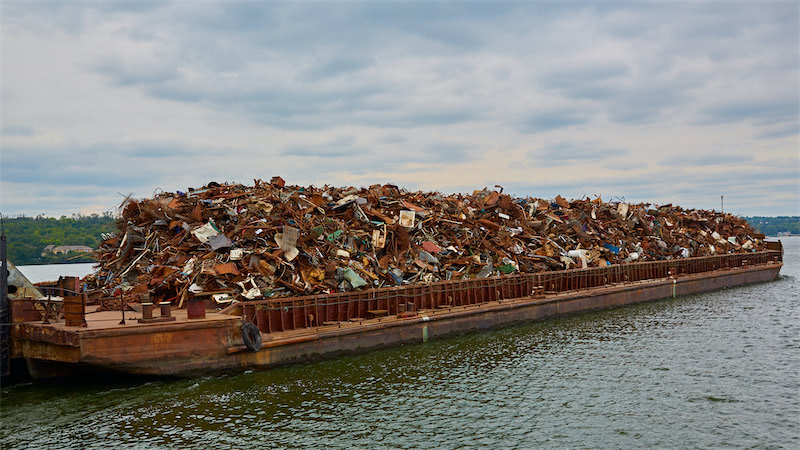
In China, the domestic aluminium scrap accounted for 89% of the total raw materials of secondary aluminium, meaning that the production of secondary aluminium has been more independent. China’s secondary aluminium production capacity has reached 14 million mt, accounting for about 30% of the global total secondary aluminium production. And it has become the world's largest producer of secondary aluminium.

SHANGHAI, Oct 13 (SMM) - In China, the domestic aluminium scrap accounted for 89% of the total raw materials of secondary aluminium, meaning that the production of secondary aluminium has been more independent. China’s secondary aluminium production capacity has reached 14 million mt, accounting for about 30% of the global total secondary aluminium production. And it has become the world's largest producer of secondary aluminium.

The whole industry has been developing in a more balanced pattern. While the scaled recycling enterprises have also become an important supply channel for aluminium scrap, indicating heightening industry concentration ratio.

During the "13th Five-Year Plan" period, China's secondary aluminium output totalled about 34.8 million mt, reducing the extraction of aluminium ore by 139.2 million mt, conserving the utilisation of standard coal and water by 120 million mt and 770 million cubic metre, respectively, and reducing the discharges of carbon dioxide and solid waste by 380 million mt and 696 million mt, respectively.

China's secondary aluminium industry has made great achievements in the past, but it should also be pointed out that China’s proportion of secondary aluminium in the total aluminium production is still at the level of developed countries in the eighties.

According to the resource and consumption forecast, China's aluminium consumption is expected to reach a peak by 2024, after which it will basically be in a plateau period, with primary aluminium production gradually shrinking due to policy and economic reasons; while the production of secondary aluminium will ramp up year by year, and the proportion in total consumption will gradually increase.

By 2025, China's secondary aluminium production will reach 11.5 million mt; the aluminium scrap utilisation efficiency and the added value of products will both be improved; the technical level of secondary aluminium and the equipment will be significantly enhanced; the degree of harmless treatment of aluminium ash and the utilisation rate of resources will be further improved. By 2030, the output of secondary aluminium will reach 18 million mt; the secondary aluminium processing technology will reach the international advanced level; a sophisticated industrial system will be formed; and the utilisation rates of aluminium ash and other solid wastes will reach 100%.

Déclaration sur la source des données : À l'exception des informations publiques, toutes les autres données sont traitées par SMM sur la base d'informations publiques, d'échanges avec le marché et en s'appuyant sur le modèle de base de données interne de SMM. Ils sont fournis à titre indicatif uniquement et ne constituent pas des recommandations décisionnelles.

Pour toute demande d'information ou pour en savoir plus, veuillez contacter : lemonzhao@smm.cn
Pour plus d'informations sur l'accès à nos rapports de recherche, veuillez contacter :service.en@smm.cn
Actualités Connexes
La dynamique haussière liée aux coûts se poursuit, et le prix moyen des produits finis en acier pourrait légèrement augmenter la semaine prochaine [Rapport hebdomadaire sur la chaîne industrielle de l'acier SMM]
il y a 14 heures
La dynamique haussière liée aux coûts se poursuit, et le prix moyen des produits finis en acier pourrait légèrement augmenter la semaine prochaine [Rapport hebdomadaire sur la chaîne industrielle de l'acier SMM]
Lire la suite
La dynamique haussière liée aux coûts se poursuit, et le prix moyen des produits finis en acier pourrait légèrement augmenter la semaine prochaine [Rapport hebdomadaire sur la chaîne industrielle de l'acier SMM]
Cette semaine, les métaux ferreux ont généralement augmenté, avec des performances variant légèrement selon les variétés. Le charbon à coke et le coke ont été les plus performants, tandis que le minerai de fer et l'acier fini ont enregistré des gains relativement limités. Au cours de la semaine, la supervision de la sécurité est restée stricte, le rythme des reprises de production dans les mines de charbon a été inférieur aux attentes, et les pénuries structurelles de qualités de charbon à coke se sont encore creusées, entraînant une hausse continue des contrats à terme sur le charbon à coke. Les cokeries ont subi de lourdes pertes...
il y a 14 heures
Résumé des transactions du marché des batteries usagées du 21 août [Revue quotidienne SMM]
il y a 14 heures
Résumé des transactions du marché des batteries usagées du 21 août [Revue quotidienne SMM]
Lire la suite
Résumé des transactions du marché des batteries usagées du 21 août [Revue quotidienne SMM]
il y a 14 heures
[SMM Aperçu hebdomadaire du marché indien] Les indications à l'exportation augmentent tandis que les prix intérieurs se stabilisent
il y a 16 heures
[SMM Aperçu hebdomadaire du marché indien] Les indications à l'exportation augmentent tandis que les prix intérieurs se stabilisent
Lire la suite
[SMM Aperçu hebdomadaire du marché indien] Les indications à l'exportation augmentent tandis que les prix intérieurs se stabilisent
[SMM Aperçu hebdomadaire du marché indien] Les indications à l'exportation augmentent tandis que les prix intérieurs se stabilisent
Le marché sidérurgique indien s'est renforcé du 17 au 21 août, bien que la résistance des acheteurs étrangers ait limité les transactions. Les indications pour les billettes à l'exportation ont grimpé à 470 USD/tonne FOB Inde, mais aucune transaction n'a été confirmée à ce niveau. Les offres de HRC indien vers le Vietnam sont passées à 520–525 USD/tonne CFR, contre des indications acheteurs de 505–510 USD/tonne CFR. Sur le marché intérieur, le HRC est resté stable à 609 USD/tonne (58 100 INR/tonne) EXW Mumbai, tandis que la billette s'établissait à environ 453 USD/tonne (43 200 INR/tonne) livrée Mandi Gobindgarh, 449 USD/tonne (42 800 INR/tonne) EXW Mumbai et 415 USD/tonne (39 600 INR/tonne) EXW Raipur.
il y a 16 heures
The New Development Era of Secondary Aluminium under China’s Carbon Strategy - Shanghai Metals Market (SMM)