Core point of view
The tight balance between supply and demand in the lithium industry continues, and lithium prices are expected to remain strong.
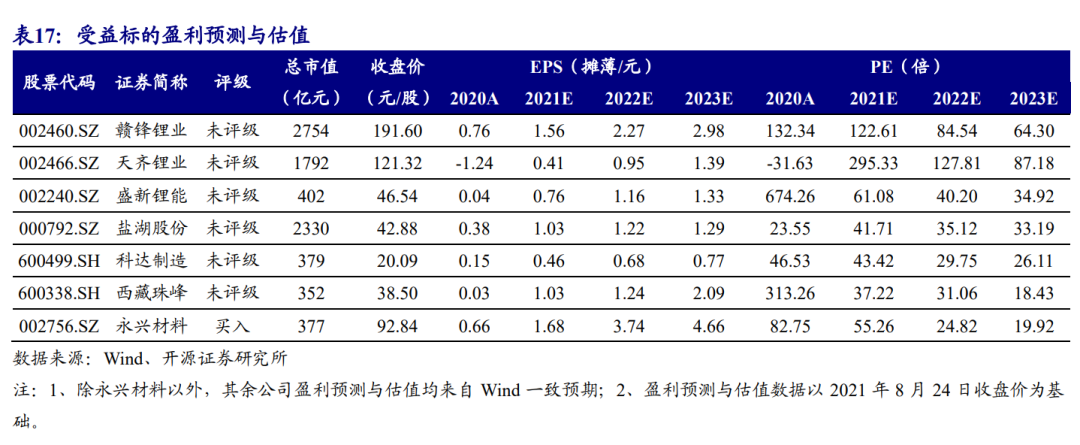
On the supply side, the new capacity of global lithium resources is limited in the short term, and the supply shortage has been basically determined, while on the demand side, the downstream demand represented by new energy vehicles is accelerating the release. According to our estimates, the global lithium supply and demand balance is expected to reach + 5.4,1.0,2.3 and + 53000 tons respectively from 2020 to 2023. LCE,2021-2022 will continue to maintain a tight balance. Lithium prices are expected to continue to strengthen, and lithium mining enterprises are expected to fully benefit. The main beneficiaries include Ganfeng Lithium Industry, Tianqi Lithium Industry, Yongxing Materials, Shengxin Lithium Energy, Salt Lake shares, Koda Manufacturing, Tibet Everest and so on.
Supply side: short-term increment is limited, continue to continue the tense situation
Western Australia lithium mine with the continuous clearance of production capacity, there are only 4 mines left, the new production capacity is limited in the short term, and the supply increment will mainly be built capacity. At the same time, after the planned expansion of salt lakes in South America has been postponed, although there will be a certain scale of production capacity in the future, it is expected to be released centrally from 2023. In addition, China is speeding up the pace of lithium resources development, salt lake, spodumene, lithium mica routes blossom, production capacity growth is also relatively fast, but due to the small base, the overall increment is also relatively limited. Therefore, on the whole, the increase of global lithium supply is relatively small in the next 1-2 years, and the supply tension has been basically determined. From 2020 to 2023, the global lithium supply is expected to reach 42.7,53.1,68.3 and 968000 tons of LCE,CAGR, respectively, reaching 31.4%.
Demand side: the release of demand is accelerated, and the growth attribute is highlighted.
The trend of global electrification is accelerating, and the market penetration of new energy vehicles in major countries or regions such as China, Europe and the United States are all increasing. At the same time, the demand for energy storage batteries is expected to benefit from the rapid growth of power energy storage and communication energy storage. In addition, 3C battery will also usher in the spring of development with the gradual application of 5G technology. Overall, the downstream demand for lithium resources is accelerating the release, and the industry growth attribute is also increasingly prominent. It is estimated that the global lithium demand from 2020 to 2023 will reach 36.2,50.4,68.4 and 889000 tons of LCE,CAGR, respectively.
Supply and demand docking: from 2021 to 2022, the supply and demand of the industry continues to be tight, and lithium prices are easy to rise but difficult to fall.
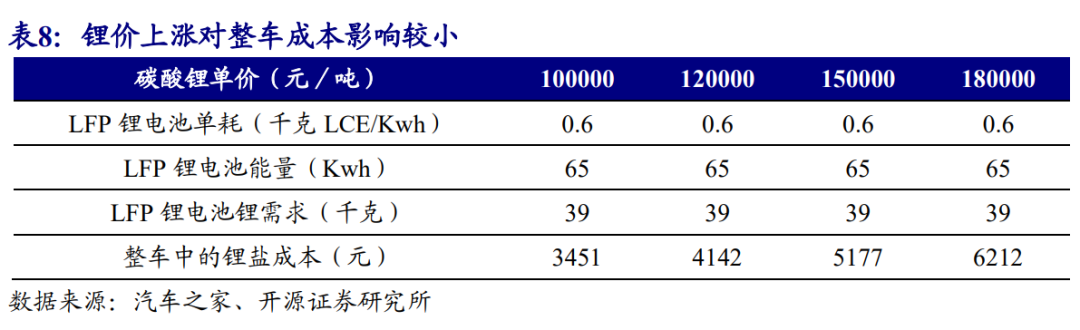
Although the latest quoted price of battery-grade lithium carbonate has reached more than 100000 yuan / ton, the bottom has more than doubled, but according to our calculations, it is expected that the tight situation of supply and demand in the global lithium industry from 2021 to 2022 is difficult to change, and lithium ore is easy to rise and fall under the rigid gap. In order to judge the fluctuation range of lithium price, we continue to draw the cost curve of lithium concentrate from the supply side. It is found that the complete cost of lithium ore at the rightmost end of the cost curve has reached 700 US dollars / ton, and the corresponding production cost of lithium carbonate is close to 70,000 yuan / ton. After adding value-added tax, the bottom price of lithium carbonate has been close to 80,000 yuan / ton. Of course, 80,000 yuan is only the bottom price, and the latest market quotation for battery-grade lithium carbonate has far exceeded this level. we think that when the rigid gap of lithium salt is difficult to make up before 2023, the long-term shortage of supply and demand will easily lead to a sustained soaring price. even hit the previous historical high level of 160000 yuan. As for the sharp rise in the price of lithium salt, we need to consider the downstream acceptance. after calculation, taking an electric vehicle of 65Kwh as an example, when the price of lithium carbonate rises to 150000 yuan and 180000 yuan respectively, the cost of the battery of the whole vehicle will rise by 1726 yuan and 2761 yuan respectively compared with the current one. The impact of the rise in lithium price on the cost of the whole vehicle can be controlled.
Risk hint: sales of new energy vehicles fall short of expectations, and new production capacity in the industry exceeds expectations.
Report body
1. The prosperity of the industry continues to recover, and lithium prices return to the upstream channel.
After the horizontal trading in May-July, the price of lithium carbonate finally returned to the upstream channel in early August, reaching about 100000 yuan / ton (up about 10, 000 yuan / ton from the end of July). On the other hand, the price of lithium hydroxide has continued to strengthen since May, and successfully ended the upside-down situation with the price of lithium carbonate for half a year. So why has the price of lithium hydroxide continued to strengthen while the price of lithium carbonate has been more stable since May? Now that the price of lithium carbonate has returned to the upstream channel, can it continue to rise in the future? Next, we will focus on the above problems for further analysis.
1.1. Lithium price review: both supply and demand are good, driving the price of lithium hydroxide to continue to strengthen.
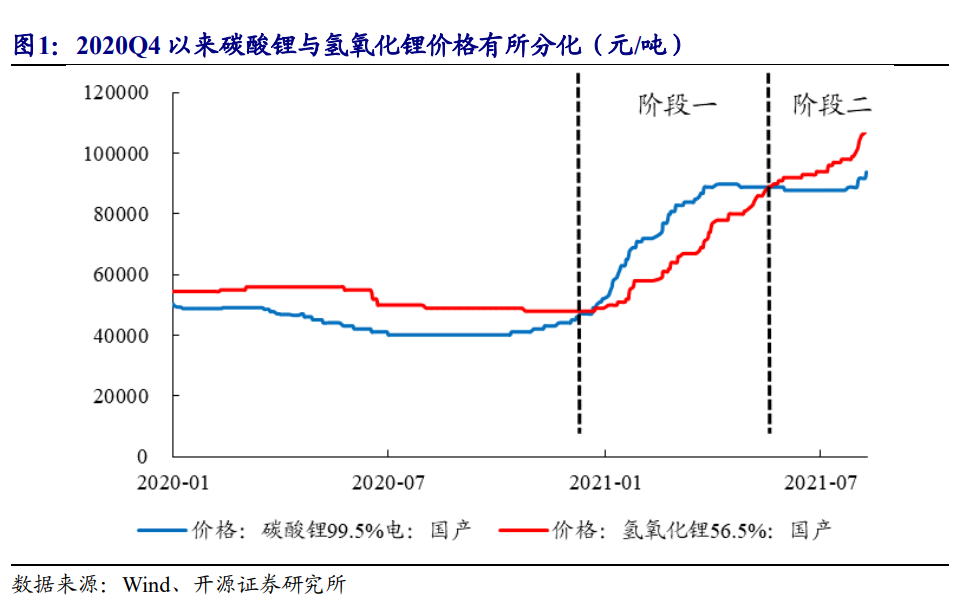
Benefiting from the continuous clearance of lithium mines in Western Australia and the accelerated release of downstream demand represented by new energy vehicles, the prosperity of the lithium industry has gradually recovered since 2020Q4, and lithium prices have also begun to rebound. Further, although the price of lithium salt has shown a rising trend so far in 2020Q4, the price trend of lithium carbonate and lithium hydroxide is different. Specifically, it can be divided into two stages:
The first stage (October 2020 to April 2021): during this period, the prices of lithium carbonate and lithium hydroxide are both in a continuous upward trend, but lithium carbonate is stronger, and the prices of the two are upside down (up to 19000 yuan / ton).
The second stage (from May 2021 to the present): during this period, the overall price of lithium carbonate was relatively stable (it began to return to the upstream channel in early August). On the other hand, lithium hydroxide continued to strengthen and successfully anti-supercarbonate (more than 15000 yuan / ton as of late August).
So why are the price trends of lithium carbonate and lithium hydroxide diverging in different periods? Next, we will discuss the reasons for the trend of lithium price in the two stages from the supply side and the demand side respectively.
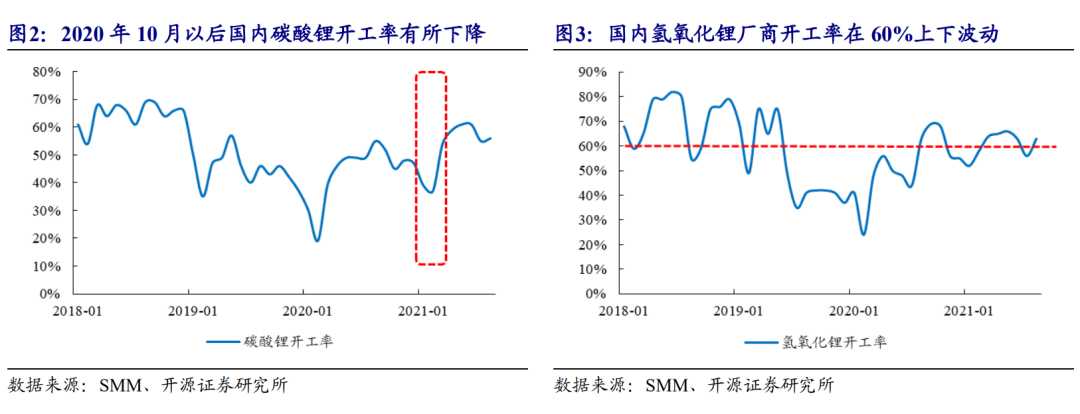
The first stage (October 2020 to April 2021): on the supply side, the limited electricity of lithium salt manufacturers in Jiangxi and the output affected by device maintenance were reduced, and the output rate of salt lakes decreased due to the superimposed low temperature weather in Qinghai. The capacity utilization rate of domestic lithium carbonate manufacturers has decreased, and the supply is insufficient. On the demand side, the rapid expansion of lithium iron phosphate batteries represented by Wuling Hongguang MINI and Biadihan has led to the rapid growth of lithium carbonate demand. In this context, the price of lithium carbonate continues to rise, and is in a rising trend.
The second stage (from May 2021 to now): on the supply side, at this stage, more than 80% of the world's lithium hydroxide production is concentrated in China, because there is no additional causticizing cost for the production of lithium hydroxide from spodumene. More than 90% of lithium hydroxide in China is produced in this way. At the same time, at present, more than 80 percent of domestic spodumene is imported from Western Australia, and with the continuous clearance of spodumene mine capacity in Western Australia in the past few years, there are only four mines in production, of which Marion capacity is fully underwritten by Ganfeng Lithium Industry, Greenbushes capacity is jointly underwritten by Tianqi Lithium Industry and Yabao, and only a small amount of bulk orders from Pilbara and Cattlin are supplied to the outside world, which leads to a low capacity utilization rate of domestic lithium hydroxide production enterprises. Resulting in insufficient supply of lithium hydroxide. On the demand side, Europe issued stricter carbon emissions policies and subsidy policies, the United States also launched a series of new subsidy policies, with the introduction of relevant policies, the rapid release of overseas new energy vehicles. At the same time, as most of the overseas car companies are high-end models, most of them are equipped with medium-and high-nickel ternary lithium batteries, which further accelerates the release of lithium hydroxide demand. Driven by the above dual effects of supply and demand, the price of lithium hydroxide continues to strengthen. At the same time, due to the gradual increase in the operating rate of lithium carbonate production enterprises, the tight supply situation has been alleviated, and the overall price of lithium carbonate is relatively stable.
1.2. Discussion on the linkage mechanism: the price of lithium hydroxide does not outshine others, and lithium carbonate is expected to continue to rise.
Affected by the production process, the price of lithium hydroxide is higher than that of lithium carbonate under normal circumstances. In the production process of lithium carbonate and lithium hydroxide, lithium carbonate products can be produced using spodumene, lithium mica and salt lake brine as raw materials. As for lithium hydroxide, in the current mainstream lithium extraction process, only spodumene can directly produce lithium hydroxide in one step, while both salt lake brine and lithium mica need to produce lithium carbonate first. and then use lime milk to causticize it to get lithium hydroxide (corresponding to the increased causticizing cost of about 10,000 yuan / ton). Historically, lithium hydroxide was mainly produced by one-step extraction of lithium from spodumene, which has a higher cost, avoiding the competition of low-cost salt lakes to extract lithium, so the price of lithium hydroxide produced by lithium hydroxide is slightly higher than that of lithium carbonate under normal circumstances.
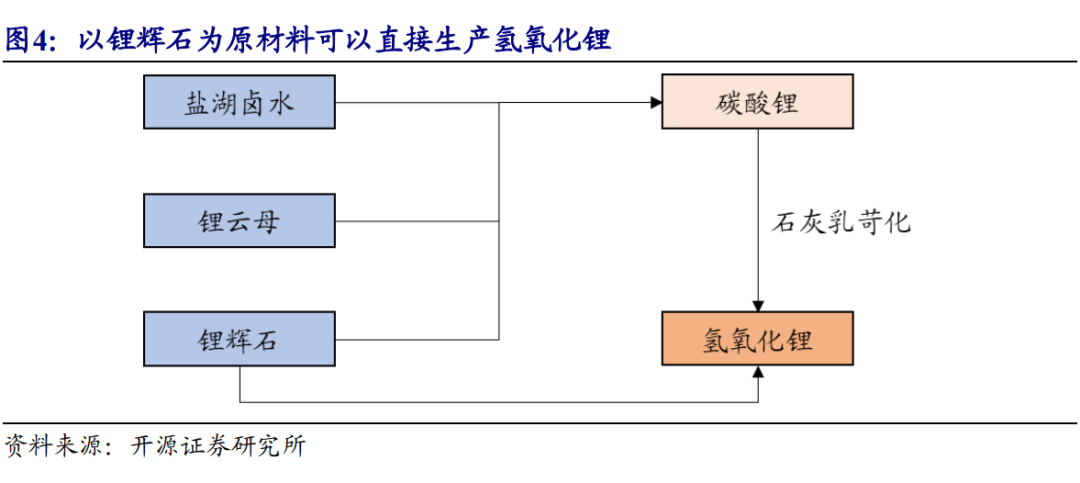
We review the price trends of lithium carbonate and lithium hydroxide since 2016 and find that they are basically the same. At the same time, the price of lithium hydroxide is in the lead most of the time, but there have also been three price reversals. Next, we will explore the reasons for the price upside down in the past three times.
The first price upside down (before June 2016): at that time, the domestic high-nickel ternary lithium battery was still in its infancy, and lithium hydroxide was rarely used in lithium battery, while buses and other models equipped with lithium iron phosphate battery had gradually begun to sell capacity. The corresponding demand for lithium carbonate has increased steadily, and the difference in demand has led to an upside-down price between the two.
The second price upside down (August 2017 to April 2018): during this period, domestic cathode material manufacturers began to expand production on a large scale, and the rapid release of new energy vehicles led to a substantial increase in the demand for lithium carbonate. but at the same time, the lithium hydroxide production capacity of Tianqi lithium industry, Ganfeng lithium industry and other enterprises began to concentrate, so the price of lithium hydroxide is relatively stable. In this context, the price of lithium carbonate is in a strong position, and the prices of the two are upside down.
The third price upside down (December 2020 to May 2021): as we analyzed earlier, this round of price upside down is mainly driven by both supply and demand of lithium carbonate. the supply side is reflected in the decline in the operating rate of lithium carbonate manufacturers leading to a shortage of supply, while the demand side is driven by the rapid growth of lithium carbonate demand due to the rapid expansion of lithium iron phosphate models.
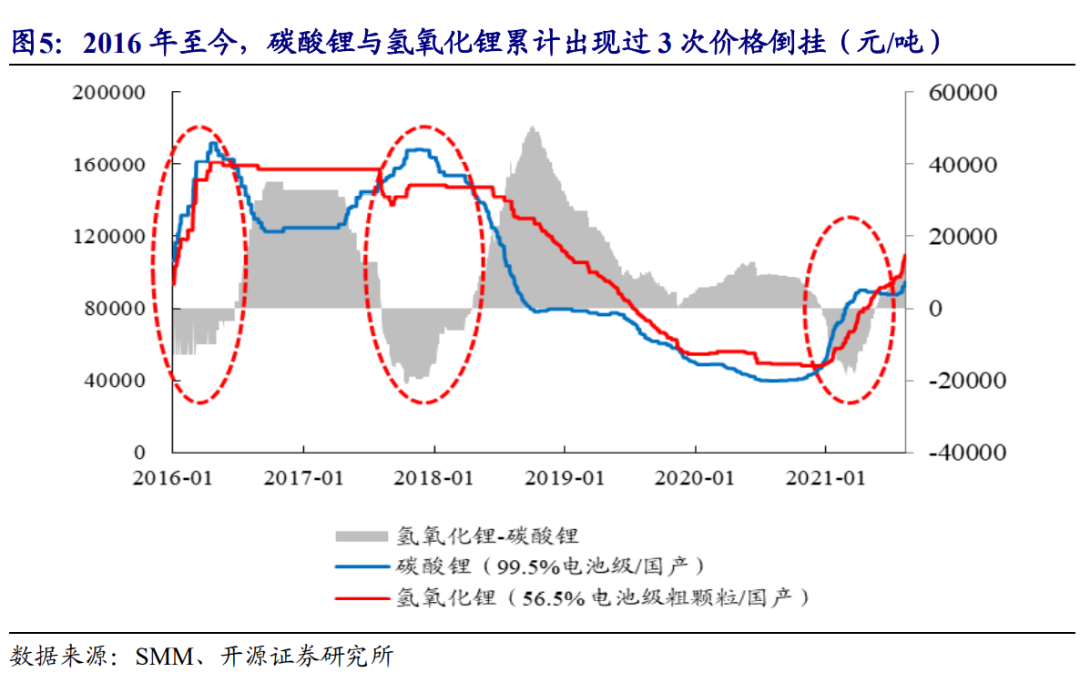
The price of lithium hydroxide will not strengthen alone, and lithium carbonate is expected to continue to rise. Although the price of lithium hydroxide continues to strengthen recently, we do not think its price will outshine others, mainly due to two aspects: (1) Lithium carbonate and lithium hydroxide can be produced from spodumene as raw materials. although the two process routes and the production equipment are different, the final production costs are about the same. Therefore, in the long run, the linkage of the two on the raw material side will lead to the convergence of price trends. (2) there is no great technical obstacle in the product conversion between lithium carbonate and lithium hydroxide. Taking the conversion of lithium carbonate to lithium hydroxide as an example, lithium hydroxide can be obtained by the conversion of lithium carbonate by adding additional equipment and causticizing with lime milk (corresponding to the causticizing cost of about 10,000 yuan / ton). Because of the low technical difficulty and moderate cost of the mutual conversion between this kind of products, it is difficult to have a large price difference between them. We expect that with the growing demand for lithium salt, the price of lithium carbonate is expected to continue to rise in the future.
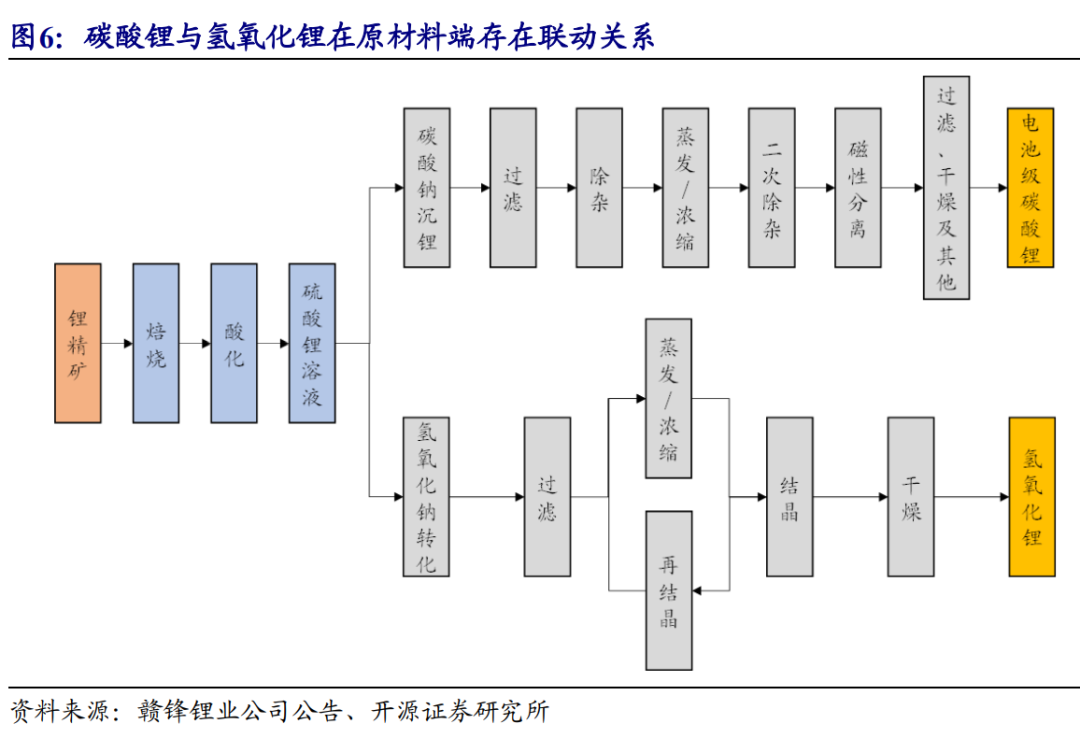
Of course, the price of lithium carbonate will continue to rise only from the linkage relationship between lithium hydroxide and lithium carbonate, but in the final analysis, the rise and fall of lithium price depends on the change of supply and demand in the industry. Below, we will sort out the future supply and demand situation of lithium ore in detail. Further judge the trend of lithium ore.
two。 Supply side: short-term increment is limited, continue to continue the tense situation
2.1. Overseas spodumene: there are only 4 mines in production in Western Australia, and the increment will be based on the completion of production capacity.
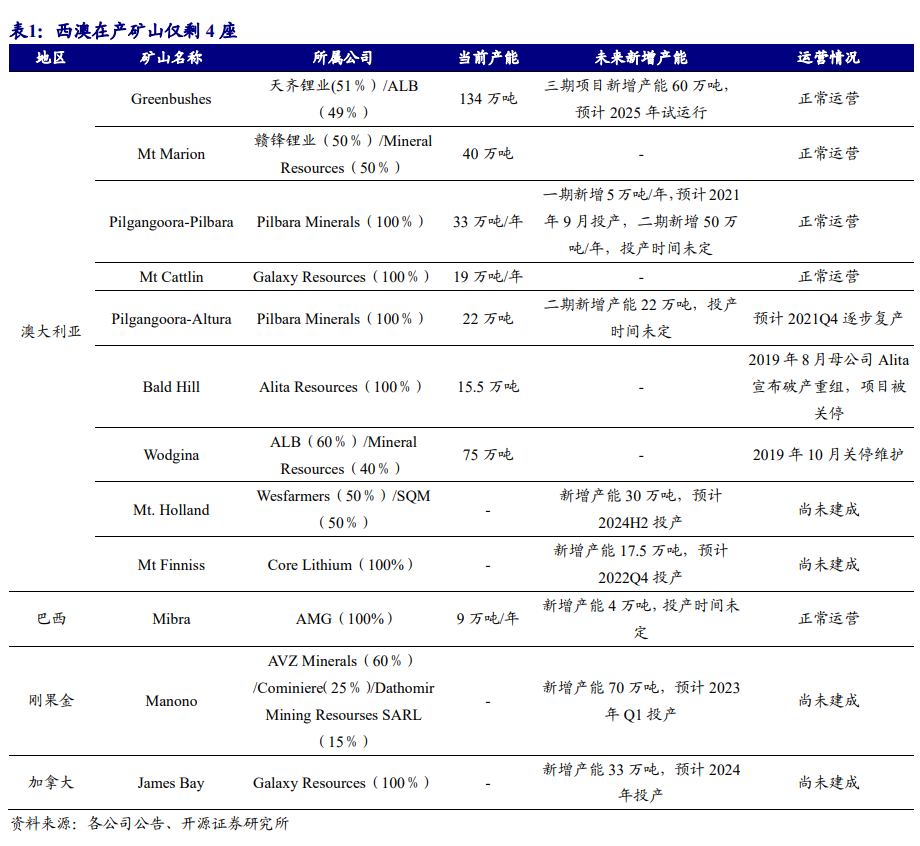
After a continuous clearance of production capacity, there are only four mines in production in Western Australia. Among them, Marion and Cattlin have no production expansion plans for the time being to put into production after the second phase of the Pilbara project has been postponed. Although Greenbushes has a completed capacity of 1.34 million tons / year (including the second phase of the new capacity of 600000 tons / year), it also needs to gradually put into production with the Quinana project of Tianqi lithium industry and the Kemerton project of ALB. At the same time, the production capacity of mines under construction such as Finniss and Holland is also relatively small and the production time is relatively late, which is expected to be put into trial production in 2022Q4 and 2024H2 respectively. In addition, for the previously closed mines, except that Altura announced that it would gradually resume production from 2021Q4 (limited by its small production capacity and relatively limited impact on the total supply), other closed mines such as Bald Hill and Wodgina have no plans to resume production at present.
Mines in other areas, such as Manono and James Bay, are still under construction. Although there will be a certain supply increment in the future, it is expected that the volume will not be released until 2023-2024, which will not affect the supply of the industry in the short term. Therefore, on the whole, the production capacity of overseas spodumene mines will tend to be stable in the next 1-2 years, and there will be no significant growth. However, it should be noted that with the continued rise in lithium concentrate prices in 2021, Pilbara and Cattlin mines that had previously taken the initiative to reduce production are expected to return to full production, which may form a certain supply increment.
2.2. Overseas Salt Lake Brine: capital expenditure of South American Salt Lake has been suspended, and production expansion plans have been postponed.
Compared with lithium extraction from spodumene, thanks to the excellent resource endowment conditions, the cost advantage of lithium extraction from South American salt lake brine is significant, so the pace of production expansion is more radical. However, due to the continuous decline in lithium salt prices and the impact of novel coronavirus's epidemic in 2020, its capital expenditure has also been suspended, and production expansion plans have also been postponed. At this stage, in the short term, with the exception of SQM's Atacama Salt Lake first phase expansion project (50,000t LCE, including 8000 tons of lithium hydroxide) and ALB's Atacama Salt Lake expansion project (40,000 tons of lithium carbonate) are expected to be put into production by the end of 2021, most of the other expansion or new projects are expected to be put into trial production one after another from 2022. Considering that most of the previous expansion projects of South American Salt Lake have been delayed, and it takes some time for new capacity to climb, we believe that the new supply of South American Salt Lake may be less than expected in the future.
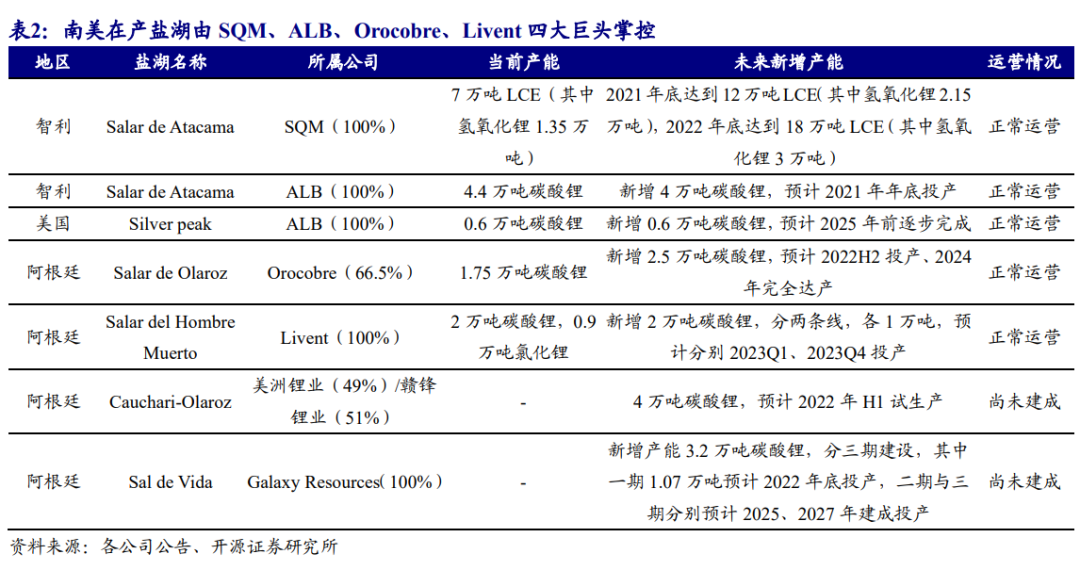
2.3. Domestic: the route of lithium extraction is in full bloom, and the development of resources is accelerated.
2.3.1. Spodumene: the production capacity is concentrated in three major mines, and the increment will be released centrally from 2023.
Domestic spodumene resources are mainly concentrated in Sichuan. Although the overall resource endowment is excellent and the ore grade is good, the development scale is relatively small due to topography, transportation, humanities and other reasons. At the present stage, there are only two spodumene mines in China, of which the lithium concentrate output of Methyl Card and Yelonggou Mine in 2020 is 58000 tons and 11000 tons respectively, with a total of about 9000 tons of LCE. In terms of new production capacity, the methyl card plans to add about 470000 tons / year of lithium refined mineral capacity, which is expected to be completed in 2022. At the same time, the Lijiagou mine under construction also has lithium refined mineral energy of about 180000 tons / year, which is expected to be put into production by the end of 2022. Therefore, the future domestic spodumene production increment will be concentrated from 2023. With the continuous commissioning of the above projects, we estimate that by 2025, the output of domestic spodumene mines will reach 100000 tons of LCE.
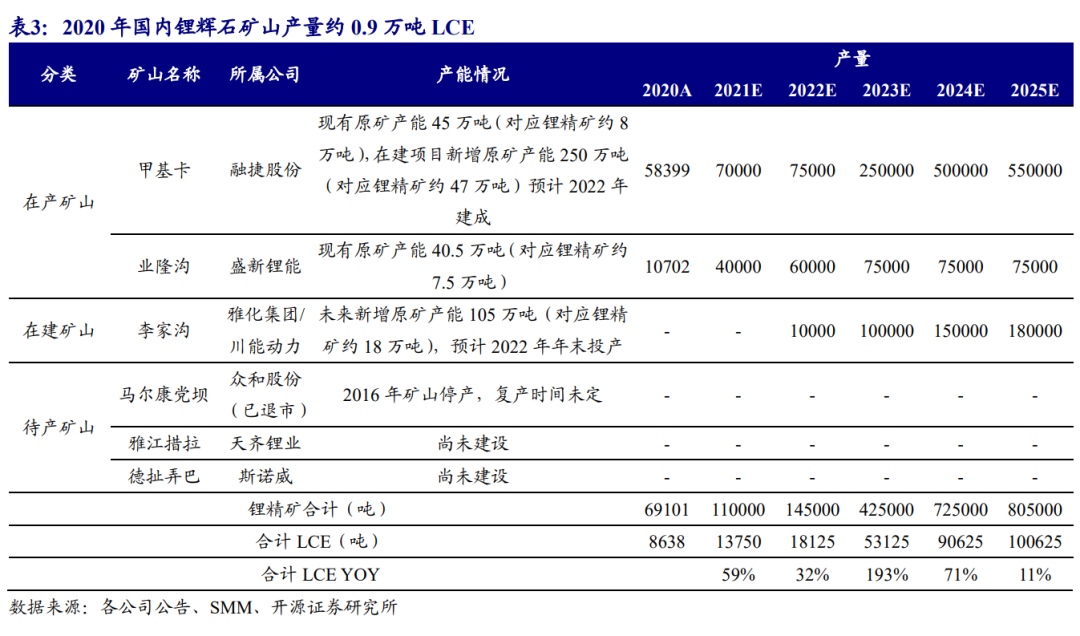
2.3.2, salt lake brine: rich in resources, policy support is expected to usher in the spring of development
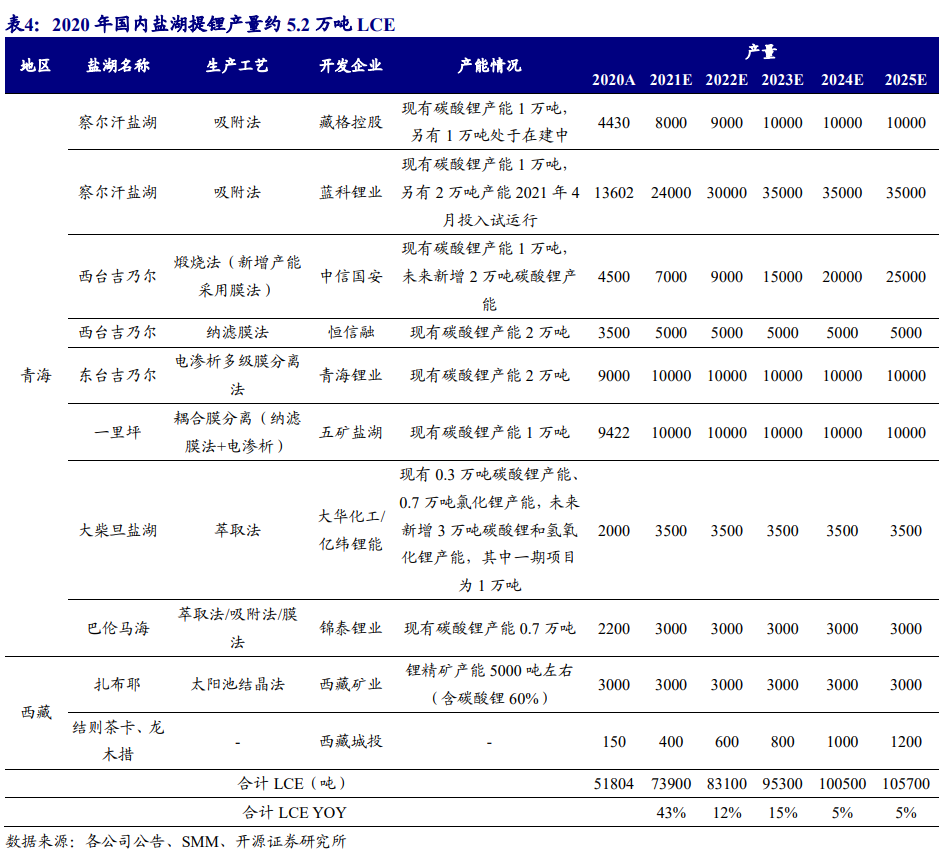
Domestic lithium resources in salt lakes are mainly concentrated in Qinghai and Tibet, but due to the fragile ecological environment in Tibet, which is restricted by traffic and electric power, it has not been developed and utilized on a large scale. There are only Zhabuye and Jiezecha in the salt lake, with an annual output of more than 3000 tons of LCE. At present, the main production bases of lithium extraction from salt lakes in China are still concentrated in Qinghai, including Chaerhan Salt Lake, Xitaijinel, Dongtai Guinel, Yiliping, Dachaidan Salt Lake and so on. Compared with South American salt lake, Qinghai salt lake has poor resource endowment conditions (high magnesium-lithium ratio and low lithium ion concentration), and the development technology is more difficult. In view of this situation, according to local conditions, various production enterprises have successively developed a variety of lithium extraction routes, such as adsorption, nanofiltration membrane, calcination, extraction and so on. Large-scale production is being carried out in an orderly manner, and the annual output of various enterprises has also reached thousands of tons to tens of thousands of tons (in 2020, the total output of lithium extraction from salt lakes reached 52000 tons LCE).
Although a series of progress has been made in extracting lithium from salt lakes in China, there are still some outstanding problems. For example, the overall capacity utilization rate of domestic salt lake lithium extraction enterprises is too low (only about 52% in 2020). In addition to the lack of production willingness caused by the sharp drop in lithium salt prices in 2020, this is mainly due to immature lithium extraction technology, energy shortage and other reasons. In addition, the limitations of infrastructure, ecological environment and other development conditions have also hindered the development and expansion of salt lakes. Even so, we are still firmly optimistic about the bright prospect of extracting lithium from domestic salt lakes for two main reasons: (1) compared with South American salt lakes, even though the resource endowment of domestic salt lakes is poor, on the whole, the cost of extracting lithium is still lower than that of imported ores, and the profitability under the current price of lithium salt is also considerable. (2) with the rising demand for lithium, lithium resource has become a global strategic metal. However, at the present stage, China's lithium raw materials are heavily dependent on Western Australian imports, and the current uncertainty of Sino-Australian relations further leads to the lack of stability of China's lithium resources supply. At the same time, according to the statistics of the US Geological Survey, China's lithium reserves are about 5.2 million tons of metal equivalent in 2020, of which salt lake lithium reserves account for about 85% (Qinghai and Tibet salt lakes account for 62% and 23%, respectively). In this context, it is urgent to ensure the supply of lithium resources in China, and it is imperative to extract lithium from salt lakes. In May 2021, the Plan and Action Plan for the Construction of a World-class Salt Lake Industrial Base was formally reviewed and approved. With the introduction of relevant supporting policies, the domestic salt lake lithium extraction industry is expected to usher in the development spring. We estimate that by 2025, the domestic output of lithium extraction from salt lakes will reach 106000 tons of LCE.
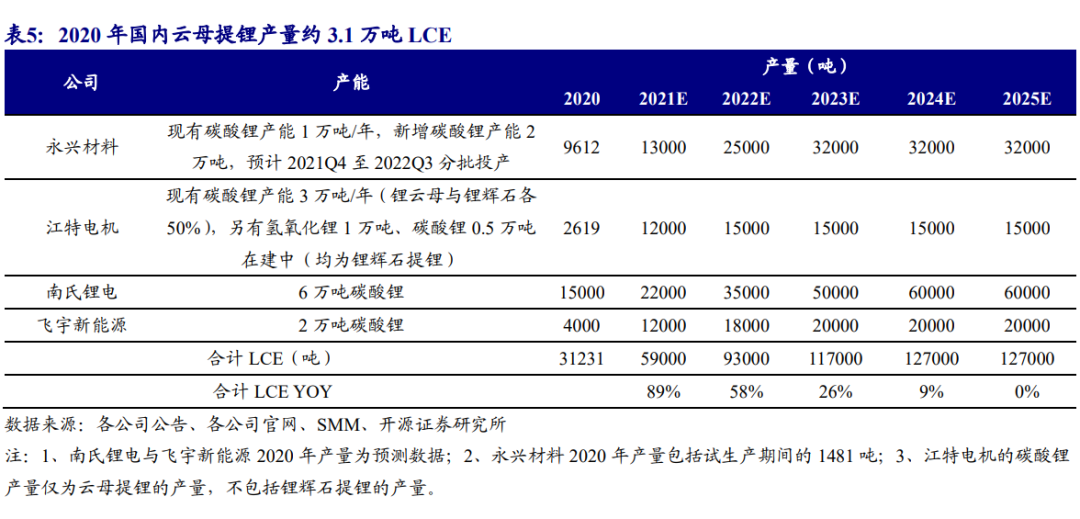
2.3.3. Lithium mica: lithium extraction process is mature and capacity release is accelerated.
China is rich in lithium mica resources, which are mainly concentrated in Yichun area of Jiangxi Province. According to Huaxia Longitude and Weft Network data, the recoverable lithium oxide reserves in Yichun area is 2.6 million tons, accounting for about 50% of the country and 25% of the world. Previously, due to the limitations of lithium extraction technology (mica lithium extraction process is easy to form insoluble fluoride, easy to corrode production equipment and lead to low yield, but also produce residue pollution), mica lithium extraction has not been fully valued and promoted. But in recent years, the enterprises represented by Yongxing materials have overcome the difficulties step by step after a long period of technological research and innovation, and finally overcome the technical problem of extracting lithium from mica, and the extraction of lithium from mica has also achieved large-scale production. At present, the main production enterprises include Yongxing Materials, Jiangte Motor, Nansi Lithium Power, Feiyu New Energy and so on, with a production capacity of tens of thousands of tons. In 2020, the overall output of lithium extraction from mica is about 31000 tons of LCE. With the commissioning of new production capacity in the future and the gradual improvement of the utilization rate of existing capacity, the domestic production scale of lithium extraction from mica is expected to further expand, and we expect it to reach 127000 tons of LCE by 2025.
3. Demand side: the release of demand is accelerated, and the growth attribute is highlighted.
3.1. The new energy vehicle industry is booming, and the global electrification trend continues to accelerate.
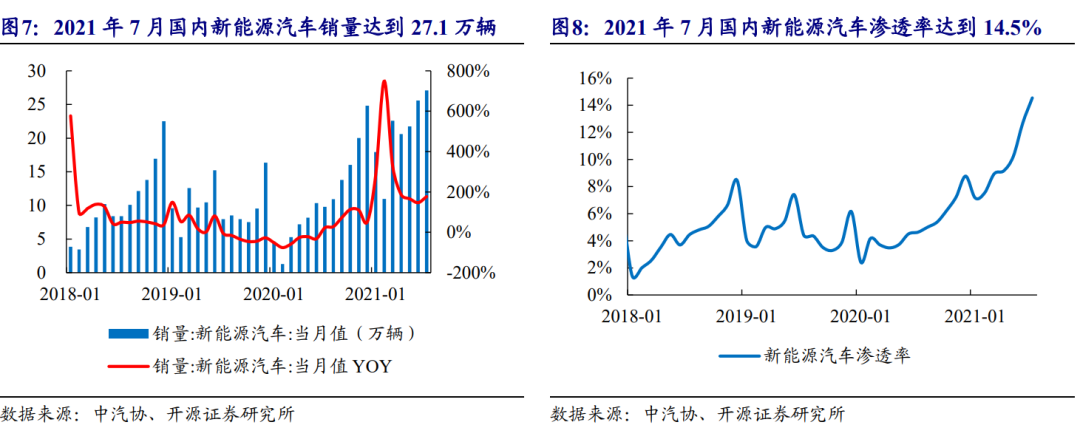
Domestic sales of new energy vehicles have increased significantly for 13 consecutive months, and the permeability has shown a trend of rapid increase. According to the statistics of the China Automobile Association, domestic sales of new energy vehicles reached 1.3229 million in 2020, still growing by 9.69% year-on-year in the first half of the year under the impact of the epidemic. At the same time, since July 2020, domestic sales of new energy vehicles have increased significantly for 13 consecutive months compared with the same period last year, and the monthly sales have reached 271000 as of July 2021. In addition, in terms of permeability, the overall permeability of domestic new energy vehicles has increased rapidly since January 2020. In July 2021, the permeability of domestic new energy vehicles has reached 14.5%. From January to July, the permeability has also reached 9.9%.
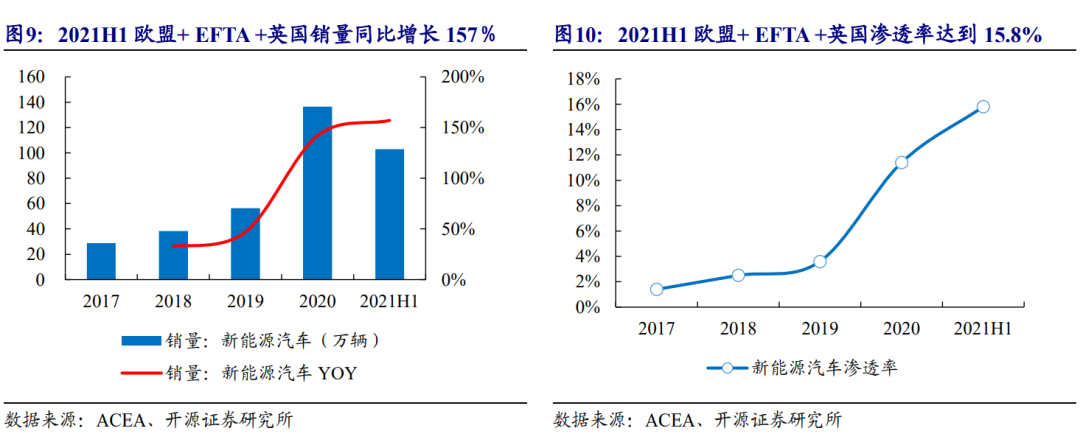
Carbon emission targets will be stringent and preferential policies will be adopted to promote the rapid release of new energy vehicles in Europe. Since 2019, major European countries represented by Germany, Britain and France have issued a series of preferential policies for the new energy vehicle industry, including tax relief, car purchase subsidies, infrastructure construction subsidies and so on. It has promoted the rapid development of the new energy vehicle industry. At the same time, the European Commission formally released the 2030 Climate Target Plan in September 2020, further tightening the carbon emission target. Under the stimulation of relevant policies, the sales of new energy vehicles in Europe have grown rapidly. According to ACEA, EU + EFTA + UK sales totaled 1.365 million vehicles in 2020, up 142 per cent year-on-year to 1.029 million, up 157 per cent year-on-year. At the same time, in terms of penetration, the penetration rate of H1 EU + EFTA + UK new energy vehicle market has reached 15.8% in 2021. In the future, with the accelerated release of new energy vehicles, the penetration rate is expected to continue to increase.
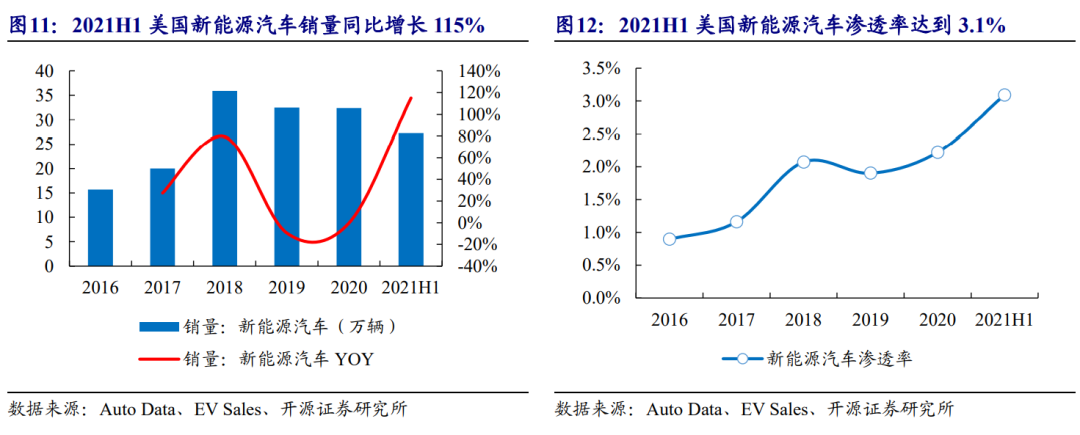
With the inauguration of Biden as president, the US new energy vehicle industry has ushered in a policy inflection point. Biden was officially sworn in as president of the United States on January 20, 2021. According to the Clean Energy Revolution and Environmental Justice Plan issued during his previous campaign, the Biden administration will continue to strengthen its new energy policy in the future. these include: (1) ensuring that the United States achieves a 100% clean energy economy and net zero emissions by 2050; (2) use the federal procurement system ($500 billion per year) to achieve 100% clean energy and zero-emission vehicles; (3) establish stricter fuel emission standards to ensure that 100% of new light and medium-sized vehicles sold in the future are electrified; and (4) deploy more than 500000 new public charging stations by the end of 2030 to restore full electric vehicle tax credits.
On March 31, 2021, Biden further announced the American Jobs Plan, which is expected to invest 2.25 trillion US dollars to rebuild the infrastructure of the United States over eight years, of which 174 billion US dollars will be used to accelerate the popularity of electric vehicles. The main measures include providing sales discounts and tax concessions, building charging stations, and so on. Under the active promotion of relevant policies, the US new energy vehicle industry has developed rapidly. The sales of 2021H1 new energy vehicles reached 273000, an increase of 115% over the same period last year, and the market penetration also reached 3.09%, an increase of 0.87pct over 2020.
In addition, on August 4, 2021, Biden again signed a presidential decree that, according to the presidential decree, new energy vehicle sales in the United States will account for 50% of new car sales by 2030. We expect that in the future, with the introduction of the relevant support policies of the Biden government, the penetration of the US new energy vehicle market is expected to increase rapidly.
With the advent of the wave of 3.2 and 5G, the demand for 3C batteries is expanding.
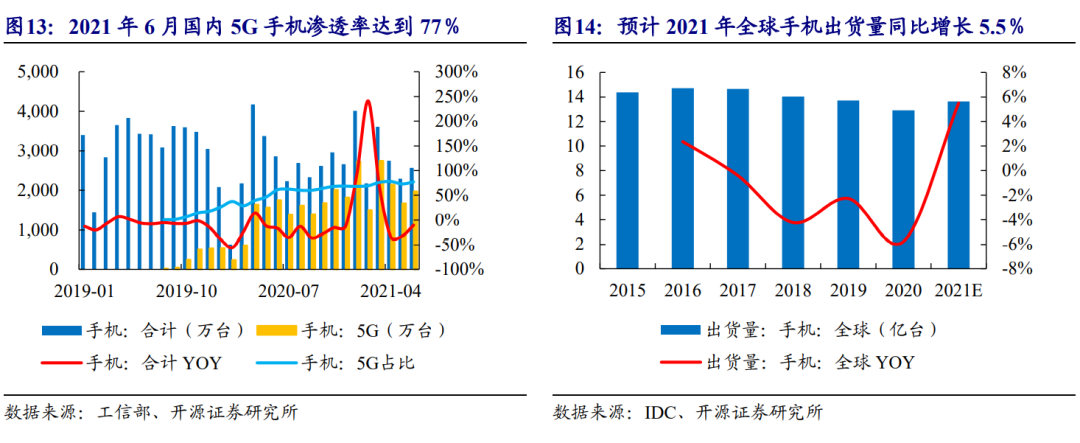
Riding on the 5G east wind, the prosperity of the global mobile phone industry continues to recover. According to the Ministry of Industry and Information Technology, domestic mobile phone shipments reached 25.66 million units in June 2021, of which 19.79 million 5G phones were shipped, with a market penetration rate of 77.12%. With the advent of the 5G wave, the prosperity of the mobile phone industry continues to recover. Domestic mobile phone shipments from January to June in 2021 reached 174 million units, an increase of 13.73% over the same period last year. In addition, on the global level, according to IDC statistics, affected by the novel coronavirus epidemic, global mobile phone shipments dropped to 1.292 billion units in 2020, down 5.76 percent from the same period last year. IDC expects global mobile phone shipments to grow 5.5 per cent year-on-year in 2021 and a compound annual growth rate of 3.6 per cent from 2020 to 2025 as demand continues to recover and 5G penetration continues to rise.
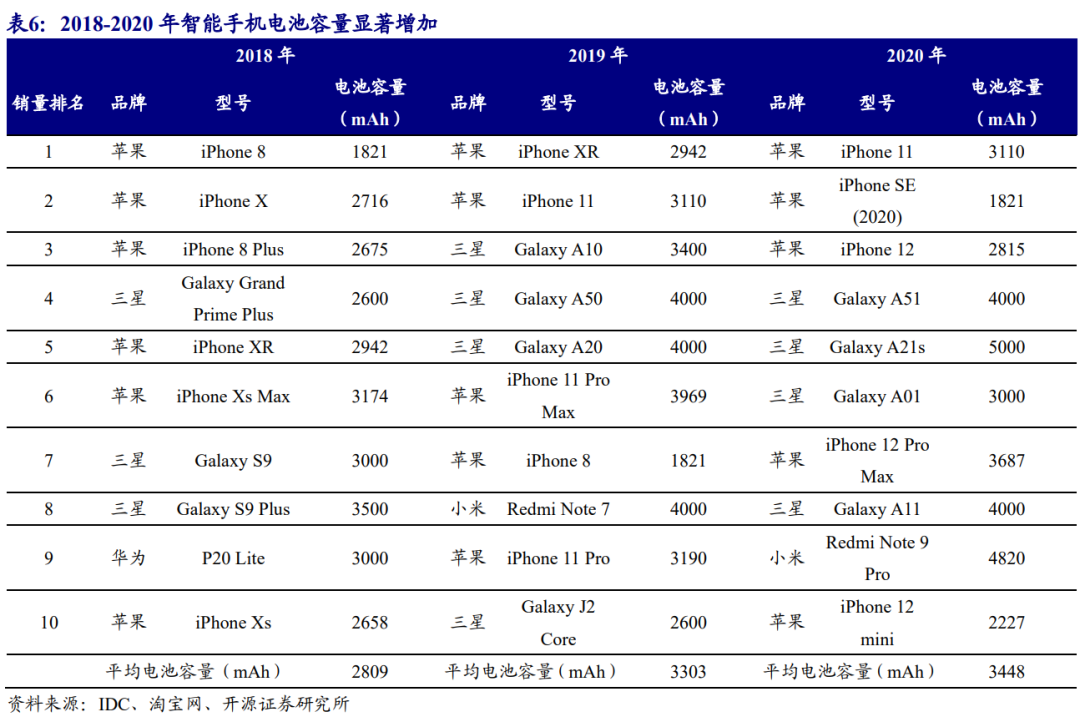
The performance of smart phones has been continuously optimized, and the power of a single phone has increased significantly. By comparing the average battery capacity of the top 10 models sold in the world from 2018 to 2020, it can be found that the single battery capacity of smart phones has increased significantly, mainly because the continuous optimization of mobile phone performance has put forward higher requirements for battery capacity. At the same time, IDC predicts that global 5G smartphone shipments will account for more than 40 per cent of global smartphone shipments in 2021 and grow to 69 per cent by 2025. The increase in the penetration rate of 5G mobile phones will further force manufacturers to continue to optimize the performance of mobile phones, when the power of a single smartphone will also continue to increase.
3.3. The prospect of energy storage battery is broad, and the blue ocean market needs to be developed urgently.
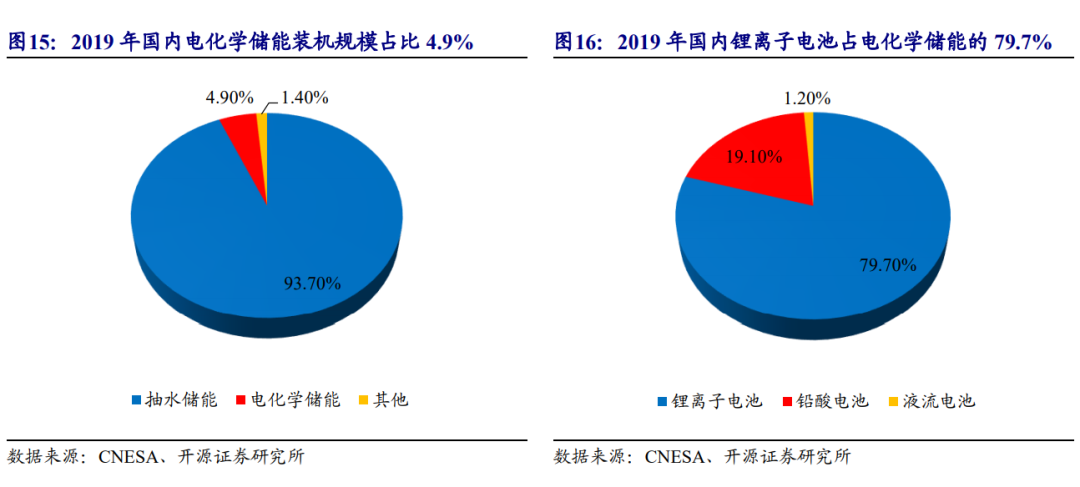
Lithium-ion battery has become the mainstream direction of electrochemical energy storage. According to the category, energy storage technology can be divided into physical energy storage and chemical energy storage, in which physical energy storage is mainly water storage (the domestic installed scale accounts for 93.7% in 2019). Chemical energy storage can also be divided into lithium-ion battery, lead-acid battery and liquid flow battery. Compared with lead-acid battery, lithium-ion battery is slightly more expensive, but thanks to higher capacity density, more cycles and longer service life, its comprehensive performance-to-price ratio is significantly higher than that of lead-acid battery. With the accelerating process of lithium-ion battery replacing lead-acid battery, lithium-ion battery has gradually become the mainstream direction of electrochemical energy storage. By 2019, domestic lithium-ion battery has accounted for about 80% of electrochemical energy storage.
Electric energy storage and communication energy storage will open up a new space for the growth of the energy storage battery market. Among them, in terms of electric energy storage, with the continuous promotion of the relevant policies of "carbon neutralization and carbon peak", wind power generation as a representative of clean energy is expected to usher in a major development opportunity. At the same time, due to the strong intermittence and uncontrollability of wind power generation affected by season and weather, large-scale access will cause greater pressure on the Electroweb system, so it is necessary to match the corresponding energy storage equipment to achieve the smooth output of wind power generation. On July 29, 2021, the National Development and Reform Commission issued the notice on further improving the time-sharing electricity price mechanism, deploying various localities to further improve the time-sharing electricity price mechanism to serve the construction of a new power system with new energy as the main body. On August 10, the National Development and Reform Commission and the National Energy Administration jointly issued the notice on encouraging renewable energy power generation enterprises to build themselves or purchase peak regulation capacity to increase the scale of grid connection, proposing that on the basis of Electroweb enterprises undertaking the responsibility of renewable energy security grid connection, power generation enterprises should be encouraged to increase the installed scale of renewable energy generation through self-construction or purchase peak regulation energy storage capacity. To sum up, we believe that with the support of relevant favorable policies, the demand for energy storage batteries is expected to meet rapid growth.
In addition, in terms of communication energy storage, according to the data of the Ministry of Industry and Information Technology, with the gradual increase of 5G permeability, China has built a total of 718000 5G infrastructure by the end of 2020, and it is expected that 600000 will continue to be added in 2021. Compared with the 4G base station, the power consumption of the single station equipment of the 5G base station increases greatly and shows the trend of miniaturization and lightweight. At the same time, because the 5G base station energy storage battery participates in peak regulation and cost reduction, the number of charge and discharge will be greatly increased, which puts forward higher requirements for the performance of the energy storage battery. At this stage, lithium iron phosphate batteries are mostly used in domestic 5G base station energy storage batteries, so with the gradual advent of the 5G era, the demand for energy storage lithium-ion batteries is also expected to usher in centralized release.
4. Supply and demand docking: the pattern of supply and demand is improving, and lithium price is expected to continue to strengthen.
4.1. The tight balance between supply and demand continues, and lithium prices are easy to rise but difficult to fall.
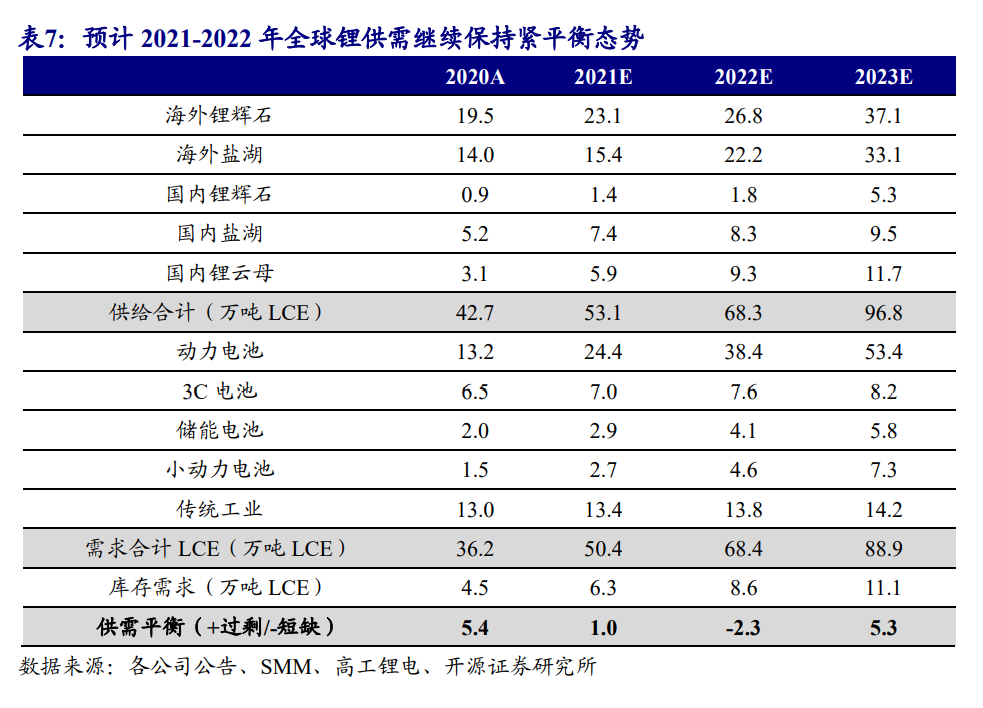
It is expected to maintain a tight balance from 2021 to 2022, and lithium prices are easy to rise but difficult to fall. According to our estimates, the global lithium supply is expected to reach 42.7,53.1,68.3 and 968000 tons respectively from 2020 to 2023, with a LCE,CAGR of 31.4%. At the same time, on the demand side, we expect the global lithium demand to reach 36.2,50.4,68.4 and 889000 tons LCE,CAGR respectively from 2020 to 2023, accounting for 34.9%, of which power battery, energy storage battery and small power battery will contribute the main increment. With the docking of supply and demand, we expect that the global lithium industry will continue to maintain a tight balance between supply and demand from 2021 to 2022, lithium prices are expected to continue to strengthen, lithium mining enterprises are expected to fully benefit, and the industry inflection point may come in 2023 with the further release of global lithium supply. However, it should be noted that the calculation of the balance of supply and demand is not achieved overnight, but a process of dynamic change, and there is greater uncertainty in the prediction of longer dimensions. For example, although the energy increment of lithium minerals measured in 2023 is large, with a year-on-year growth rate of 42%, the demand side is likely to continue to exceed expectations, driven by new energy vehicles and energy storage. Therefore, to sum up, we believe that the tight supply and demand situation of the global lithium industry from 2021 to 2022 is difficult to change, and lithium ore prices are expected to continue to strengthen.
4.2. The bottom of lithium price is tamped, and the impact of price increase on the whole vehicle can be controlled.
Following the above, after measuring the global supply and demand of lithium, we continue to explore the bottom range of the price of lithium carbonate from the supply side. At the same time, as a whole, compared with lithium extraction from salt lake and lithium mica, the cost of lithium extraction from spodumene is relatively high, which is located at the right end of the cost curve, so its cost basically determines the bottom range of lithium carbonate price. In this context, we will focus on the cost of spodumene in Western Australia.
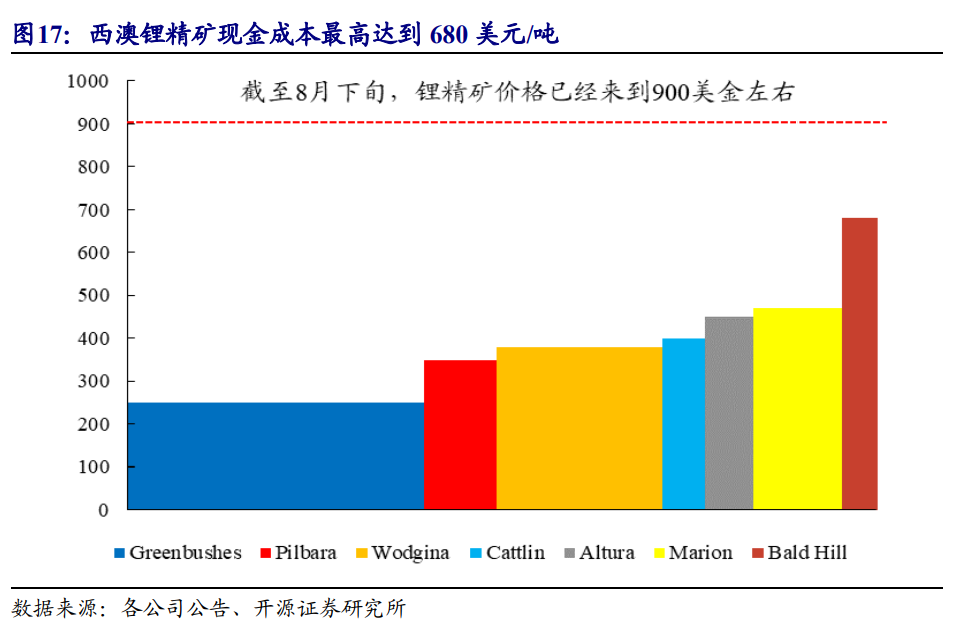
According to our statistics, at present, except for the cash cost of Greenbushes in Western Australia, the cash cost of lithium concentrate in other mines is concentrated in the range of US $350-500. In addition, it should be noted that the cash cost of the Bald Hill mine to be reproduced has reached US $680 / ton. under the current situation that the supply of lithium concentrate exceeds demand, assuming that the mine begins to resume production, the complete cost of producing lithium carbonate with its lithium concentrate as raw material (in addition to the cash cost of lithium concentrate, including the non-cash cost of lithium concentrate, freight, etc., as well as the processing cost and four fees of lithium carbonate) has been close to 70, 000 yuan / ton. In this context, the bottom price of lithium carbonate is also close to 80,000 yuan / ton (the bottom price is determined by the highest full cost plus VAT, and the price of lithium carbonate will not be lower than this level at least). Of course, 80,000 yuan is only the bottom price. At present, the latest market quotation for battery-grade lithium carbonate has exceeded 100000 yuan. It is difficult to make up for the rigid gap of lithium salt before 2023, and the long-term shortage of supply and demand can easily lead to a sustained soaring price. even hit the previous historical high level of 160000 yuan.
In addition, the vehicle cost is less sensitive to the change of lithium price, which also provides an important opportunity for the rise of lithium price. Take Biadihan EV with lithium iron phosphate battery as an example, its battery energy is 65 KWH. When the price of lithium carbonate is 100000 yuan / ton, the cost of lithium salt of the whole vehicle is only 3451 yuan. At the same time, for every 10, 000 yuan increase in the price of lithium carbonate, the cost of lithium salt in the whole vehicle only increases by about 350 yuan, and even if the lithium price reaches 180000 yuan per ton, the cost of lithium salt in the whole vehicle is only 6212 yuan. Thus it can be seen that the rise in lithium price will not lead to a substantial increase in vehicle costs, nor will it have a significant negative impact on terminal demand.
5. Beneficial target
5.1. Ganfeng lithium industry: the global lithium industry leader in the layout of the whole industry chain, with significant resource advantages.
The company started from the manufacture of mid-stream lithium compounds and metal lithium, after more than 20 years of overcoming difficulties, now it has become a global lithium industry leader in the development of upstream lithium resources, mid-stream metal lithium smelting and lithium salt deep processing, downstream lithium battery manufacturing and comprehensive recycling of waste batteries.
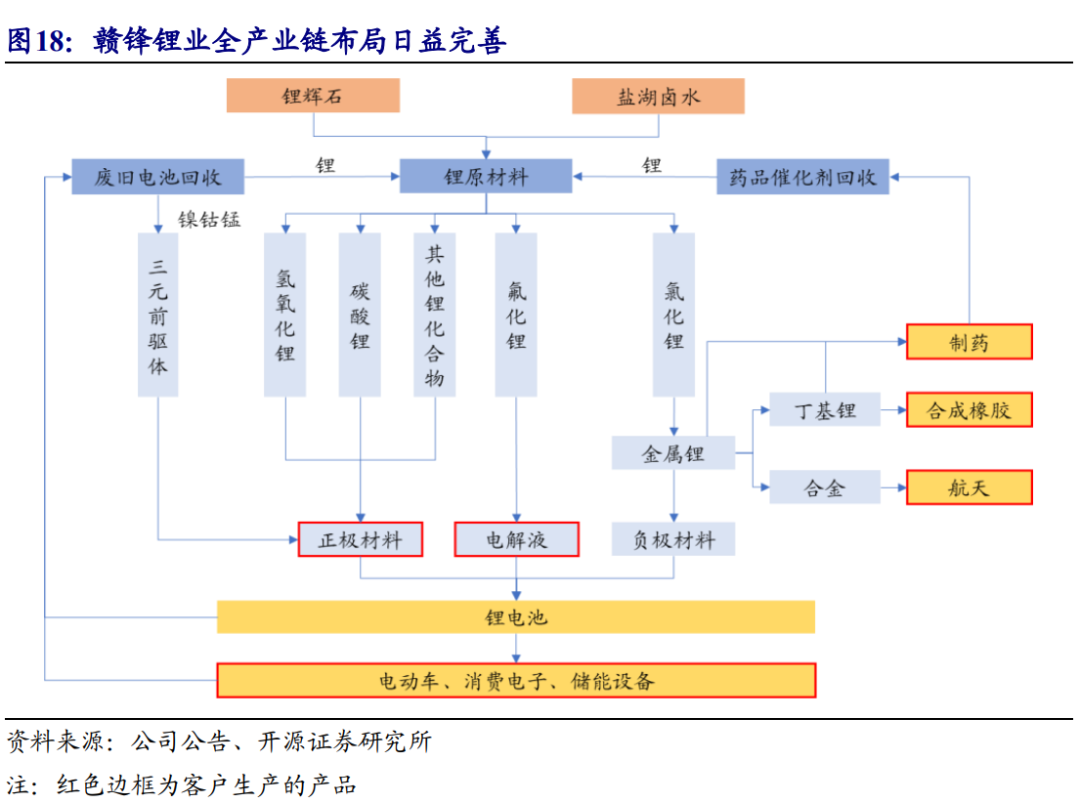
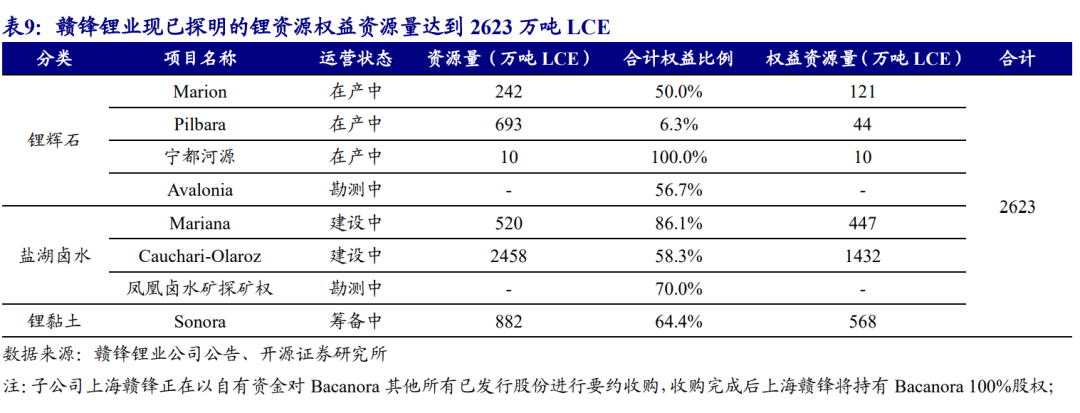
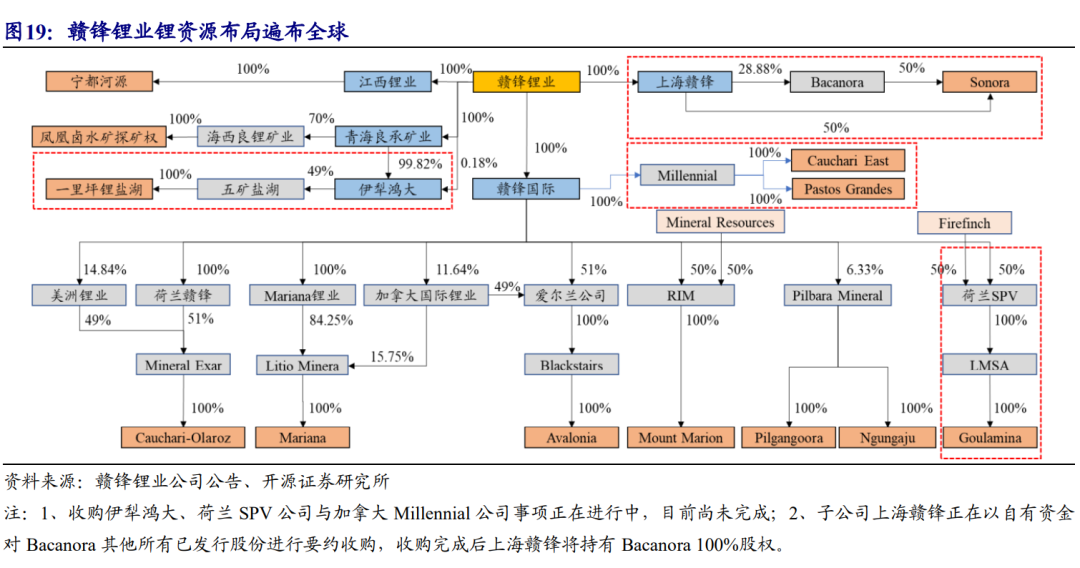
The advantage of resources is remarkable, and the empowering company has grown steadily for a long time. In the upstream lithium resource end, the company currently has eight superior lithium resources around the world, distributed in China, Argentina, Australia, Mexico and other places, covering the main ways of lithium extraction, such as spodumene, salt lake brine, lithium clay and so on. Up to now, the company has proved that the amount of lithium resources has reached 26.23 million tons of LCE. In addition, according to the company announcement, the company is currently carrying out acquisitions by Yili Hongda, SPV of the Netherlands and Millennial of Canada, and the relevant acquisition procedures are also being processed, when the company's lithium reserves will be further enriched.
Lithium salt production capacity continues to expand, capacity utilization is expected to increase rapidly. At present, the company has a capacity of 40500 tons / year of lithium carbonate and 81000 tons / year of lithium hydroxide (which was put into production at the end of 2020), with a total production capacity of 121500 tons / year. At the same time, the Cauchari-Olaroz Salt Lake project in Argentina, which is under construction, is expected to increase the production capacity of 40, 000 tons of lithium carbonate in the first half of 2022. The company's lithium series products sold 63000 tons in 2020. With the gradual completion of the above projects, the company's lithium salt products (including only lithium carbonate and lithium hydroxide) are expected to reach 85000 tons, 120000 tons and 150000 tons respectively from 2021 to 2023.
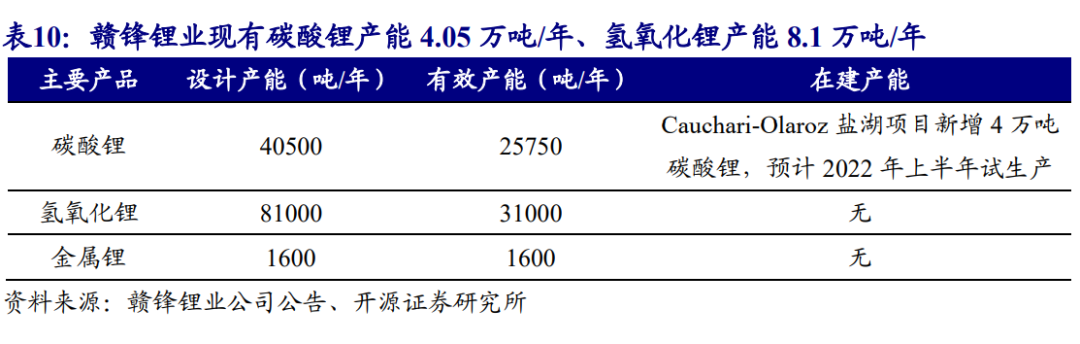
5.2. Tianqi Lithium Industry: holding the world's largest mine, Quinana project is about to expand.
Holding the world's largest spodumene mine, rich in lithium resources. In terms of spodumene resources, the company owns Greenbushes Mine and Yajiang Zola spodumene Mine through its subsidiaries Tylison and Sheng he Lithium Industry respectively. Among them, Yajiang Zola has not yet been developed, while the existing lithium concentrate capacity of the Greenbushes mine has reached 1.34 million tons / year, ranking first in the world. At the same time, it is expected that the third phase of the new lithium concentrate project with an annual production capacity of 600000 tons will be put into operation in 2025, when the company's total lithium concentrate production capacity will reach 1.94 million tons / year. In addition, the company has realized the distribution of high-quality salt lake lithium resources by taking a 20% stake in Xigaze Zabuye and a stake in SQM25.86%. Up to now, the total equity reserves of the company's lithium resources have reached 16.07 million tons of LCE.
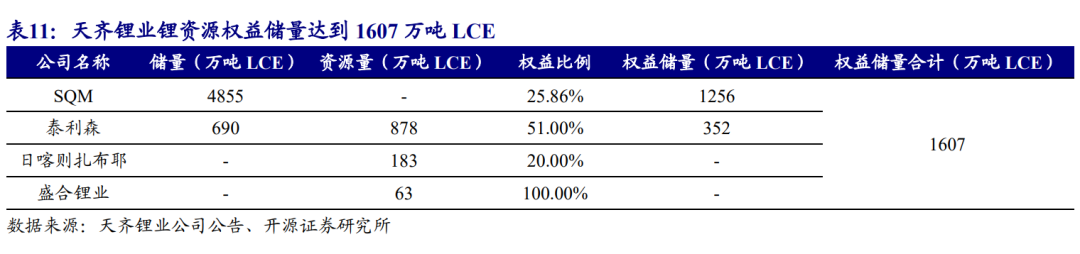
The Quinana project is about to expand, and the output of lithium salt is expected to double. The company has a total capacity of 44000 tons / year for all kinds of lithium salts, including 34500 tons / year of lithium carbonate, 5000 tons / year of lithium hydroxide and 4500 tons / year of lithium chloride. At the same time, the company also has a metal lithium production capacity of 800 tons / year. In terms of additional capacity, in addition to the suspended Sichuan Suining project with an annual capacity of 20,000 tons of lithium carbonate, the company's 48000 tons of lithium hydroxide project in Quinana, Australia, is actively under way, of which 24000 tons in the first phase has entered the commissioning stage and is expected to be put into production by 2021 and reach production in 2022Q4. With the gradual expansion of the Quinana project, the company's lithium salt sales are expected to double.
5.3. Yongxing Materials: representative company of lithium extraction from mica, lithium carbonate phase II project is ready to be launched.
Lithium mica is rich in resources, which lays a solid foundation for the long-term development of the company's lithium business. In terms of ore resources, the company currently has two mines, namely Huashan porcelain Stone Mine and Baishuidong Gaoling Earth Mine. Among them, Huashan porcelain Stone Mine is a subordinate mine of Huaqiao Mining of Sun Company, with a total area of 1.87 square kilometers and newly proved ore reserves of 45.07 million tons. Baishuidong Kaolin Mine is a subordinate mine of Huali Mining Co., Ltd., with a total area of 0.76 square kilometers. all exploration has been completed, with a total proved ore reserves of 7.31 million tons. At the present stage, the total proved raw ore reserves in the upstream of the company is more than 50 million tons. Assuming that 6 tons of raw ore produces 1 ton of lithium mica concentrate and 20 tons of concentrate produces 1 ton of lithium carbonate, the company's future potential output of lithium carbonate exceeds 420000 tons. Rich ore resources have laid a solid foundation for the long-term development of the company's lithium power business.
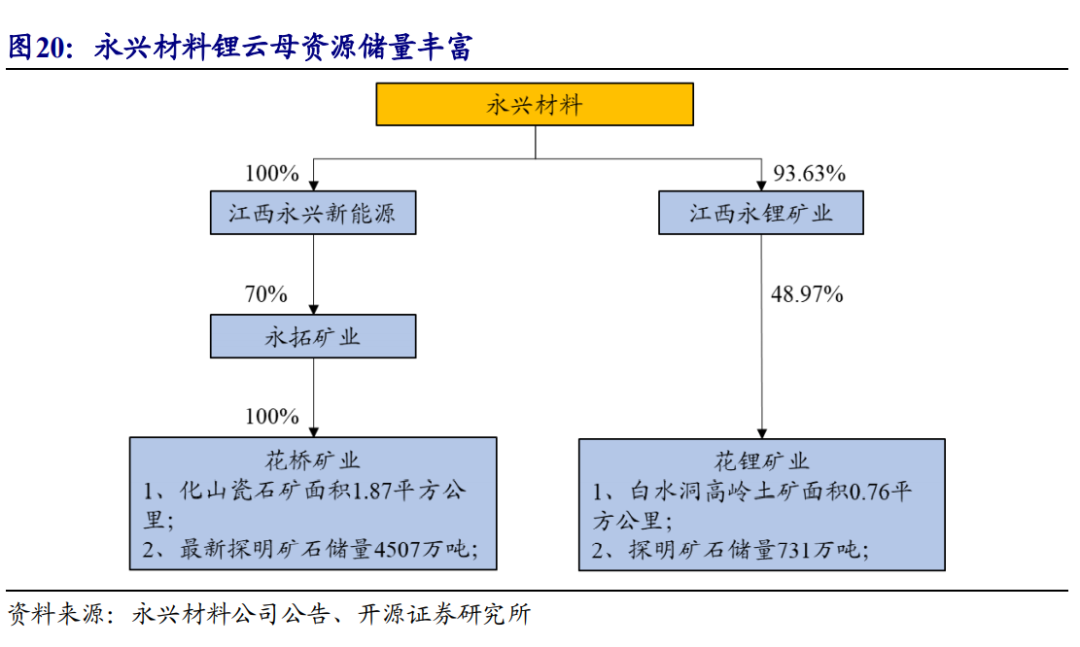
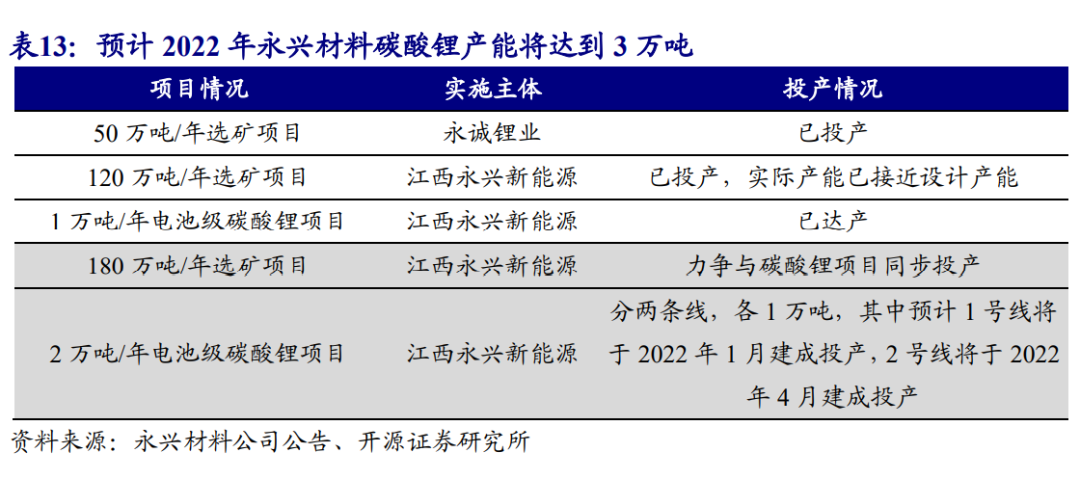
Actively promote capacity expansion, lithium carbonate phase II project is ready to start. In terms of mineral processing, the company currently has a production capacity of 1.7 million tons per year (500000 tons of Yongli Mining + 1.2 million tons of Yongxing New Energy), which can not only meet the demand for lithium concentrate of the downstream 10, 000 tons / year lithium carbonate production project. it also provides a guarantee for the further expansion of lithium carbonate production capacity. At the same time, the second phase of the company's "annual production of 20, 000 tons of battery-grade lithium carbonate project" and the supporting "1.8 million tons / year mineral processing project" are being actively promoted and are expected to be put into production in January 2022 and April 2022. With the concentrated release of the company's capacity under construction, we expect the company's lithium carbonate product sales to increase from 9612 tons in 2020 (including 1481 tons during trial production) to 13000 tons, 25000 tons and 32000 tons respectively in 2021-2023.
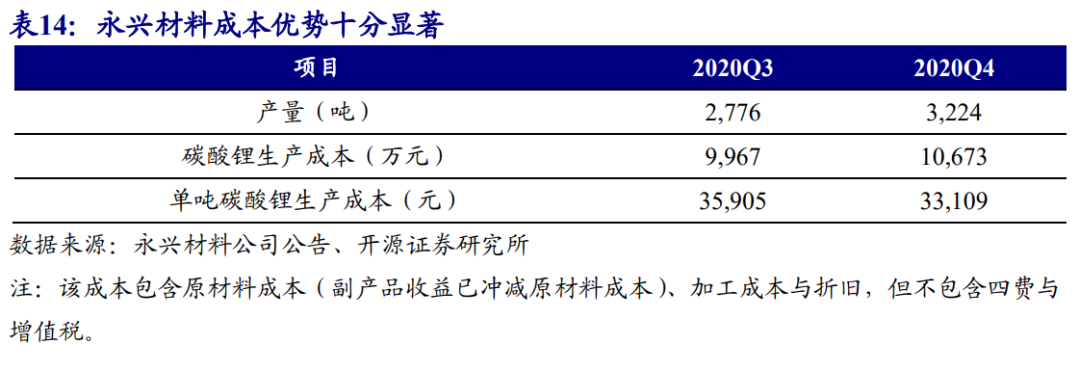
The company's costs are properly controlled and its profitability is considerable. The company has excellent performance in cost control. According to the company announcement, Q3 company produced 2776 tons of lithium carbonate per quarter in 2020, and the production cost was 35905 yuan / ton. Since then, with the gradual improvement of capacity utilization of the first phase of lithium carbonate project, Q4 company's single-quarter lithium carbonate output in 2020 has further increased to 3224 tons, and the production cost has also dropped to 33109 yuan / ton. According to SMM data, by late August 2021, the domestic price of battery-grade lithium carbonate has reached about 100000 yuan / ton. At this price level, the profitability of the company's lithium carbonate products is very considerable.
5.4. Shengxin Lithium Energy: the expansion of lithium salt production capacity is accelerated, and the performance is expected to be released centrally.
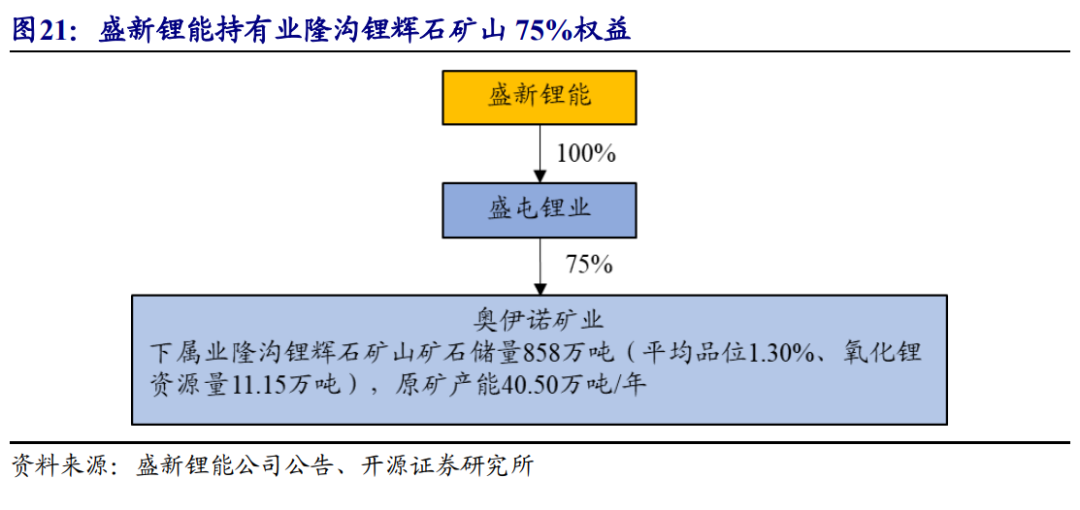
Acquire Shengtun lithium industry and actively enter the upstream lithium mining industry. In the upstream lithium mine, through the acquisition of 100% stake in Shengtun Lithium Industry in 2019, the company holds a 75% stake in Oyino Mining. Its Yelonggou spodumene mine has lithium oxide reserves of 111500 tons. At present, the original mineral capacity is 405000 tons per year (corresponding to about 75000 tons of lithium concentrate). It has been put into production in November 2019. Affected by production capacity climbing, epidemic situation and other factors, Yelonggou Mine produced 10700 tons of lithium concentrate in 2020, which was supplied to Zhiyuan Lithium Industry, a subsidiary company, for lithium salt production. We estimate that with the gradual improvement of capacity utilization, the output of lithium concentrate in Yelonggou Mine is expected to reach about 40,000 tons in 2021.

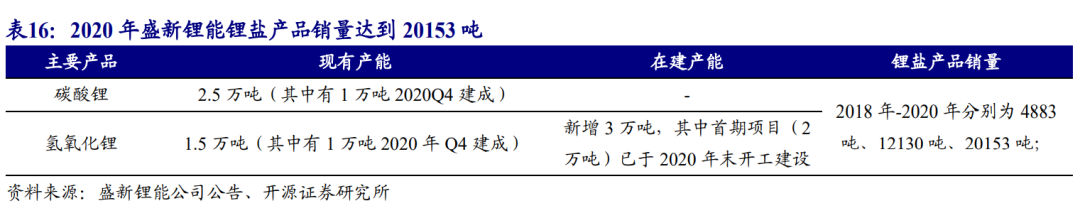
With the rapid release of production capacity, production and sales are expected to increase significantly. In terms of lithium salt production, the company currently has a capacity of 25000 tons / year for lithium carbonate and 15000 tons / year for lithium hydroxide, and plans to increase the production capacity of lithium hydroxide to 30, 000 tons / year in the future. among them, the first phase of the project (production capacity of 20, 000 tons / year) has started construction at the end of 2020. Since 20, 000 tons of the existing production capacity of lithium salt is 2020Q4 (10, 000 tons of lithium carbonate and 10, 000 lithium hydroxide each), the company's total sales of lithium salt products were only 20153 tons in 2020. With the rapid release of subsequent production capacity, we expect the company's lithium product sales to reach 30000 tons, 38000 tons and 50000 tons respectively from 2021 to 2023.
5.5, Salt Lake shares: domestic salt lake lithium extraction leader, the cost advantage is prominent
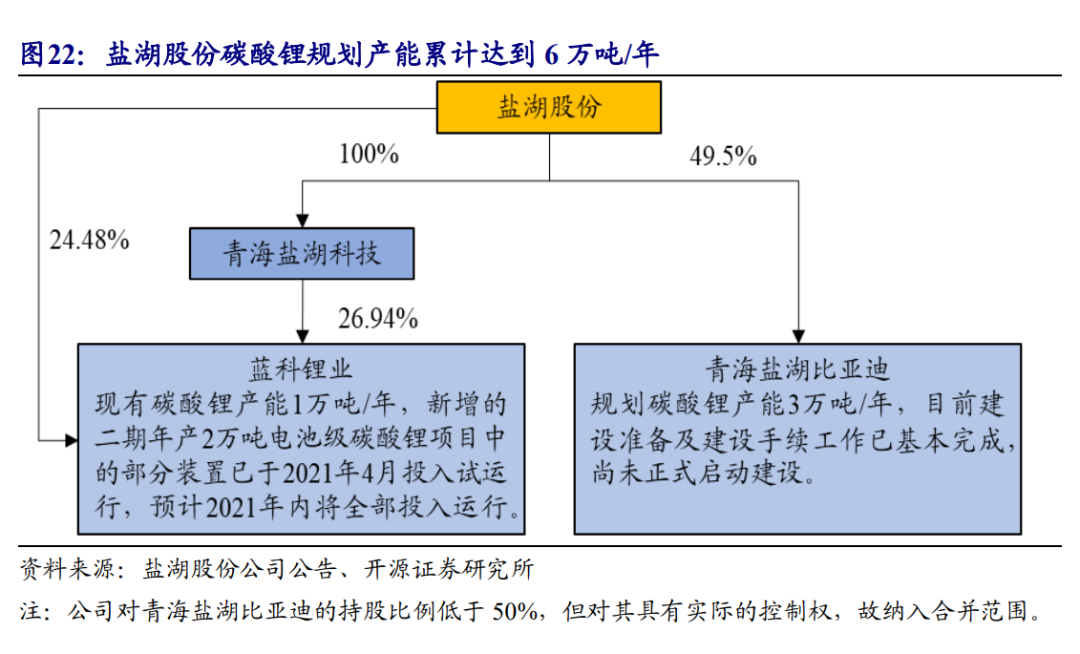
The company's main business is the development, production and sales of potash and lithium salts. In terms of potash fertilizer, the company is the largest producer of potassium chloride in China. The designed production capacity of potassium chloride has reached 5 million tons, with production and sales volume reaching 5.5175 million tons and 6.449 million tons respectively in 2020. In terms of lithium salts, the company, through its holding subsidiary Lanke Lithium Industry, has a capacity of 10,000 tons of lithium carbonate per year. The project uses the production of old brine emitted from potash fertilizer as raw material and uses adsorption to produce lithium carbonate. At the same time, part of Lanke Lithium Industry's new lithium carbonate project with an annual capacity of 20,000 tons was put into trial operation in April 2021 and is expected to be fully operational within 2021. In addition, the preparatory work for the project with an annual production capacity of 30,000 tons of lithium carbonate owned by Qinghai Salt Lake BYD (jointly established by the company and BYD) has been completed, and after it is completed and put into production, the company's lithium carbonate production capacity will reach 60,000 tons per year.
The cost advantage is significant, and there is still room for capacity expansion. According to the Investor Relations activity record Table released by the company on June 10, 2021, the full cost of producing industrial-grade lithium carbonate in Lanke Lithium Industry, a subsidiary of the company, is less than 34000 yuan / ton, compared with purchased lithium extraction from spodumene and mica. Its cost advantage is very significant. In addition, the company's potash plant production emissions of about 200 million cubic meters of old brine, according to the current Lanke lithium production of 1 ton industrial-grade lithium carbonate consumption of about 2000 cubic meters of lithium chloride in the 0.25-0.3g/l brine to estimate, the company's lithium carbonate production capacity of up to 100000 tons / year, so the company still has room for further expansion in the future.
5.6. Koda Manufacturing: strategic investment in Lanke Lithium Industry, capacity utilization far exceeds expectations
At the beginning of its establishment, the company is mainly engaged in building materials machinery and overseas building ceramics business, while expanding and strengthening the traditional main business, the company actively develops the secondary industry and enters the field of lithium electricity. In 2015, the company began to enter the field of anode materials for lithium batteries, carrying out R & D, production and sales activities of negative electrode products such as graphitized processing, artificial graphite, silicon-carbon composite and so on. Subsequently, in 2017, the company strategically participated in Lanke Lithium (so far indirectly held 48.58% of its equity), laid out lithium carbonate deep processing and trading business, and further extended the industrial chain.
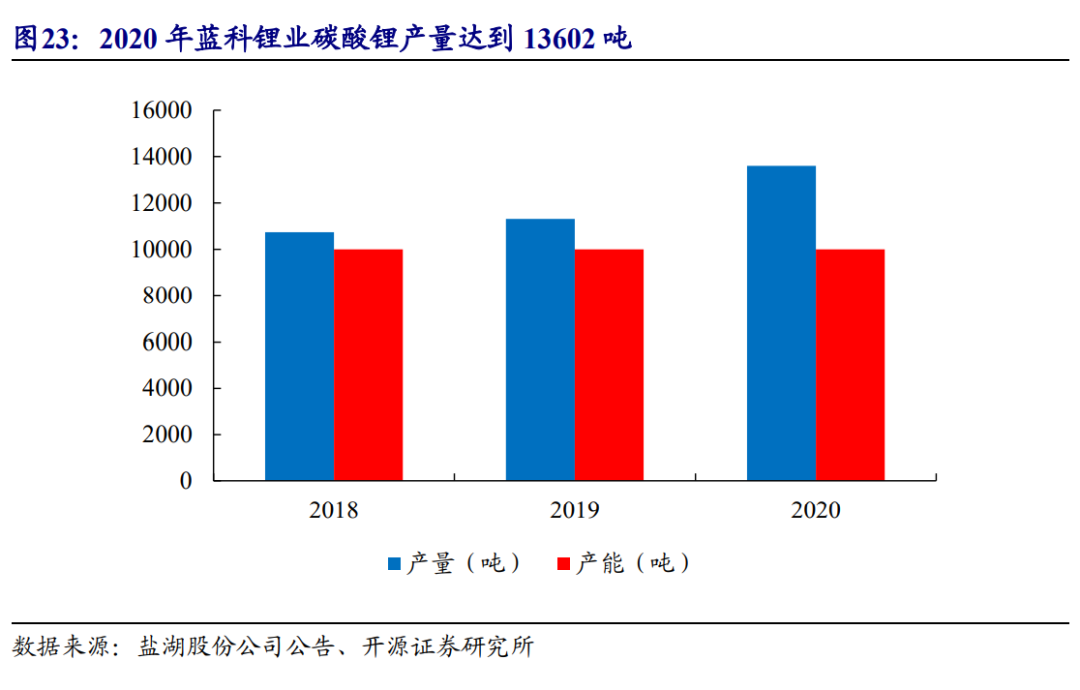
By the end of 2020, Lanke Lithium Industry has a capacity of 10, 000 tons of lithium carbonate. at present, its adsorption lithium extraction process has been fully verified, and the actual output has greatly exceeded the original design level (13602 tons in 2020). At the same time, part of the new second phase of the battery-grade lithium carbonate project with an annual capacity of 20,000 tons was put into trial operation in April 2021 and is expected to be fully operational within 2021. With the gradual production of the second phase of the project, we estimate that the output of lithium carbonate in Lanke lithium industry will reach 24000 tons, 30000 tons and 35000 tons respectively from 2021 to 2023.
5.7. Mount Qomolangma, Tibet: plan ahead and lay out the world's largest salt lake to be developed.
Previously, the company was mainly engaged in the mining and production activities of lead-zinc polymetallic mines, including lead concentrate (containing silver), zinc concentrate and copper concentrate (containing silver) and so on. In 2018, the company further expanded its business scope by acquiring a stake in Lithium100% and laying out the field of lithium resources.
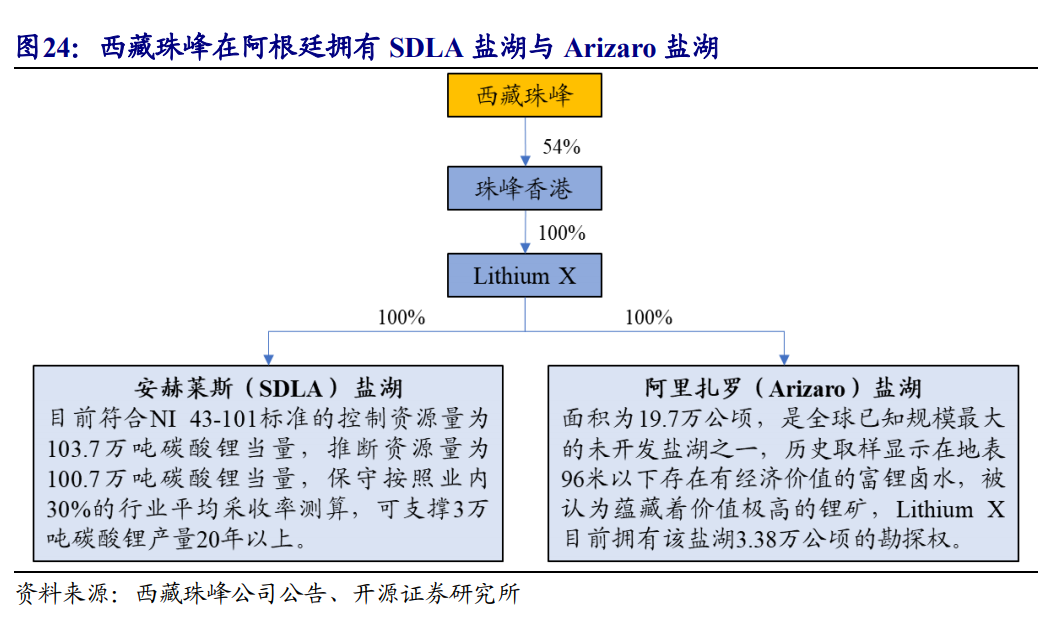
The company has two salt lakes in Argentina. Arizaro (Arizaro) Salt Lake is located in the lithium-rich "lithium triangle" area of South America, which is rich in lithium deposits, covering an area of 197000 hectares (Lithium has an exploration right of 33800 hectares). It is one of the largest known undeveloped salt lakes in the world. Historical samples show that there is economically valuable lithium-rich brine below 96 meters below the surface, which is considered to contain high-value lithium deposits. At present, the salt lake is still in the stage of exploration. In addition, Angeles (SDLA) Salt Lake is also very rich in resource reserves (a total of more than 2 million tons of LCE). At present, its lithium-rich brine project with an annual output of 2500 tons of LCE has reached production capacity, which can steadily produce 5.5% of the old brine products with a lithium concentration of 5.5% and sell some of the products to domestic customers. At the same time, SDLA Salt Lake's annual output of 25000 tons of LCE basic lithium salt product project has also completed the feasibility study report, is in the early preparatory stage, when it is completed, the company's lithium salt product capacity is expected to reach 27500 tons LCE.
6. Risk hint
Sales of new energy vehicles fell short of expectations, and new production capacity in the industry exceeded expectations.
![Analyse de la production de sulfure de lithium de qualité batterie en août : le quatrième trimestre connaîtra-t-il une hausse ? [Analyse SMM]](https://imgqn.smm.cn/usercenter/mpqgn20251217171727.jpg)