SHANGHAI, Jan 18 (SMM) – Operating rates at major aluminium processors decreased 0.2 percentage point last week. Aside from impact from non-market factors, such as gas restrictions, slower logistics, and environmental protection, orders began to decline. The decline in orders was more obvious from the construction sector, while orders from the automotive sector were relatively strong. Most processors will begin to close for Chinese New Year (CNY) from January 15-20. Therefore, operating rates will continue to decline this week.
Primary aluminium alloy: Orders were largely stable, but demand is beginning to weaken due to the arrival of the low season in the auto industry. Operating rates have shown a downward trend. Major producers may reduce production as their inventory has begun to increase. Most of the small aluminium wheel factories plan to close during CNY, while medium and large plants will begin to reduce output from this week, and this will drag down operating rates at primary aluminium alloy producers. Operating rates at aluminium wheel factories will not pick up significantly until March.
Aluminium plate and strip: Some producers controlled production and orders due to annual fiscal settlement, while others maintained full production and orders were fully booked until March. Worsening pandemic in north China has disrupted transport of raw materials and finished products, but has not affected production. Producers in south China were little affected. Operating rates at small and medium-sized producers in Henan were still low as orders flowed to large producers due to environmental protection and gas restrictions.
Aluminium wire and cable: Large producers remained stable production and will not close early for CNY as orders are scheduled to the end of January. Producers will produce extra products as the pandemic may affect production after CNY. Producers in Henan produced based on orders and have no plans to increase production as soaring natural gas prices have increased their costs. Operating rates in Jiangsu and Zhejiang are expected to remain stable before CNY, while those in the north may decline.
Aluminium extrusion: New orders at large construction extrusion companies decreased and their production schedules continued to shorten. Road blockage in north China due to worsening pandemic lowered orders at extrusion producers and drove some to reduce output slightly. Orders for industrial extrusion from photovoltaic, automobile and electronics sectors remained abundant. Volatile aluminium prices left extrusion producers hesitant about buying. It is expected that the overall operating rates will continue to drop this week as some small and medium-sized producers plan to close in late January for CNY.
Aluminium foil: Large-scale enterprises maintained stable production and will not close early for CNY as their orders are scheduled to the end of January. Producers will produce extra products as the pandemic may affect production after CNY. Producers in Henan produced based on orders and have no plans to increase production as soaring natural gas prices have increased their costs. Operating rates in Jiangsu and Zhejiang are expected to remain stable before CNY, while those in the north may decline.
Secondary aluminium alloy: Some companies have stop taking orders and are focusing on delivering orders instead as CNY is drawing near. Panic sell-off among aluminium scrap suppliers due to falling secondary aluminium prices eased shortage of raw materials for secondary aluminium producers to a certain extent, but supply remained tight in some areas. Some producers in the north cut or halted production as the pandemic and colder weather disrupted raw material transport. Producers showed little interest in stockpiling due to falling aluminium prices. Operating rates will remain stable or decline slightly in the short term.
Operating rates at major aluminium processors by region (updated on Jan 15)
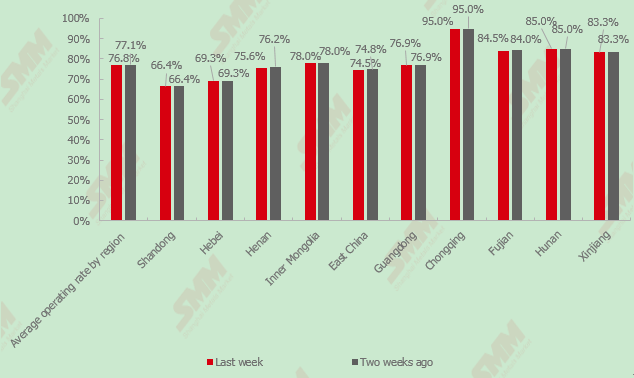
Source: SMM
For more information on the silicon metal and aluminium markets, please subscribe to China Aluminium Weekly.
![[ Analyse SMM ] Les stocks de fil d'aluminium connaissent une accumulation saisonnière après les fêtes, le centre des frais de transformation devrait progressivement augmenter](https://imgqn.smm.cn/usercenter/ifCaw20251217171652.jpg)