[SMM analysis] inventory transfer stainless steel to reverse?

Publié: Apr 01, 2020 21:21 (GMT+8)

SMM4, January 1:

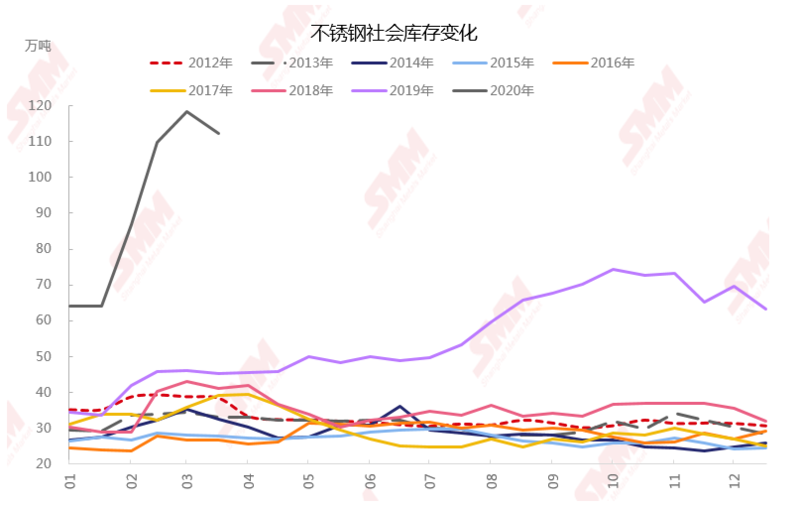
According to statistics, the social inventory of stainless steel at the end of March was slightly lower than that in February. The inventory in Foshan and Wuxi was about 1.123 million tons, down 61000 tons from the end of February, down 5.18 percent from the previous month.

On the one hand, the decline in inventory is mainly due to the price reduction of traders in March and the consumption of inventory; on the other hand, due to the large reduction in production of steel mills in February, the arrival of goods in March has decreased to a certain extent, superimposed on the certain consumption of social inventory by centralized procurement in the lower reaches of early March, resulting in a small decline in the social bank in March. However, with the gradual recovery of steel production and the non-continuous improvement in downstream demand, stainless steel stocks are expected to increase slightly in April.

Since mid-March, the rework rate of industrial enterprises above the national scale has increased rapidly, and the rework rate of other provinces (autonomous regions and municipalities) has exceeded 90%, of which Zhejiang, Jiangsu, Shanghai, Shandong, Guangxi and Chongqing have reached nearly 100%.

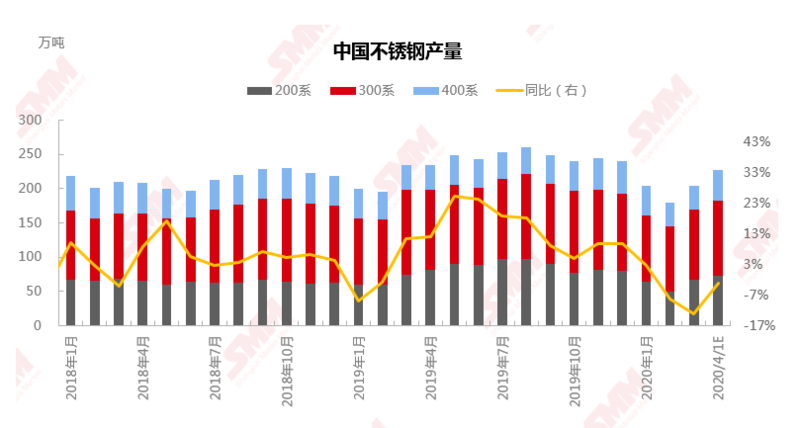
According to SMM, the output of stainless steel plants in March rebounded from February, totaling 2.04 million tons, an increase of 13.4 percent over the same period last year, but still decreased from the same period last year, down 12.98 percent from the same period last year.

With the control of the epidemic, the output of steel mills has gradually returned to normal, with stainless steel production expected to be about 2.27 million tons in April, an increase of 11.5 percent over March.

According to investigation and understanding, although the current domestic epidemic situation has been brought under control, the demand in the downstream market of stainless steel has not completely improved; and the spread of the overseas epidemic has affected the export orders of some enterprises (the export orders of existing metal products production enterprises in Foshan have been cancelled due to the epidemic), and the export demand for stainless steel has also shrunk to a certain extent. Production has gradually recovered, while demand has failed to keep pace with the increase in supply, and stainless steel is expected to improve or remain weak in April.


[for more information, please subscribe to SMM Nickel Research Group products "China Nickel Chromium stainless Steel Industry chain General report" and "China Nickel Chrome stainless Steel Industry chain High end report" to obtain the latest nickel mine, nickel pig iron (China + Indonesia), electrolytic nickel, nickel sulfate, chromium ore, ferrochromium, stainless steel (China + Indonesia) related data analysis and market analysis! For ordering and trial reading, please call 021-5166 6817 QQ: 2880505562, contact: Li Chuntian]

     
 (上海有 色 网  李春田 TEL:021-5166 6817 QQ :2880505562)

Déclaration sur la source des données : À l'exception des informations publiques, toutes les autres données sont traitées par SMM sur la base d'informations publiques, d'échanges avec le marché et en s'appuyant sur le modèle de base de données interne de SMM. Ils sont fournis à titre indicatif uniquement et ne constituent pas des recommandations décisionnelles.

Pour toute demande d'information ou pour en savoir plus, veuillez contacter : lemonzhao@smm.cn
Pour plus d'informations sur l'accès à nos rapports de recherche, veuillez contacter :service.en@smm.cn
Actualités Connexes
[SMM Analysis] Les réductions de NPI liées à l’eau d’IMIP face à une faible demande d’acier inoxydable
il y a 46 minutes
[SMM Analysis] Les réductions de NPI liées à l’eau d’IMIP face à une faible demande d’acier inoxydable
Lire la suite
[SMM Analysis] Les réductions de NPI liées à l’eau d’IMIP face à une faible demande d’acier inoxydable
[SMM Analysis] Les réductions de NPI liées à l’eau d’IMIP face à une faible demande d’acier inoxydable
Les usines RKEF de NPI d’IMIP ont commencé à réduire leur charge d’exploitation de 30 à 40 % en raison de pénuries d’eau. Des réductions prolongées pourraient diminuer la production cumulée de NPI de plus de 100 kt, soit plus de 11 kt de nickel à une teneur de 11 %. Parallèlement, la faiblesse de la demande devrait réduire la production chinoise d’acier inoxydable de série 300 d’octobre de plus de 100 kt. Les stocks élevés de NPI pourraient amortir l’impact initial, le soutien des prix dépendant de la durée de la perturbation et des achats en aval.
il y a 46 minutes
Données : évolution des marchés SHFE et DCE (23 septembre)
il y a 1 heure
Données : évolution des marchés SHFE et DCE (23 septembre)
Lire la suite
Données : évolution des marchés SHFE et DCE (23 septembre)
Le tableau suivant présente l'évolution des métaux ferreux et non ferreux sur le SHFE et le DCE au 23 septembre 2026.
il y a 1 heure
【SMM Info-éclair sur le nickel】Point sur le marché indonésien du nickel — 23 septembre 2026
il y a 2 heures
【SMM Info-éclair sur le nickel】Point sur le marché indonésien du nickel — 23 septembre 2026
Lire la suite
【SMM Info-éclair sur le nickel】Point sur le marché indonésien du nickel — 23 septembre 2026
Le marché indonésien du minerai de nickel est resté stable le 23 septembre, les évaluations SMM pour le minerai de nickel indonésien livré aux ports de destination étant inchangées pour toutes les principales teneurs : Ni 1,2 % : 26,5 $/t humide, inchangé. Ni 1,3 % : 28,5 $/t humide, inchangé. Ni 1,4 % : 51,8 $/t humide, inchangé. Ni 1,5 % : 58,5 $/t humide, inchangé. Ni 1,6 % : 63,4 $/t humide, inchangé. Sur le marché, les approbations RKAB supplémentaires pour 2026 entrent progressivement en vigueur, contribuant à atténuer la pénurie antérieure de minerai de nickel. Cependant, le quota supplémentaire total n'a pas encore été officiellement annoncé, et le rythme d'exécution des quotas demeure un facteur clé pour l'approvisionnement futur en minerai et la production des fonderies. Parallèlement, la sécheresse provoquée par El Niño est devenue une nouvelle préoccupation du côté de l'offre. IMIP a confirmé que les pénuries d'eau ont contraint certaines fonderies à réduire leur production de NPI, bien que les opérations n'aient pas été interrompues.
il y a 2 heures