[SMM exclusive] the amount of waste used at the processing end continues to decline, and the decline in copper consumption is difficult to change.

Publié: Jul 2, 2019 19:10
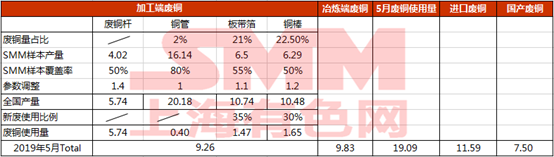
According to the SMM survey, the national scrap copper consumption of SMM in May was 190900 tons, an increase of 2100 tons, or 1.09 percentage points, from the previous month. Copper scrap flows to the processing end of 92600 tons, accounting for about 48.52%, to the smelting end of 98300 tons, accounting for about 51.48%. Among them, the consumption of imported scrap copper is 115900 tons, accounting for about 60.70%, and the consumption of domestic scrap copper is 75000 tons, accounting for about 39.30%.
News from SMM7 on the 2nd of June:

According to the SMM survey, the national scrap copper consumption of SMM in May was 190900 tons, an increase of 2100 tons, or 1.09 percentage points, from the previous month. Copper scrap flows to the processing end of 92600 tons, accounting for about 48.52%, to the smelting end of 98300 tons, accounting for about 51.48%. Among them, the consumption of imported scrap copper is 115900 tons, accounting for about 60.70%, and the consumption of domestic scrap copper is 75000 tons, accounting for about 39.30%.

In May, the total amount of waste used at the processing end was 92600 tons, a decrease of 14600 tons compared with the previous month. The average price difference for refined waste in May was 831 yuan per ton, a decrease of 257 yuan per ton compared with the previous month. In May, trade friction between China and the United States escalated again, and copper prices fell continuously, with the center of gravity falling from 49000 yuan per ton to 46000 yuan per ton, down nearly 3000 yuan. The price difference between fine and waste has also narrowed to less than a thousand yuan. Domestic scrap copper goods are sold sparingly, and the outflow of goods is reduced. On the other hand, the narrowing of refined copper price difference also makes scrap copper lose its price advantage compared with refined copper, which is manifested in the effect of refined copper extruding copper on the consumer side. In April, as the tax price gap narrowed to about 1,000 yuan, proficiency and scrap copper could not be replaced. Scrap copper in May provided some support for refined copper consumption, accelerating the seasonal removal of domestic stocks. The consumption of copper scrap rod accounts for more than 60% of the consumption of copper scrap processing end. In May, the starting rate of copper scrap rod making enterprises is only 54.44%, which is 12.54% lower than that of the previous month.

At the beginning of the year, due to the warming of the market, some scrap copper rod-making enterprises that stopped production last year due to environmental protection benefits and other problems resumed production. While the demand increased, the supply of domestic scrap copper was not abundant. Together, the two intensified the tense pattern of domestic scrap copper supply this year, resulting in high scrap copper prices this year, and traders' sentiment of cherishing sales at low prices is even more obvious. Whether early tax cuts or problems in China and the United States in May led to a drop in copper prices, the weakening of scrap copper consumption advantage has also put further pressure on this year's scrap copper rod makers.

As for the import of scrap copper, according to SMM statistics, in May 2019, China imported a total of 184952 tons of scrap copper, a decrease of 24.37 percent over the same period last year, with an average copper grade of 84.34 percent, equivalent to 155981 tons of metal, an increase of 31.76 percent over the same period last year. From January to May 2019, China imported 581558 scrap copper metals, an increase of 12.94 percent over the same period last year, to about 67000 metal tons. In April and May, due to the import effect, the import of scrap copper increased greatly, and it is expected that the amount of imported scrap copper can maintain a slight increase in the first half of the year before the implementation of the restrictive policy.

Starting from July 1, import of scrap copper requires approval before it can be imported. At present, the approval documents in Zhejiang and Anhui have been issued, and the quantity is basically the same as that of the six categories of imports scrapped in the same period last year. It is reported that the second batch of approvals will be released on July 10. It is expected that the amount of scrap copper and metal imported in the third quarter of last year will be basically the same as that of the six categories of scrap metal imported in the same period last year, with a decrease of only seven categories imported in the third quarter of last year, equivalent to about 60,000 tons of metal. In the case of a slight increase in imported scrap copper in the first half of the year, the supply of imported scrap copper remained basically stable in the third quarter. However, it has been reported that the number of approvals issued in the fourth quarter will be reduced.

As a result of the turnaround in Sino-US trade, the price of copper in Shanghai has rebounded sharply, and the gap between refined and scrap prices has also widened to more than 1,000 yuan. However, due to the decline in early prices too much, scrap copper traders still show the sentiment to cherish the sale, scrap copper prices of the small rise in the market is not obvious, scrap copper market is still weak supply and demand.

(SMM Wei Xue)
 

Déclaration sur la source des données : À l'exception des informations publiques, toutes les autres données sont traitées par SMM sur la base d'informations publiques, d'échanges avec le marché et en s'appuyant sur le modèle de base de données interne de SMM. Ils sont fournis à titre indicatif uniquement et ne constituent pas des recommandations décisionnelles.

Pour toute demande d'information ou pour en savoir plus, veuillez contacter : lemonzhao@smm.cn
Pour plus d'informations sur l'accès à nos rapports de recherche, veuillez contacter :service.en@smm.cn
Actualités Connexes
L'Inde et la Russie envisagent un partenariat élargi dans les mines et les minéraux critiques
il y a 2 heures
L'Inde et la Russie envisagent un partenariat élargi dans les mines et les minéraux critiques
Lire la suite
L'Inde et la Russie envisagent un partenariat élargi dans les mines et les minéraux critiques
New Delhi et Moscou cherchent à élargir leur coopération, de l'exploration minière aux matériaux avancés.
il y a 2 heures
Données : évolution des marchés SHFE et DCE (9 septembre)
il y a 5 heures
Données : évolution des marchés SHFE et DCE (9 septembre)
Lire la suite
Données : évolution des marchés SHFE et DCE (9 septembre)
Le tableau suivant présente l'évolution des métaux ferreux et non ferreux sur le SHFE et le DCE au 9 septembre 2026.
il y a 5 heures
Cobre sécurise un approvisionnement en minerai tiers pour ajouter 300 t/mois de cathode de cuivre à Sierra Atacama
il y a 5 heures
Cobre sécurise un approvisionnement en minerai tiers pour ajouter 300 t/mois de cathode de cuivre à Sierra Atacama
Lire la suite
Cobre sécurise un approvisionnement en minerai tiers pour ajouter 300 t/mois de cathode de cuivre à Sierra Atacama
Cobre Limited a annoncé le 9 septembre que son opération Sierra Atacama au Chili a signé des accords d'achat de minerai avec deux producteurs tiers de minerai d'oxyde de cuivre dans la région d'Antofagasta, les livraisons devant monter en puissance à partir du quatrième trimestre 2026. Ces accords devraient fournir environ 50 000 à 75 000 tonnes de minerai oxydé par mois, titrant 1,0 à 1,5 % de cuivre total, soit un ajout d'environ 300 tonnes par mois de production de cathodes de cuivre. La production supplémentaire sera traitée par l'usine SX-EW existante de Sierra Atacama, dont la capacité installée de cathodes de cuivre est d'environ 20 000 tonnes par an et qui fonctionne actuellement en dessous de sa capacité nominale. Le minerai acheté ne nécessitant pas de coûts d'extraction et de développement propres à Cobre, la société a indiqué que les coûts supplémentaires comprendront principalement le prix d'achat du minerai et les coûts de traitement variables, notamment l'acide, l'électricité et les réactifs. Un débit plus élevé devrait également permettre de répartir les coûts fixes de l'usine sur une base de production plus large. Les quelque 300 tonnes par mois de cathodes supplémentaires s'ajouteront aux objectifs de production précédemment annoncés par Cobre, qui restent inchangés. La société continue de stabiliser la production souterraine tout en se préparant à une transition vers une exploitation à ciel ouvert de plus grande envergure à partir de 2027. Cobre a indiqué que des négociations avec d'autres fournisseurs régionaux de minerai sont également en cours, ce qui pourrait fournir une alimentation supplémentaire à l'usine SX-EW sous-utilisée. Ces accords représentent une augmentation à court terme de l'offre de cathodes de cuivre de Sierra Atacama sans nécessiter de développement minier supplémentaire ni de nouvelles capacités de traitement. Au rythme initial prévu, l'alimentation par des tiers pourrait contribuer à environ 3 600 tonnes de cathodes supplémentaires en rythme annualisé. Plus important encore, cela devrait accroître l'utilisation de l'usine SX-EW existante avant la transition prévue par Cobre vers une production à ciel ouvert élargie en 2027. D'autres accords d'approvisionnement en minerai offriraient un potentiel supplémentaire d'augmentation de l'utilisation de l'usine et de la production de cathodes.
il y a 5 heures