At a press conference held by the Ministry of Commerce on July 12, Gao Feng, a spokesman for the Ministry of Commerce, first took the initiative to inform you of two pieces of information, the first on the absorption of foreign capital throughout the country in the first half of this year. This paper summarizes the four characteristics of foreign capital absorption in China from January to June 2018. The second piece of information is about the 2017 China Shopping Center Development Index report and the China convenience Store Prosperity Index report. At the next peak, more than a dozen questions about Sino-US economic and trade frictions were answered one after another. Gao Feng stressed: China firmly opposes the US trade hegemonism and will have to fight back as necessary to safeguard the interests of the country and the people and defend the global free trade and multilateral system.
In response to the question of whether the scale of the Sino-US trade war will be further expanded, Gao Feng pointed out that this is entirely up to the US side. With regard to trade wars, China's attitude is clear and consistent, and we are unwilling to fight, are not afraid to fight, and have to fight if necessary. This is a matter of principle of multilateral versus unilateral and open to protection, and China has no other choice. Escalating the trade war will not only solve no problems, but also have a lot of secondary effects.
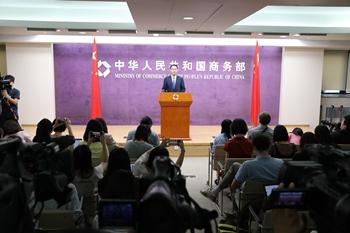
On July 12, the Ministry of Commerce held a regular press conference, and the spokesman, Gao Feng, answered reporters' questions.
SMM made the following arrangements for answering reporters' questions at the peak scene:
The so-called "theft of intellectual property" in the United States blames historical facts
Q: the US side accuses China of stealing intellectual property rights and forcing technology transfer. what is your comment on this?
A: the accusations made by the United States for so-called "compulsory technology transfer" and "theft of intellectual property rights" ignore historical facts and are totally unacceptable. Since the reform and opening up, the combination of China's low-cost labor force with international capital and technology has promoted the rapid growth of China's economy, promoted the prosperity of the world economy, and created rich returns for foreign enterprises. This kind of cooperation is entirely the voluntary behavior of Chinese and foreign enterprises based on the commercial contract. After so many years and huge profits made by foreign-funded enterprises in China, accusing China of compulsory technology transfer and theft of intellectual property rights is not only a distortion of China's reform and opening up and historical facts, but also a destruction of commercial credit. It's a violation of the spirit of the contract. We believe that this approach is very dangerous and will shake the institutional basis of a market economy and free enterprise.
Any country has the right to promote development through the implementation of appropriate industrial policies
Q: in the statement of the Office of the US Trade Representative, I accused China's industrial policy of causing market distortion. what is the comment of the Ministry of Commerce on this?
A: the accusations made by the US side are simply untenable. Any country has the right to development and the right to promote development through the implementation of appropriate industrial policies. Historically, Hamilton, the first Treasury secretary of the United States, was an early advocate of industrial policy. in the 1950s and 1960s, the United States implemented industrial revitalization plans in aerospace, military industry, and other fields, and achieved good results. In the context of economic globalization and accelerated technological progress, we oppose differentiated and protective industrial policies, and what is more needed is a development policy in line with reality, with greater emphasis on future forecasting, open cooperation, promotion of competition, quality of education, and so on.
Are there any consultation arrangements between China and the United States? Will the trade war between the United States and the United States expand further?
Q: after the two sides introduced tax increases, are there any consultations between China and the United States? Are there any arrangements for consultation in the next step? Now that the United States has drawn up a new list, does it mean that the Sino-US trade war will be further expanded? It is also reported that Tesla has reached an agreement with Shanghai to build a factory in Shanghai. what are your comments and expectations?
A: China has made it clear on many occasions that the premise of the consultations is credit. As far as I know, there has been no contact between the two sides on the resumption of negotiations.
The question of whether the scale of the Sino-US trade war will be further expanded depends entirely on the US side. With regard to trade wars, China's attitude is clear and consistent, and we are unwilling to fight, are not afraid to fight, and have to fight if necessary. This is a matter of principle of multilateral versus unilateral and open to protection, and China has no other choice. Escalating the trade war will not only solve no problems, but also have a lot of secondary effects. China notes that many experts and scholars, high-end think tanks, multinational enterprises and industry organizations around the world have recently expressed concern about the trade war waged by the US side and its huge negative externalities.
On the issue of Tesla building a factory, China welcomes Tesla's investment in setting up a factory in China. This is not only the achievement of China's initiative to open wider to the outside world, but also the concrete embodiment of mutually beneficial and win-win economic and trade cooperation between China and the United States. We will continue to improve the domestic investment environment, attract more outstanding foreign enterprises to come to China, and achieve common development in the opportunities for China's development.
The United States publishes a list of $200 billion in taxes. how can China counter that?
Q: the United States has announced a list of tariff increases on 200 billion of China's value products. how does China intend to counter this? What measures does China intend to take? Does China hope to have a new round of trade talks with the United States?
A: the US side has taken such an approach to accelerate the escalation of the trade war, which is of serious concern to the international community. The actions of the United States are leading the global economy into a "trap of uncertainty," which, if eventually implemented, will affect more innocent businesses and consumers and have a huge impact and even a recessionary impact on the world economy. China firmly opposes the US trade hegemonism and will have to fight back as necessary to safeguard the interests of the country and the people and the global free trade and multilateral system.
It is the right policy choice not to fight a trade war and to maintain the security of the global industrial chain and value chain.
Q: it has been reported that the United States will give US companies importing Chinese goods 90 days to apply for exemption from tariffs, which is good news for US companies affected by the trade war, but still imposes strict tariffs on other companies. How does the Commerce Department comment on this behavior? Do you think this is a very clear signal against China?
A: this is the domestic policy and procedure of the US side. Provoking a trade war in the context of economic globalization will inevitably create a "instability trap" for the global industrial chain and value chain, and will not only cause losses to other countries. At the same time, it will inevitably harm the interests of domestic enterprises and ordinary consumers. It is the right policy choice not to fight a trade war and to maintain the security of the global industrial chain and value chain.
Is there no justification for China's counter-measures? It's all "thief shouting to catch thief" robber logic.
Q: in his statement, US Trade Representative Leitzer said that there is no international law basis or justification for China to impose tariff countermeasures on US products. how will China respond?
A: this is entirely the robber logic of "thieves shouting to catch thieves." In the first place, the US side violates WTO rules and unilaterally imposes tariff measures in accordance with its domestic law. it is a typical act of unilateralism and trade protectionism, and there is no legitimate international legal basis in itself. In order to safeguard national and people's interests and safeguard free trade and the multilateral trading system, China has had to take the necessary countermeasures and institute proceedings at the WTO, which is fully in line with the principles of international law. Instead of trampling on the multilateral trading system, the US side accuses China of being forced to take legitimate defense, which is self-evident and self-evident.
Will trade friction between China and the United States lead to a further decline in Chinese exports to the United States?
Q: the growth rate of China's exports to the United States in the first half of the year was 13.9 percentage points lower than that in the same period last year, and in June it dropped by 23.8 percentage points. what does the Ministry of Commerce think of this phenomenon?. Whether the trade friction between China and the United States is the main reason for the sharp decline in export growth. Even if export growth slows, China's trade surplus with the United States remains relatively high. what do you think of this? And with regard to the trade situation in the second half of the year, will Sino-US trade frictions lead to a further decline in China's exports to the United States?
A: with the continuous adjustment of China's economic structure, China's foreign current account trade surplus as a share of GDP has fallen sharply, from 9.9 per cent in 2007 to 1.4 per cent in 2017, but at the same time, The trade surplus between China and the United States is still large, so it can be seen that the reasons for this reverse contrast need to be found in the United States itself.
The long-term implementation of the export control policy of the United States, the low domestic savings rate, the tax system that is not conducive to exports and the status of the reserve currency of the United States dollar, and so on, make the United States inevitably have a large-scale foreign trade deficit. It is totally wrong for the United States to violate this basic economic law and blame China for unwarranted charges. The US side has provoked and continuously escalated trade wars, which has brought serious challenges to bilateral economic and trade cooperation, and it is estimated that the impact will gradually emerge in the second half of the year.
We will vigorously promote the diversification of trade, strive to open up third-party markets, and properly respond to them. At the same time, the Chinese government will continue to ask about the market and take more targeted measures.
Is there a risk of transfer and withdrawal of foreign-funded enterprises after taxation?
Q: nearly six of the nearly six Chengdu on the US 34 billion tariff list involve foreign-funded enterprises in China. is there a risk that foreign-funded enterprises will choose to transfer and withdraw to other countries after the tax is levied, and how will China deal with it?. Will it affect China's position in global value chains?
A: the US tax measures will indeed have an impact on foreign-funded enterprises in China, including US-funded enterprises. we also deeply regret this. we hope that US-funded enterprises will do more of the work of the US Government and strive to safeguard their own interests. China has a stable investment environment, strong industrial supporting capacity, great potential, is upgrading and constantly opening up the consumer market. Recently, as far as I know, foreign companies such as General Electric, Ford, BMW and Tesla have further expanded their production capacity, scale and investment in China. We will continue to improve the business environment, protect the legitimate rights and interests of foreign-funded enterprises in China, and make China continue to be the preferred place for foreign enterprises to invest.
What measures will China take to help enterprises reduce their losses?
Q: at present, the Sino-US trade dispute has entered a new stage. the US side has announced in the form of accelerated upgrading a tariff list to be imposed on China's US $200 billion exports to the United States. on the other hand, it has issued a bill restricting Chinese enterprises' investment in the United States. At the same time, it hinders the normal selection process of the WTO appellate body. under this external pressure, what measures will China take to help enterprises reduce their losses?
A: with regard to the measures that the US side has taken and may take, we will continue to assess the impact on enterprises and take targeted measures in the light of the situation. For example, enterprises are encouraged to adjust the import structure, open up emerging markets externally, tap consumption potential domestically, and, in particular, in accordance with the needs of the people and the requirements of high-quality development, promote enterprise challenges as opportunities and actively transform and upgrade. Adjust the industrial structure, market structure, investment structure, support enterprises to carry out vocational training. In short, there are more ways than difficulties.
What is the significance of Chicago Mayor leading an economic and trade delegation to China?
Q: the mayor of Chicago has led an economic and trade delegation to China in the past two days. what is the significance of this visit against the backdrop of escalating trade between China and the United States?
A: to celebrate the fifth anniversary of the establishment of the Joint working Group on Trade and Investment Cooperation between Chinese cities and Chicago, Mayor Emanuel of Chicago led a large economic and trade delegation to China from July 9 to 12, with more than 50 entrepreneurs on the delegation. Chicago and eight Chinese cities have signed the "five-year key Industrial Cooperation Plan for 2018-2023," the first five-year economic cooperation plan signed between the local governments of China and the United States. It has drawn up a blueprint for Chicago to expand economic and trade exchanges with China and deepen mutually beneficial cooperation between the two sides.
In recent years, Chicago has attached importance to the development of economic and trade relations with China. In trade, China has become the largest trading partner in the Chicago customs area since 2010. In terms of investment, Chicago has become a bridgehead for Chinese companies to invest in the United States. Vientiane Group, Bank of China, Lenovo Group and other more than 60 Chinese enterprises have settled in the Chicago area, operating in good condition.
In the United States, there are a large number of states and cities like Chicago that are willing to actively expand economic and trade cooperation with China. In recent years, the Ministry of Commerce, together with 25 provinces and cities in China and 7 states and cities in the United States, has established a joint working group mechanism on trade and investment cooperation between China and the United States. The economic and trade cooperation between China and the United States has become an important basis for Sino-US economic and trade relations.
Since its accession to the WTO, China has always complied with WTO rules
Q: on July 11, Geneva time, the WTO began a routine trade policy review of China. at this review, some member States said that China has a tendency towards mercantilism and has such criticism. How does the Commerce Department respond to this?
A: I hope that individual members will not wear colored glasses to see China, let alone use outdated thinking to label China indiscriminately. Since its accession to the WTO, China has always complied with WTO rules and fulfilled the obligations of a responsible member. We will continue to adhere to the decisive role of the market in the allocation of resources, deepen reform, open wider to the outside world, and strive to promote mutual benefit and common development with WTO members.
What actions does China have to further expand its consumption?
Q: the third meeting of the Central Committee for Comprehensive deepening Reform, held on Friday, adopted the "A number of opinions on improving the Mechanism of promoting consumption system and further stimulating the consumption potential of residents." Will the Business Department speed up its actions in the next step in promoting consumption? Some voices believe that China is expected to become the world's number one consumer market this year, which may defuse the impact of the Sino-US trade war. what does the spokesman think of this statement? What will be the role or actions in further expanding consumption?
A: China has a huge consumer market of nearly 1.4 billion people, and the people's demand for a better life is constantly rising. In 2017, China's consumer spending contributed 58.8% to national economic growth, reaching 77.8% in the first quarter of this year. Promoting and expanding consumption has always been one of the important contents of our work. No matter how the economic and trade relations between China and the United States change, we will actively and steadily promote the work of promoting consumption in accordance with the established goals and rhythms.
In the next step, in accordance with the requirements of high-quality development and in line with the new trend of residents' consumption, we will work hard from both ends of supply and demand to do the following work well:
The first is to promote convenient consumption in urban and rural areas. For example, we will actively promote the "15-minute community service circle" construction;
The second is to increase the supply of high-end. Focus on promoting the construction of high-grade pedestrian streets and the cultivation of international consumer cities, while actively expanding imports, making full use of China International Import Expo and other platforms to enrich the domestic supply of goods and services;
Third, improve the supply chain. Promote the pilot demonstration of modern supply chain and the construction of efficient logistics distribution system in an all-round way;
Fourth, create a safe and secure consumption environment. For example, we will continue to promote the construction of traceability systems for important products such as edible agricultural products and food, and actively promote the construction of a business integrity system.
![Les métaux précieux restent dans une fourchette alors que la macroéconomie entre dans une fenêtre de validation clé [Analyse macroéconomique des métaux précieux SMM]](https://imgqn.smm.cn/usercenter/yhuhG20251217171735.jpg)