SMM7, 6 Feb: the rise in the US dollar earlier last week was mainly due to increased global trade tensions and the development of the European political situation. commodity currencies such as the New Zealand dollar and the Australian dollar weakened sharply, and investors bought the US dollar as a safe haven. In addition, the improvement in the US data also provides support for the dollar. The dollar index rose as high as 95.14 last week, not far from an 11-month high of 95.53, but the final shock weakened, hitting a three-week low around 93.90 to close at 94.00, down 0.52 percent from last week. For the worst performance in four weeks.
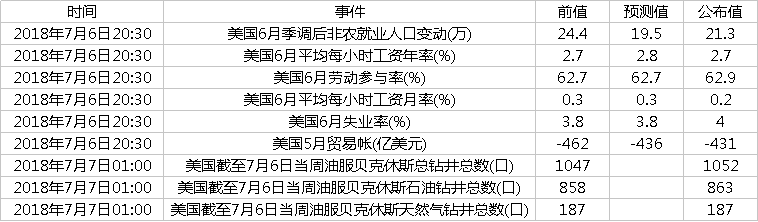
U.S. nonfarm payrolls rose 213000 to 195000 in June from a previous 223000 to 244000, compared with 175000 in April from 159000 in April, according to U.S. non-farm data released on Friday. As a result of the revision, the average number of non-farm payrolls in the United States over the past three months was 211000. Non-farm payrolls in the United States have increased by 2.4 million over the past 12 months.
The rest of the data show that the unemployment rate in the United States was 4% in June, expected to be 3.8%, and the previous value was 3.8%. The labor force participation rate in the United States was 62.9 per cent in June and is expected to be 62.7 per cent, compared with a previous value of 62.7 per cent.
The average hourly wage in the United States in June was 0.2 per cent, expected to be 0.3 per cent and the previous value was 0.3 per cent. The average hourly wage in the United States in June was 2.7 per cent compared with the same period a year earlier, with an expected rate of 2.8 per cent and a previous value of 2.7 per cent. The United States worked an average of 34.5 hours a week in June and is expected to work 34.5 hours, compared with 34.5 hours previously.
Although the US non-farm payrolls data again exceeded expectations in June, the hourly wage growth rate in June fell short of expectations and previous levels, which was disappointing.
Employment growth in the United States was strong in June as manufacturers stepped up hiring. As more people entered the labour market with confidence in the job market, the unemployment rate rebounded to 4 per cent in June, slightly higher than the 18-year low of 3.8 per cent set last month. Modest wage growth should allay concerns about strong inflationary pressures. Average hourly wages in the US rose 0.2 per cent in June from a month earlier, with steady wage growth pointing to moderate inflationary pressures, suggesting that the Fed will continue to raise interest rates gradually. The Fed raised interest rates for the second time this year in June and is expected to raise them twice by the end of the year, and the minutes of the Fed's June meeting, released on Thursday, provide an optimistic assessment of the labor market.
In addition, US trade account data showed that the US trade account for May was-$43.1 billion, with a deficit of a year and a half low, with a forecast of-$43.7 billion, and the previous value of-$46.2 billion was revised to-$46.1 billion.
The US trade deficit fell to a year-and-a-half low in May as exports rose to record highs, boosted by growth in soyabean and commercial aircraft exports. The trade deficit narrowed 6.6 per cent to $43.1 billion in May from the previous month, the lowest since October 2016. The narrowing of the trade deficit suggests that trade could contribute positively to GDP growth in the second quarter. However, trade tensions between the US and countries such as China, the European Union and Mexico could overshadow the outlook for trade for the rest of the year. The US trade deficit with China rose 18.7 per cent to $33.2 billion in May, while the US trade deficit with Mexico also rose 18.8 per cent.
The number of oil wells in the United States increased by five to 863 in the week to July 6, according to the Baker Hughes Weekly, which was released on Saturday. The number of natural gas wells in the United States remained unchanged at 187 in the week to July 6, while the total number of wells increased by 5 to 1052.
Important overnight financial data are shown in the following table: