Las exportaciones de magnesio alcanzaron su máximo en marzo, impulsadas por el acopio en el extranjero y la resonancia de envíos posvacacionales
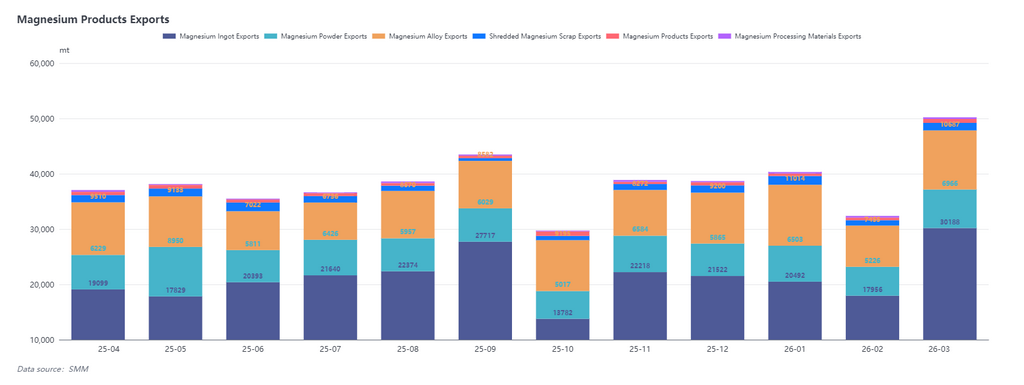
En marzo de 2026, las exportaciones de productos de magnesio de China alcanzaron 50.200 t, un 55% más intermensual y un 21% más interanual, alcanzando un máximo reciente de exportación. Los datos históricos muestran que los picos de exportación en 2022 y 2024 también ocurrieron en marzo, con volúmenes de exportación en gran medida comparables a los de marzo de 2026. En contraste, el desempeño exportador general en 2025 fue débil, con una caída del 6,24% interanual. Afectadas por cambios en la política arancelaria y la crisis energética europea, las exportaciones se mantuvieron débiles en el primer semestre de 2025; septiembre se convirtió en el mes pico relativo de ese año debido al efecto de anticipación de envíos ante el endurecimiento de las políticas de exportación.
Hubo dos razones principales para el fuerte aumento de las exportaciones en marzo de este año: primero, los precios del magnesio estaban en niveles bajos en diciembre de 2025, lo que llevó a las empresas downstream fuera de China a aprovechar la oportunidad para realizar pedidos y acopiar, coincidiendo con el período de adquisiciones del primer trimestre; segundo, debido a las vacaciones del Año Nuevo Chino, los clientes extranjeros concentraron sus pedidos antes de principios de febrero, mientras que un gran número de pedidos retrasados por las vacaciones se enviaron en masa en marzo, impulsando conjuntamente el volumen de exportación del mes.
El lingote de magnesio lideró las ganancias, la aleación de magnesio creció de forma constante y la recuperación del polvo de magnesio impulsó las exportaciones de marzo
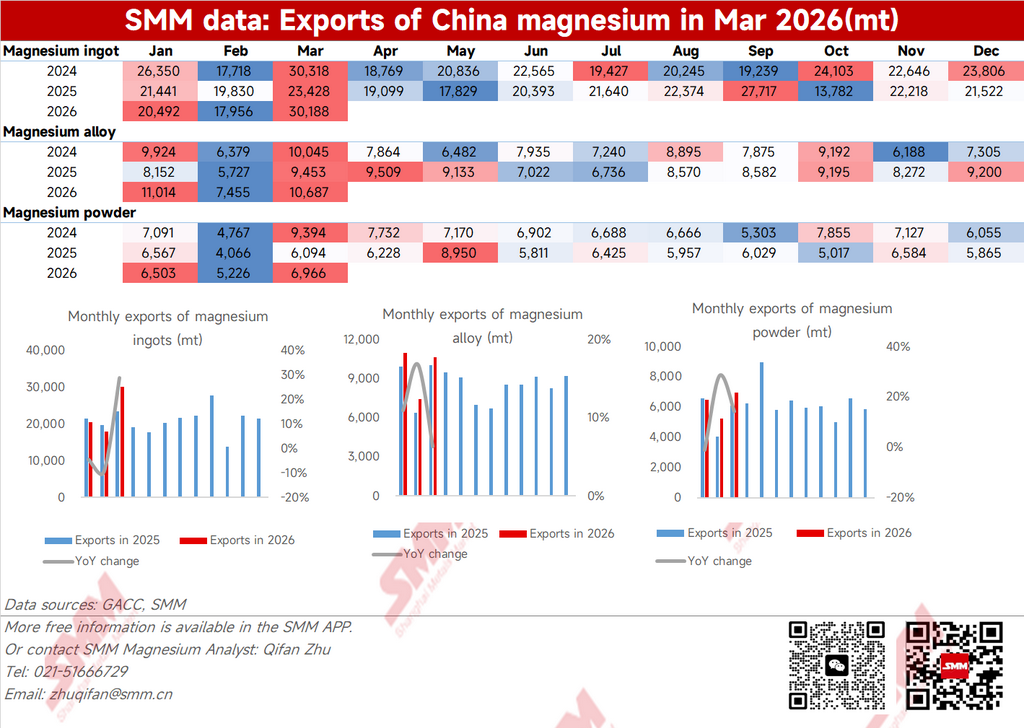
Por producto, las exportaciones de lingote de magnesio alcanzaron un máximo cercano a un año en marzo, mientras que la aleación de magnesio mantuvo una tendencia de crecimiento constante.
En marzo de 2026, las exportaciones de lingote de magnesio alcanzaron 30.200 t, un 68,12% más intermensual, con un crecimiento acumulado interanual del 6,08%. En cuanto a precios, los precios de exportación del lingote de magnesio se mantuvieron generalmente estables con una ligera tendencia alcista de febrero a marzo, subiendo solo hacia finales de mes debido al sentimiento de las fábricas de mantener precios firmes y contener las ventas. El entorno de precios estables proporcionó condiciones favorables para la colocación de pedidos de exportación y el acopio por parte de los comerciantes. Además, algunas licitaciones de pedidos se publicaron a principios de febrero, y combinado con las expectativas de los comerciantes sobre fluctuaciones en las tarifas de flete marítimo, algunos espacios de envío a principios de marzo se reservaron con antelación, impulsando envíos concentrados de lingote de magnesio en la primera decena de marzo.
En marzo de 2026, las exportaciones de polvo de magnesio totalizaron 6.966 t, un 33,3% más intermensual, con un crecimiento acumulado interanual del 11,77%. Desde principios de 2026, los pedidos de exportación de polvo de magnesio se han recuperado gradualmente, con una demanda mensual liberándose de forma constante. Las empresas de polvo de magnesio compraron materias primas principalmente según necesidad y mantuvieron un ritmo estable de producción y envío. Los pedidos enviados en marzo incluyeron algunos contratos firmados en el cuarto trimestre de 2025 y principios de este año.
En marzo de 2026, las exportaciones de aleación de magnesio totalizaron 10.700 t, un 43,35% más intermensual, con un crecimiento acumulado interanual del 24,96%. Desde principios de este año, los pedidos de exportación de aleación de magnesio han tenido un buen desempeño. Según una encuesta de SMM, los pedidos de exportación de aleación de magnesio se han programado de forma constante hasta abril de este año. La demanda de aleación de magnesio del mercado automotriz extranjero crece de manera constante, con múltiples tecnologías de fundición a presión y conformado entrando gradualmente en producción en masa, impulsando la demanda incremental de aleación de magnesio tanto fuera como dentro de China simultáneamente.
Liberación concentrada de demanda desde Europa y Japón, Canadá lidera las exportaciones de aleación de magnesio
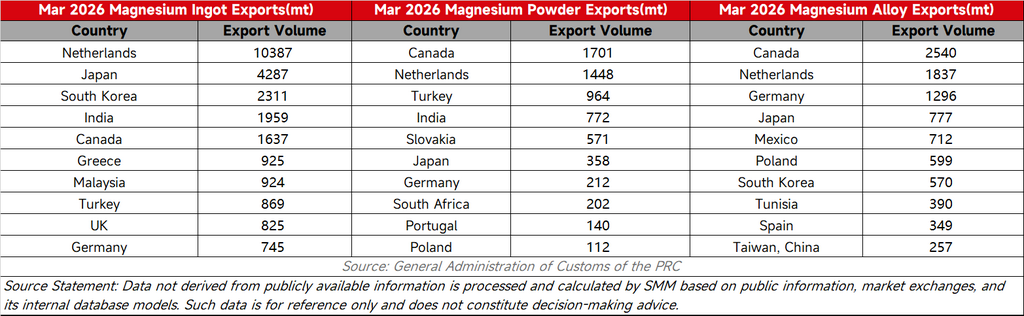
Por destino de exportación, en marzo de 2026, las exportaciones de lingote de magnesio de China a los Países Bajos alcanzaron 10.400 t, representando el 34%. La demanda general en Europa aumentó significativamente, impulsada por dos factores: primero, los pedidos de licitación del período anterior se colocaron en masa en febrero; segundo, las expectativas de aumento en las tarifas de flete marítimo llevaron a que un gran volumen de pedidos se enviara en marzo. Además, las exportaciones de lingote de magnesio a Japón en marzo totalizaron 4.287 t, un 234% más intermensual, principalmente porque el endurecimiento de las políticas de exportación hacia Japón provocó acopio por pánico entre las empresas downstream, adelantando la demanda y llevando las exportaciones mensuales a un máximo.
En cuanto al polvo de magnesio y la aleación de magnesio, Canadá se ha convertido en un destino de exportación importante. Desde 2026, las exportaciones de aleación de magnesio de China a Canadá han seguido aumentando gradualmente, superando a Europa. Este cambio fue impulsado principalmente por la creciente demanda de los sectores automotriz y aeroespacial en el mercado norteamericano, impulsando la liberación de pedidos de aleación de magnesio.
Perspectiva del mercado: exportaciones sólidas pero con preocupaciones persistentes — la tendencia del segundo trimestre está por verse
De cara al segundo trimestre, los altos niveles de exportación en marzo emitieron una señal positiva, indicando que la demanda general fuera de China se está recuperando este año. Los principales mercados como Europa y Norteamérica han salido gradualmente del período de amortiguación de 2025, con una demanda de consumo recuperándose de forma constante. Sin embargo, queda por ver si esta tendencia de crecimiento puede sostenerse. Históricamente, tras los envíos concentrados en marzo, las exportaciones suelen retroceder notablemente en abril y mayo. Además, la escalada de conflictos geopolíticos desde marzo de 2026 ha introducido incertidumbres en los pedidos de exportación, y su impacto en la industria del aluminio y los mercados energéticos podría manifestarse con retraso en el segundo trimestre. Si las exportaciones en 2026 pueden mantener el impulso positivo aún depende del ritmo de liberación de nuevos pedidos fuera de China, las fluctuaciones en el mercado de flete marítimo y los ajustes posteriores a las políticas de exportación de China.