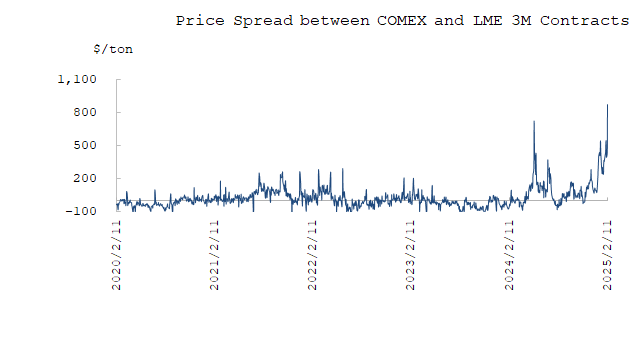
Between January 2 and February 11, 2025, LME and SHFE copper prices recorded two-week gains of approximately 6.31% and 5.28%, respectively. However, the standout performer was the COMEX copper futures contract, which surged by an impressive 15.26%, significantly outperforming both the SHFE main contract and LME 3M copper. For the first time since May 2024, the price spread between COMEX and LME 3M contracts has widened again, reaching nearly $950/ton intraday on February 11, 2025. Unlike the short-lived short squeeze in 2024, this time, the spread window has remained open for a longer period and with greater volatility. Below is a detailed analysis of the factors driving this phenomenon.
Stockpiles Indicate No Short Squeeze in COMEX-LME Spread Expansion
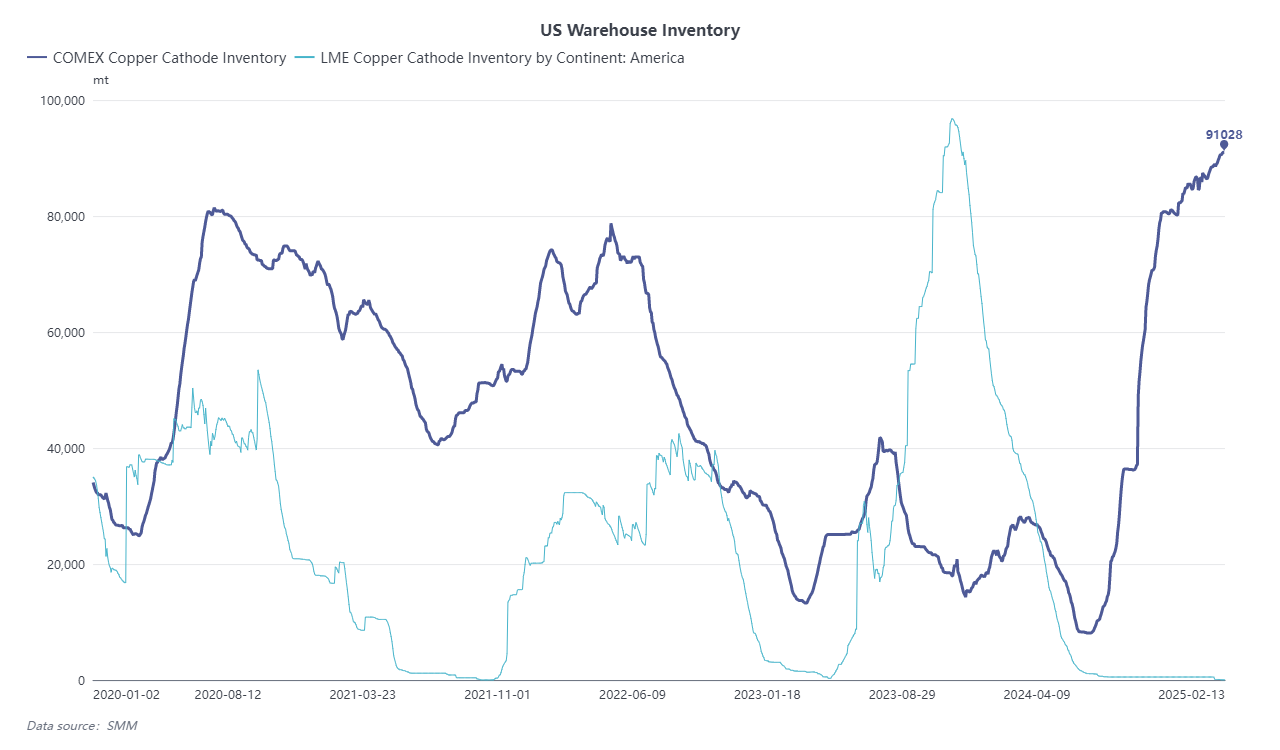
The widening spread between COMEX and LME this time is not the result of a short squeeze. Since May 2024, COMEX copper inventories have been on a steady rise, currently approaching 90,000 tons, a six-year high. The primary driver behind this trend has been the escalating uncertainty surrounding U.S. trade policy since January 2025.
The Trump administration has repeatedly adjusted tariffs, targeting Mexico, Canada, China, and Europe with actual or threatened tariff hikes. On January 20, the government announced potential 25% tariffs on Canadian and Mexican imports and signed an executive order tightening import controls. Shortly after, the administration threatened higher tariffs on EU imports and confirmed plans to impose tariffs on Canadian and Mexican goods, only to later delay their implementation. In early February, the U.S. revoked tariff exemptions on small-scale Chinese trade, and on February 10, it announced a 25% tariff increase on steel and aluminum products. This policy uncertainty has heightened global trade tensions, prompting U.S. market participants to factor in potential future cost increases, significantly driving up COMEX copper prices.
Structural Supply Shifts Exacerbate Arbitrage Opportunities
Changes in copper supply dynamics have also played a key role in the widening spread. The U.S. domestic refined copper supply remains limited, with imports relying heavily on Chile, Canada, Peru, and Mexico, which collectively accounted for over 90% of total imports in 2024. Meanwhile, China and Europe contributed only 0.1%-0.2% of U.S. copper imports.
In contrast, copper supply remains relatively abundant in Asian and European markets, creating a clear market divergence and widening arbitrage opportunities. As the spread between COMEX and LME widened, arbitrage traders increasingly exploited price differentials between the two markets, further fueling the COMEX copper price surge. These combined factors have contributed to the persistent expansion of the LME-COMEX price gap.
Copper Trade Flows Shift Amid Expanding Arbitrage
The evolving price spread has led to significant changes in global refined copper trade flows since January 2025:
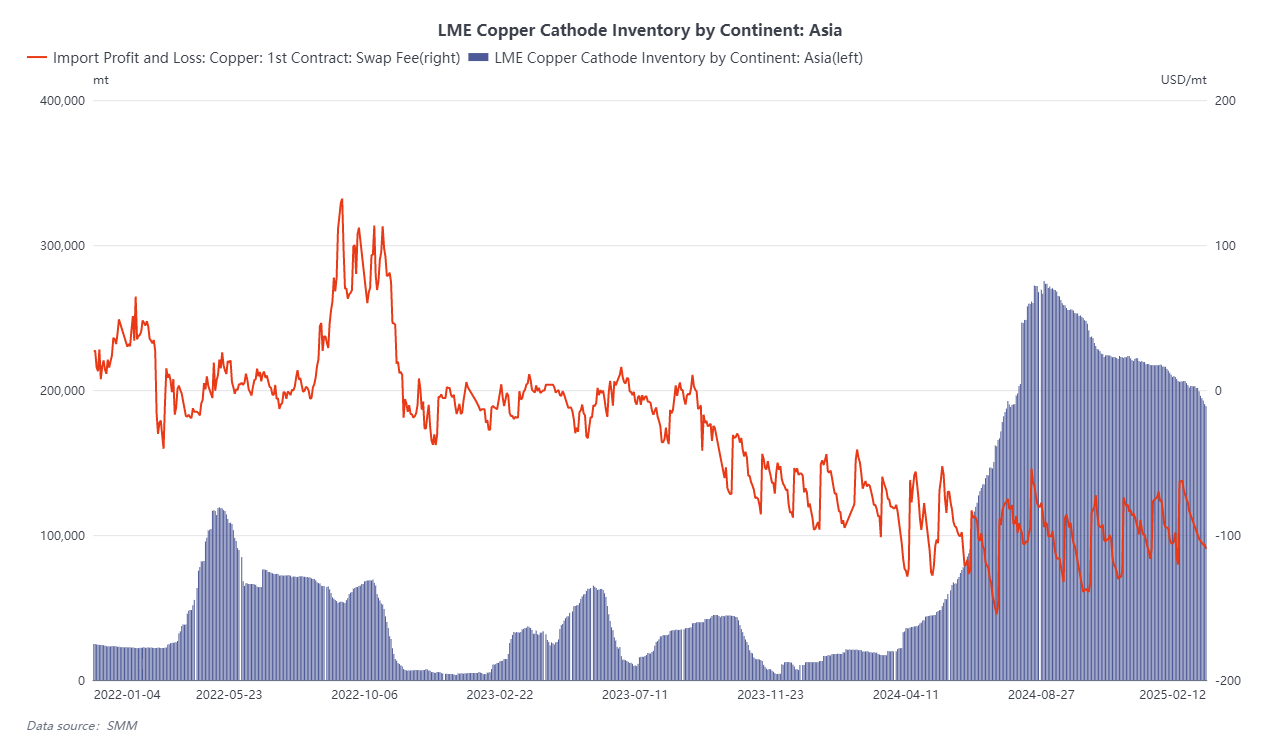
- LME Asia warehouse cancellations surge: Deliverable copper stocks at LME warehouses in Asia that meet COMEX specifications have been continuously canceled, with shipments redirected to North America since January.
- Decline in South American exports to Asia: Copper shipments from South America to Asia have decreased, and some long-haul shipments have been postponed. Market sources indicate that major suppliers have begun reducing deliveries to China.
- Increased African shipments to North America: During the Lunar New Year period, additional shipments from Africa have also been diverted to North America. Estimates suggest that the total in-transit volume heading to North America now ranges between 55,000 and 65,000 metal tons.
Outlook: Arbitrage Opportunities Persist, Driving Market Realignments
As the COMEX-LME price spread remains open, several key impacts are expected:
-
U.S. Imports Rise While China Faces Supply Constraints
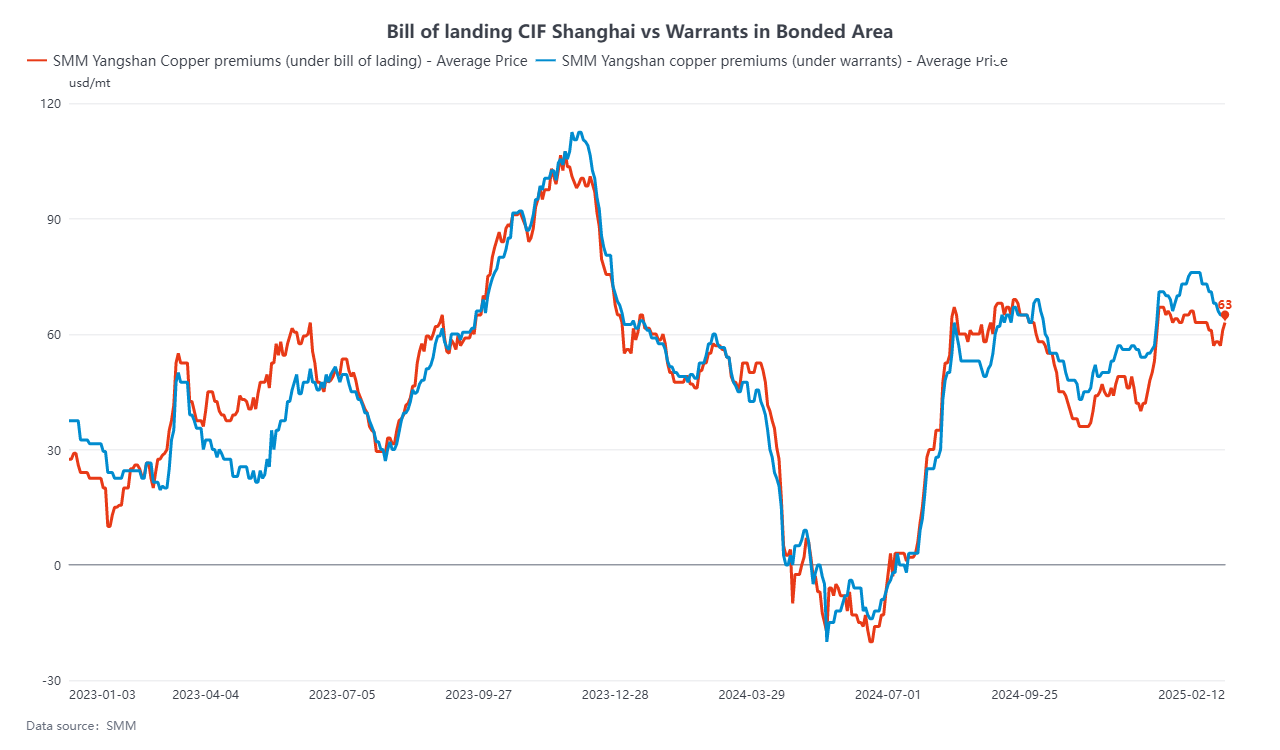
Arbitrage funds are increasingly flowing into the U.S. market, significantly boosting U.S. refined copper imports. Meanwhile, Chinese imports, particularly those from South America, are expected to decline. This shift is forcing major trading houses and smelters to reconfigure logistics channels. If U.S. tariff policies remain uncertain, reduced copper inflows into China between March and May 2025 could support Yangshan copper premiums. -
LME Inventory Decline Narrows Contango Structure
The ongoing trend of LME warehouse cancellations in Asia will continue to erode LME copper inventories, potentially tightening the LME contango structure. As a result, high basis arbitrage opportunities could shrink, pushing up dollar-denominated copper holding costs. This could dampen cross-market arbitrage incentives while simultaneously increasing CIF bill of lading premiums. -
China’s Scrap Copper Imports from the U.S. Decline Sharply
With COMEX copper prices remaining elevated and expectations of Chinese tariff countermeasures, Chinese scrap copper importers—especially those relying on COMEX-linked pricing—are likely to drastically reduce purchases from the U.S. This would directly tighten domestic copper raw material supplies, exacerbating the balance pressures on copper availability in the Chinese market.In a market already strained by negative copper concentrate treatment charges (TCs), reduced scrap copper imports could further drive up production costs for downstream smelters. Consequently, copper prices in China may remain well-supported amid ongoing supply constraints.
Trade Fragmentation and Market Divergence Intensify
Looking ahead, the U.S. market is likely to maintain a clear pricing advantage in copper imports, sustaining strong demand for overseas shipments. However, as price-driven trade adjustments unfold, the short-term surge in trans-Pacific copper flows may eventually cool, further deepening the structural divergence in global copper trade.
![Los inventarios sociales de cobre caen a 88.900 t, Guangdong alcanza un nuevo mínimo anual [datos semanales de SMM]](https://imgqn.smm.cn/usercenter/gCNEi20251217171715.jpeg)
![La divergencia de inventarios en el este de China es evidente; las primas del cobre al contado en la SHFE podrían consolidarse en mínimos [Cobre al contado de Shanghái SMM]](https://imgqn.smm.cn/usercenter/JopQJ20251217171712.jpg)