"Reverse Invoicing" Topic Rekindles Heated Discussions: What Are the Dynamics of Secondary Rod Plants? [SMM Analysis]

Publicado: Dec 20, 2024 09:46
Fuente: SMM
Recently, the "reverse invoicing" policy has once again become a focal point of industry discussions, sparking widespread speculation about whether this policy will be fully implemented in the future.

Recently, the "reverse invoicing" policy has once again become a focal point of industry discussions, sparking widespread speculation about whether this policy will be fully implemented in the future. To gain deeper insights into the views of secondary rod plants on this policy and their future expectations, SMM communicated with enterprises across multiple regions. The key points of these discussions are summarized as follows:
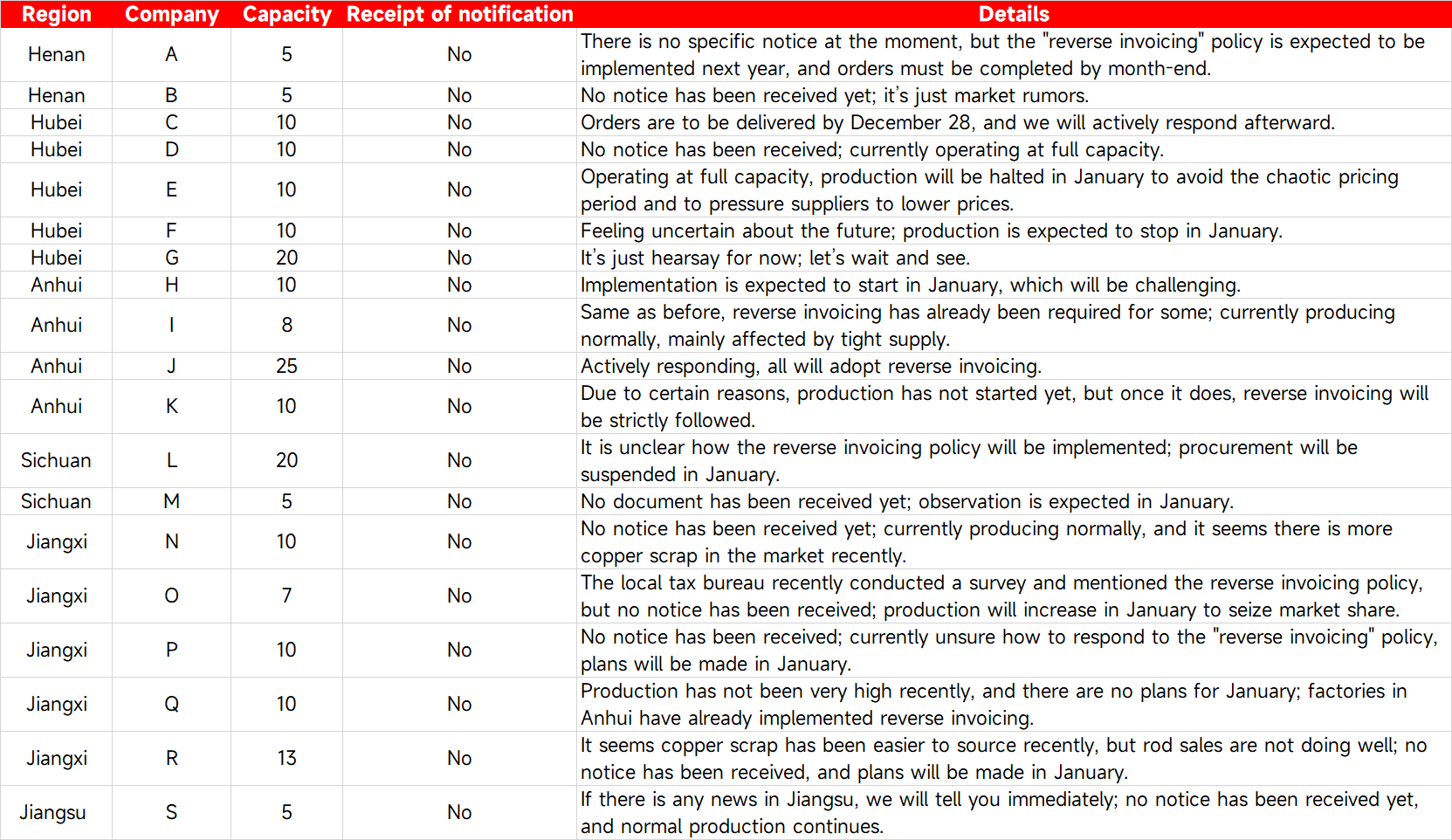
From market feedback, enterprises' reactions to the "reverse invoicing" policy show significant diversity. Although most enterprises have heard that the policy is expected to be officially implemented starting January 2025, they all indicated that they have not yet received specific local execution documents.

In terms of regional differences, Anhui province has required enterprises to at least partially implement "reverse invoicing" since April, but the specific execution varies by region. For instance, certain areas in Anhui have enforced stricter inspections on "reverse invoicing" since September, while other areas, due to strong wait-and-see sentiment, have prohibited enterprises from operating. Currently, secondary copper rod enterprises in Anhui that are operating normally report that a certain proportion of raw material procurement has already adopted "reverse invoicing," with production mainly affected by tight supply of raw materials. If the policy is fully implemented in the future, enterprises express willingness to actively comply, but specific operational details remain unclear.

Enterprises in Hubei and Sichuan provinces stated that the subsequent implementation of the policy remains uncertain. Considering the potential market turmoil in early January and the upcoming Chinese New Year, they plan to suspend production for a few days in January to mitigate risks. In Jiangxi province, one of the regions most affected by the "reverse invoicing" policy previously, enterprises have yet to receive specific notifications. Regarding the policy's implementation, enterprises expressed confusion and uncertainty.

Based on SMM survey results, most enterprises across regions generally adopt a wait-and-see attitude. If the "reverse invoicing" policy is fully implemented in 2025, the actual tax burden on secondary rod plants is expected to increase by at least 1.5%, up to approximately 1.9%. Enterprises found by tax authorities to still be using "unofficial receipts" for accounting purposes will face tax collection equivalent to 2% of their revenue. Regardless of the handling methods during the transition period, this poses significant pressure on secondary rod plants. Some enterprises have already taken measures to address potential cost increases by lowering upstream copper scrap prices. Most secondary rod plants plan to monitor market developments in early January to avoid potential risks.

Despite the many uncertainties in the market, enterprises are expected to maintain full-capacity production in December, and the overall market is likely to remain stable. SMM will continue to monitor the latest market developments.

Declaración de Fuente de Datos: Excepto la información disponible públicamente, todos los demás datos son procesados por SMM basándose en información pública, comunicación de mercado y confiando en el modelo de base de datos interna de SMM. Son solo para referencia y no constituyen recomendaciones para la toma de decisiones.

Para cualquier consulta o para obtener más información, por favor contacte: lemonzhao@smm.cn
Para más información sobre cómo acceder a nuestros informes de investigación, contacte con:service.en@smm.cn
Noticias relacionadas
One and One Secures Over 2,000 Tonnes of Feedstock for New Philippine Metals Recovery Line
hace 1 minuto
One and One Secures Over 2,000 Tonnes of Feedstock for New Philippine Metals Recovery Line
Leer más
One and One Secures Over 2,000 Tonnes of Feedstock for New Philippine Metals Recovery Line
One and One Green Technologies has secured more than 2,000 tonnes of feedstock, including copper-bearing, nickel and electronic sludge, for its new metals recovery line in the Philippines. Equipment installation is underway and production is targeted before end-2026. The facility will recover copper, nickel, gold and silver from industrial and electronic waste, adding new local processing capacity for complex secondary metal feedstocks.
hace 1 minuto
Los precios del cobre se consolidan bajo presión mientras la oferta se relaja ligeramente y la demanda sigue débil [Actas de la reunión matutina sobre cobre de SMM]
hace 10 minutos
Los precios del cobre se consolidan bajo presión mientras la oferta se relaja ligeramente y la demanda sigue débil [Actas de la reunión matutina sobre cobre de SMM]
Leer más
Los precios del cobre se consolidan bajo presión mientras la oferta se relaja ligeramente y la demanda sigue débil [Actas de la reunión matutina sobre cobre de SMM]
Resumen matutino del SMM: Durante la noche, el cobre en la LME abrió en 14.127 USD/t, cayó a un mínimo de 14.102,5 USD/t en las primeras operaciones, luego su centro de precios subió directamente hasta tocar los 14.292,5 USD/t, antes de retroceder para cerrar en 14.236,5 USD/t, con un alza del 0,31%. El volumen de negociación alcanzó 22.700 lotes y el interés abierto se situó en 268.600 lotes, un aumento de 3.229 lotes respecto a la jornada anterior, impulsado por posicionamiento alcista. Durante la noche, el contrato de cobre más negociado del SHFE, el 2610, abrió en 108.500 yuanes/t, cayó a 108.310 yuanes/t en las primeras operaciones, luego su centro de precios subió directamente hasta tocar los 108.760 yuanes/t, antes de retroceder para cerrar en 108.390 yuanes/t, con un alza del 0,26%. El volumen de negociación alcanzó 28.300 lotes y el interés abierto se situó en 206.000 lotes, una disminución de 876 lotes respecto a la jornada anterior, impulsado por reducción de posiciones bajistas.
hace 10 minutos
La situación en Oriente Medio registra un continuo tira y afloja; el cobre en el LME y en la SHFE sube ligeramente en la sesión nocturna [Comentario matutino sobre el cobre de SMM]
hace 19 minutos
La situación en Oriente Medio registra un continuo tira y afloja; el cobre en el LME y en la SHFE sube ligeramente en la sesión nocturna [Comentario matutino sobre el cobre de SMM]
Leer más
La situación en Oriente Medio registra un continuo tira y afloja; el cobre en el LME y en la SHFE sube ligeramente en la sesión nocturna [Comentario matutino sobre el cobre de SMM]
hace 19 minutos