Be careful! New regulations on lithium battery transportation come into effect on April 1

Publicado: Mar 25, 2022 13:27 (GMT+8)
Attention! According to the official (IATA) of the International Air Transport Association, IATA has revised the regulations governing the separate transportation of lithium batteries, which actually came into effect on January 1, 2022, but there will be a transition period before March 31, 2022 to comply with the new regulations, and the new rules will come into effect after April 1.

According to the official (IATA) of the International Air Transport Association, IATA has revised the regulations for the separate transportation of lithium batteries, which actually came into effect on January 1, 2022, but there will be a transitional period before March 31, 2022 to comply with the new rules, and the new rules will come into effect after April 1.

This regulatory change is mainly a revision of the multi-page packaging instructions PI 965 and PI 968 of the 63rd edition of the International Air Transport Association dangerous goods regulations. The most significant impact of this dangerous goods regulation change is the deletion of PI 965 as lithium-ion cells and batteries (including mobile power sources) and PI 968 as packaging instructions for lithium metal / primary cells and batteries. This change does not affect PI 966, PI 967, PI 969 or PI 970 for Section II lithium-containing battery products. According to the provisions of part II, neither lithium-ion batteries nor lithium-metal batteries can be transported.
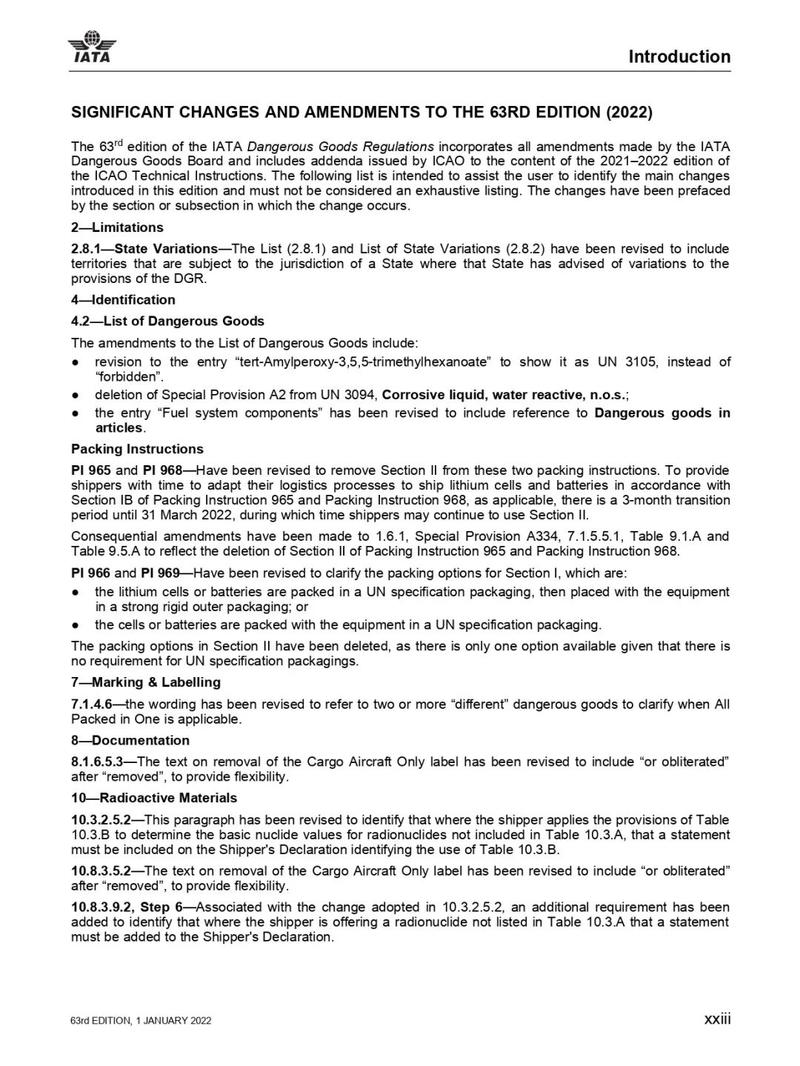
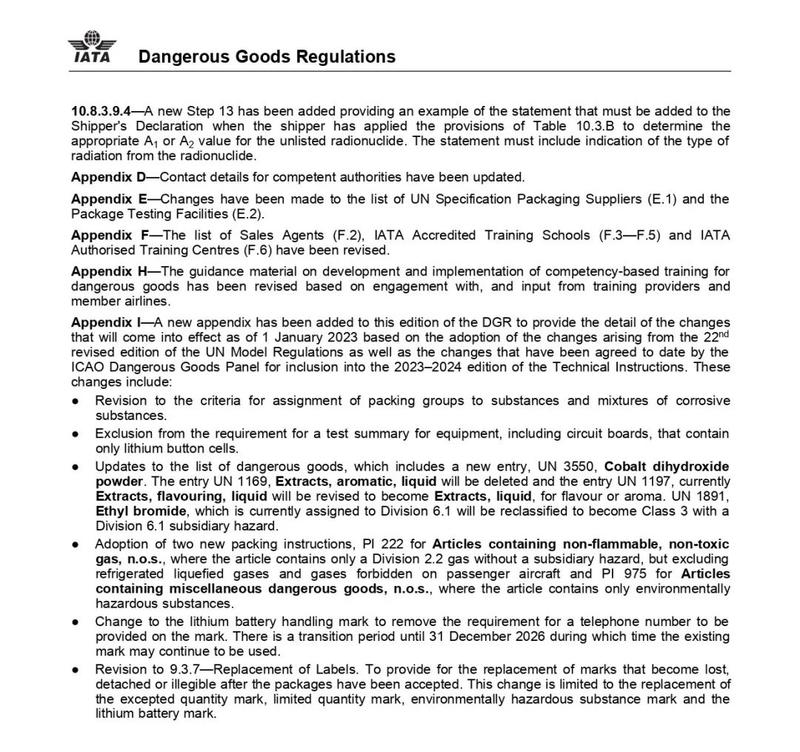
In this way, all shippers who ship lithium batteries themselves are required to complete the declaration, marking and labelling of dangerous goods, as well as complete training in the air transportation of dangerous goods.

Shippers of lithium batteries have become accustomed to annual changes in transport rules, while air transport rules seem to change more frequently than other modes of transport (rail, road, sea and inland waterways). The reasons for these changes include the increase in the transportation of lithium batteries. Lithium batteries are now available for everything from mobile phones to bicycles, motorcycles, drones, trucks and a variety of scientific, medical and industrial equipment.

In addition, lithium battery accidents continue to pose a threat to safety, as if the regulations are not fully met, the battery may rapidly heat up to 400 °C while releasing toxic gases. Some airlines have invested in sealing systems that can withstand lithium battery fires, but these systems are costly and add to the cost of the supply chain, which will inevitably be borne by the shipper.

From April 1st, both lithium-ion batteries and lithium-metal batteries must be declared in accordance with the terms of IA or IB. It should be noted that this rule change does not apply to lithium batteries included in equipment or lithium batteries packaged in air transportation equipment.

In addition, the ADR (Road), RID (Railway) or IMDG (Shipping) regulations remain unchanged, and special clause 188 does make it easier to use lithium-ion batteries below 100 Wh (watt-hours) and lithium-metal batteries with a total lithium metal content of less than 2 g. Differences in rules between different modes of transport reflect different risks but also increase the complexity faced by shippers many of whom use multiple modes of transport.

The practical effect of these changes is that many packages with only lithium batteries must become larger, if only to leave enough room for the hazards and handling labels and other information that must appear on each package. According to Section IA, the shipper needs two labels, and according to Section IB, two labels and one mark are required, and the labels and marks must comply with the minimum size standards stipulated in the IATA regulations.

The shipper also needs to prepare the shipper's statement for each shipment of self-shipped lithium batteries, which are subject to full acceptance by the ground handling agent, and then enter the Captain's notice, which lists the dangerous goods that have been loaded on the aircraft.

Shippers will face higher transport costs because airlines, handling agents, integrators and freight forwarders must do more to ensure compliance. Air freight rates for most aviation divisions have risen sharply as a result of the epidemic, rising fuel prices, high demand for freight capacity, and the recent Russian-Ukrainian crisis that led to the cancellation of some capacity. Sadly, more cost increases are just around the corner.

Over time, it will become increasingly clear whether this latest regulatory amendment will further improve security or cause obstacles and delays to legitimate shippers and distributors. For all participants in the supply chain, not changing lithium battery regulations for a few years will also be a welcome respite.

Declaración de Fuente de Datos: Excepto la información disponible públicamente, todos los demás datos son procesados por SMM basándose en información pública, comunicación de mercado y confiando en el modelo de base de datos interna de SMM. Son solo para referencia y no constituyen recomendaciones para la toma de decisiones.

Para cualquier consulta o para obtener más información, por favor contacte: lemonzhao@smm.cn
Para más información sobre cómo acceder a nuestros informes de investigación, contacte con:service.en@smm.cn
Noticias relacionadas
[SMM News] Solis inicia perforación de litio en Campo Grande
hace 1 hora
[SMM News] Solis inicia perforación de litio en Campo Grande
Leer más
[SMM News] Solis inicia perforación de litio en Campo Grande
[SMM News] Solis inicia perforación de litio en Campo Grande
Solis Minerals ha iniciado la perforación diamantina en su Proyecto de Litio Campo Grande, en el Valle del Litio Araçuaí-Salinas, Brasil. La empresa planea cinco sondajes con un total aproximado de 1.000 m, con profundidades previstas de hasta 200 m, para evaluar pegmatitas de litio a lo largo de un corredor de 500 m. Los objetivos se basan en anomalías geoquímicas multielemento coincidentes en superficie y en resultados históricos de perforación con barreno. Los trabajos históricos de Rio Tinto y el posterior mapeo y trabajo geoquímico de Solis definieron los objetivos. Solis también ha mapeado un nuevo enjambre de pegmatitas con tres zonas de afloramiento coherentes entre los sondajes planificados DHCG-001 y DHCG-004. El programa evaluará la continuidad, la geometría y el potencial de litio de las pegmatitas bajo la superficie, comenzando donde las pegmatitas mapeadas coinciden con anomalías geoquímicas. Solis señala que la geología y la geoquímica de Campo Grande son comparables a las del Proyecto de Litio Colina de PLS Group, situado a unos 100 km al suroeste. Por otra parte, Solis ha completado siete sondajes en su Proyecto de Litio Mandacaru, en Brasil, con resultados de ensayo pendientes.
hace 1 hora
[SMM News] Charger reanuda la perforación en el yacimiento de litio Medcalf
hace 1 hora
[SMM News] Charger reanuda la perforación en el yacimiento de litio Medcalf
Leer más
[SMM News] Charger reanuda la perforación en el yacimiento de litio Medcalf
[SMM News] Charger reanuda la perforación en el yacimiento de litio Medcalf
Charger Metals ha movilizado una segunda plataforma de perforación a su proyecto de litio Lake Johnston, en Australia Occidental, como parte de un programa de 10.000 m orientado al crecimiento de recursos. Actualmente operan plataformas de diamantina y de circulación inversa en el depósito de litio Medcalf, y la perforación de circulación inversa comenzó hace poco más de una semana. El programa duplicará los metros perforados en Medcalf. La perforación apunta a extensiones y relleno en la estimación de recursos minerales inferidos de Medcalf, de 10,6 Mt con una ley del 1 % de Li₂O. La perforación ha definido con mayor precisión el objetivo de exploración Medcalf West, de 3 a 5 Mt con leyes del 1 al 1,4 % de Li₂O. El programa también busca proporcionar testigos de diamantina para ensayos metalúrgicos y geotécnicos. Tras la reciente mejora de recursos de Medcalf, que elevó el Li₂O contenido en un 34 %, el directorio de Charger se ha comprometido a realizar un estudio de alcance del proyecto Lake Johnston. El recurso actual se asienta sobre una malla de perforación predominantemente de 40 m x 80 m, que incluye 10.936 m de perforación a un costo de 32 dólares por tonelada de Li₂O contenido. El programa está totalmente financiado con la venta del proyecto de litio Bynoe a Core Lithium por 3,75 millones de dólares en efectivo, recibidos el 17 de julio de 2026. Lake Johnston se encuentra a 450 km al este de Perth, en la provincia de Yilgarn, a unos 70 km del proyecto de litio Earl Grey, donde Covalent Lithium inició la extracción y la puesta en marcha en marzo de 2024.
hace 1 hora
[SMM Noticias] Savannah recaudó más de 40 millones de dólares para desarrollar el proyecto de litio en Portugal
hace 1 hora
[SMM Noticias] Savannah recaudó más de 40 millones de dólares para desarrollar el proyecto de litio en Portugal
Leer más
[SMM Noticias] Savannah recaudó más de 40 millones de dólares para desarrollar el proyecto de litio en Portugal
[SMM Noticias] Savannah recaudó más de 40 millones de dólares para desarrollar el proyecto de litio en Portugal
El 23 de septiembre, Savannah Resources recaudó 30 millones de dólares para su proyecto de litio Barroso en Portugal, mediante 408 millones de acciones a 0,055 libras por acción, incluidos 11,2 millones de dólares procedentes de acuerdos de suscripción con accionistas principales. Sumados a los 15,5 millones de dólares en efectivo disponibles, los fondos se destinarán a la fabricación de equipos de largo plazo, obras de caminos de acceso, contratación EPCM, ingeniería de planta, permisos y derechos de uso del suelo. El estudio de factibilidad definitivo de la fase uno de Barroso, previsto para julio de 2026, contempla una vida útil de 14 años con una producción de 183.000 toneladas anuales de óxido de litio, con una ley del 5,5 %, basado en un precio de 1.788 dólares por tonelada, lo que generaría un EBITDA de 3.200 millones de dólares, un flujo de caja libre de 1.900 millones de dólares y un valor actual neto después de impuestos de 913 millones de dólares. El yacimiento contiene 39 millones de toneladas con una ley del 1,05 % de Li2O, equivalentes a 411.900 toneladas de litio contenido, lo que lo convierte en el mayor recurso de espodumeno de roca dura de Europa. La financiación impulsa una de las pocas fuentes de litio de roca dura a gran escala en desarrollo fuera de China, vinculada a cadenas de suministro africanas y sudamericanas, contribuyendo a los objetivos de diversificación de materias primas críticas de la UE.
hace 1 hora