SHANGHAI, Feb 25 (SMM) - Supply shortage has been common in the new energy sector after the Chinese New Year (CNY) holiday. Among them, lithium salt is in palpable supply deficit, which has result in significant growth in prices. According to SMM research, the average price of battery grade and industry grade lithium carbonate stood at 410,000 yuan/mt and 400,000 yuan/mt respectively in February, up 26.5% and 29.5% month-on-month. The surging lithium prices have heightened the costs of CAMs (cathode active materials). The prices of 5-series NMC materials and LFP materials (for power battery) averaged 310,000 yuan/mt and 140,000 yuan/mt respectively in February, up 17.6% and 20% MoM. In addition, the prices of nickel sulphate and cobalt sulphate both recorded significant gains of 8.5% and 6.5% respectively post the CNY holiday.

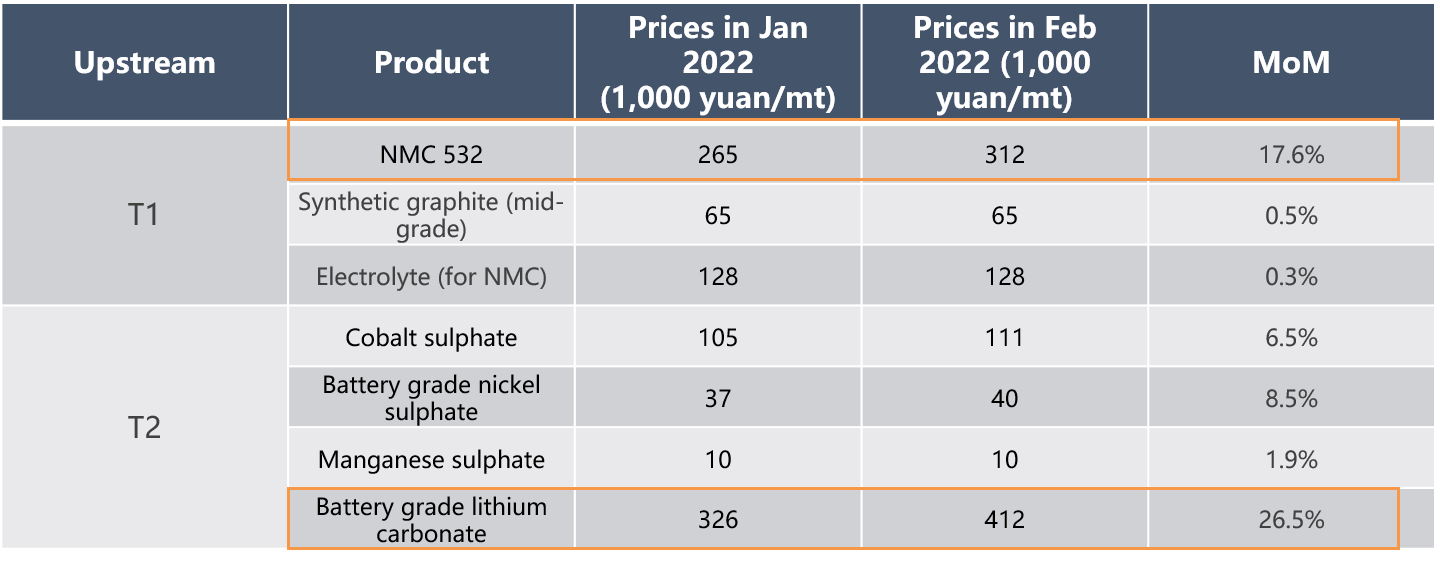
Apart from the rising prices of raw materials for CAMs including lithium salt as well as cobalt and nickel salt in February, the pricing scheme of CAMs has also changed. It started as early as in the fourth quarter of 2021, when the basis of pricing shifted from the monthly average prices of lithium carbonate from third-party information platform to intraday lithium salt prices or the most recent traded prices. The cause for such shift lies in the fact the lithium prices have been rising too fast, while most LFP manufacturers purchase in small orders from lithium salt suppliers rather than long-term orders, hence LFP manufactures are more sensitive to lithium prices. Meanwhile, the demand for LFP materials from battery companies have risen greatly, resulting in significantly supply shortage that gives more pricing power to the LFP manufacturers. As such, the pricing scheme has improved in order to transmit the rising costs directly to battery companies.
NMC materials enterprises are also increasingly less willing to bear high lithium prices starting from 2022, and the pricing scheme has also been changed and is subject to intraday lithium prices or traded prices now. Therefore, the costs of battery companies have been rising continuously after the growth of lithium prices have been transmitted to them more quickly.
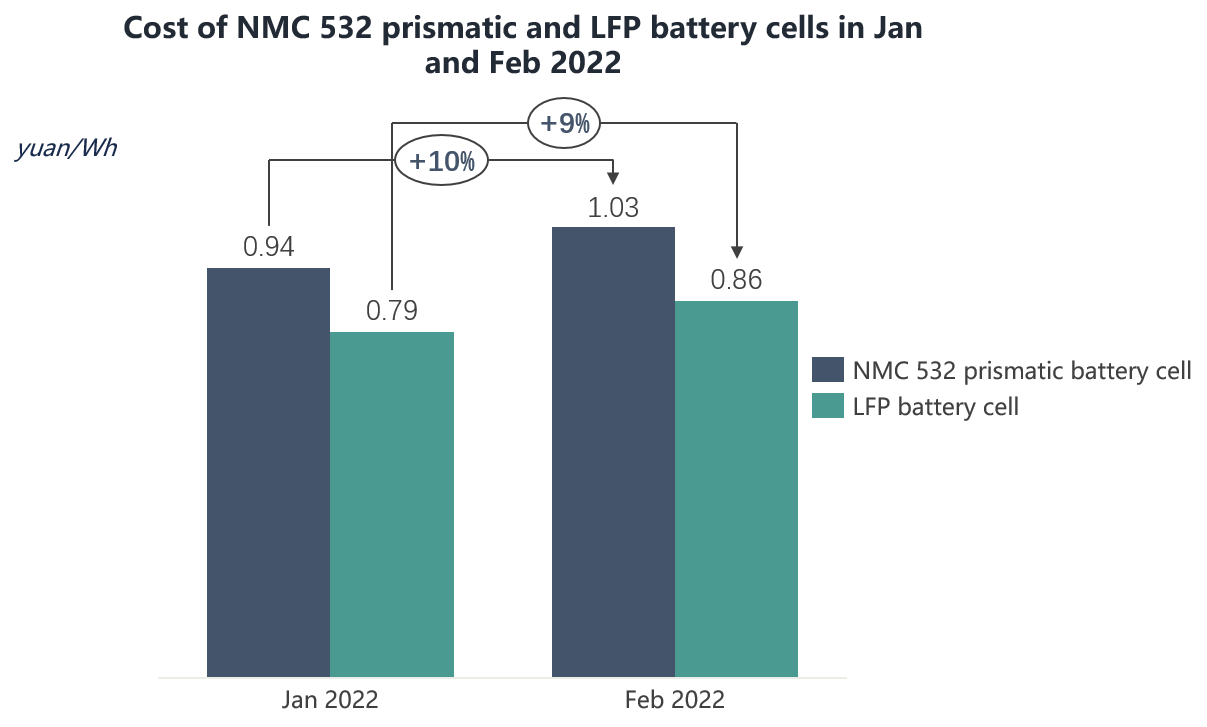
Specifically speaking, the costs of NMC and LFP battery cells are climbing in February along with the rising raw materials prices. The costs of NMC and LFP battery cell have exceeded 1 yuan/Wh and 0.86/Wh respectively in February, up 10% and 9% MoM.
Battery companies also modified its cooperation mode of fixed prices with car makers entering 2022. There are currently two pricing schemes. One is subject to the monthly average prices of raw materials from third-party information platform; the other one is to directly raise the prices by 20-40% from the level in Q4 2021, which is the popular cooperation mode with new forces and medium and small-sized car makers.
To sum up, the growth of raw materials have been largely borne by battery companies and car makers.
For battery companies, the recently soaring lithium prices have greatly pulled up their costs, but some small-sized companies are unable to raise their finished products prices, hence they have to lower their purchase demand. Leading battery companies, on the other hand, have maintained robust purchases, but are also increasingly unwilling to accept high lithium carbonate prices. Based on the current market feedback, most battery companies would only purchase when the prices of lithium carbonate are below 480,000 yuan/mt, which subsequently contained the strong upside momentum of lithium carboante.
For car makers, ORA recently announced to suspend taking orders of car models – black and while cat – as the rising raw materials prices have created losses of more than 10,000 yuan per black cat model. Most car makers have no or negative profits on the back of broadly rising raw materials prices. Nonetheless, the supply shortage of raw materials could hardly be addressed in the short term in light of drastically growing demand in the power battery and energy storage sectors. Hence the prices of raw materials are likely to keep rising throughout 2022.
It is expected that the downstream demand will be depressed by such price hikes to some extent, and more car makers may have to suspend or lower the output of some models, leading to a potentially less-than-expected NEV output in 2022.
![[Análisis de SMM] Dos suspensiones en dos meses: los permisos de Sigma Lithium se suspenden nuevamente y la expansión se ve afectada](https://imgqn.smm.cn/usercenter/ipFFo20251217171725.jpg)
![[El proyecto Kachi de Lake Resources recibe aprobación ambiental]](https://imgqn.smm.cn/usercenter/HySQT20251217171731.png)
![[China Union Holdings: La FIRES de Canadá revisará más a fondo la inversión en salmuera de litio]](https://imgqn.smm.cn/usercenter/jZvMC20251217171729.jpg)