A few days ago, the Ministry of Industry and Information Technology released the catalogue of recommended models for the promotion and application of new energy vehicles (the first batch in 2022), which is the first catalogue released since the implementation of the new policy on subsidies for new energy vehicles in 2022.
According to statistics, a total of 171 new energy vehicles are on the list in the first batch of catalogues. Among them, there are 139 new energy vehicles and 32 other new energy vehicles that meet the technical requirements of the notice on improving the Financial subsidy Policy for the Promotion and Application of New Energy vehicles.
In terms of vehicle classification, the number of new energy special-purpose vehicles is the largest, with 128, accounting for 75%, while new energy passenger vehicles and new energy buses have 22 and 21 respectively.
The iron-lithium model takes the lead again.
As far as new energy passenger cars are concerned, there are 12 models with lithium iron phosphate batteries in the first catalogue, accounting for 55%, and 10 models with ternary batteries, accounting for 45%. Thus it can be seen that the proportion of lithium iron phosphate battery models in the first catalogue exceeds that of ternary battery models, indicating that lithium iron phosphate batteries are once again leading the way in the field of new energy passenger vehicles, and are expected to continue the outbreak of installed capacity in 2021 and continue to achieve rapid growth in 2022.
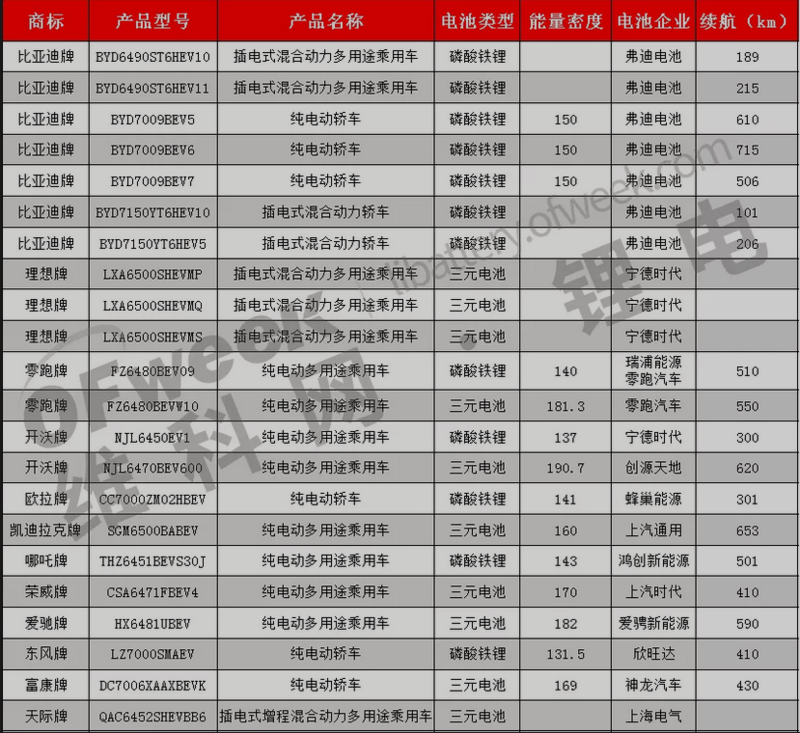
Source: Ministry of Industry and Information Technology
It is worth noting that the significant reduction in the number of new energy passenger cars in the first catalogue has also led to a significant reduction in the number of battery companies that provide battery matches. there are less than 10 battery companies this time, mainly for Fudi battery, Ningde era, honeycomb energy, Ruipu energy, Xinwanda, Hong innovation energy, SAIC era.
Specifically, the top three on the list are BYD, ideal car, zero-running car and Kevo car. Among them, BYD has a total of seven models on the list, all equipped with its own lithium iron phosphate batteries; ideal cars have three models on the list, all equipped with ternary batteries of the Ningde era; zero-running cars have two models on the list; lithium iron phosphate batteries and ternary batteries each have one, and battery companies include their own and Ruipu Energy. Kaiwo car is also a lithium iron phosphate model and a ternary model on the list, supporting cars for the Ningde era and Chuangyuan Tiandi respectively.
Return of Lithium Iron Phosphate King in 2021: data show that from January to December 2021, China's power battery production totaled 219.7 GWH, an increase of 163.4% over the same period last year. Among them, the output of lithium iron phosphate batteries totaled 125.4 GWH, accounting for 57.1 percent of the total output, an increase of 262.9 percent over the same period last year.
In terms of sales, from January to December 2021, the cumulative sales of power batteries in China reached 186.0 GWH, an increase of 182.3% over the same period last year. Among them, the cumulative sales of lithium iron phosphate batteries were 106.0 GWH, an increase of 245.0% over the same period last year.
In terms of loading capacity, from January to December 2021, China's power battery loading totaled 154.5 GWH, an increase of 142.8% over the same period last year. Among them, lithium iron phosphate batteries loaded a total of 79.8 GWH, accounting for 51.7% of the total loading, an increase of 227.4% over the same period last year.
In other words, no matter in terms of production, sales, or even loading, lithium iron phosphate batteries have achieved a comprehensive surpassing of ternary batteries in 2021!
Now, lithium iron phosphate batteries have once again gained the upper hand in the field of new energy passenger vehicles, making a good start to the "new war" between ternary batteries and 2022.
Lithium iron phosphate battery 2022 is expected to continue to rise.
In 2021, China's automobile production and sales completed 26.082 million and 26.275 million respectively, an increase of 3.4% and 3.8% respectively over the same period last year, ending three consecutive years of decline. As the first year of the 14th five-year Plan, China's automobile industry got off to a good start in 2021.
Among them, the sales of new energy vehicles completed 3.521 million, an increase of 1.6 times over the same period last year, accounting for 13.4% of total vehicle sales, ranking first in the world for seven consecutive years.
Looking to the future, at the "2022 China Automobile Market Forecast Summit" held at the end of 2021, industry experts analyzed and predicted and reached the basic judgment that China's automobile market will continue to grow in 2022. Among them, the number of new energy vehicles will reach 5 million, an increase of 42% over the same period last year, and the market share is expected to exceed 18%.
Under the huge market demand, the installed capacity of lithium iron phosphate battery is expected to continue to rise.
On the one hand, in the field of passenger cars, models with lithium iron phosphate come from behind: with the influence of policy factors such as subsidies, the cost advantage of lithium iron phosphate battery begins to appear, and more vehicle factories begin to launch new energy models with lithium iron phosphate battery, such as lithium iron phosphate version Model3, BYD Han, Hongguang MINI and so on.
The latest release of the first batch of recommended catalogue in 2022, lithium iron phosphate battery passenger cars accounted for more than three yuan, is one of the best proof. It means that the whole car factory will regard lithium iron phosphate battery as an important choice to cope with the pressure of rising price and shortage of raw materials for lithium battery in 2022.
On the other hand, lithium iron phosphate battery also has two advantages. Needless to say, the field of passenger cars and special-purpose vehicles, which occupies a dominant position.
In the field of non-power batteries, lithium iron phosphate mainly involves three applications: 5G base station energy storage, new energy generation end energy storage and lead-acid market substitution.
According to statistics, it is estimated that by 2025, the number of 5G base stations in China will reach 8.16 million. Based on the estimated power consumption of about 2700W per 5G base station and emergency 4 hours, from 2021 to 2025, the 5G base station energy storage market will provide 15.5GWh lithium iron phosphate battery demand space, corresponding to the LFP material demand of about 36000 tons.
The new installed capacity of electrochemical energy storage is 2.5 GW in 2021, and the cumulative installed capacity is expected to reach 35.52/55.88GW by 2025. And in the field of electrochemical energy storage in 2025, there will be an additional demand space of 13.0-23.1Gwh, corresponding to the demand of 3.0-54000 tons of LFP materials.
In 2020, the output of lead-acid batteries in China is 227.36GWhh, corresponding to more than 130 billion alternative space. About 33% of them are used in light power batteries, mainly in the power system of electric two-wheelers.
In 2020, shipments of lithium batteries for electric two-wheeled vehicles in China reached 10.7 GWH, an increase of 91.1% over the same period last year. It is estimated that the demand for lithium batteries for electric two-wheeled vehicles will reach 45.9Gwh by 2025.
![[Análisis de SMM] Portugal cancela la construcción de una industria integrada de extracción y procesamiento de litio](https://imgqn.smm.cn/usercenter/WBREf20251217171728.png)
![[SMM Flash] Se insta a la SADC a pasar de exportar minerales en bruto a procesarlos; se cita como modelo la prohibición del litio en Zimbabue](https://imgqn.smm.cn/usercenter/mpqgn20251217171727.jpg)