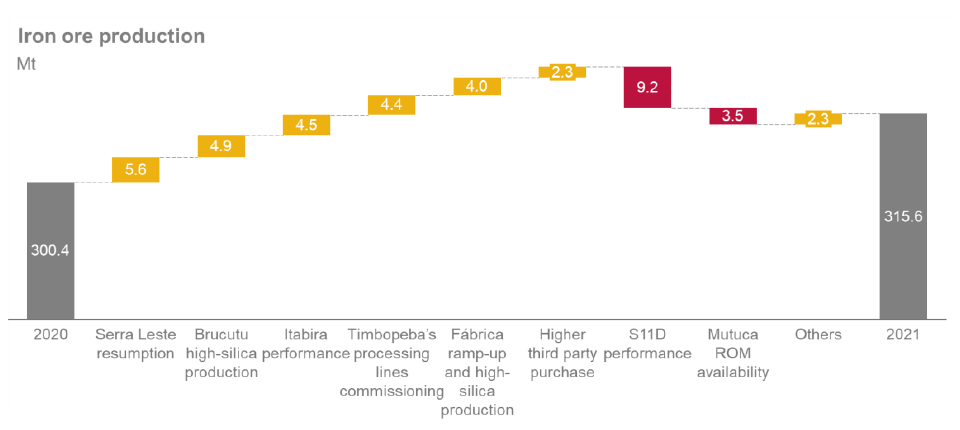
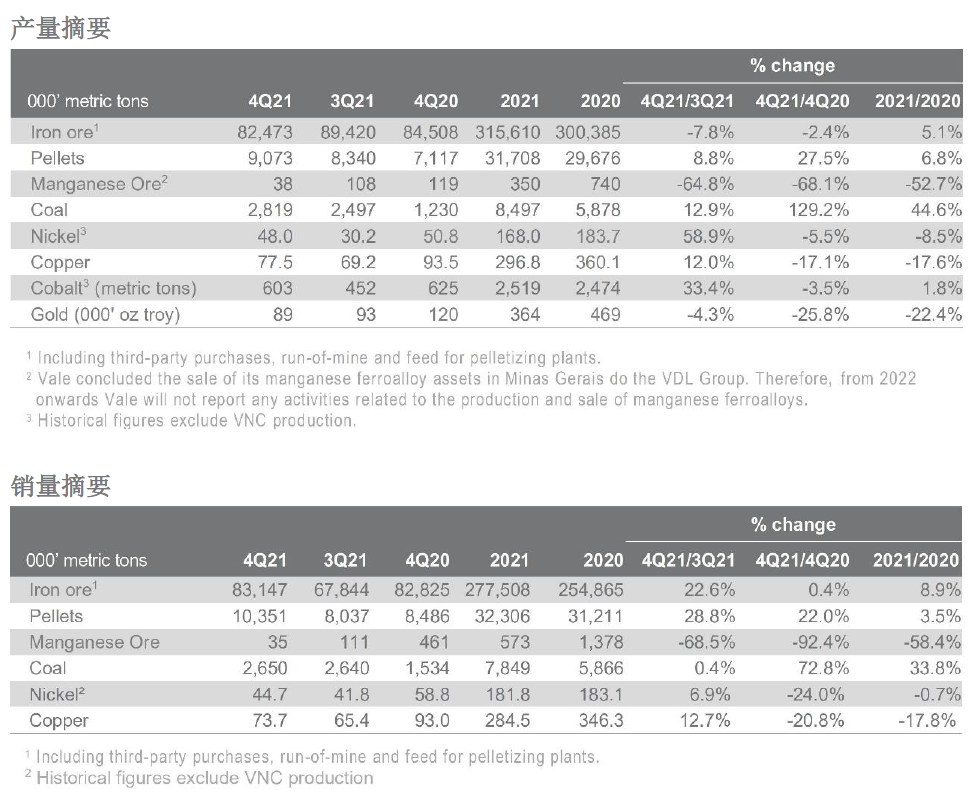
The cumulative production of Vale iron ore powder reached 315.6 million tons in 2021, an increase of 15.2 million tons over 2020. The reasons include: (1) the Dongling (Serra Leste) operation area will resume production at the end of 2020; (2) the output of high silicon products in the Brukutu (Brucutu) operation area will increase by 3; (3) the Itabila (Itabira) integrated operation area has improved despite the restrictions related to tailings disposal. (IV) six mineral processing lines have been used since March 2021 in the (Timbopeba) operation area of Timbo Peiba; (v) wet mineral processing operations and production of high silicon products have been resumed in the F á brica operation area; and (VI) third-party procurement has increased. These improvements were partially offset by the following factors: (I) the performance of the S11D operation was mainly affected by higher stripping ratios and lower mining productivity during the year due to the existence of higher Jasper iron rock materials in the orebody; and (II) the Mutuka (Mutuca) operation was in the process of applying for a license, affecting the availability of the original mine.
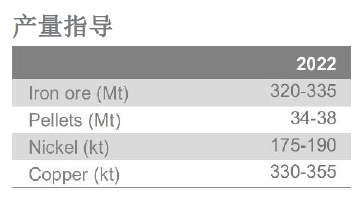
In order to improve the performance of the S11D operating area to reach its rated capacity, thereby achieving annual production of 80 million to 85 million tons by 2022, Vale is installing four primary crushers and four mobile crushers to handle Jasper iron rock materials. these equipment will be put into use in the first half of 2022. In addition, the company will need to use a new crusher to deal with large compressed waste blocks, which will be operational by 2025, before which the annual production capacity of S11D will be limited to about 5 million tons.
The annual production capacity of Vale iron ore will reach about 340 million tons by the end of 2021. In the second half of 2022, the Filter tailings plants in the Itabilla and Brukutu operations will gradually reach capacity, and the Itabiru ç u and Tolto (Torto) dams in these two major operating areas will increase their tailings storage capacity, after which Vale is expected to produce 370 million tons of iron ore per year by the end of 2022.
All operating areas in Minas Gerais State were affected by heavy rainfall in early 2022 but resumed normal operations after safety conditions were met again. The shutdown has had an impact on Vale's iron ore production of about 2 million tons, and the company has directed production to remain unchanged throughout the year as the seasonal effects of the rainy season have been taken into account. Vale pellet production reached 31.7 million tons in 2021, an increase of 2 million tons compared to 2020, as the Grand Val (Vargem Grande) pellet plant resumed production in January, but pellet production is still subject to the supply of pellet concentrate in the Itabela and Brukutu camp, which will gradually improve by the end of 2022 with the opening of the Tolto Dam and the completion of the lifting operation of the Ita Birosu Dam.
Sales of iron ore fines and pellets totaled 309.8 million tons in 2021, an increase of 23.7 million tons over 2020 and equivalent to output in 2021.
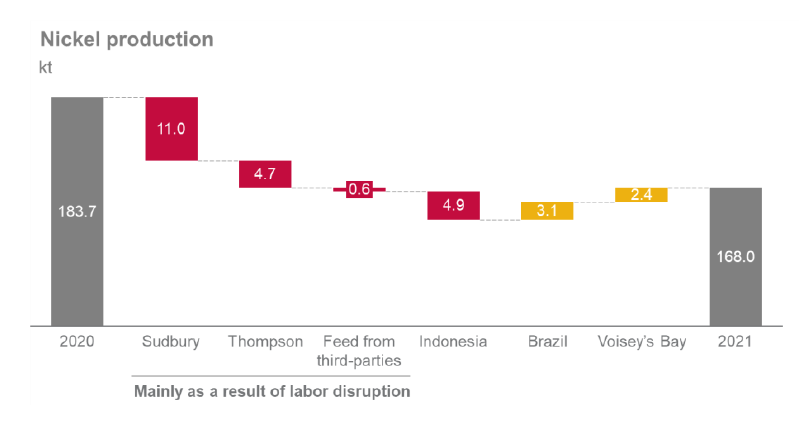
The output of finished nickel in 2021 was 168000 tons, a decrease of 15700 tons compared with 2020, mainly due to: (1) labor interruption at the Sudbury plant, which affected the output of nickel concentrate processed by Tongya (Copper Cliff) smelter and based on nickel ore from Thompson (Thompson) plant; (2) the decrease in the production of finished nickel based on nickel ore from the Indonesian plant (PTVI) is due to travel restrictions caused by COVID-19, which delayed blast furnace maintenance from 2021 to 2022, thereby reducing the efficiency of high matte production. The positive factor is that the performance of the On ç a Puma) plant has improved despite the extended maintenance time throughout the year. In addition, thanks to the improved operating performance of the Changgang (Long Harbour) refinery, the production of finished nickel using nickel ore from the (Voisey's Bay) plant in Vois Bay increased, achieving an optimal annual output of 38100 tons.
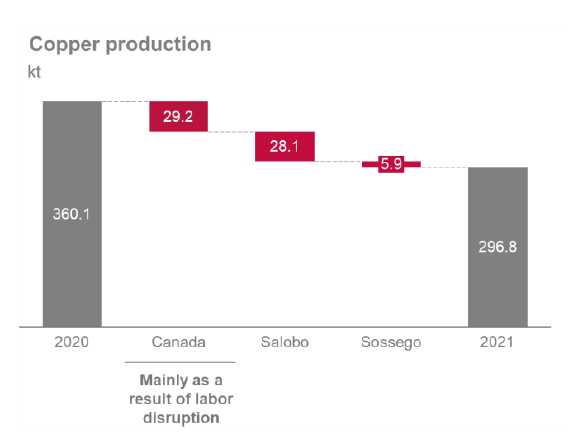
Copper production in 2021 was 296800 tons, a decrease of 63300 tons compared with 2020, mainly due to: (1) labor interruption at the Sudbury plant; (2) the availability of semi-automatic grinding rigs at the Soussegu (Sossego) plant, which should be resolved after the completion of major continuous maintenance in the first quarter of 2022; (III) the Salobo (Salobo) plant reviewed maintenance routines in early 2021, resulting in planned maintenance delays, limited mining activities and affecting fine powder grade; and (iv) the Salobo plant conveyor belt accident limited production in the fourth quarter. Despite the challenges, restrictions on mining activities at the Salobo plant continued to improve and reached pre-safety review levels at the end of the year.
On December 21, 2021, Vale announced the signing of a binding agreement on the sale of coal assets in Mozambique, another achievement of Vale in fulfilling its commitment to reshape the company and focus on its core business. Vale's coal production reached 8.5 million tons in 2021, an increase of 2.6 million tons over 2020, thanks to improved operating performance brought about by plant renovation in the second half of 2021.
![[Mingyi Electronics lanza equipos de galvanoplastia en línea de pórtico de alta relación de aspecto para servidores de IA y sustratos de CI]](https://imgqn.smm.cn/usercenter/CaDcj20251217171711.jpg)
![La inflación de EE. UU. supera las expectativas y, combinada con la acumulación de inventarios en China, los precios del cobre repuntan bajo presión [Reseña macroeconómica semanal de SMM]](https://imgqn.smm.cn/usercenter/JnFuh20251217171711.jpg)