Rare earth market continued to weaken, prices of praseodymium-neodymium oxide showed signs of stabilising

Publicado: Apr 27, 2021 10:04
Rare earth prices were generally lower last week, with prices of many products including praseodymium-neodymium, terbium, dysprosium, and holmium down from a week ago, and transaction atmosphere cooled down significantly. Prices of praseodymium-neodymium oxide showed signs of stabilising, while prices of praseodymium-neodymium metal remained weak amid muted trades. Prices of terbium and dysprosium found no support and market participants generally hoped that large enterprises would stockpile. Prices of gadolinium and holmium diverged. Gadolinium received brisk inquiries, while holmium saw quiet trades. Prices of praseodymium were largely stable , while prices of neodymium continued to decline amid sluggish transactions.
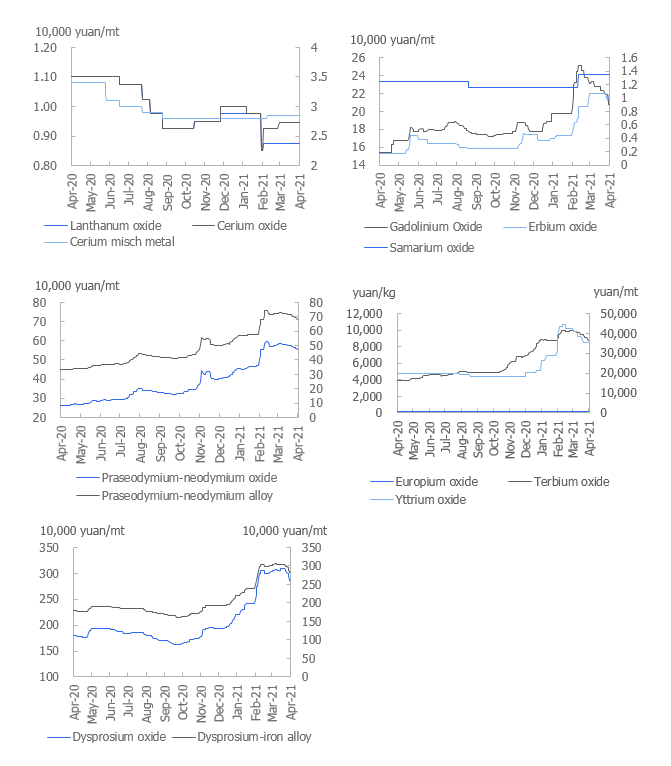
SHANGHAI, Apr 27 (SMM)—Rare earth prices were generally lower last week, with prices of many products including praseodymium-neodymium, terbium, dysprosium, and holmium down from a week ago, and transaction atmosphere cooled down significantly. Prices of praseodymium-neodymium oxide showed signs of stabilising, while prices of praseodymium-neodymium metal remained weak amid muted trades. Prices of terbium and dysprosium found no support and market participants generally hoped that large enterprises would stockpile. Prices of gadolinium and holmium diverged. Gadolinium received brisk inquiries, while holmium saw quiet trades. Prices of praseodymium were largely stable , while prices of neodymium continued to decline amid sluggish transactions.

In terms of light rare earth, praseodymium-neodymium oxide was quoted at 552,000-558,000 yuan/mt as of April 23, while mainstream traded prices were 550,000 yuan/mt, and some transactions were done below 550,000 yuan/mt, and the weekly average price fell 2.41% from a week ago. Neodymium-praseodymium metal was offered at 680,000-685,000 yuan/mt, with the weekly average price down 2.99%, and some sellers made offers at 670,000 yuan/mt for shorter payment period and 690,000 yuan/mt for longer payment period. Praseodymium oxide was offered at 535,000-540,000 yuan/mt, with the weekly average price up 1.23%, and mainstream traded prices were 535,000 yuan/mt. Neodymium oxide was offered at 556,000-560,000 yuan/mt, with the weekly average price down 3.18%, and some companies said buyers showed no interest even at 550,000 yuan/mt. Prices of lanthanum oxide and cerium oxide were relatively stable.

In terms of medium and heavy rare earth, europium oxide was offered at 190,000-200,000 yuan/mt as of April 23, with a slight increase in inquiries and few spot cargoes available in the market. Terbium oxide was offered at 8.7-8.8 million yuan/mt, with the weekly average price down 4.11%, and major producers had low willingness to make offers, with the low-end price around 8 million yuan/mt. Dysprosium oxide was offered at 2.86-2.88 million yuan/mt, with the weekly average price down 4.9%, and the low-end price around 2.8 million yuan/mt. Holmium oxide was offered at 820,000-870,000 yuan/mt, with the weekly average price down 4.64%, and traded price at 800,000 yuan/mt, with very few transactions. Price of gadolinium oxide rebounded, and producers were reluctant to sell at below 200,000 yuan/mt.

Mines reported poor sales. Separation plants and metal factories were cautious in making quotations and held offers firm, while traders were more willing to sell. Magnet material companies went bargain hunting.

According to SMM's survey, magnetic materials companies are still generally taking a wait-and-see stance. Some mid and high-end NdFeB manufacturers expanded production in April as downstream orders continued to improve. Some metal factories said that the recent price increase of gadolinium iron may be due to improving orders from mid and low-end magnetic materials companies. A few large rare earth permanent magnet traders said their new orders fell slightly recently, but orders on hand have been fully booked until July-August. The inventories of magnetic material companies range from half a month to two months. It is difficult to predict when magnetic material companies will make concentrated purchases. 

Trades in the rare earth market are expected to be thin this week due to approaching Labour Day and upcoming announcement of China Northern Rare Earth (Group) High-tech’s selling prices for May.  Prices of neodymium-praseodymium may remain hover around 550,000 yuan/mt, with limited downside room. In the absence of purchase by large companies, prices of terbium and dysprosium are likely to continue to weaken. Prices of gadolinium products are expected to rise slightly, while those of holmium are expected to inch lower. Prices of other rare earth products are likely to be largely stable.
Declaración de Fuente de Datos: Excepto la información disponible públicamente, todos los demás datos son procesados por SMM basándose en información pública, comunicación de mercado y confiando en el modelo de base de datos interna de SMM. Son solo para referencia y no constituyen recomendaciones para la toma de decisiones.

Para cualquier consulta o para obtener más información, por favor contacte: lemonzhao@smm.cn
Para más información sobre cómo acceder a nuestros informes de investigación, contacte con:service.en@smm.cn
Noticias relacionadas
Comentario de la sesión vespertina de tierras raras de SMM del 18 de septiembre
hace 9 horas
Comentario de la sesión vespertina de tierras raras de SMM del 18 de septiembre
Leer más
Comentario de la sesión vespertina de tierras raras de SMM del 18 de septiembre
hace 9 horas
Legislación sudamericana redefine la oferta, Europa acelera la entrega de imanes y la separación militar-civil [Reseña semanal de tierras raras en el extranjero de SMM]
hace 11 horas
Legislación sudamericana redefine la oferta, Europa acelera la entrega de imanes y la separación militar-civil [Reseña semanal de tierras raras en el extranjero de SMM]
Leer más
Legislación sudamericana redefine la oferta, Europa acelera la entrega de imanes y la separación militar-civil [Reseña semanal de tierras raras en el extranjero de SMM]
Esta semana, los precios de tierras raras fuera de China se mantuvieron en general estables, con el óxido de terbio y el terbio metálico ambos bajando 12 USD/kg. En el frente político, Argentina y Brasil avanzaron en legislación sobre estrategias nacionales de tierras raras, fortaleciendo la revisión soberana de recursos y los requisitos de procesamiento local. En el frente industrial, la planta de imanes de Neo en Estonia logró su primer envío comercial de imanes para motores de tracción de vehículos eléctricos; Arabia Saudita descubrió 114 millones de toneladas de recursos de tierras raras y uranio; Ucore recibió financiación adicional del Departamento de Defensa de EE. UU. para avanzar en la separación de samario y gadolinio. En general, la cadena de suministro fuera de China está acelerando su transición de la “competencia por recursos” a una fase de realización de “confirmación de derechos políticos + ampliación de la separación + entrega de imanes”.
hace 11 horas
Los precios del mercado de tierras raras siguen deprimidos, con una expansión limitada del volumen real de transacciones [SMM Rare Earth Daily Review]
hace 14 horas
Los precios del mercado de tierras raras siguen deprimidos, con una expansión limitada del volumen real de transacciones [SMM Rare Earth Daily Review]
Leer más
Los precios del mercado de tierras raras siguen deprimidos, con una expansión limitada del volumen real de transacciones [SMM Rare Earth Daily Review]
[SMM Revista diaria de tierras raras: Los precios del mercado de tierras raras continúan deprimidos, con un crecimiento limitado del volumen real de transacciones] En general, el mercado mostró hoy un patrón divergente de "óxidos totalmente estables, metales en descenso aislado": la serie Pr-Nd no ha registrado cambios durante dos días consecutivos, mientras que el gadolinio, el holmio, el erbio y otras variedades previamente ajustadas han entrado en consolidación, y solo la aleación de disprosio-hierro y el terbio metálico continúan cediendo en precio; el lado de las transacciones aún no se recupera, con compradores y vendedores todavía en un punto muerto en niveles bajos, y las concesiones de precios de los productores de metales solo han aportado una mejora limitada en los envíos reales. Los actores intermedios se dedican principalmente a consultas comparativas de precios y compras justo a tiempo, y la implementación real del aprovisionamiento previo a las vacaciones sigue siendo la mayor variable en la actualidad.
hace 14 horas