Manufacturing activity across nickel downstream sectors in China retreated to contraction in October

Publicado: Nov 2, 2020 14:18
Manufacturing activity across nickel downstream sectors in China retreated to the contractionary territory in October.

SHANGHAI, Nov 2 (SMM)—Manufacturing activity across nickel downstream sectors in China retreated to the contractionary territory in October. 

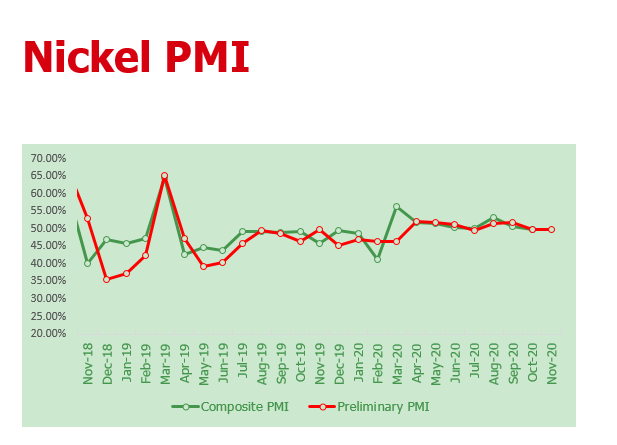
SMM data showed that the purchasing manager's index (PMI) for downstream nickel industries, including stainless steel, electroplating, alloy and battery, stood at 49.68 in October, down 0.94 point from September. A reading below 50 indicates contraction.


Production sub-index stood slightly higher above 50, with the battery and electroplating sectors still in expansion

The composite sub-index for production in October lost 1.32 points from September to 50.56 in October, staying in expansion.

The production sub-index in the stainless steel sector came in at 50, down 1.14 points from a month ago. Most of the steel makers kept stable production, and total stainless steel output in October is expected to be higher than in September. But output of the #300 series is likely to dip as some stainless steel mills switched to production of the #400 series. The production sub-index in the battery sector stood at 58.77 in October, as new energy enterprises mostly maintained relatively high production amid robust consumption. The production sub-index in the electroplating sector came in at 51.45, as many electroplating plants reported improved production in October though most of them halted production during the National Day holidays.


New orders sub-index fell to contraction, mainly dragged down by the stainless steel sector

The overall sub-index for new orders in October declined 1.79 points on the month to 49.23 in October, falling into contraction. Among the surveyed sectors, the stainless steel sector was the worst performer in terms of new orders, weighing on the overall sub-index. Its new orders sub-index slid 1.9 points from the final reading of September to 48.1 in October, retreating from expansion to contraction, basically in line with early expectations, as mills were in the face of great pressure in selling cold-rolled coil. 


Raw materials inventory sub-index remained in contraction, with producers in the stainless steel and electroplating sectors slowing procurements

The composite sub-index for raw materials inventory in October gained 0.94 point month on month to 48.18 in October, remaining in contraction. The purchasing volume sub-index in the stainless steel sector dropped 2.1 points from the final reading of September to 46.19 in October, while the raw materials inventory sub-index inched up 0.48 point to 47.62. The two sub-indexes that both stood under 50 suggested slowed purchasing activities at steel mills. Although mills slashed purchasing volume of high-grade NPI, their production was barely affected as they replaced with other raw materials such as ferronickel and scrap stainless steel. The raw materials inventory sub-index in the electroplating sector dipped to 49.73 as plants reduced procurements as nickel prices rose consistently after the National Day holidays.


Finished goods inventory sub-index was still in contraction, inventory pressure of cold-rolled coil increased as expected

The overall sub-index for finished goods inventory fell 2.34 points on the month to 47.28 in October, staying in contraction. The finished goods inventory sub-index in the stainless steel sector retreated 3.3 points from the final reading of September to 46.7 in October. Tepid sales led to increased inventories.


Declaración de Fuente de Datos: Excepto la información disponible públicamente, todos los demás datos son procesados por SMM basándose en información pública, comunicación de mercado y confiando en el modelo de base de datos interna de SMM. Son solo para referencia y no constituyen recomendaciones para la toma de decisiones.

Para cualquier consulta o para obtener más información, por favor contacte: lemonzhao@smm.cn
Para más información sobre cómo acceder a nuestros informes de investigación, contacte con:service.en@smm.cn
Noticias relacionadas
[SMM Análisis de mediodía del níquel] Los precios del níquel se consolidaron a la baja el 9 de septiembre, con un fuerte sentimiento de espera en el mercado antes de la publicación del IPC de EE. UU. el viernes
hace 15 minutos
[SMM Análisis de mediodía del níquel] Los precios del níquel se consolidaron a la baja el 9 de septiembre, con un fuerte sentimiento de espera en el mercado antes de la publicación del IPC de EE. UU. el viernes
Leer más
[SMM Análisis de mediodía del níquel] Los precios del níquel se consolidaron a la baja el 9 de septiembre, con un fuerte sentimiento de espera en el mercado antes de la publicación del IPC de EE. UU. el viernes
[SMM Análisis de mediodía del níquel] Los precios del níquel se consolidaron a la baja el 9 de septiembre, con un fuerte sentimiento de espera en el mercado antes de la publicación del IPC de EE. UU. el viernes
hace 15 minutos
El IPC de China sube un 0,8 % interanual y el IPP un 3,8 % en agosto de 2026
hace 1 hora
El IPC de China sube un 0,8 % interanual y el IPP un 3,8 % en agosto de 2026
Leer más
El IPC de China sube un 0,8 % interanual y el IPP un 3,8 % en agosto de 2026
En agosto de 2026, el Índice de Precios al Consumidor de China subió un 0,8% interanual, mientras que el Índice de Precios al Productor subió un 3,8% interanual y un 0,4% mensual.
hace 1 hora
[SMM Noticias del acero inoxidable] Šefčovič confirma por escrito: las pymes deben pagar para que la regulación siderúrgica de la UE funcione
hace 1 hora
[SMM Noticias del acero inoxidable] Šefčovič confirma por escrito: las pymes deben pagar para que la regulación siderúrgica de la UE funcione
Leer más
[SMM Noticias del acero inoxidable] Šefčovič confirma por escrito: las pymes deben pagar para que la regulación siderúrgica de la UE funcione
[SMM Noticias del acero inoxidable] Šefčovič confirma por escrito: las pymes deben pagar para que la regulación siderúrgica de la UE funcione
El comisario europeo de Comercio, Šefčovič, respondió el 1 de septiembre a una pregunta parlamentaria escrita en la que se preguntaba por qué las pymes no quedaban exentas de la doble carga del CBAM y del Reglamento sobre el acero, afirmando explícitamente: «Dado que las pymes representan una parte significativa de los operadores de la UE activos en el sector del acero, no es posible eximirlas de la aplicación del Reglamento sobre el acero. De lo contrario, se socavaría la eficacia de dicho Reglamento». Esto significa que los pequeños y medianos importadores, transformadores y distribuidores de acero inoxidable deben soportar simultáneamente el arancel del 50 % fuera de contingente sobre el acero y los costes de carbono del CBAM, y la Comisión enmarca explícitamente la carga económica para las pymes como una característica necesaria, y no un defecto, del diseño de la política. Los datos de Eurostat muestran que las grandes empresas representaron el 61 % del valor de las importaciones de acero en 2023, mientras que las pymes supusieron el 38,6 %; sin embargo, no se ha publicado ninguna evaluación completa del impacto acumulativo para las pymes. Los críticos señalan que el umbral de 50 toneladas del CBAM cubre en la práctica solo a importadores ocasionales y no a auténticos comerciantes de acero, y que superar el umbral genera responsabilidad sobre el volumen total anual de importaciones.
hace 1 hora
Manufacturing activity across nickel downstream sectors in China retreated to contraction in October - Shanghai Metals Market (SMM)