Is It Profitable for China to Import Lead Now? SMM Reports

Published: Nov 22, 2016 17:30
Rising price ratio and high spot premiums have put lead import market, which has been silent for many years, under spotlight.

SHANGHAI, Nov. 22 (SMM) – The SHFE/LME lead price ratio has increased sharply following price surge on SHFE lead market recently. Suppliers in China’s domestic spot market hold back sales due to tight supply, with firm offers, sending spot premiums up to 500 yuan per tonne briefly against SHFE three-month lead. Rising price ratio and high spot premiums have put lead import market, which has been silent for many years, under spotlight.

“In the short term, profit space for lead imports will be limited despite the rise in the price ratio, which has approached to a critical point,” SMM lead analyst points out.

Surging Spot Lead Stimulates Downstream Stock-Building Demand, SMM Surveys

As of noon on Nov. 22, the SHFE/LME lead price ratio was at 8.6 based on SHFE 1612 lead price at 19,065 yuan per tonne and LME lead at $2,207 per tonne. SMM lists lead import tariff in the table below, and also calculates when profits will be available at what price ratio (LME lead: $2,207 per tonne and Chinese yuan exchange rate: 6.89)

Products

Unwrought Refined Lead (%)

Import Tariff for Most-Favored Nations

3

Import Tariff for South Korea

1.8

Import Tariff for Australia

0

For tariff at 3 per cent, CIF will be 19,230 yuan per tonne, and the SHFE/LME lead price ratio should be at 8.7.

For tariff at 1.8 per cent, CIF will be 19,009 yuan per tonne, and the SHFE/LME lead price ratio should at be 8.61.

For tariff at 0 per cent, CIF will be 18,676.49 yuan per tonne, the SHFE/LME lead price ratio should be at 8.46.

According to the calculation, it is unprofitable to import goods from most-favored nations at the current price ratio, while conditions are different for South Korea and Australia, as the current ratio seems favorable. But, it needs fussy applications for imports because of country-to-country trade agreement. Meanwhile, Australia has no warehouses, making it unable to track goods volumes.

Moreover, domestic traders will meet difficulties in looking for trading partners after the lead import market stayed silence for many years. Data show China exported 221 tonnes of lead from January to September 2016, with few imports. 

In addition, traders will be exposed to price risks as imported lead are unable to be delivered to domestic warehouses, and qualities of imported goods will be also another problem due to impurities in imported lead.

For news cooperation, please contact us by email: sallyzhang@smm.cn or service.en@smm.cn. 

Data Source Statement: Except for publicly available information, all other data are processed by SMM based on publicly available information, market communication, and relying on SMM‘s internal database model. They are for reference only and do not constitute decision-making recommendations.

For any inquiries or to learn more information, please contact: lemonzhao@smm.cn
For more information on how to access our research reports, please contact:service.en@smm.cn
Related News
Explosion at Kazzinc Metallurgical Site in Kazakhstan Leaves Two Dead and Five Injured
12 hours ago
Explosion at Kazzinc Metallurgical Site in Kazakhstan Leaves Two Dead and Five Injured
Read More
Explosion at Kazzinc Metallurgical Site in Kazakhstan Leaves Two Dead and Five Injured
On May 5th, according to Reuters, an explosion occurred at Kazzinc’s site. Kazzinc said that it occurred during cleaning work on a smoke extraction system, followed by a fire and partial structural collapse. So far, emergency ministry said the fire had been extinguished. Kazzinc, owned by Glencore, has an annual production of roughly 250-300 kt of zinc, 100-150 kt of lead and around 87.5 kt of copper cathode. Kazzinc hasn't disclosed the specific impact. Based on currently available information, the incident mainly involved smoke extraction/dust-collection equipment, may cause temporary disruption to related operations. There is no evidence so far that the main zinc electrowinning line was damaged. Further updates needed on the scope of any cuts or suspensions and the repair timeline.
12 hours ago
SMM Analysis: Maintenance Recovery & Falling Zinc TC Shape May Refined Lead Output Outlook
May 1, 2026 13:03
SMM Analysis: Maintenance Recovery & Falling Zinc TC Shape May Refined Lead Output Outlook
Read More
SMM Analysis: Maintenance Recovery & Falling Zinc TC Shape May Refined Lead Output Outlook
SMM Analysis: Maintenance Recovery & Falling Zinc TC Shape May Refined Lead Output Outlook SMM May 1 News: In April 2026, China's refined lead production continued its modest upward trend, rising 1.22% month-on-month and 3.01% year-on-year.
May 1, 2026 13:03
Japan's Waste Disposal Law Amendment: New Metal Resource Control Regulations and Reactions
May 1, 2026 10:27
Japan's Waste Disposal Law Amendment: New Metal Resource Control Regulations and Reactions
Read More
Japan's Waste Disposal Law Amendment: New Metal Resource Control Regulations and Reactions
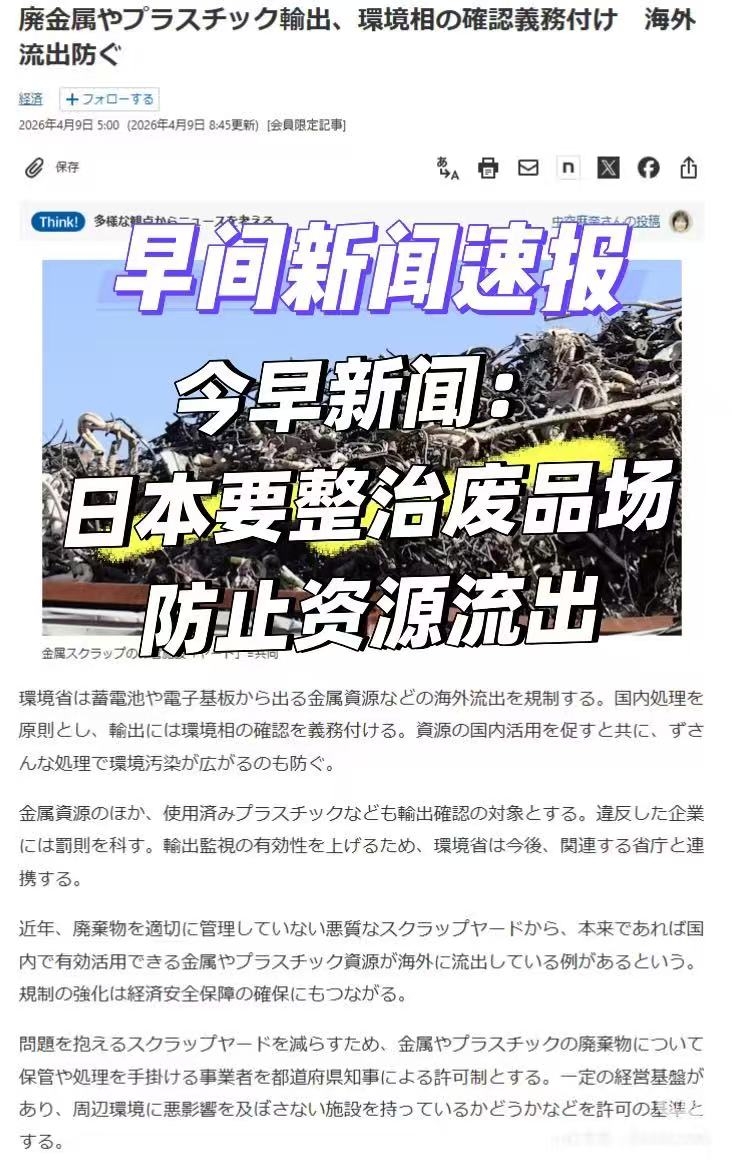
On April 9, 2026, the Japanese Cabinet officially approved the latest amendment to the Waste Disposal and Public Cleansing Act (commonly known as the "Waste Cleansing Act"). The core of the amendment is to upgrade metal recycling operations from a notification system to a permit system, and to impose a new obligation requiring confirmation from the Minister of the Environment for scrap metal exports.
May 1, 2026 10:27
Is It Profitable for China to Import Lead Now? SMM Reports - Shanghai Metals Market (SMM)