The 2026 iron ore supply narrative still looks comfortable on the surface. The numbers tell a different story.Sixteen major mining entities produced about 1,017 Mt in the first nine months, up roughly 23 Mt year-on-year (2.3%). Around 8 Mt of the gain came from India’s NMDC, most of it sold at home, so the seaborne increase was closer to 15 Mt.
Rio Tinto Pilbara, BHP WAIO, Fortescue and Vale’s own mines — the Big Four — added just 0.6 Mt between them, and all of that came from a weak first quarter. MinRes’s Onslow and Guinea’s Simandou delivered about 20.4 Mt of the increase. The growth has shifted. It is no longer coming from the Big Four.
1. A net ~23 Mt increase, with 0.6 Mt from the Big Four
Eight of the 16 operations grew, eight fell. Gross gains were about 38.3 Mt, declines 15.3 Mt — so cuts wiped out 40% of the additions. The gains were tightly concentrated. Onslow, Simandou SimFer and WCS together added roughly 20.4 Mt (53% of the gross increase). Throw in NMDC’s 8.1 Mt and those four names delivered 74% of the growth.
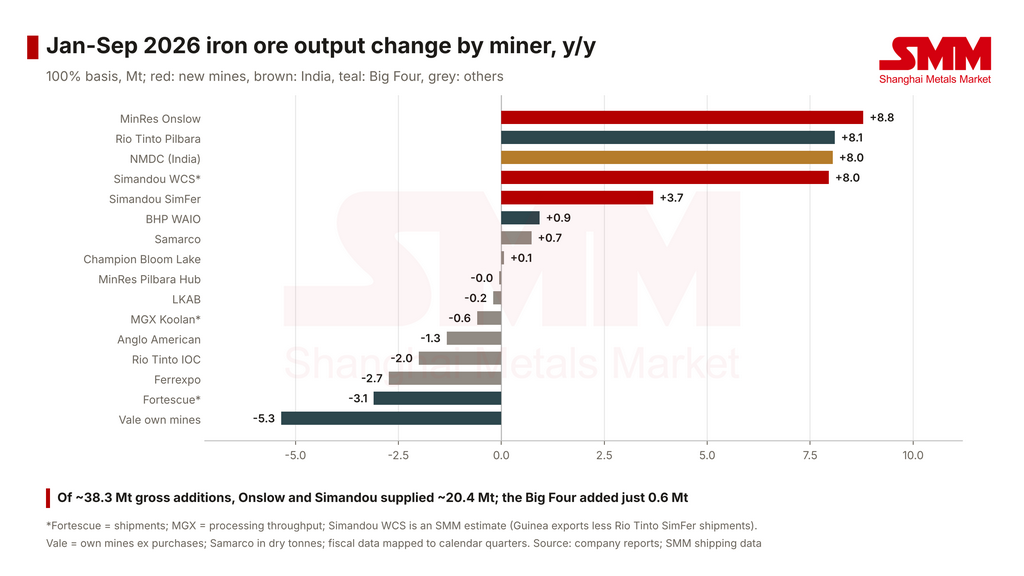
Figure 1: Jan-Sep 2026 iron ore output change by miner, y/y (Mt). Source: company reports; SMM shipping data
The Big Four produced 827.5 Mt in the first nine months, only 0.6 Mt more than last year — less than 0.1%. When the four biggest systems are essentially flat, the smaller new mines decide the direction of supply.
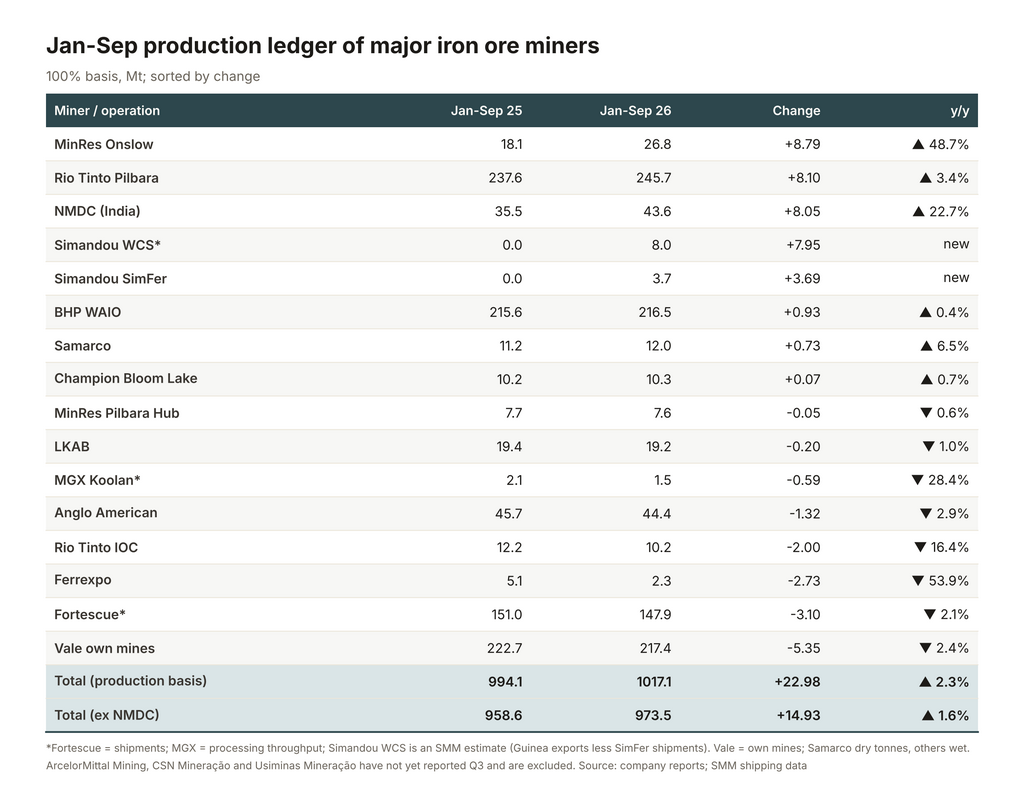
Figure 2: Jan-Sep production ledger of major iron ore miners (Mt). Source: company reports; SMM shipping data
2. New mines drive the expansion: Onslow and Simandou take over
Onslow is the clear growth leader this year. MinRes’s Onslow Iron produced 26.85 Mt (100% basis) in the first nine months, up 8.79 Mt or 48.7%. It was still ramping through the first half of 2025 (only 6.18 Mt in Q2). By Q3 2026 it reached 10.26 Mt, a quarterly record. Current shipping rates are already around 36.9 Mt a year — above the 35 Mtpa nameplate.
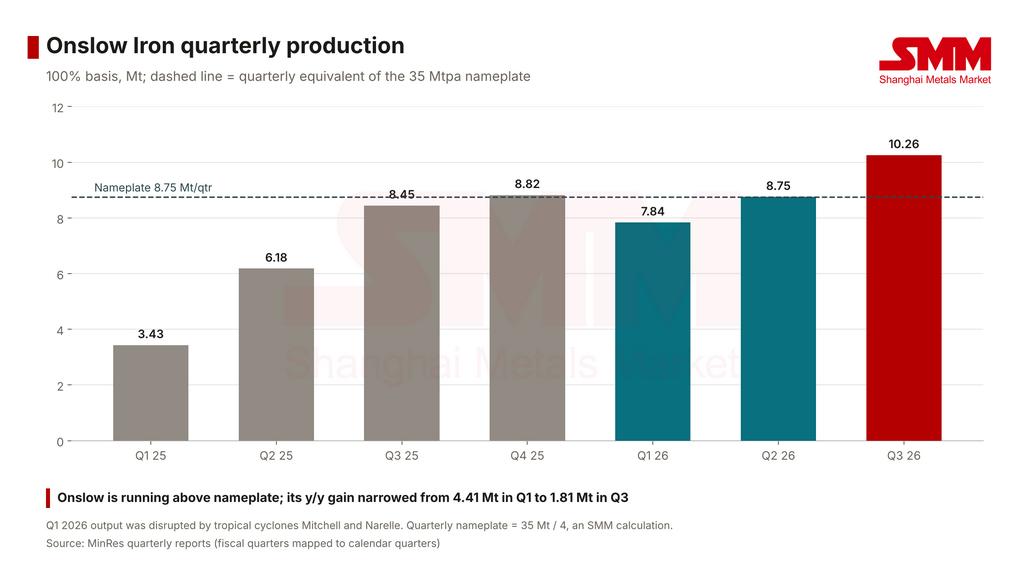
Figure 3: Onslow Iron quarterly production (Mt). Source: MinRes quarterly reports
Simandou is moving faster still. Guinea exported 12.35 Mt in the first nine months of 2026 (SMM shipping data), against almost nothing a year earlier. Monthly volumes rose from 0.28 Mt in January to 3.54 Mt in September. Rio Tinto’s SimFer operation (Blocks 3 and 4) produced 3.69 Mt and shipped 4.40 Mt to China over the first three quarters. Third-quarter output was already annualising near 10 Mt. SimFer’s own port only started loading in the fourth quarter; until then the ore went out via WCS.
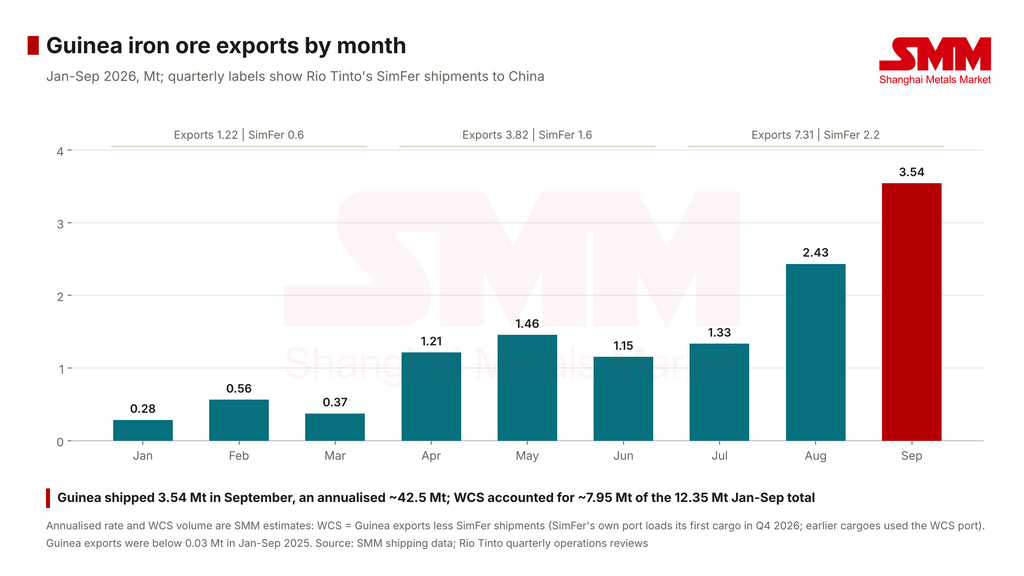
Figure 4: Guinea iron ore exports by month (Mt). Source: SMM shipping data; Rio Tinto quarterly operations reviews
NMDC is a further growth line, but its gains mostly stay in India. NMDC produced 43.55 Mt in January-September, up 8.05 Mt, or 22.7%. Sales were 37.52 Mt, up only 7.5%, and have run well below output since June; NMDC did not explain the gap.
3. Cuts are concentrated in older districts, led by Vale's Northern System
Vale's own mines lost 5.35 Mt, the largest decline of any operation this year. Vale's own-mine output was 217.4 Mt in January-September, down 2.4% y/y. Total output including third-party purchases was 242.3 Mt, down 1.4%, with purchases up 1.96 Mt providing some cushion. The losses came from two places: Serra Norte and Serra Leste in the north fell 13.05 Mt, or 21.2%, and Paraopeba in the south fell 5.66 Mt, or 50.7%.
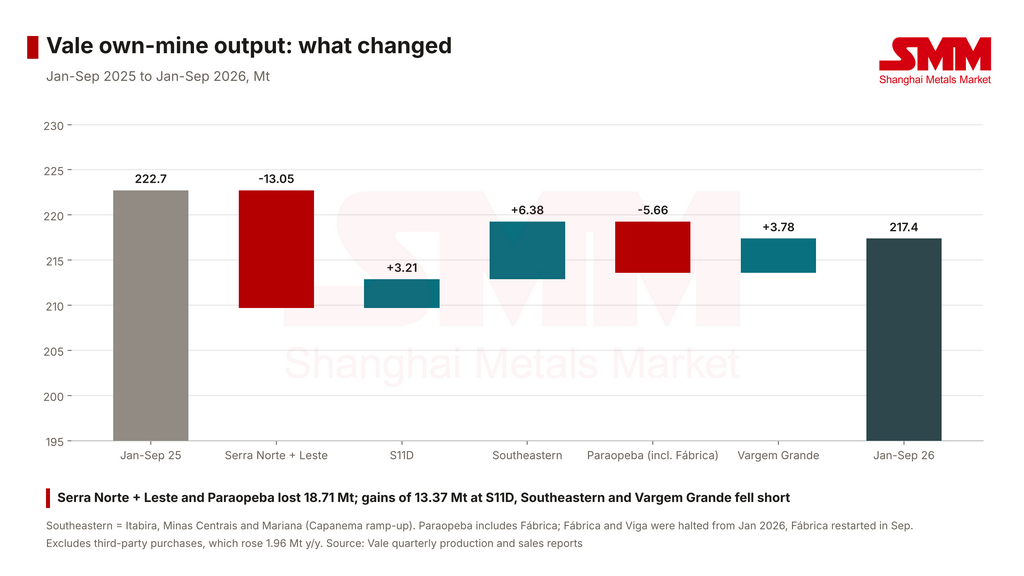
Figure 5: Vale own-mine output: what changed (Mt). Source: Vale quarterly production and sales reports
The two declines have different causes. Vale said lower run-of-mine availability at Serra Norte reflected operating constraints near cave-related exclusion zones and at the bottom of the pits, plus a one-off fleet reliability issue in the third quarter. The Paraopeba loss came from the halt of the Fábrica and Viga mines from January; Fábrica restarted in September. Gains of 13.37 Mt at S11D, the Southeastern System (Capanema ramp-up) and Vargem Grande did not fill the gap. Vale's third-quarter report said it remains confident of delivering the lower end of its 335-345 Mt guidance for the year.
The other declines were scattered. Fortescue's shipments fell 3.1 Mt, or 2.1%, with hematite lower and Iron Bridge magnetite concentrate up 1.2 Mt. Ferrexpo's output fell 2.73 Mt, or 54%, after attacks on Ukraine's power grid and a production halt in August following an attack on its Black Sea export route. Rio Tinto's IOC lost 2.0 Mt to pit remediation and a port car dumper replacement. Anglo American fell 1.32 Mt, mainly because Kumba's Sishen mine shut its existing plant to tie in the ultra-high dense media separation (UHDMS) project. MGX's Koolan Island stopped mining after the main pit collapsed in October 2025; it sold only low-grade stockpiles this year and flooded the pit in October.
new mines supplied more than half of the ~23 Mt net increase, the Big Four contributed almost nothing, and Vale's Northern System is the largest gap.
4. The Big Four's gain came from a low base and turned negative by Q3
All of the Big Four's 0.6 Mt gain came in the first quarter. By quarter, the four added 14.84 Mt y/y in the first quarter, then lost 4.74 Mt in the second and 9.51 Mt in the third. The first-quarter gain came mainly from Rio Tinto: four tropical cyclones in the first quarter of 2025 cost the Pilbara about 13 Mt of shipments, creating a low base, and Pilbara output rose 13% y/y in the first quarter of 2026. Across the second and third quarters, Pilbara output was about 0.9 Mt lower than a year earlier.
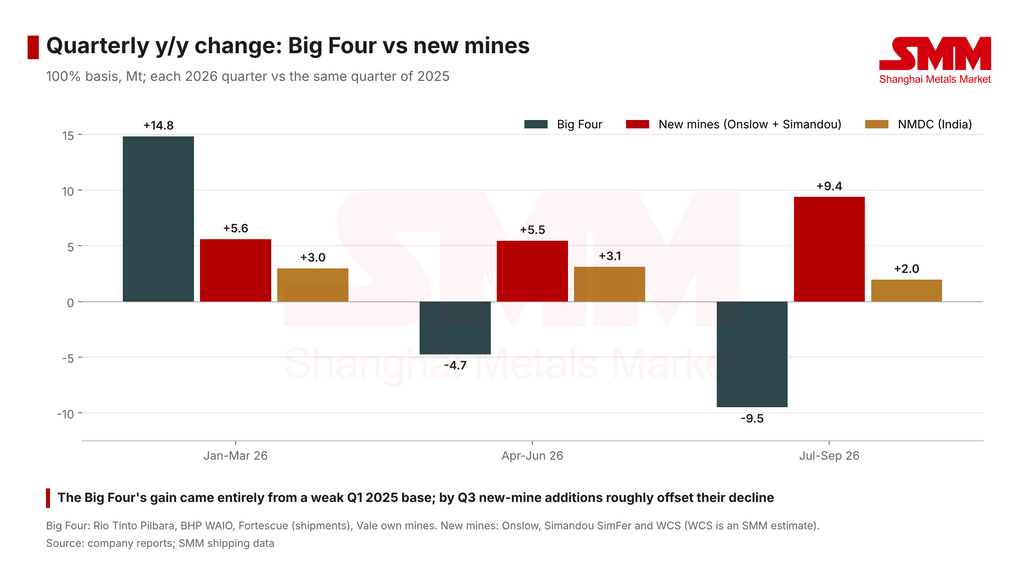
Figure 6: Quarterly y/y change: Big Four vs new mines (Mt). Source: company reports; SMM shipping data
The new mines moved the other way. Onslow and Simandou together added 9.38 Mt y/y in the third quarter, roughly offsetting the Big Four's 9.51 Mt decline. Within the new mines the baton is also passing: Onslow's y/y gain narrowed from 4.41 Mt in the first quarter to 1.81 Mt in the third, and Simandou has taken over the acceleration.
The Big Four's bottlenecks lie mostly in ports and system maintenance rather than in the mines. BHP's WAIO mines and port set quarterly records in the third quarter, but the rebuild of car dumper 4 cost 1.4 Mt. Fortescue carried out what it called the largest planned port shutdown in its history in the third quarter. Rio Tinto has flagged that Pilbara port capacity will fall below 360 Mtpa in some quarters of 2027-2028. For systems producing more than 800 Mt a year, standing still already requires constant investment.
5. Declines are mostly constraint-driven; market-driven cuts have only just begun
This year's main declines nearly all stem from clear operating or external constraints: Vale's exclusion zones and halted mines, IOC's pit remediation, Kumba's plant upgrade, the war around Ferrexpo, and the collapse at Koolan. Vale, IOC and Kumba have defined recovery paths. Vale said the extra stripping and contact-ore work in the third quarter would raise hematite availability in the coming months and expects Serra Norte to grow y/y in the fourth quarter. Koolan has left the market for good.
The only explicitly market-driven cut came from Brazil's CSN Mineração. On 29 September CSN Mineração cut its 2026 production guidance (including purchases) from 45-47 Mt to 39-41 Mt, citing higher freight and a tighter market. It temporarily reduced low-grade output at the Pires complex's dry plant and cut purchases, saying the volume can be restored at any time. SMM's Tubarão to Beilun/Baoshan freight rate averaged US$36.26/t in the third quarter, against US$24.67/t in the first. Low-grade, long-haul and purchase-dependent output is the first to be squeezed when freight rises.
Fortescue's uncertainty lies in the next phase. Its third-quarter sales were 42.9 Mt, 3.9 Mt below shipments, because negotiations with China Mineral Resources Group (CMRG) were still under way. Fortescue expects product inventory to rise by a further 4-5 Mt in October and said operations could be affected if talks are not concluded by year-end; its FY27 shipment guidance of 197-207 Mt is also subject to the outcome.
6. Three miners with first-half data: Liberia accelerates, Brazil's mid-tier shrinks
ArcelorMittal Mining, CSN Mineração and Usiminas Mineração have not yet reported third-quarter figures and are excluded from the totals above, but their first-half direction matches the main story. ArcelorMittal Mining (AMMC in Canada plus Liberia) produced 19.8 Mt in the first half, up 18.6% y/y, mainly on improved operations and concentrator ramp-up in Liberia. CSN Mineração's first-half output (including purchases) was 20.94 Mt, down 3.9%; Usiminas Mineração produced 4.14 Mt, down 7.2%. Together the three added 1.92 Mt in the first half, with West Africa growing and Brazil's mid-tier miners shrinking.
The Big Four's output is locked in place by maintenance, permitting and geology; the most price-sensitive output, and the first to shrink, belongs to mid-tier miners relying on purchases and low-grade ore.
7. 2027 growth is still queuing at the new mines
Most new capacity in 2027 still sits outside the Big Four. At Simandou, Rio Tinto maintains its target for SimFer to reach 60 Mtpa (dry) in the second half of 2028, with 2026 sales guidance of 5-10 Mt. SMM's April analysis of African iron ore showed WCS plans to reach 60 Mt at Blocks 1 and 2 within 2-3 years. Based on September exports of 3.54 Mt, Guinea is already running at an annualised ~42.5 Mt. ArcelorMittal Liberia's 20 Mtpa Phase 2 is commissioning and is due to be completed by end-2026, against 2025 shipments of 10 Mt.
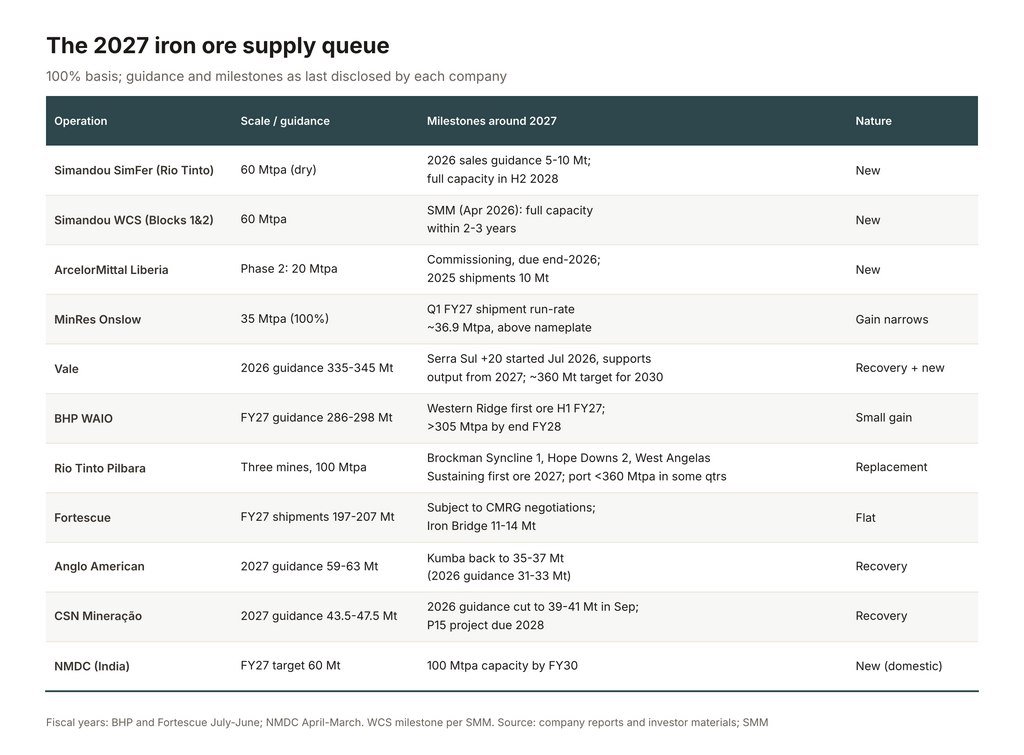
Figure 7: The 2027 iron ore supply queue. Source: company reports and investor materials; SMM
Onslow’s contribution will narrow sharply next year. The operation has been running near nameplate since the fourth quarter of 2025. Its first-nine-months 2026 output already annualises at about 35.8 Mt, so the year-on-year gain in 2027 is likely to be far smaller than this year’s 8.79 Mt.
Most of the Big Four’s 2027 projects are about sustaining or replacing existing capacity rather than adding new growth. Rio Tinto’s Brockman Syncline 1, Hope Downs 2 and West Angelas Sustaining projects (combined 100 Mtpa) are due for first ore in 2027 and are positioned as continuations of existing hubs. BHP guides WAIO to 286–298 Mt in FY27 and is targeting more than 305 Mtpa by the end of FY28. Vale started its Serra Sul +20 project in July and expects it to support output from 2027, with a longer-term target of about 360 Mt by 2030.
Simandou heads the 2027 growth list. Most of the Big Four’s projects are about replacing depleted capacity rather than adding new growth.
8. End game: iron ore supply can no longer be read from Big Four guidance alone
The 2026 numbers show the Big Four shifting from growth engines to volume defenders. Systems that together produce more than 800 Mt a year were essentially flat through the first nine months. The extra tonnes came from Guinea, Onslow and India. Once growth moves like this, the Big Four’s quarterly numbers no longer tell the full story.
Three things now matter more than the Big Four’s annual guidance:
- ✅ Simandou's ramp-up: Guinea exported 3.54 Mt in September; can it keep climbing once SimFer's own port starts loading?
- ✅ Recovery in Vale's north: Serra Norte and Serra Leste lost 13.05 Mt in the first nine months; will they return to y/y growth in the fourth quarter as Vale expects?
- ✅ Price-sensitive volume: the outcome of Fortescue's CMRG talks and its inventory, and how low-grade, long-haul output such as CSN Mineração's responds to freight.
The baton has changed hands, but the new operators still have a long ramp ahead. Simandou remains a long way from the combined 120 Mtpa design capacity across the two concessions.