I. Data Overview: China Rebounds, Overseas Contracts — A Month of Role Reversal
Let us begin with the main theme. Cumulative crude steel output outside China from January to September 2026 reached 642.7 million tonnes (Mt). Based on official World Steel Association (WSA) YTD data, this represents a year-on-year (YoY) increase of approximately +1.9%, translating to an annualized run-rate of around 857 Mt—still comfortably exceeding the 2025 full-year total of 843 Mt.
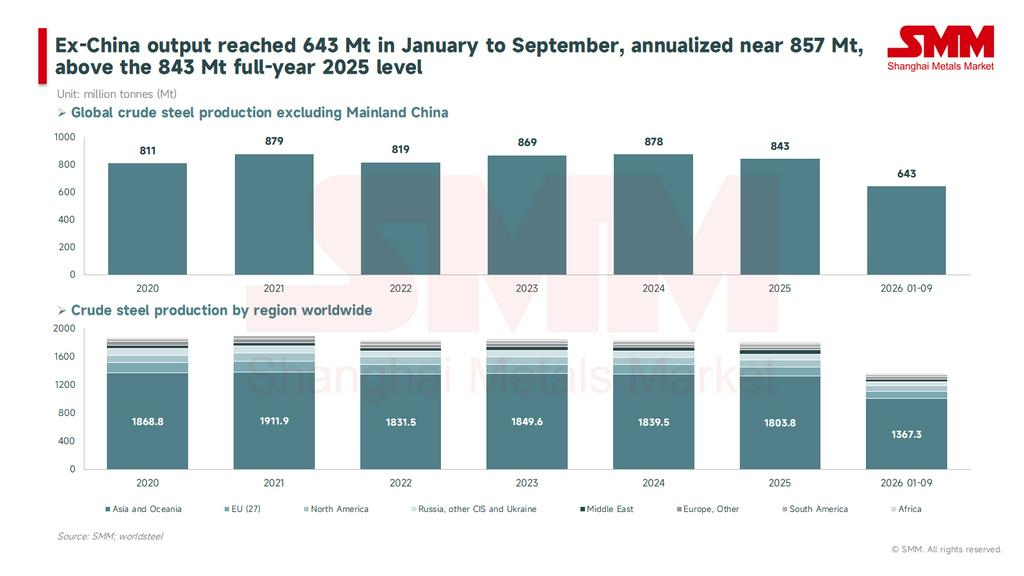
However, single-month momentum in overseas markets has been weakening progressively: +3.5% in July → +1.6% in August → -0.5% in September, marking its first dip into negative territory since April. In the same month, China's YoY growth turned back above the zero axis at +0.1% (only the second time this year, following +0.4% in June). While the global cumulative YTD decline of -0.7% remains entirely driven by China, September witnessed a clear role reversal: China began restocking while overseas supply contracted.
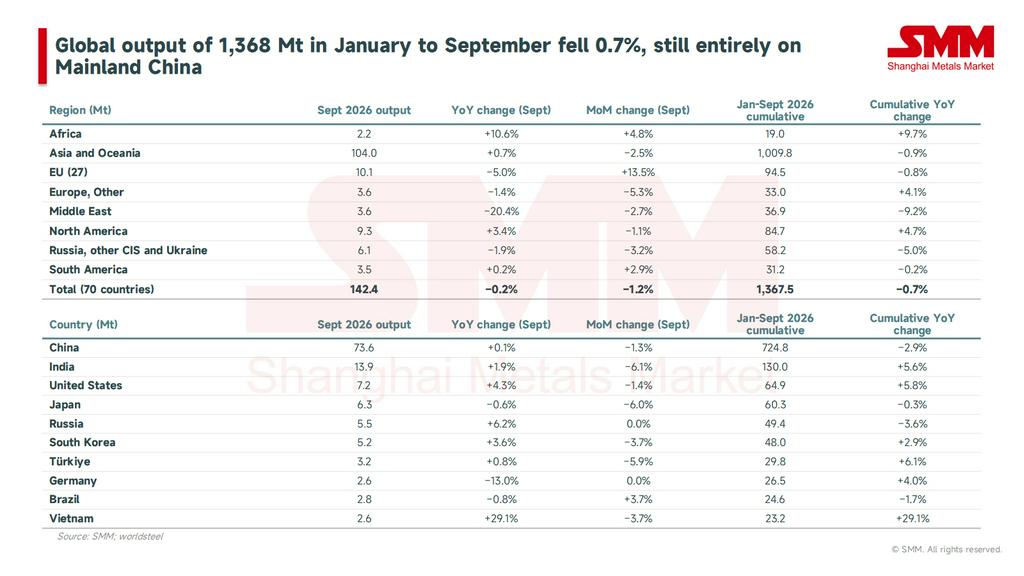
Global production in September totaled 142.4 Mt (-0.2% YoY), bringing the January–September cumulative total to 1,367.5 Mt (-0.7% YoY). Calendar effects this month were opposite to August: September has 30 days versus August's 31 days, meaning absolute MoM figures in standard tables understate the true production pace by about 3.3 percentage points. Assessing supply velocity through daily run-rates shows global daily output rose +2.0% MoM—a normal post-summer holiday seasonal recovery.
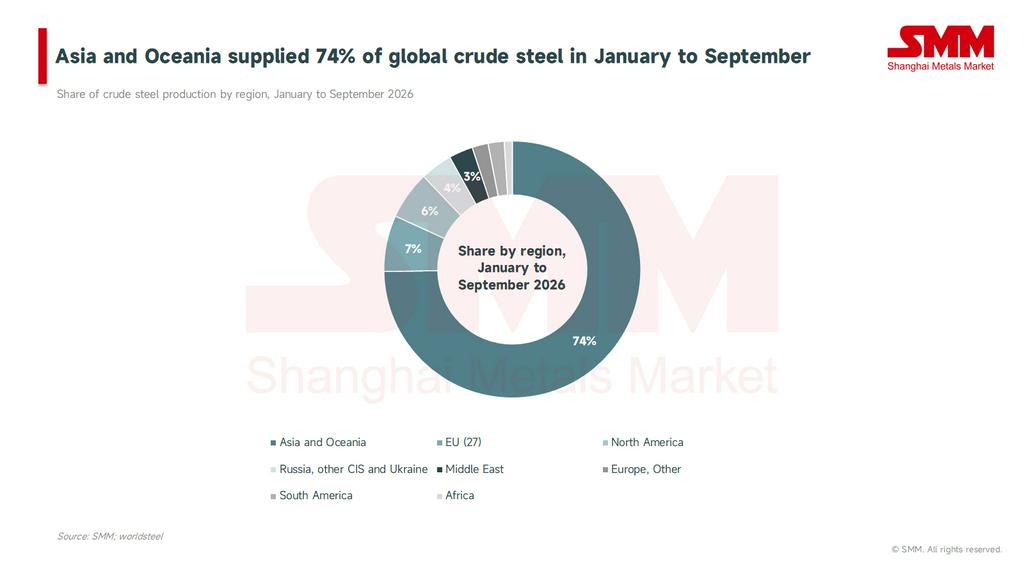
Global structural shares remained essentially unchanged: Asia & Oceania accounted for 74% of global output from January to September, followed by the EU at 7% and North America at 6%.
II. Key Developments in Overseas Markets
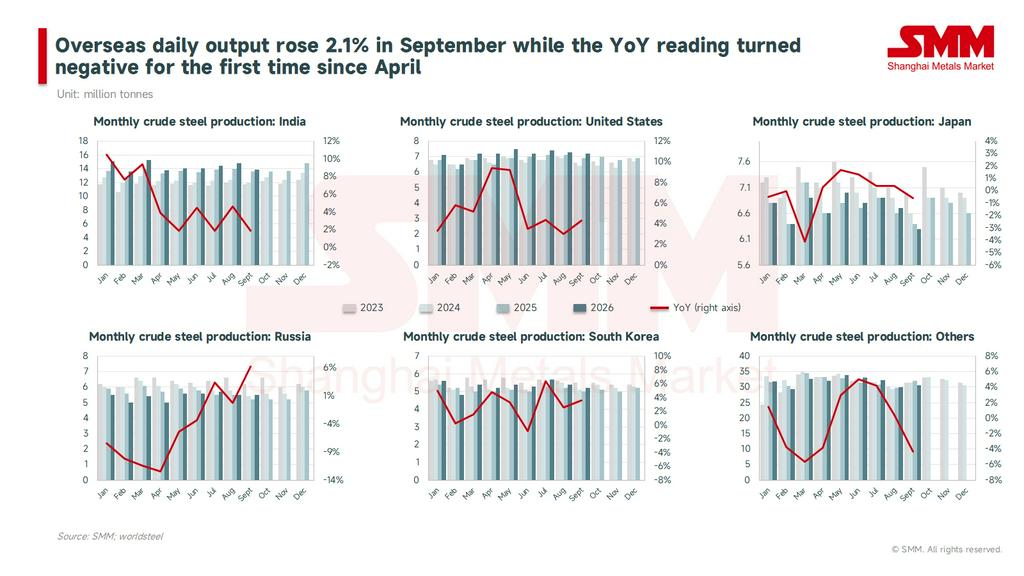
Monthly production and YoY trends across six major markets exhibit dramatic headline swings this month—Middle East down -20.4%, Russia up +6.2%, Vietnam up +29.1%, and Germany down -13.0%. However, analyzing each market individually reveals that three of these four major swings were pure baseline illusions; the only true physical shift was that European supply is disappearing.
1. EU (-5.0%) & Germany (-13.0%): Driven by Supply Outages, Not Weak Demand
EU crude steel production in September reached 10.1 Mt (-5.0% YoY), deteriorating further from August's -1.0%. Interpreting the MoM trend requires careful attention: while the EU experienced its usual post-summer holiday rebound (+13.5% MoM), the magnitude of this recovery fell visibly short of last year’s ~+18% rebound. That missing increment is directly attributable to a cluster of severe supply disruptions in September:
- Germany: ArcelorMittal Eisenhüttenstadt suffered a blast furnace fault that reduced hot metal output, which, coupled with sluggish order books, kept Germany's September production flat MoM at 2.6 Mt. In a normal year, September output rises significantly above August (last September was 3.0 Mt). This absent seasonal ramp-up caused the -13.0% YoY plunge, representing the single largest deficit point in the EU this month.
- Italy: Acciaierie d'Italia (ADI) Taranto idle its coke ovens and its sole operating Blast Furnace No. 2 (2 Mt/year capacity) on September 16. A court order mandated a complete hot-end shutdown by October 28 at the latest (the special commissioner appealed on October 20). Italian September output still posted +2.1% YoY (Federacciai data) because the shutdown covered only half the month; the true supply loss will show up in October.
- Thyssenkrupp: Ongoing maintenance at Duisburg further constrained German hot metal supply.
Conversely, the demand side showed signs of stabilizing. EUROMETAL's September survey indicated improving distributor confidence, while buyers in Southern Europe rushed to restock ahead of ADI's halt. Last month's projection of "EU output turning positive in Q4" requires revision: supply outages have delayed the production rebound, but price strength has materialized ahead of schedule.
2. First Month of Dual October 1 Milestones: Quotas "Exhausted Instantly" & Melt-and-Pour Implemented
- Q4 Import Quotas: Upon the Q4 quota reset on October 1, "Other Countries" allocations for certain categories (such as tinplate) were exhausted on day one. The same quota allocation lasted six weeks in Q3 but barely survived a single day in Q4. Port-cleared stock releases combined with front-running meant quota constraints proved far tighter in practice than on paper.
- Melt-and-Pour Certification: Mandatory enforcement began on October 1 (Implementing Regulation IR 2026/1963). Mill Test Certificates (MTC) must explicitly state the melt-and-pour country and heat number; transitional allowances for alternative documentation (invoices, supplier declarations) run through September 30, 2027. For billet-to-reroll routes transshipped via Turkey or Vietnam, the compliance chain now concretely determines customs clearance.
- Policy Escalation: The European Parliament voted on September 17 to expand CBAM coverage to downstream products such as fasteners and wire rod; the deadline for the first statutory scope review is December 31 (stakeholder consultations concluded September 28).
3. Middle East (-20.4%): Pure Baseline Effect, Not a Reversal in Recovery
The YoY growth rate plummeted from -4.6% in August to -20.4% in September, which at first glance looks like a collapsed recovery. However, daily output actually rose +0.5% MoM, indicating stable physical run-rates. The drop was entirely caused by the baseline profile: September 2025 (4.5 Mt) was a high-production month prior to the conflict, whereas August 2025 stood at only 3.9 Mt. Operational recovery has not stalled, but linear expectations of "monthly YoY improvement" must be abandoned. As Q4 2025 base figures rise, headline YoY readings will fluctuate. With YTD at -9.2%, market participants should track absolute volumes and daily run-rates rather than YoY metrics.
4. Vietnam (+29.1%): Postponing the Baseline Normalization Timeline
Last month's report anticipated that Vietnam's YoY growth would collapse to single digits in September as Dung Quat Phase 2 entered the prior-year baseline. That transition did not occur in September due to a timing misconception: Hoa Phat's Blast Furnace No. 2 was commissioned in September 2025, but full commercial ramp-up took place in Q4 2025 (September 2025 output remained at 2.0 Mt, on par with August). Baseline normalization will instead materialize step-by-step throughout Q4 2026. Vietnam produced 2.6 Mt in September (daily MoM -0.5%), representing steady full-capacity operation, with YTD output up +29.1%. The structural premise holds—decelerating YoY figures will reflect baseline normalization rather than production cuts—with the timeline shifted from September to Q4.
5. Russia (+6.2%): Low Base Distortions Persist, but Daily Run-Rate (+3.3%) Shows Genuine Uptick
Russian output reached 5.5 Mt in September (+6.2% YoY). Applying the standard baseline discount, the depressed H2 2025 base continues to inflate YoY readings, leaving YTD output at -3.6%. However, September offered a distinct signal: daily average output rose +3.3% MoM, holding flat in absolute terms versus August without the expected seasonal dip—a rare genuine MoM increase this year. Regionally, CIS production fell -1.9%, hampered by Ukraine, where ArcelorMittal Kryvyi Rih suffered attacks in late September, pointing to further potential weakness in October.
6. China (Brief Summary): Gentle Rebound Supports Asian Prices
China's daily crude steel production reached 2.453 Mt/day in September (+1.9% MoM), slightly above mid-month trade estimates (2.40 Mt/day). The post-parade production catch-up combined with peak seasonal demand brought YoY growth back to +0.1%, with YTD output at 724.8 Mt (-2.9%). For overseas markets, the core transmission remains unchanged: supply restraint and firm export quotes position China as a price anchor rather than a deflationary pressure, providing underlying support for Asian scrap prices to follow Turkish upward momentum.
III. Key Watchpoints for November–December
1. EU Supply Bottlenecks & Restocking Window
- ADI Judicial Timeline: With the October 28 hot-end shutdown order in effect, if 2 Mt/year of blast furnace capacity halts alongside German production issues, the Q4 European supply deficit will widen beyond previous expectations, expanding price elasticity during the November restocking window.
- Q4 Quota Exhaustion: The speed at which quotas fill across product categories will determine which export avenues are blocked in Q4. The December 31 CBAM expansion review serves as a key leading variable for 2027 trade flows.
2. Global Scrap Prices: 400 USD/tonne Was Just an Intermediate Stop; Spot Deals Hit 435 USD/tonne
- CFR Turkey HMS 80:20: Prices rose from 400 USD/tonne in mid-September to 411 USD/tonne in mid-October, with late-October US-origin cargoes booked at 435 USD/tonne and shredded scrap at 440 USD/tonne CFR. Drivers include November shipment restocking in Turkey, tightening European scrap supply, and stronger US domestic demand diverting cargoes.
- Asian Rebound: Asian markets are following suit, with Vietnamese import scrap rising and Tokyo Steel repeatedly raising domestic buy prices above 51,000 JPY/tonne. If ADI's halt boosts Turkish finished steel exports to Europe, scrap prices could see a second upward wave.
3. Middle East & Russia: Fluctuating Q4 YoY Metrics — Focus on Daily Run-Rates
- Middle East YoY figures will oscillate between -10% and -20% as the late-2025 base rises, making absolute production volumes and Iranian ramp-ups the true indicators to watch.
- Russian YoY figures will remain artificially inflated by low baselines, while Ukrainian supply faces downside risks following recent facility attacks.
4. China as an Exogenous Anchor: Export Quotes Set the Asian Floor
- The "Silver October" demand and export booking window will be critical. If Chinese export prices hold current levels, the Asian scrap-to-finished-steel price linkage will remain intact.
IV. Summary
The dramatic swings in September's figures were largely optical: China turning positive, overseas turning negative, the Middle East plunging, and Russia surging were mostly baseline artifacts. The single genuine physical shift was that European steel supply is disappearing due to German blast furnace disruptions and ADI's court-ordered shutdown. Instantly exhausted Q4 quotas on October 1 and scrap prices surging to 435 USD/tonne confirm that the market has begun pricing in a European steel shortage. The elasticity of the November restocking window may prove even greater than previously anticipated.