I. Weekly Price Review
Germanium prices broke upward this week: germanium ingot was raised to 28,250 yuan/kg on October 20 and further to 28,500 yuan/kg on October 21, then held steady; germanium dioxide moved up in tandem, raised successively to 19,750 yuan/kg and 19,900 yuan/kg. Both products hit new highs since the start of the current uptrend.
The current germanium price rally began in early August, characterized by a stepwise climb of "one step per week," with no weekly pullback during the period; this week, after consolidating for nearly three weeks last month, prices stepped up again, extending the uptrend.
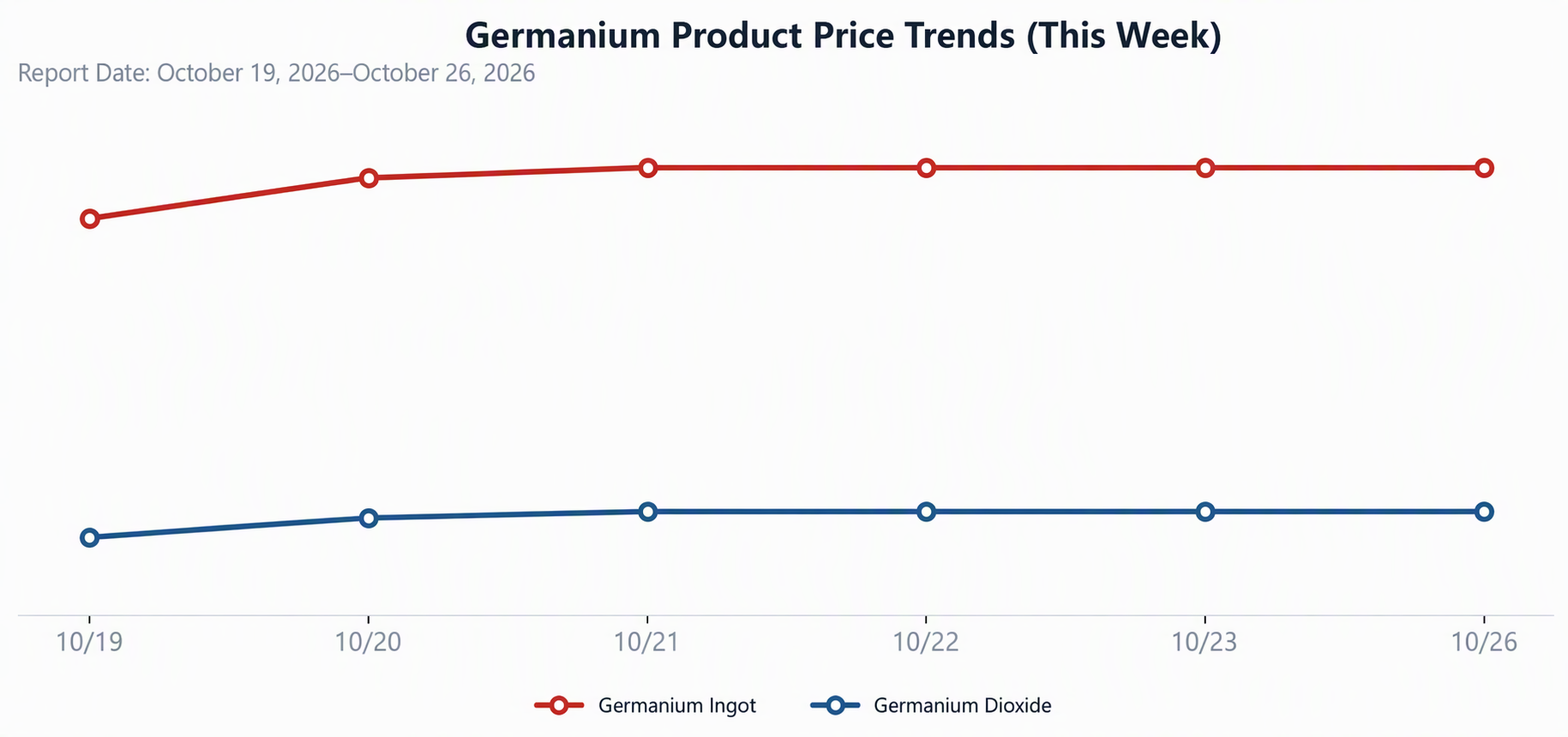
Chart-1: Germanium product price trends (October 19–October 26)
In Chart-1, the two curves completed their upward adjustments simultaneously within the first two days of the week and then flattened, showing a clean, decisive pattern: once prices were adjusted in a single move, there was no back-and-forth, indicating that smelters have strong willingness and confidence to execute price increases. The gap between the two curves (the price spread between germanium ingot and germanium dioxide) remained stable, and the oxide strengthened in tandem with the metal ingot, confirming that the price increase is driven by costs and supply-demand dynamics across the entire chain rather than speculation in a single segment.
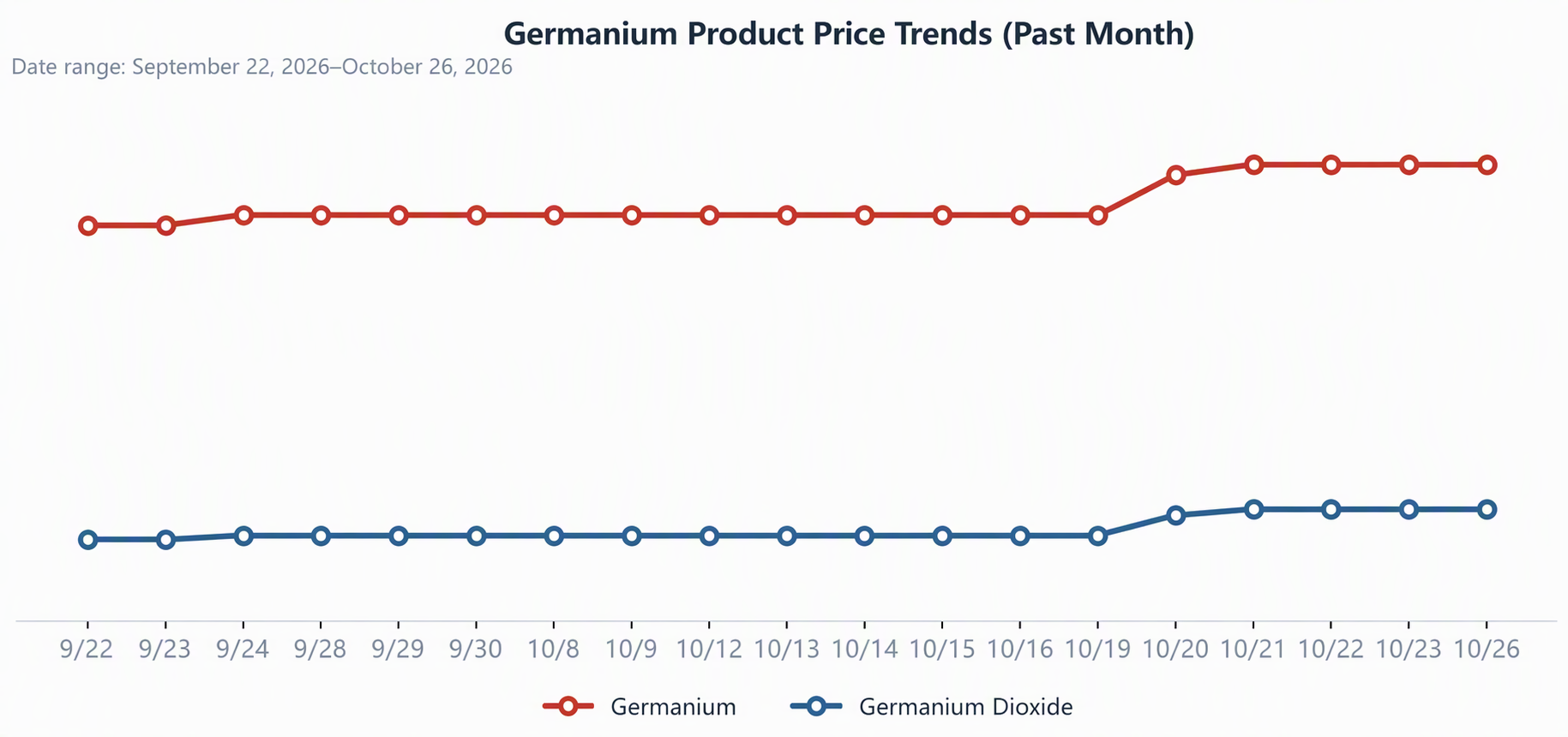
Chart-2: Germanium product price trends (September 22–October 26)
The one-month perspective clearly shows a "long plateau—step up" rhythm: since late September, germanium prices consolidated on a plateau for nearly a month, and this week the curve rose sharply by two levels. The longer the plateau and the more fully accumulated the momentum, the better the stability after the step-up typically is; combined with previous cycles of "consolidation—upward adjustment—re-consolidation," the curve pattern indicates that the current uptrend remains in a healthy stepwise progression, with no signs of an overheated spike yet.
II. Supply Dynamics
Supply remained tight: germanium in China is mainly associated with lead-zinc ores and lignite, with limited total mining output, tight supply of germanium-bearing materials, low raw material inventories at smelters, and limited output elasticity; recycled germanium volumes are small and channels are fragmented, making it difficult to provide effective supplementation.
This week's active upstream transactions confirmed the tightness of raw materials: the germanium concentrates sales project of Shaoguan Zhongjin Lingnan Danxia Smelter was successfully concluded early in the week, with the transaction price in the upper range of spot prices, and the buyer was a company in Yunnan. High tender prices for raw materials provided direct support from the cost side for the upward adjustment of germanium ingot and germanium dioxide quotes.
III. Trade and Policy
Export controls on germanium-related items continued to be implemented on a normalized basis, with exports requiring case-by-case approval and restricted circulation of ex-China cargoes; ex-China germanium prices have long been significantly higher than domestic prices, and with the inverted price spread between China and ex-China markets, the impulse for domestic cargo outflows coexists with control constraints.
High ex-China prices have created a "ceiling-lifting" effect on domestic prices: domestic smelters' quotes continue to converge toward ex-China levels, which is also an important exogenous driver of the steadily rising domestic germanium price center in this cycle. The pace of control approvals and changes in the China-ex-China price spread remain the core windows for observing price upside potential.
IV. Demand Side
Infrared optics is the core demand engine: germanium is the key material for infrared lenses in thermal imaging cameras, and sectors such as national defense and military, security monitoring, industrial temperature measurement, and automotive night vision remain highly prosperous. Q4 has traditionally been the peak season for military order deliveries and security equipment procurement, and downstream infrared lens producers have already stepped up stockpiling of germanium-bearing materials in advance.
Satellite and optical fiber demand is resonating: germanium substrates are key materials for high-efficiency gallium arsenide solar cells used in satellites, and the acceleration of low-orbit satellite constellation deployment is boosting germanium substrate orders; demand for germanium tetrachloride used in optical fiber doping remains stable along with optical communication construction. It is worth noting that downstream acceptance of high price ranges has weakened compared with low-price phases, and the marginal boost from demand to prices has diminished somewhat.
V. Market Outlook
In the short term, the pattern of tight supply resonating with peak-season demand remains unchanged, and germanium prices are expected to continue consolidating on a strong note with a rising center; however, the pace of gains may gradually slow compared with earlier, and the probability of another step-up after a period of consolidation is relatively high.
Risk points include: the cumulative dampening effect of high prices on downstream demand, with some infrared lens producers already beginning to evaluate alternative materials such as zinc sulfide; and the commissioning progress of new ex-China supply projects also needs to be monitored. In the medium term, the logic of a trend-widening germanium supply-demand gap is the most solid among strategic minor metals, and the price center still has room to move higher.
Key Points to Watch Next Week
|
Focus Area |
Details |
|
Price trends |
Stability of the 28,500 yuan/kg platform; whether the "consolidation—upward adjustment" rhythm continues |
|
Supply side |
Supply of germanium-bearing materials, smelter raw material inventories, changes in raw material tender transaction prices |
|
Trade |
Pace of export control approvals, China-ex-China price spread trends |
|
Demand side |
Strength of Q4 military infrared and security procurement peak-season fulfillment, low-orbit satellite orders |
|
Risk items |
Progress in application of alternative materials such as zinc sulfide, developments in new ex-China supply projects |
Note: Price data as of October 26, 2026; this report covers October 19–October 26.