I. Weekly Price Review
The indium market fell first and then rebounded this week: at the beginning of the week (October 19–20), quotes across all grades were lowered in a concentrated manner, with refined indium dropping from 5,050 yuan/kg to 4,750 yuan/kg; mid-week (the 22nd), it hit the range low of 4,700 yuan/kg before the decline lost momentum; at the end of the week (the 23rd and 26th), a notable rebound occurred, with refined indium recovering to 4,900 yuan/kg and crude indium rebounding to 4,725 yuan/kg.
For the full week, all three grade ranges still ended lower than at the start of the week, with declines of around 150 yuan/kg; however, the rebound over the last two trading days of the week was substantial, marking the first meaningful recovery since this downward cycle began.
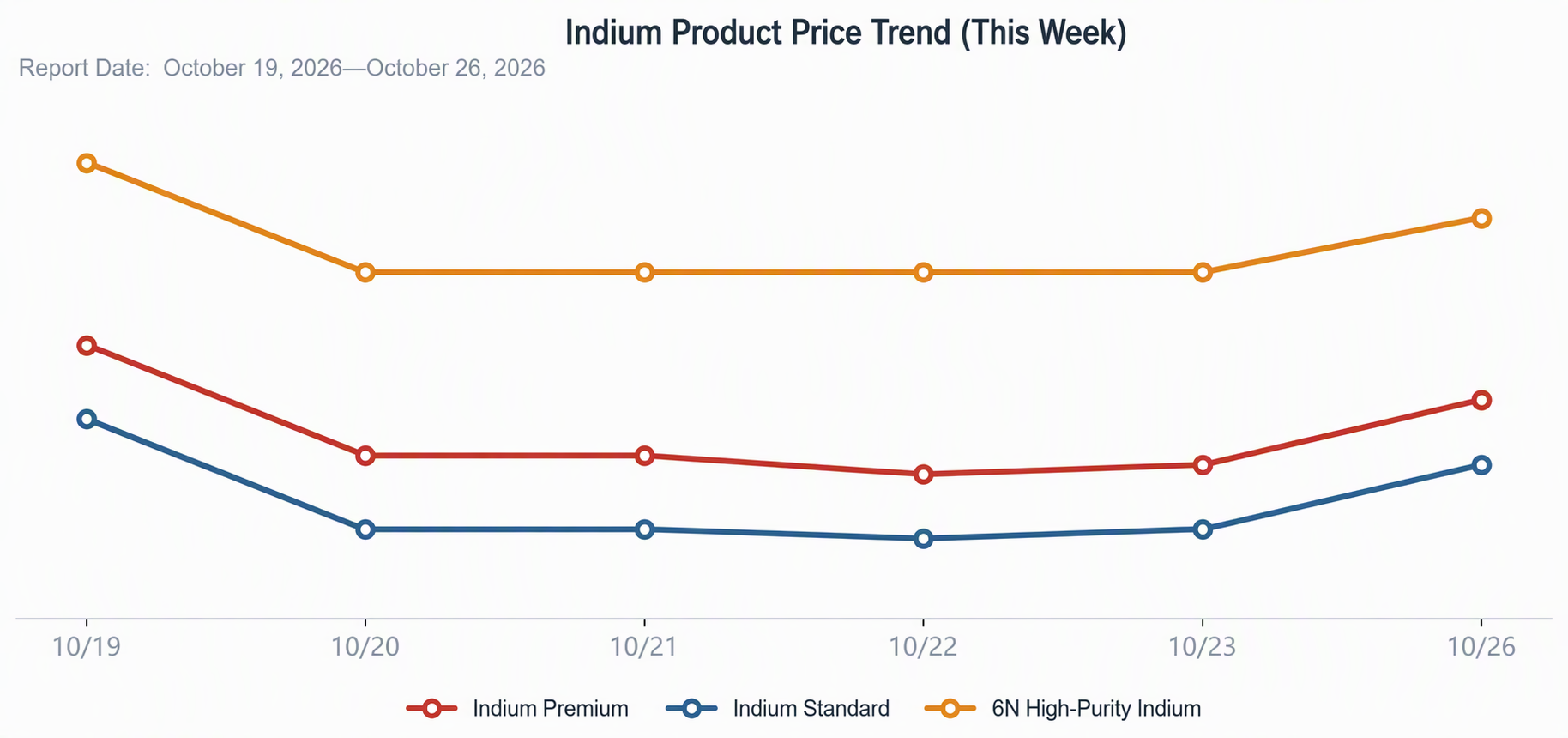
Chart-1: Indium Product Price Trends (October 19–October 26)
In Chart-1, the three curves moved in a synchronized V-shaped pattern of "step down–rebound," and the price spread structure among grades remained stable throughout—the relative positions of refined indium, crude indium, and 6N high-purity indium did not change amid this week's fluctuations, indicating that this was a market-wide repricing of supply and demand rather than an isolated disturbance in any single segment. The upward inflection of the curves after hitting bottom on the 22nd deserves attention: a synchronized rebound from lows typically suggests that prices had fallen to levels where some buyers were willing to re-enter the market, and short-term selling pressure had been absorbed.
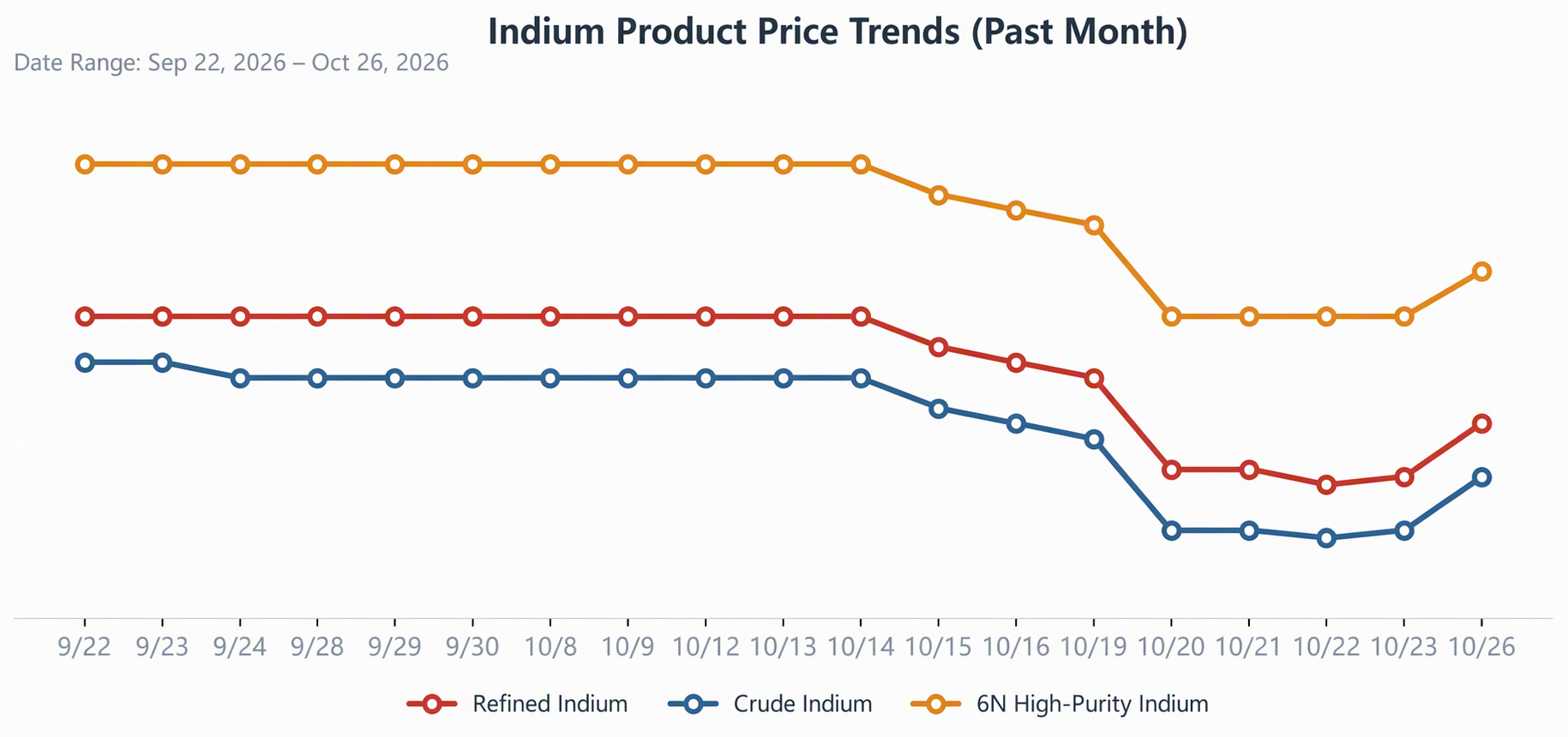
Chart-2: Indium Product Price Trends (September 22–October 26)
From a one-month perspective, indium prices followed a three-stage pattern of "extended high plateau–stepwise decline–rebound from lows": from late September through early October, the three curves were nearly flat; from mid-October, they declined continuously, completing the final leg down early this week before turning upward. The step-like character of the downward segment was pronounced, reflecting the process of suppliers conceding on price level by level; the upward hook at the end marks the first clear directional reversal in the curves in nearly a month. If it continues next week, a short-term bottoming pattern may be confirmed.
II. Supply Dynamics
The supply-side structure remained unchanged: primary indium is mainly produced as a byproduct of zinc smelting systems, with output pacing zinc plant operating rates and remaining generally stable; secondary recycling channels have relatively ample material, and supply pressure is most pronounced in the crude indium segment, which was one reason crude indium hit the deepest lows this week.
At the supplier level, after consecutive price concessions earlier in the period, the willingness to sell has moderated somewhat, and sentiment of holding back from selling at low prices began to emerge mid-week, setting the stage for the weekend rebound.
III. Trade and Policy
Domestic and ex-China markets continued to diverge: ex-China refined indium CIF quotes held steady for most of the week and were raised to $895/kg on Friday, further widening the price spread between China and ex-China markets. The firmness of ex-China quotes has a "ceiling-raising" effect on domestic prices; if export orders can be fulfilled, they will provide phased support for domestic prices.
Indium is not currently on the export control list, and export channels are relatively smooth. The existence of an arbitrage window between China and ex-China markets makes exports an important channel for absorbing domestic surplus supply. Going forward, attention should be paid to the pace of ex-China restocking and the fulfillment of export orders.
IV. Demand Side
The core variable on the demand side remains ITO targets: indium consumption is highly concentrated in the display panel sector, and the pattern of downstream purchasing as needed with weak stockpiling willingness has not changed, which is the fundamental reason for the downward shift in the price center.
A positive signal is that after the price pullback, procurement cost pressure on target producers has eased, and the Q4 panel stockpiling window is approaching. If end-user orders improve, restocking demand may be released in a concentrated manner. The weekend rebound this week may already partly reflect these expectations.
V. Market Outlook
In the short term, prices are expected to consolidate at lows with the center gradually stabilizing: if the synchronized weekend rebound is validated by trading volume next week, a short-term bottom may be confirmed; conversely, if the rebound fizzles, prices will continue to fluctuate at low levels.
In the medium term, indium demand lacks incremental scenarios to provide a hedge, and its price elasticity is weaker than that of germanium and antimony. A recovery in the price center depends on a substantive rebound in ITO demand and the continued diversion of surplus supply through export channels.
Key Points to Watch Next Week
|
Focus Area |
Details |
|
Price Trends |
Whether the weekend rebound can continue and whether refined indium can reclaim the 5,000 yuan/kg level |
|
Supply Side |
Evolution of supplier hold-back sentiment and changes in secondary material circulation |
|
Trade |
Direction of refined indium CIF quotes, the price spread between China and ex-China markets, and fulfillment of export orders |
|
Demand Side |
Order placement during the Q4 panel stockpiling window and operating rates at ITO target producers |
|
Macro Front |
Impact of ex-China restocking pace and exchange rate changes on exports |
Note: Price data as of October 26, 2026; this report covers October 19–October 26.