Lead
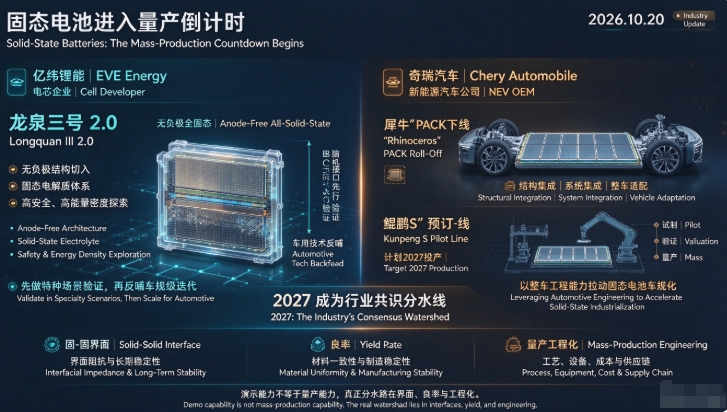
On October 20, 2026, EVE Energy and Chery Automobile unveiled the latest engineering milestones in all-solid-state batteries on the same day. At its Chengdu base, EVE Energy released the “Longquan No. 3 2.0” all-solid-state battery, targeting implantable brain-computer interfaces with a volumetric energy density of 1,045 Wh/L. On the same day, Chery unveiled a roadmap for its “Kunpeng S” all-solid-state battery trial production line at the 2026 Global Innovation Conference, with production scheduled to begin in 2027; a day earlier, its “Rhino” all-solid-state battery pack had just rolled off the line and made its debut. These latest moves by the two companies offer two equally crucial yet distinctly positioned samples for observing the real cadence of China’s solid-state battery transition from technical validation to engineering validation.
I. EVE Energy’s “Scenario Wedge”: An Alternative Validation Path Beyond the Automotive Narrative
1.1 Longquan No. 3 2.0
In public communication, EVE Energy’s newly released “Longquan No. 3 2.0” may easily be folded into the broad narrative of “a new breakthrough in all-solid-state batteries,” but its technical positioning calls for a more precise reading. The product adopts an anode-free route and achieves a volumetric energy density of 1,045 Wh/L in a titanium-cased coin cell measuring 23 mm in diameter and 4 mm in thickness, explicitly serving the implantable brain-computer interface segment—a field with extremely stringent demands on volume, safety, and long-term stability.
It follows a different product logic from automotive traction batteries: automotive all-solid-state batteries pursue a comprehensive balance of high specific energy, high rate capability, and wide-temperature cycling, whereas the core constraint for implantable medical power sources is to achieve the highest possible volumetric energy density within an extremely small space while eliminating leakage and thermal-runaway risks through a solid electrolyte.
1.2 Longquan No. 4
In March this year, the “Longquan No. 4” 60 Ah all-solid-state battery for traction applications had already rolled off the line and can cycle under a pressure of ≤5 MPa, showing preliminary potential for practical use. EVE’s published roadmap also points to launching an all-solid-state battery 1.0 at 350 Wh/kg and 800 Wh/L in 2026, and advancing a 2.0 product exceeding 1,000 Wh/L in 2028.
But the decision to make the implantable brain-computer interface the debut scenario for “Longquan No. 3 2.0” reveals a pragmatic validation strategy: at a stage when large-scale engineering validation of automotive-grade all-solid-state batteries still takes time, first complete the technical loop and manufacturing ramp-up in a niche market with clear scenario constraints, higher cost tolerance, and a greater weighting on safety. The implantable medical segment is far too small in volume to support power-battery-scale capacity, yet it imposes sufficiently rigorous validation requirements on the reliability of the “anode-free + solid electrolyte” scheme under extreme conditions, and its engineering experience can feed back into interface control and packaging processes for later automotive products. EVE Energy also signed strategic agreements with Jingyu Medical and Sichuan Provincial People’s Hospital to forge a chain from R&D to industrialization to clinical application, showing that this is not a mere concept launch but a concrete deployment with clear downstream uptake.
Compared with anode-containing routes, the anode-free route is more like an extreme challenge with zero buffer. Anode-free design discards pre-existing anode active material and allows lithium ions to deposit directly on a current collector (such as copper foil) to form the anode. This removes the “buffer layer” of a conventional anode and magnifies the risk to the extreme.
Extreme demands for uniform deposition: Without anode material as a backstop, lithium deposition must be even more uniform than in a lithium-metal anode. Any non-uniformity can directly trigger lithium dendrites, pierce the solid electrolyte, and cause a short circuit.
Irreversible accumulation of “dead lithium”: Lithium dendrites and volume changes cause the SEI film to repeatedly fracture and re-form, continuously consuming limited active lithium and forming “dead lithium” that can no longer participate in reactions—directly manifesting as rapid decay in cycle life. Some analyses explicitly note that anode-free solid-state batteries are “more technically difficult and pose greater challenges to cycle stability.”
II. Chery’s “Manufacturing Readiness”: What the PACK Roll-off and Trial Line Signify
Chery has recently disclosed a denser set of information, but several milestones of different natures need to be distinguished. The October 19 debut of the “Rhino all-solid-state battery PACK” rolling off the line means the technology has advanced to the system-integration level—cells are integrated into a pack, involving thermal management, structural safety, and BMS adaptation, a form closer to a vehicle-ready engineering configuration than cell roll-off. The “Kunpeng S” all-solid-state trial production line unveiled at the Global Innovation Conference on October 20, scheduled to begin production in 2027, sets its time anchor on building manufacturing capability. Chery Chairman Yin Tongyue previously laid out the vehicle-installation cadence: hybrid solid-liquid batteries will be installed in vehicles in Q4 2026, and all-solid-state batteries will begin on-vehicle validation in 2027.
The trial line addresses whether cells meeting automotive-grade consistency requirements can be produced; the PACK roll-off addresses whether those cells can be safely and stably integrated into a usable pack; and “on-vehicle validation” remains essentially a validation stage, years away from large-scale consumer delivery. Chery also displays a layered approach in its technology roadmap: its developed 400 Wh/kg, 60 Ah cell uses a sulfide electrolyte and a high-nickel ternary cathode, while the 600 Wh/kg and 1,500 km range target relies on another route based on an in-situ polymerized electrolyte and a lithium-rich manganese-based cathode. The two should not be compressed into a linear iteration of the same cell. This parallel, multi-route arrangement itself reflects that all-solid-state batteries have not yet converged on a single optimal material system.
III. Beneath the “2027 Milestone” Consensus, Engineering Cadence Is the True Divide
Placing the latest moves by EVE Energy and Chery into the industry coordinate system reveals an intriguing contrast: the industry is forming a rare consensus on timelines, but the substantive differences in each company’s engineering stage are far greater than the unified “2027” label suggests. Leading companies such as CATL, BYD, and Geely have all set small-batch or demonstration vehicle-installation targets for all-solid-state batteries around 2027, and industry observers regard Chery’s progress as being in the first tier. However, Zhang Jiujun, a foreign member of the Chinese Academy of Engineering, offered a judgment in an October 20 interview that deserves serious attention: by 2030, all-solid-state batteries can be realized at the pilot-line level, but “to truly achieve large-scale mass production, frankly speaking, difficulties remain.” He pinpointed the core bottleneck as the “solid–solid interface”: the microscopic contact area between the solid electrolyte and the electrode is limited, interfacial resistance is high, and the interface may crack and fail during charge–discharge cycling—what he called a “world-class problem.”
This judgment does not deny the reasonableness of 2027 as a validation milestone, but it reminds us that between “getting a pilot line running” and “mass production with scalable yield and controllable cost” lie a series of engineering propositions—interface engineering, manufacturing consistency, supply-chain maturity—that cannot be compressed by a timeline. EVE Energy’s choice of a brain-computer-interface coin cell as the first validation scenario for anode-free all-solid-state technology, and Chery’s use of PACK roll-off and trial-line construction to secure engineering positions in system integration and manufacturing capability, are both moves under the “2027 consensus” that carry more substantive meaning than merely announcing a mass-production date. Competition in solid-state batteries is shifting from “who announces a timeline first” to “who can present verifiable physical objects at each concrete engineering milestone.” Capital-market narratives may still revolve around energy-density figures and timeline labels, but long-term position will be determined by the stability of the solid–solid interface under repeated cycling, the yield curve during the transition from pilot line to mass-production line, and the engineering chasm between coin cells and large-format automotive-grade cells that must be crossed step by step.
Tel: 021-20707860 (or add WeChat 13585549799), Yang Chaoxing. Thank you!