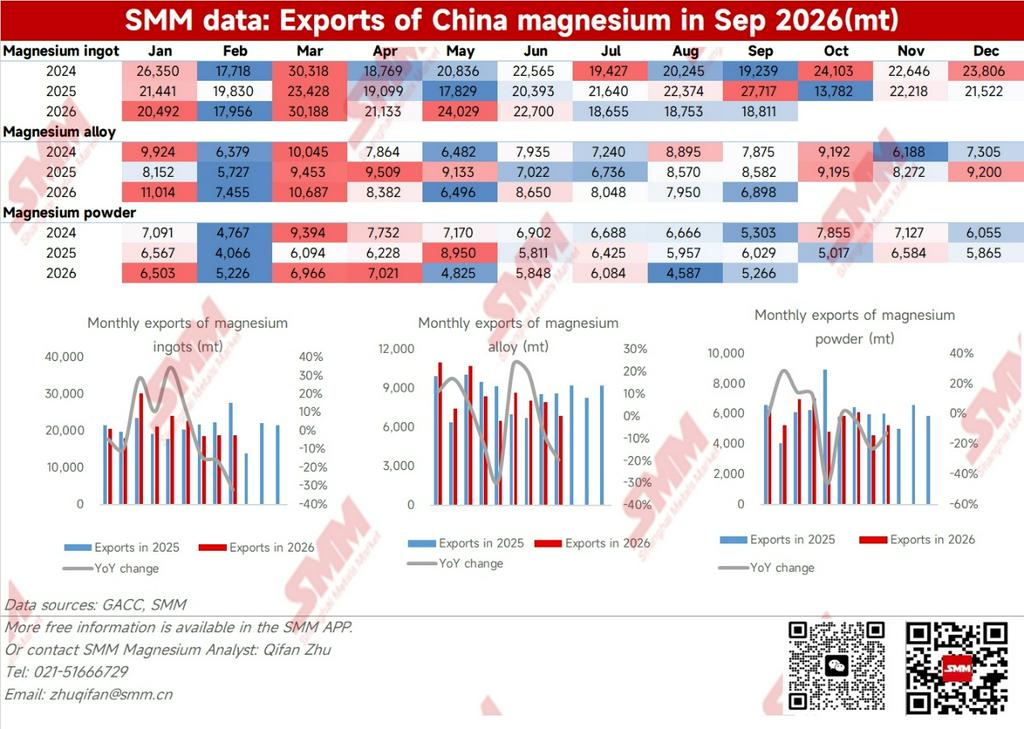
In September, China's total magnesium product exports were 33,200 mt, down 0.6% MoM and down 23.6% YoY. By product: magnesium ingot exports were 18,800 mt, up 0.3% MoM but down 32.1% YoY, consolidating around 18,000 mt for three consecutive months with relatively small MoM fluctuations. Magnesium powder exports turned from decline to growth, reaching 5,266 mt in September, up 14.8% MoM, though still down 12.7% YoY. Magnesium alloy exports were 6,898 mt, down 13.2% MoM and down 19.6% YoY. Overall, China's magnesium product export volume in September was basically flat with August, with only magnesium powder achieving a MoM rebound. Market outlook: although September peak season demand fell short of expectations, with October peak season expectations, month-end concentrated delivery demand, and the current continued price decline, downstream end-users are expected to make appropriate purchases, and October magnesium product exports still have the possibility of MoM recovery, but the final rebound will depend on the pace of actual overseas order procurement.
September magnesium product exports remained weak, with procurement pace and willingness to take orders becoming core constraints
In September 2026, China's magnesium product exports were 33,200 mt, down 0.6% MoM from August, with the YoY decline from September last year widening further to 23.6%. Cumulative exports of various magnesium products from January to September reached 340,400 mt, up slightly by 0.06% YoY.
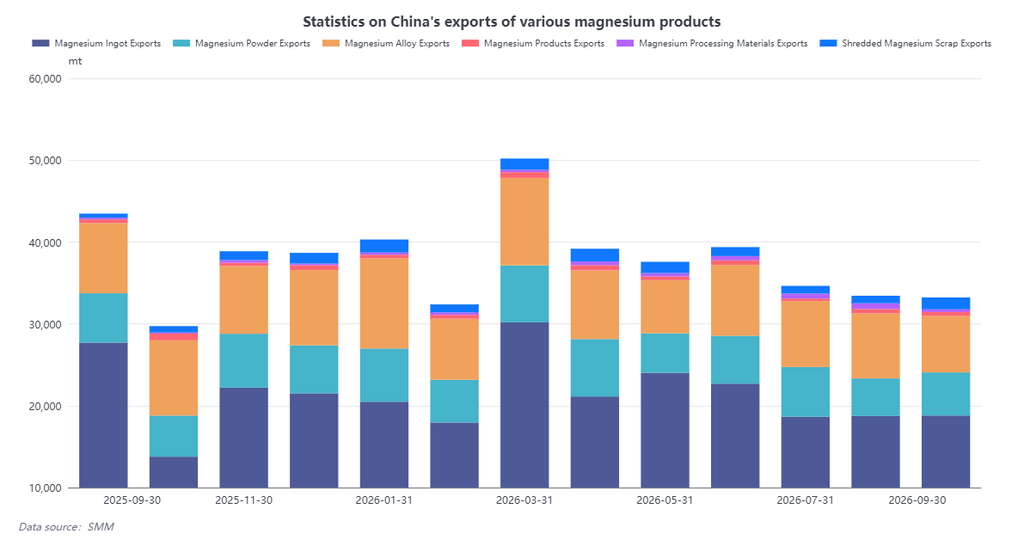
In September, China's magnesium product export trends continued to diverge, with the overall weak pattern persisting. Total magnesium product exports for the month were 33,200 mt, of which magnesium ingot exports were 18,800 mt, accounting for 57% of total exports. The YoY decline in magnesium ingots dominated overall export performance, and changes in other products could not offset its impact. Moreover, the average export price of magnesium ingots fell 15.1% YoY, showing a simultaneous decline in both volume and price. Even with price concessions, this failed to drive procurement growth. Overseas buyers reduced procurement not because prices were too high, but because they chose to delay stockpiling amid the downward price cycle: domestic magnesium prices rose first and then fell in September, and inquiries picked up after the overseas summer break ended, but most were tentative inquiries, with buyers showing a strong desire to bargain down prices and few large firm orders. Overseas downstream demand recovery fell short of expectations, remaining in a phase of continued destocking, with off-season conditions persisting. Buyers and sellers had clearly divergent price expectations, making it difficult to achieve volume transactions. This was the core reason for the simultaneous weakening of export volume and export value. Meanwhile, September coincided with the peak season, when shipping capacity was tight and port schedules were strained. Geopolitical tensions pushed ocean freight rates higher, and freight costs stayed high. The stronger yuan and frequent exchange rate fluctuations further weakened traders' willingness to take low-priced orders, exposing them to greater risks. These factors directly constrained the fulfillment and shipment of foreign trade orders, and multiple forces combined to suppress magnesium product exports.
Magnesium powder exports bucked the trend and turned to growth, while alloy exports weakened and magnesium ingot exports remained mediocre, highlighting the ongoing divergence among product categories.
In September, magnesium ingot exports totaled 18,800 mt, down 32.1% YoY, with the average export price falling 15.1% YoY, reflecting declines in both volume and price. Notably, the export weakness was not caused by a cliff-like collapse in end-use demand, but rather by mismatched expectations between buyers and sellers during the price downturn. In September, domestic supply-side maintenance-related production cuts alternated with production resumptions, compounded by raw material fluctuations. Magnesium prices rose first and then fell, entering a downward trajectory in mid-to-late September. Overseas buyers, following the pattern of rushing to buy amid continuous price rises and holding back amid price downturns, generally postponed actual purchases. Although inquiries recovered after the summer break ended, effective transactions remained limited. At the same time, magnesium ingot is a primary raw material, so the opportunity cost for buyers to delay purchases is relatively low, and they prioritized reducing purchases of this category during the demand weakening phase. Additionally, the yuan-dollar exchange rate broke through the 6.7 level in September, compressing traders' foreign exchange settlement gains on dollar-denominated orders and dampening their willingness to sell. Therefore, magnesium ingot exports remained at low levels, essentially reflecting an expectation game shaped by three intertwined factors: weak supply-side price support, rising demand-side wait-and-see sentiment, and erosion of exchange rate gains, rather than a full collapse in ex-China fundamentals.
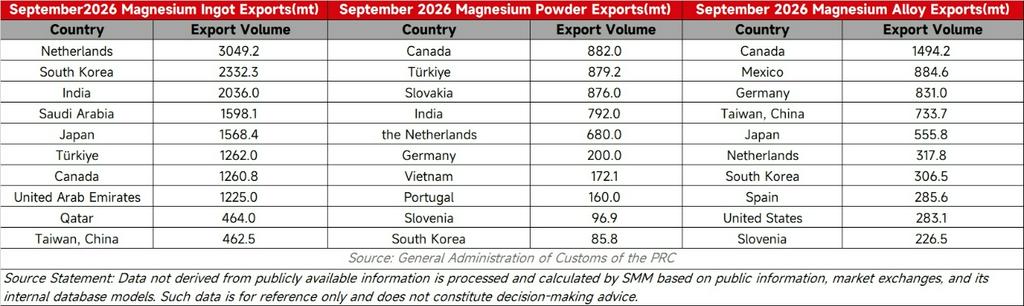
Meanwhile, magnesium alloy exports in September totaled 6,898.3 mt, down 13.23% MoM and down 19.6% YoY. The YoY decline was notably smaller than that of magnesium ingot, confirming that magnesium alloy purchases are largely tied to long-term production plans and are less susceptible to short-term price changes, a structural characteristic that lends greater resilience to price declines. However, the MoM pullback also reflected lower operating rates at overseas die-casting enterprises. Among them, the German and Indian markets bucked the trend with growth, driven by phased restocking along local automotive production lines. Exports to markets such as Canada and South Korea fell sharply, indicating that the demand contraction was broad-based, and localized growth was insufficient to offset the overall downward pressure. In September, magnesium powder exports totaled 5,265.8 mt, down 12.7% YoY, the smallest monthly decline among the three major products, but cumulative exports from January to September fell 6.77% YoY, the largest cumulative drop among the three. In August, affected by the European summer break and weakening steel desulfurization demand, magnesium powder exports fell sharply by 24.6% MoM. The 15.22% MoM rebound in September was merely a low-base recovery, not a trend reversal. Magnesium powder demand is highly tied to desulfurization demand at overseas steel mills and follows changes in steel mill operating rates. In September, demand in traditional production regions such as Canada, Turkey, and the Netherlands remained sluggish, while Slovakia and India saw phased concentrated restocking. This shows divergence in global steel desulfurization demand, with magnesium powder export destinations shifting in line with regional steel mill production pace. At the same time, given current export policy restrictions, the underlying structural weakness is unlikely to improve in the short term.
Rigid demand support cannot mask weak external demand; September magnesium product export destinations shifted sharply
Total magnesium ingot exports edged up 0.31% MoM in September. The surface trend was stable, but beneath it lay a major geographic shift in export destinations. The Middle East was the main source of MoM growth: Saudi Arabia surged 12,192.92% MoM to 1,598 mt. The UAE rose 172.22% MoM, and Qatar grew 383.33% MoM. Several European countries also fluctuated notably, with Spain surging 183.24% MoM and Italy rising 193.94% MoM. The core driver of this demand expansion was restocking driven by production resumptions. In September, domestic magnesium prices rose first and then fell, entering a downward trajectory in the middle and latter part of the month. Aluminum plants in the Middle East that had previously halted production gradually resumed operations and ramped up, while some die-casting enterprises in Europe had phased rigid demand. Buyers seized the low-price window to place concentrated orders. In contrast, traditional transit markets such as the Netherlands and Japan saw procurement volumes continue to shrink, affected by previously high inventory levels and wait-and-see sentiment. The slight MoM increase in magnesium ingot exports was essentially a phased restocking driven by low prices stimulating rigid-demand clients, combined with capacity recovery.
Total magnesium alloy exports pulled back MoM, with the surge in Germany in sharp contrast to weakening transit markets. In September, magnesium alloy exports fell 13.23% MoM, making it the deep-processing product with the most pronounced demand contraction among the three major categories, with significant divergence in internal destinations. Germany surged 81.46% MoM to 1,494 mt, and the Netherlands rose 62.47% MoM. Canada fell sharply by 47.61% MoM, and South Korea dropped 59.72% MoM. The regional divergence reflects short-term adjustments in overseas supply chains. Germany's large-volume cargo pick-up was most likely a move to take advantage of the domestic low-price window to deliver orders in a concentrated manner and replenish safety stock. The sharp reduction in procurement by Canada and South Korea reflects weak local die-casting end-user orders, with procurement scale rapidly compressed in September following a round of restocking in August. Magnesium powder posted the best MoM performance among the three major products, but this rebound was not driven by broad-based demand recovery, only supported by pulsed restocking in a few regions. Slovakia surged 130.53% MoM to 876 mt, Türkiye rose 98.73% MoM, and India grew 28.16% MoM, while Canada plunged 48.09% MoM, Poland tumbled 86.96%, and Taiwan, China fell 66.21%. Magnesium powder client stickiness is relatively weak, and export fluctuations directly track changes in overseas steel mill operating pace. The growth in Türkiye and Slovakia stemmed from concentrated procurement of low-priced Chinese supply after local steel mills depleted earlier inventories. This kind of short-term restocking in isolated regions also explains the relatively large fluctuations in total magnesium powder export volumes.
Magnesium export market outlook: short-term weakness unlikely to alter the full-year trend, with deep-processing support and base effects underpinning full-year resilience in total magnesium product exports
In the short term, magnesium product exports are expected to edge up. Some orders delayed in September are likely to be delivered in October and the near term. Combined with magnesium prices in China continuing to hit bottom since October, there is potential for bottoming out, with restocking demand from resumed production in the Middle East and some European die-casting plants likely to emerge at low prices. Meanwhile, frequent low prices have prompted traders to make concentrated low-price purchases for contract fulfillment, which is expected to improve the current export trend. However, constraints remain evident, with new large orders still scarce and regional fluctuations still likely to shift significantly.
In the long term, total magnesium product exports for the full year still have a resilience base for slight growth. Although Q4 still faces drag from weak demand and trade barriers, weakness in a single month does not determine the full-year trajectory. On one hand, deep-processing categories such as magnesium alloy have demonstrated strong counter-cyclical capability, with cumulative exports in the first three quarters maintaining steady growth and serving as the core force underpinning total volumes. On the other hand, magnesium ingot, as the core export product, has not seen a systemic collapse in its cumulative decline over the first three quarters. As overseas end-users have undergone prolonged destocking, combined with traditional pre-holiday stockpiling overseas, there is potential for phased restocking demand after bottoming out in Q4. Full-year exports are expected to demonstrate strong structural resilience overall, driven by growth in deep-processing products and the base advantage accumulated earlier.