SMM, October 19:
With zinc prices continuing to fluctuate, how has the die-cast zinc alloy market performed recently? Why did the industry operating rate fail to rebound significantly during the traditional peak season in September? How have changes in raw material prices affected producers’ costs and profits? This article examines the market from three perspectives: industry operating rates, production costs and profitability, and end-use demand.
1. September Operating Rate Declines, with the “Golden September” Peak Season Falling Short of Expectations
According to SMM data, the operating rate of SMM’s new sample of die-cast zinc alloy producers stood at 37.45% in September, down 0.15 percentage points month-on-month and 7.04 percentage points year-on-year. Overall, the industry operating rate edged lower in September, indicating that the traditional “Golden September” peak season provided only limited support for end-use demand.
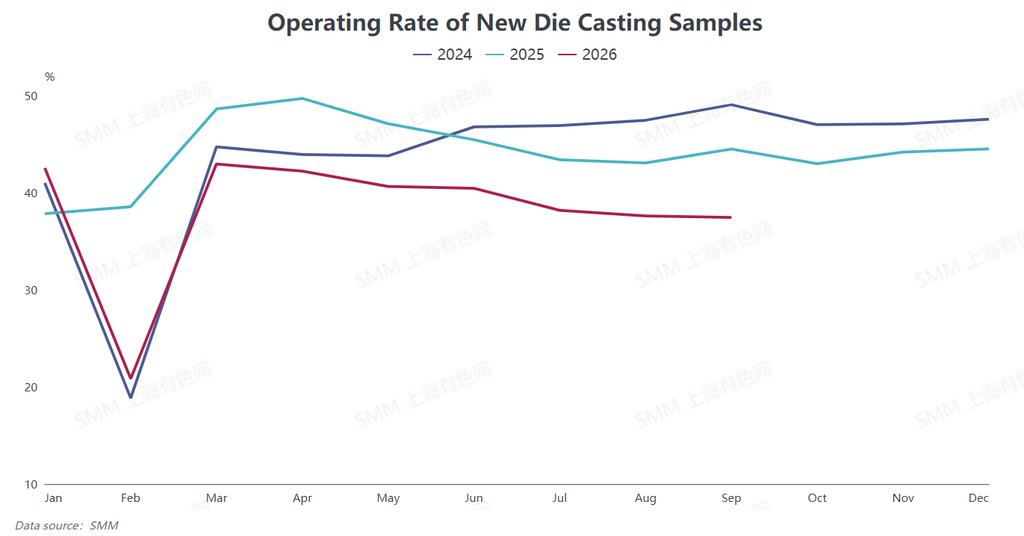
In the first half of September, elevated raw material prices dampened downstream buyers’ purchasing appetite, weighing on overall market activity and putting pressure on the industry operating rate. In the second half of the month, zinc prices gradually retreated, while some end-users replenished inventories ahead of the Mid-Autumn Festival and National Day holidays, leading to a modest recovery in demand. However, finished product inventories remained relatively high at some producers, and destocking pressures had yet to ease fully, continuing to constrain production enthusiasm. As a result, the industry operating rate edged lower month-on-month in September.
2. Profitability of Major Alloy Grades Improves, but Further Gains Remain Limited
1. Zamak 3# Zinc Alloy
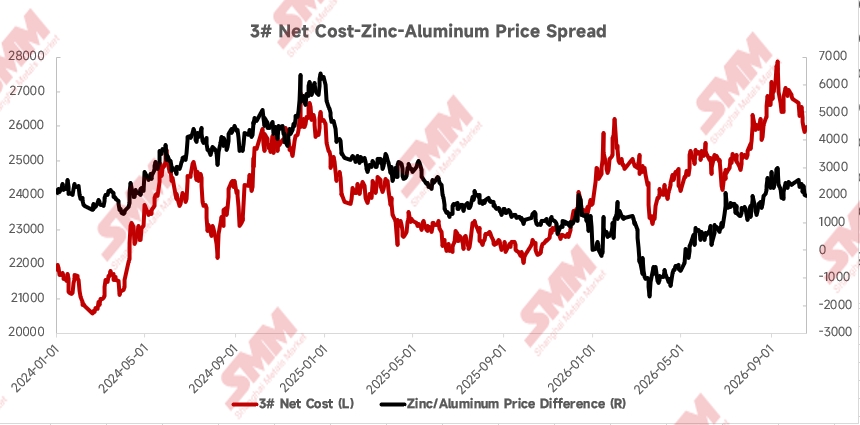
In terms of costs, the total production cost of Zamak 3# zinc alloy followed an upward trend before declining between 2024 and 2025, falling to around RMB 22,000–23,000/mt in the second half of 2025. Since the beginning of 2026, costs have risen again alongside higher raw material prices, currently standing at approximately RMB 26,000–26,500/mt.
Regarding the zinc-aluminum price spread, strong aluminum prices pushed the spread down to around negative RMB 1,700/mt at one point in the first quarter of 2026. The spread gradually recovered from May onward and remained in the RMB 1,900–2,600/mt range in October.
Based on the changes in the relevant price spread and profitability, profit margins for Zamak 3# zinc alloy improved in the second half of the year compared with the first half, easing producers’ operating pressures to some extent. Nevertheless, total production costs remain relatively high, while end-use demand remains lackluster, limiting further improvement in profitability.
2. Zamak 5# Zinc Alloy
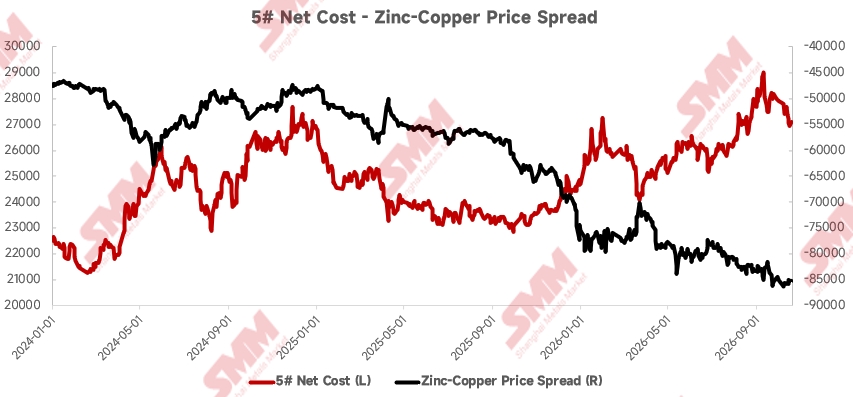
The total production cost of Zamak 5# zinc alloy has followed a trend broadly similar to that of Zamak 3#, although its absolute cost level is higher due to differences in copper content. Currently, the total production cost of Zamak 5# zinc alloy stands at approximately RMB 27,000–27,800/mt, more than RMB 1,000/mt higher than that of Zamak 3#.
The zinc-copper price spread has remained in negative territory, widening from around negative RMB 48,000/mt at the beginning of 2024 to approximately negative RMB 85,000/mt in September 2026.
In terms of profitability, Zamak 5# zinc alloy has relatively limited profit margins and is more susceptible to copper price fluctuations. Similar to Zamak 3#, its profitability has also improved in the second half of the year compared with the first half. However, overall profit margins remain relatively thin.
3. Traditional Hardware Demand Remains Weak, While Performance Varies Across Segments
According to feedback from market participants, orders for traditional hardware components remain weak, and the overall recovery in market demand has been limited. By comparison, demand in certain segments, including electronic hardware and medical equipment hardware, has remained relatively resilient, highlighting divergent performance across end-use sectors.
Regarding exports, some producers reported that overseas hardware export orders remained subdued amid geopolitical uncertainties, providing no significant boost to demand for die-cast zinc alloys.
Meanwhile, low-price competition in the die-cast zinc alloy market remains intense. Market quotations vary considerably, placing further constraints on producers’ pricing power.
4. October Operating Rate Expected to Edge Lower, with Demand Recovery Still Uncertain
Looking ahead to October, SMM expects the operating rate of its new sample of die-cast zinc alloy producers to decline to around 36.8%, down 0.65 percentage points month-on-month.
Several factors are expected to weigh on the operating rate. Most die-cast zinc alloy producers suspended production or took holidays during the National Day holiday period, which is expected to drag down the overall operating rate in October. In addition, orders from traditional hardware end-users remain weak, with no significant improvement in market demand. Combined with finished product inventory pressures at some producers and persistent low-price competition, producers are expected to remain relatively cautious about increasing production in the near term. Consequently, the industry operating rate may edge lower in October.