September 2026 Secondary Aluminum Alloy Producer Operating Rates by Region and Company Size:
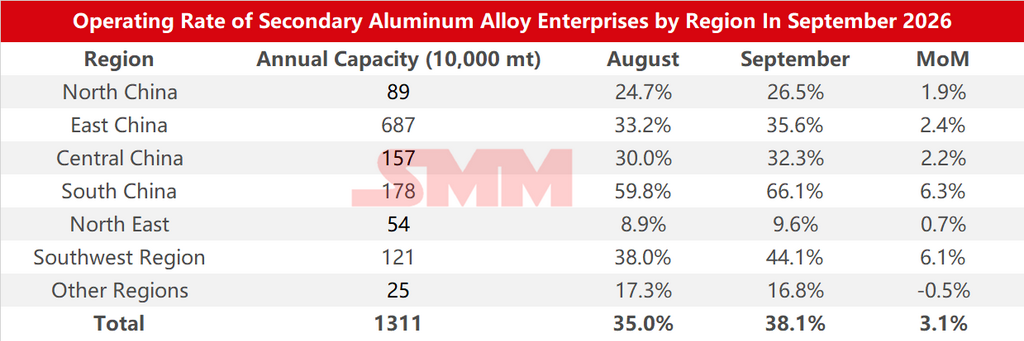
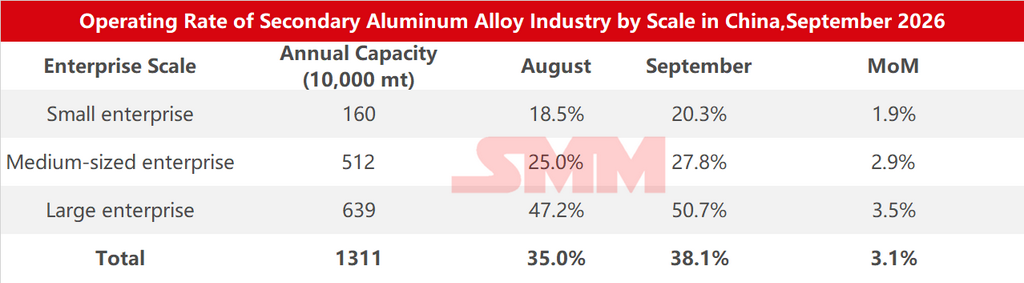
In September, the operating rate of the secondary aluminum alloy industry was 35.0%, up 3.1 percentage points MoM but down 6.7 percentage points YoY. The industry's production continued its recovery trend, though the overall operating level remained below the same period last year.
On the demand side, September marked the traditional peak consumption season, with downstream orders recovering from August. End-use demand from automobiles and other sectors improved marginally, but the peak-season effect had yet to fully materialize. According to CAAM data, automobile production in September was 2.99 million units, up 11.4% MoM but down 8.7% YoY. NEV production was 1.814 million units, up 12.2% YoY. CAAM noted that in the first three quarters, China's automotive market showed a pattern of "cold at home, hot abroad," with the Chinese market remaining under pressure while exports maintained relatively fast growth, and new momentum from NEVs and other sectors continued to be released. Looking ahead to Q4, as the trade-in policy takes further effect and various consumption-promotion activities continue to advance, China's automotive market is expected to gradually improve. Combined with sustained export growth, demand along the automotive industry chain is expected to receive some support. However, given that the recovery in China's end-use demand remains insufficient, ADC12 downstream demand is expected to see mainly mild improvement in the short term, and the actual demand growth and its boost to industry production remain to be seen.
On the raw material side, affected by stricter enforcement of fiscal and tax policies, the circulation of compliant aluminum scrap remained constrained. The issues of tight raw material supply and high procurement costs have yet to ease, and some enterprises faced greater difficulty in raw material procurement, which continued to limit capacity release. In addition, during the Mid-Autumn Festival holiday in September, most enterprises maintained normal production, with only a few arranging short breaks, resulting in limited impact on the overall operating rate for the month.
The operating rate of the secondary aluminum alloy industry is expected to pull back MoM in October, mainly due to production suspensions during the National Day holiday and the continued tightening of fiscal and tax policies. On the holiday front, large enterprises mainly maintained production, though some appropriately reduced production loads, while other enterprises mostly arranged 3-5 day holidays. The slowdown in production during the holiday period will exert some drag on the monthly operating rate. On the raw material front, stricter enforcement of fiscal and tax policies is expected to continue affecting the supply of compliant aluminum scrap, with some enterprises still facing significant procurement difficulties and high costs, constraining production stability and capacity release. Although downstream demand is expected to continue improving marginally after the holiday, given limited demand growth and persistent raw material supply constraints, the room for the industry's operating rate to rebound is expected to be limited.
![[ADC12 Daily Review] ADC12 Most-Traded Contract Closes Higher; Spot Sentiment Recovers but Demand Improvement Remains Insufficient](https://imgqn.smm.cn/usercenter/mLwgx20251217171723.jpeg)
![Holiday disruptions combined with raw material constraints are expected to pull back the operating rate of secondary aluminum producers in October [SMM Analysis]](https://imgqn.smm.cn/usercenter/YPMhF20251217171654.jpg)