I. Weekly Price Review
In the first full trading week after the holiday, the antimony market ended its consolidation at highs lasting more than a month, with quotes for all products falling across the board. On October 12 (Monday), quotes for all products were generally lowered by 3,000–4,000 yuan; the decline accelerated on October 13, with #1 antimony ingot breaking below the 100,000 yuan/mt mark to 98,000 yuan/mt; on October 14–15, prices briefly stabilized around 95,000 yuan/mt (#1); on October 16, prices dipped again, with #1 antimony ingot closing at 92,000 yuan/mt and #0 antimony ingot closing at 94,000 yuan/mt.
Cumulative changes for the week: #1 antimony ingot fell 13,000 yuan (-12.4%), #0 antimony ingot fell 13,000 yuan (-12.1%), 99.5% antimony trioxide fell 8,000 yuan (-9.1%), and antimony sulfide concentrates (Sb≥55%) fell 11,500 yuan (-13.5%). Notably, the decline in raw material antimony sulfide concentrates (-13.5%) was larger than that of antimony ingot, significantly weakening the previous logic of "firm concentrates—cost support."
This marked the first substantive pullback in antimony prices since the uptrend began in mid-August: #1 antimony ingot has cumulatively pulled back 13,000 yuan from the stage high of 105,000 yuan on October 9, giving back all gains made since August 17 (95,000 yuan/mt). Over the past 8 weeks, antimony ingot is down about 6.5% from August 24, antimony concentrates are down 11.4%, and only antimony trioxide is flat versus August 24—the oxide segment shows the strongest price stickiness, and this round of pullback has not yet fully transmitted to downstream processed products.
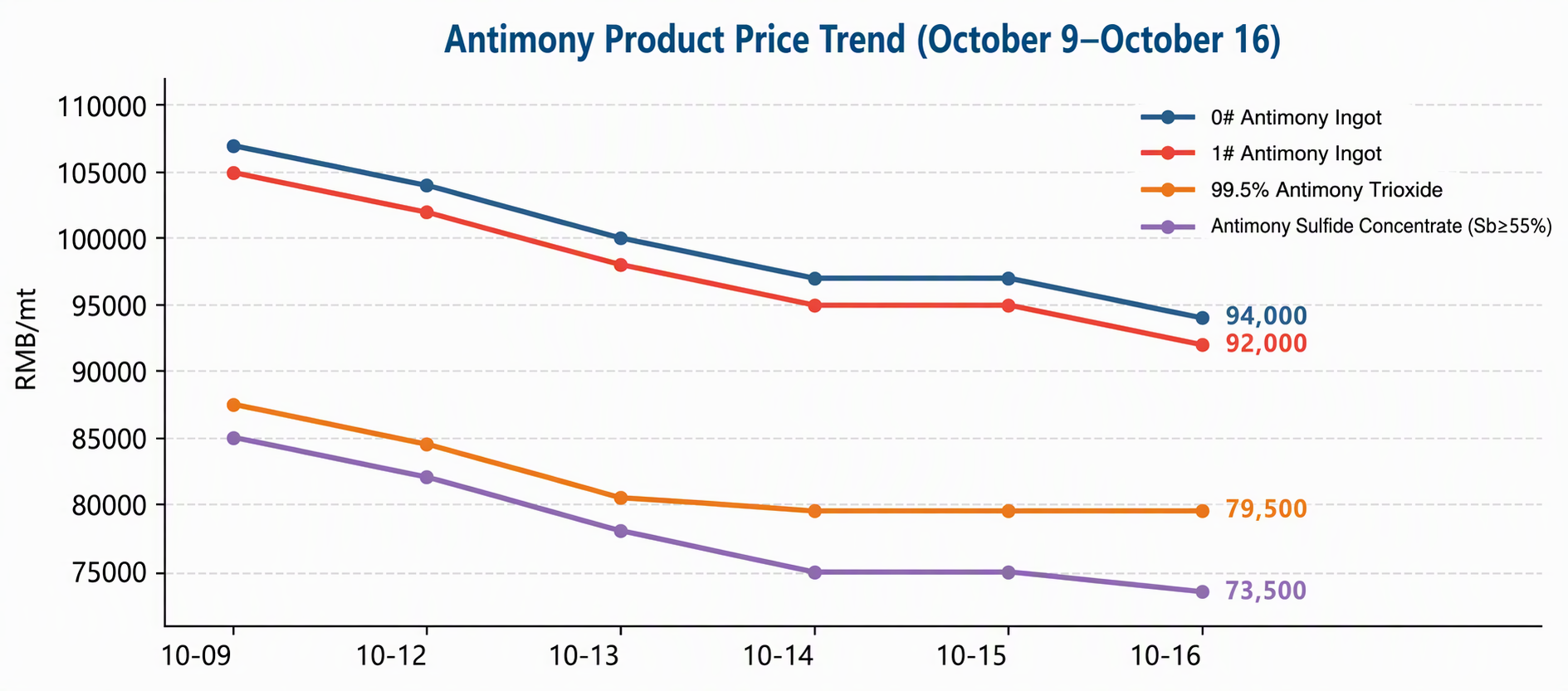
Chart-1: Antimony product price trends (October 9–October 16)
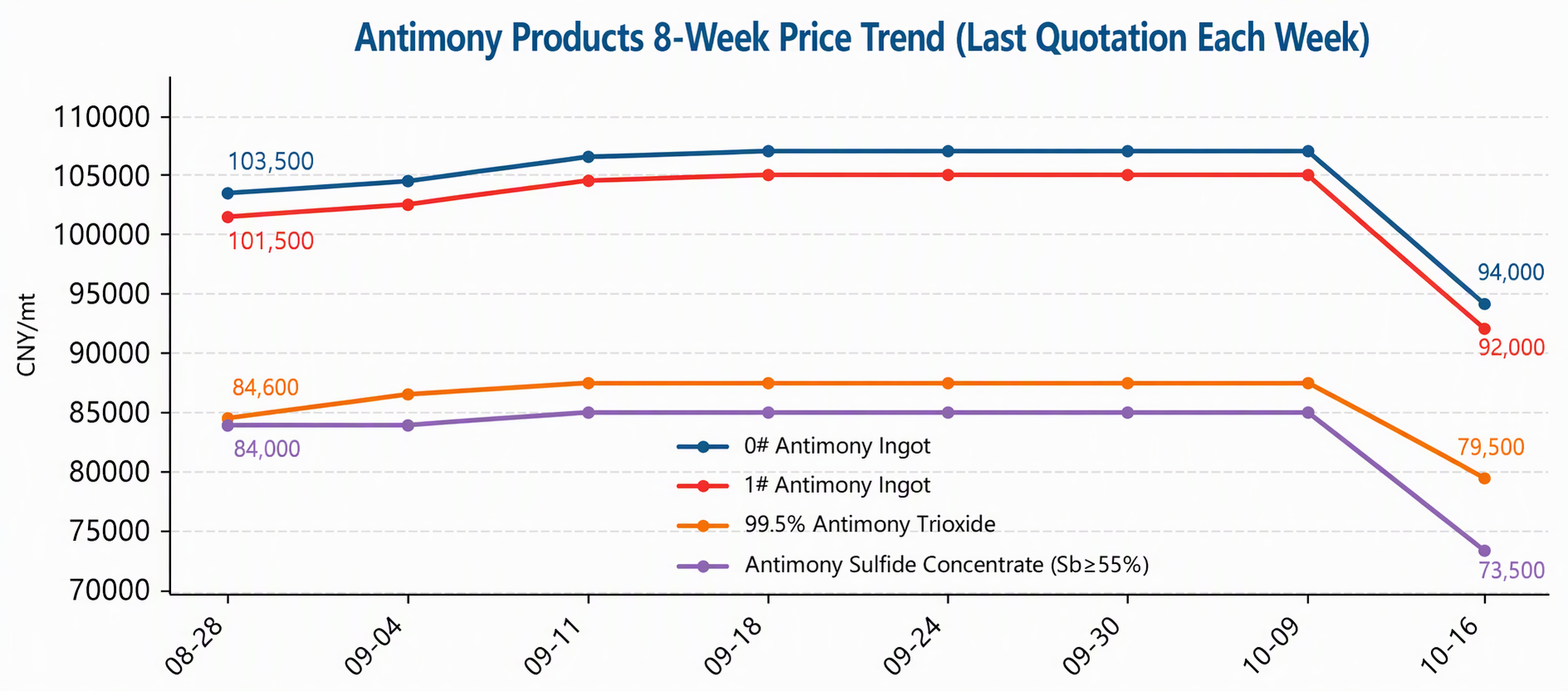
Chart-2: Antimony product price trends over the past 8 weeks (last quote date of each week)
II. Supply Dynamics
The supply side continued its contraction pattern: assessed national antimony ingot production (including antimony ingot, crude antimony conversion, antimony cathode, etc.) in September 2026 fell about 2% MoM, the second consecutive monthly decline; overseas antimony ore imports fell sharply in August, and raw material tightness has now transmitted to the smelting segment. However, it must be acknowledged that low raw material inventories at smelters did not translate into price-supporting momentum this week—as antimony ingot prices fell rapidly, antimony sulfide concentrate quotes were lowered sharply in tandem, and some producers took the lead in selling large volumes, reflecting that smelters are becoming more cautious about raw material procurement under compressed margins and are more willing to sell at lower prices. This also prompted suppliers without inventory to follow suit in selling, sharply increasing market supply pressure.
Looking ahead, if antimony ingot prices remain below 100,000 yuan/mt, there is potential for further contraction in smelter operating rates and raw material procurement pace; whether assessed antimony ingot production in October can stop falling and whether concentrate quotes can stabilize ahead of antimony ingot will be key tests of whether the supply contraction logic regains control of pricing.
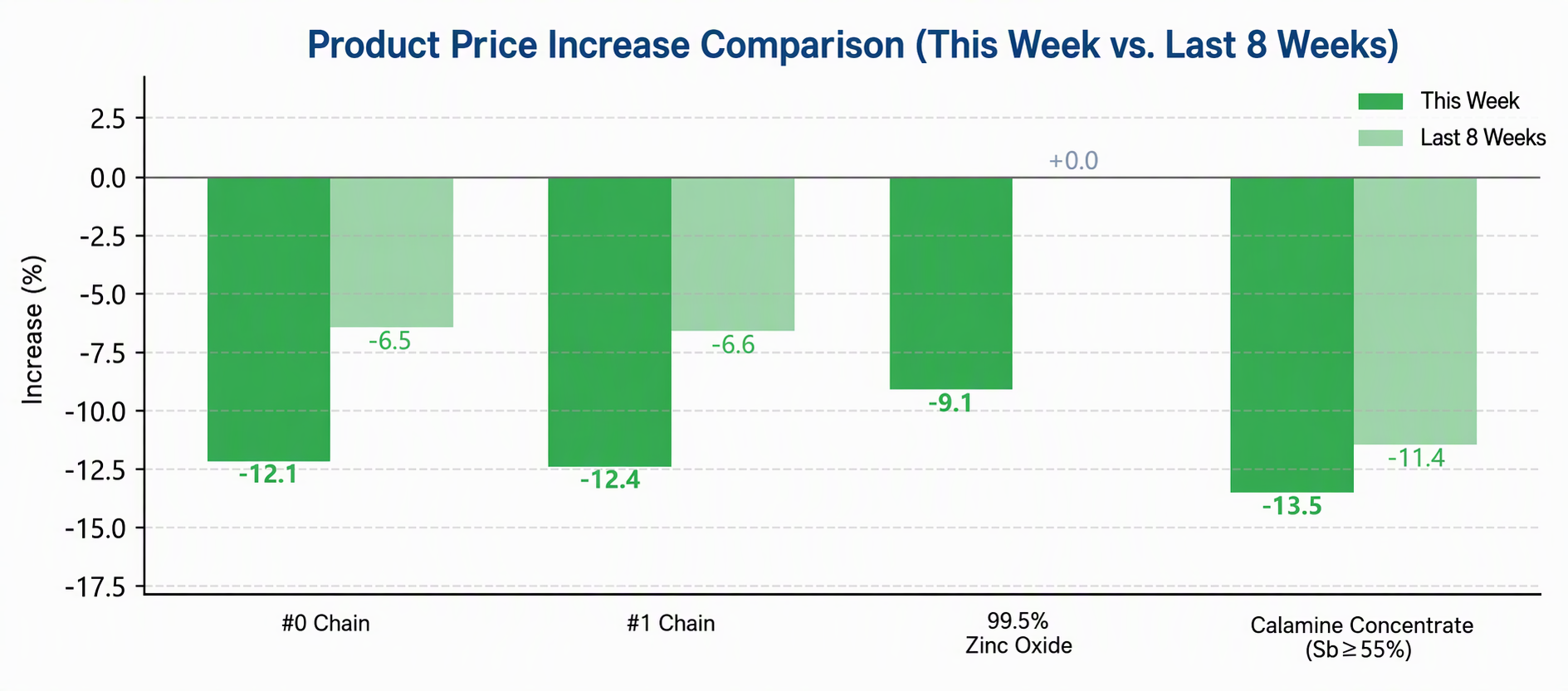
Chart-3: Comparison of % changes in antimony products (this week vs. past 8 weeks)
III. Trade and Policy
The sharp decline in overseas antimony ore imports in August remains the root cause of domestic raw material tightness, and the arrival pace of imported ore will directly affect Q4 supply elasticity. On the export side, export controls on antimony-related items continue to be implemented on a regular basis, keeping available supply outside China persistently tight; against the backdrop of rapidly falling domestic prices, the price spread between Chinese and overseas markets has widened passively, narrowing the relative advantage of overseas supply. If the spread continues to widen, attention should be paid to subsequent changes in export inquiries and transaction direction.
From a macro perspective, the China-US summit reached an eight-point consensus, including a "30 billion" reciprocal tariff reduction arrangement and the establishment of a trade council mechanism, setting an overall positive tone; if the PV trade environment improves at the margin, it would provide some support for Q4 external demand expectations, but the transmission to the current core contradiction in antimony prices (weak domestic demand) is limited.
IV. End-Use Demand
Weak demand was also one of the dominant factors behind this week's price breakdown. On the PV chain, October module production schedules are expected to edge up from September, but the growth fell short of expectations, with domestic production schedules up only 1–2 GW, and distributed-generation orders showed some contraction—antimony demand in the PV glass clarifier (sodium pyroantimonate) segment lacks upward momentum, glass prices remain in negotiation, and the transmission from production schedules to antimony demand is not smooth.
Flame retardants and polyester catalysts are also in the post-holiday stockpiling ebb phase, with procurement dominated by small rigid-demand orders. During the previous four consecutive weeks of consolidation, downstream acceptance of prices above 100,000 yuan/mt never fully materialized, and last week's weekly review already cautioned that "if high prices continue to suppress demand, slight loosening of quotes for individual products cannot be ruled out"; this week, the tug-of-war between buyers pushing for lower prices and sellers holding prices firm ended with buyers prevailing, and transaction centers shifted lower rapidly along with quotes.
From the demand-side structure, both major segments—PV and flame retardants—are unlikely to provide upward momentum for antimony prices in the short term; price stabilization will depend more on the realization of supply-side contraction or the start of rigid-demand restocking after prices fall.
V. Market Outlook
In the short term, this week's decline was rapid and substantial, with prices already back to mid-to-late August levels, and the market needs time to digest the wait-and-see sentiment brought by the sharp drop. Considering that the supply side is still contracting (September production fell for the second consecutive month) and the price retracement is already fairly substantial, room for further panic selling may be limited; however, no substantive improvement in demand has emerged, and concentrate cost support has been temporarily weakened. Antimony prices are expected to mainly seek a bottom weakly and consolidate at lows in the short term.
Two verification points warrant attention going forward: first, whether antimony ore and antimony ingot can be the first to stop falling—if they stabilize, cost support for antimony products can be rebuilt; second, whether downstream restocking emerges in late October after the price decline. If PV glass production schedules rebound or concentrated procurement of flame retardants restarts, antimony prices could see a phased stabilization or even a technical rebound; conversely, if demand remains mediocre and smelters sell at lower prices to recover funds, #1 antimony ingot could test below 90,000 yuan/mt.
In the medium and long term, the underlying logic of rigid antimony resource supply and a persistent overseas deficit remains unchanged, and an excessive downward shift in the price center lacks fundamental support; this week's decline is more of a concentrated correction of earlier gains rather than a trend reversal.
Key Points to Watch Next Week
|
Focus Area |
Details |
|
Price signals |
Transaction verification in the 90,000–100,000 yuan/mt range for antimony ingot, changes in smelter pricing strategies and hold-back sentiment |
|
Raw material side |
Whether antimony sulfide concentrates can stop falling ahead of antimony ingot, smelter raw material procurement and inventory changes |
|
Production and operating rates |
Assessed antimony ingot production in October and changes in smelter operating rates after the price decline |
|
Demand side |
Realization of October PV glass production schedules, whether procurement of sodium pyroantimonate and flame retardants restarts |
|
Overseas markets |
Overseas antimony price trends, price spread between Chinese and overseas markets, and changes in export inquiries |
|
Macro sentiment |
Impact of subsequent progress in China-US economic and trade consultations on Q4 external demand expectations |
Note: Price data as of October 16, 2026; October 12–16 was the first full trading week after the National Day holiday.

![Supply-demand weakness is evident, and antimony prices show a weak trend [SMM Antimony Market Spot Weekly Review]](https://imgqn.smm.cn/usercenter/HGHao20251217171725.jpg)