I. Weekly Price Review
This reporting period spanned the Mid-Autumn Festival and National Day holidays (the spot market was closed from October 1 to 7), with actual quotation trading days on September 28–30 and October 8–9. During this period, quotations across all antimony product categories held steady: 0# antimony ingot was quoted at 107,000 yuan/mt, 1# antimony ingot at 105,000 yuan/mt, 99.5% antimony trioxide at 87,500 yuan/mt, and antimony sulfide concentrates (Sb≥55%) at 85,000 yuan/mt in metal content, all unchanged from pre-holiday levels (September 24), with no price adjustments in the two trading days after the holiday either.
From a longer-term perspective, antimony prices have risen continuously since mid-August: the average price of 1# antimony ingot climbed from 95,000 yuan/mt on August 17 to 105,000 yuan/mt on September 11, a cumulative increase of 10.5%; 99.5% antimony trioxide rose from 76,000 yuan/mt to 87,500 yuan/mt, a cumulative increase of 15.1%. Since then, antimony prices have entered a phase of consolidation at highs, with 1# antimony ingot holding steady at 105,000 yuan/mt for four consecutive weeks. The market is in a "high-price digestion period," with both upstream and downstream players largely on the sidelines.
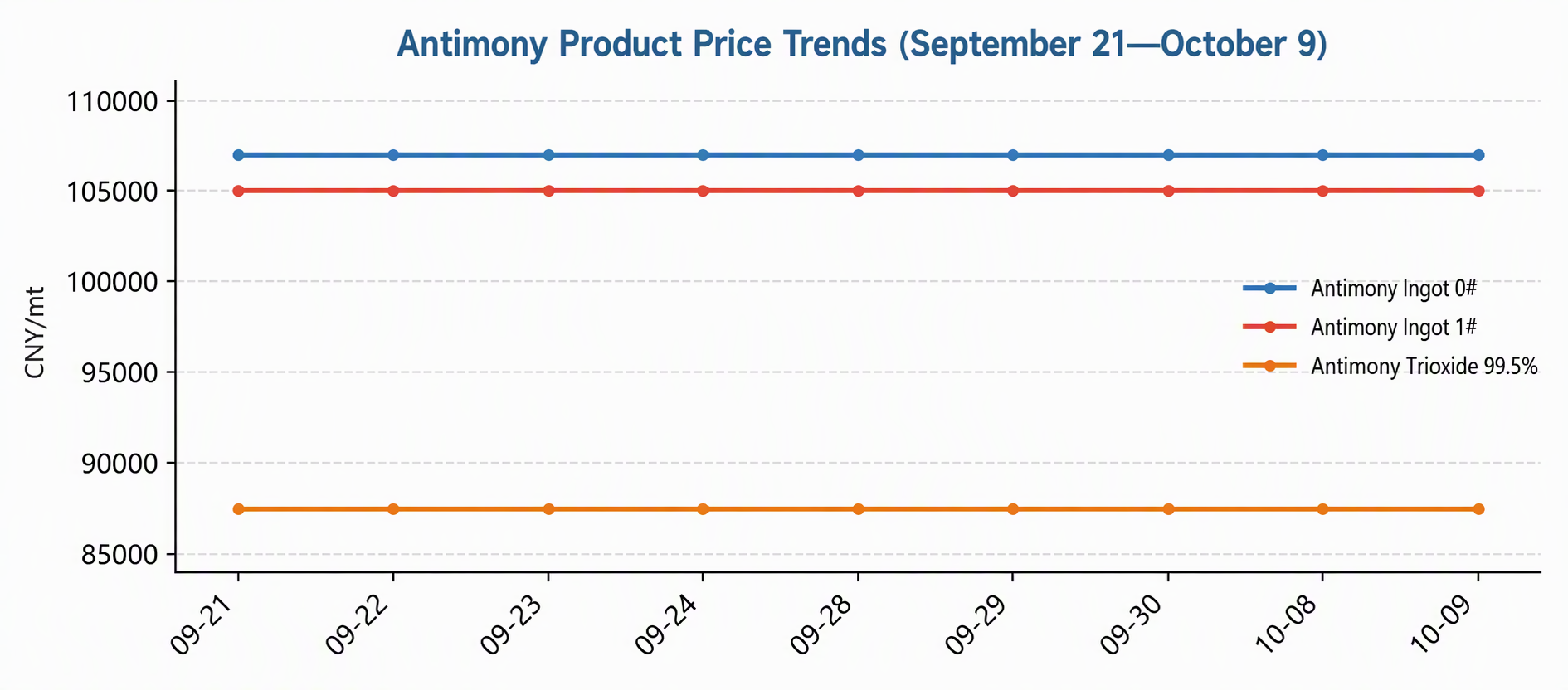
Chart-1: Antimony product price trends (September 21–October 9)
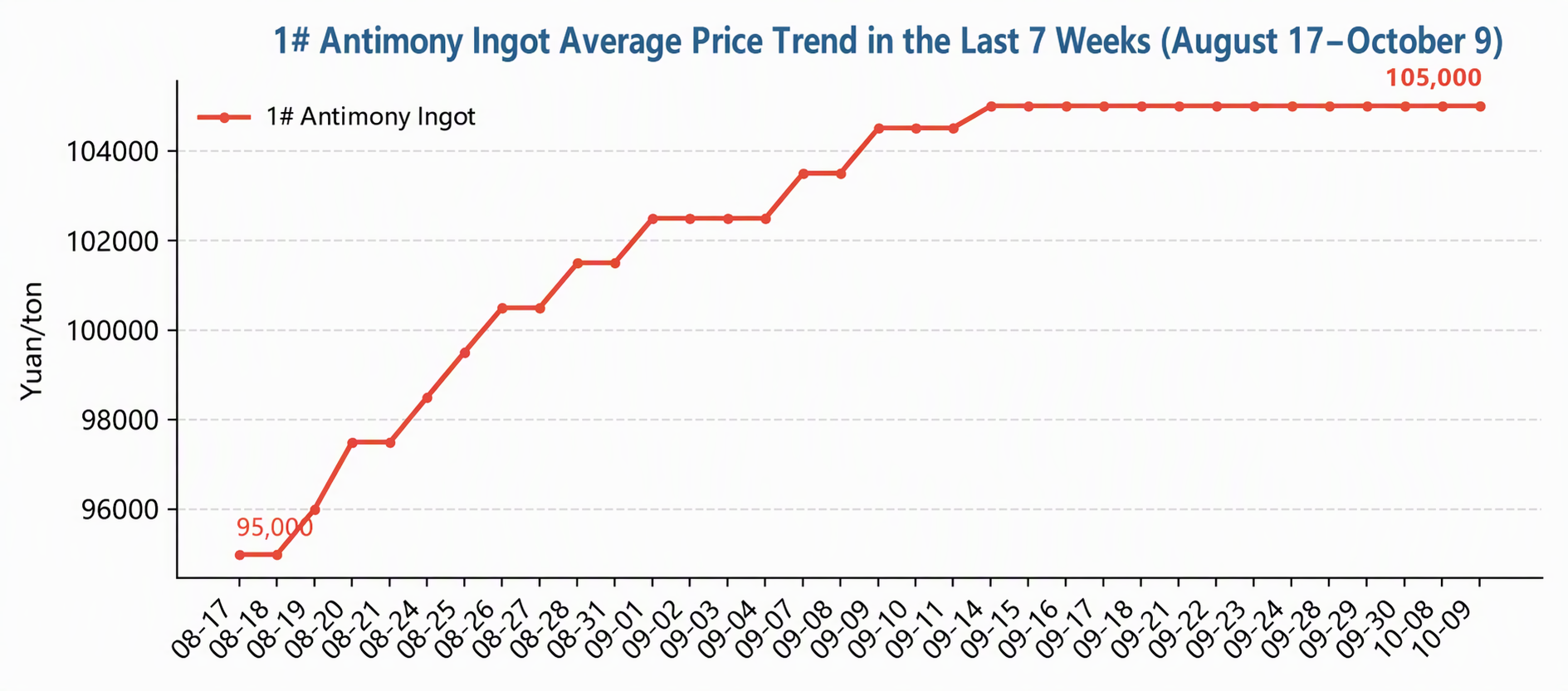
Chart-2: 1# antimony ingot average price trend over the past 7 weeks (August 17–October 9)
II. Supply Dynamics
The supply side remained tight. In September 2026, assessed national antimony ingot production (including antimony ingot, crude antimony converted, antimony cathode, etc.) fell by about 2% MoM, marking the second consecutive monthly decline. Market participants believe the production decline is a normal phenomenon: customs data showed that overseas antimony ore imports fell sharply in August, and the raw material shortage has already been transmitted to the smelting side.
Raw material prices remained firm at high levels, with antimony sulfide concentrates (Sb≥55%) quoted at 85,000 yuan/mt in metal content, up 2.4% from late August, providing strong cost support for antimony ingot. Against the backdrop of limited domestic ore production and low arrivals of imported ore, smelters' raw material inventories are generally low, output flexibility is constrained, and the short-term supply contraction trend is unlikely to reverse.
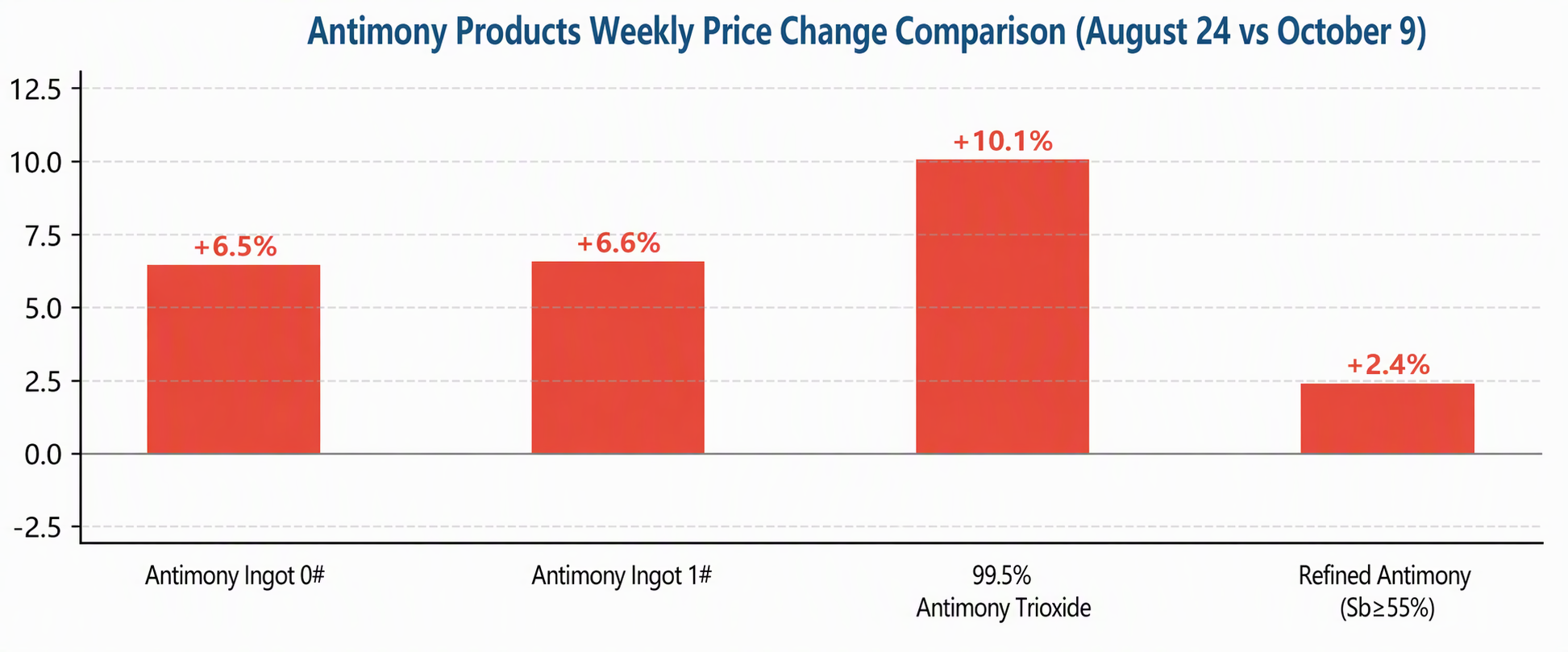
Chart-3: Comparison of % changes in antimony products over the past 7 weeks (August 24 vs. October 9)
III. Trade and Policy
Overseas antimony ore imports fell sharply in August, directly constraining the replenishment of domestic smelting raw materials and serving as the direct cause of the decline in antimony ingot production in September. On the export side, export controls on antimony-related items continued to be enforced on a regularized basis, keeping available cargo outside China persistently tight. Overseas antimony prices remained higher than domestic prices over the long term, with the price spread between Chinese and overseas markets staying elevated, creating a "ceiling-raising" effect on domestic prices.
From a macro perspective, the China-US summit reached an eight-point consensus, including a reciprocal tariff reduction arrangement of "$30 billion" on the trade and economic front and the establishment of a trade council mechanism. The overall tone was positive, and market expectations for the external demand environment in Q4 improved.
IV. End-Use Demand
The demand side showed a pattern of "pre-holiday front-running, post-holiday wait-and-see." In late September, downstream sectors including PV glass (sodium pyroantimonate), flame retardants, and polyester catalysts completed a round of pre-holiday stockpiling, after which the procurement pace slowed noticeably; market activity essentially ground to a halt during the National Day holiday.
In the two trading days after the holiday (October 8–9), market inquiries gradually recovered, but downstream buyers showed limited willingness to accept current high prices. Actual transactions were dominated by small rigid-demand orders, with the tug-of-war between buyers pushing for lower prices and sellers holding prices firm continuing. In the short term, the demand side is unlikely to provide upward momentum for prices.
V. Market Outlook
In the short term, supply contraction and high raw material costs provide solid bottom support for antimony prices, while downstream acceptance of price levels above 100,000 yuan/mt still needs time to digest, and any upward breakout lacks demand cooperation. However, market participants believe that near-term demand improvement from the PV and flame retardant industries is likely to be relatively small, and the supply-demand weakness on both sides will persist for some time. Antimony prices are expected to most likely continue consolidating on a weak note.
In the medium and long term, the rigidity of antimony resource supply is prominent and the overseas deficit persists, leaving limited room for the price center to shift downward. If post-holiday downstream restocking picks up or PV glass production schedules rebound, antimony prices could see tentative upward moves; conversely, if high prices continue to suppress demand, slight softening in quotations for individual products cannot be ruled out.
Key Watch Points for Next Week
|
Focus Area |
Details |
|
Production and operating rates |
Whether October assessed antimony ingot production can stop falling and rebound, and changes in smelter raw material inventories |
|
Raw material side |
Arrival pace of antimony ore imports and concentrate price trends |
|
Demand side |
Post-holiday PV glass production schedules, and the strength of procurement recovery for sodium pyroantimonate and flame retardants |
|
Markets outside China |
Overseas antimony price trends, price spread between Chinese and overseas markets, and export orders |
|
Macro sentiment |
Impact of China-US trade and economic consultation progress on market risk appetite |
Note: Price data as of October 9, 2026 (October 10 is a Saturday, with no spot quotation updates); no spot market quotations during the National Day holiday from October 1 to 7.
![China's September 2026 SMM assessed antimony ingot production fell about 2% MoM [SMM data]](https://imgqn.smm.cn/usercenter/NPpAM20251217171723.jpeg)