I. Weekly Price Review
In the first full trading week after the holiday, China's indium prices ended their previous sideways movement and declined in a stepwise pattern. From October 12 to 14, the three grades held at pre-holiday levels (refined indium at 5,250 yuan/kg, crude indium at 5,050 yuan/kg, and 6N high-purity indium at 5,750 yuan/kg); on October 15, all grades were uniformly lowered by 100 yuan from pre-holiday levels; on October 16, they were lowered by another 50 yuan. Over the two days, refined indium fell 150 yuan to 5,100 yuan/kg (-2.9%), crude indium fell 150 yuan to 4,900 yuan/kg (-3.0%), and 6N high-purity indium fell 150 yuan to 5,600 yuan/kg (-2.6%).
The synchronized, equal 150-yuan decline across all three grades indicates an overall downward shift in the price center rather than a structural adjustment: the price spread between refined and crude indium held at 200 yuan/kg, and the premium of 6N high-purity indium over refined indium held at 500 yuan/kg. The inter-grade price spread structure remained fully stable, with no sign yet of low-priced supply from the recycling segment squeezing high-grade quotes.
Over a longer horizon, the current decline in China's indium prices began in mid-August and has lasted about nine weeks: the average refined indium price fell step by step from 5,350 yuan/kg on August 21 to 5,100 yuan/kg, a cumulative drop of 4.7%; over the past eight weeks, crude indium fell more (-5.8%) than refined indium (-4.7%), while indium prices outside China rose 6.0% over the same period. The pace of decline remained consistently mild, with no volume-driven sharp sell-off, leaving the market in a weak equilibrium of "mediocre demand + passive price concessions by suppliers."
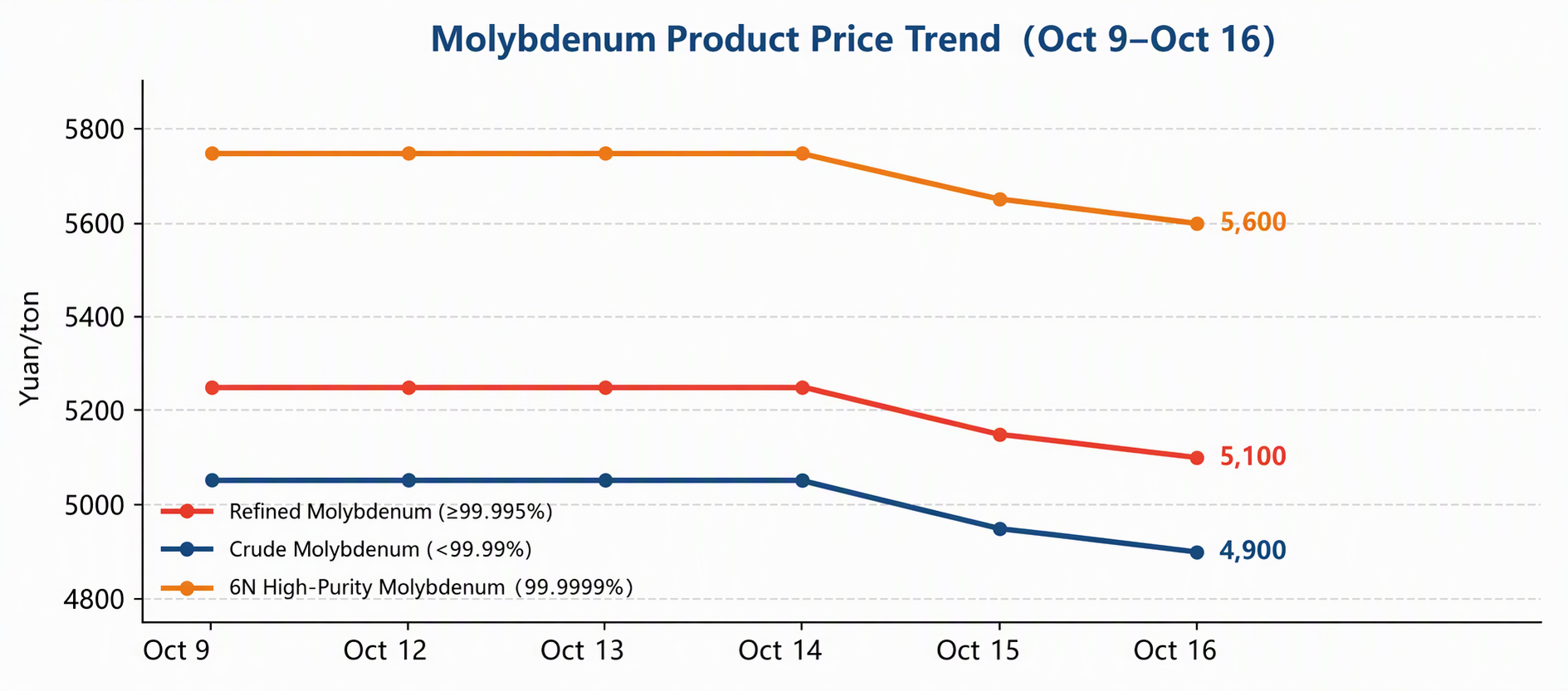
Chart-1: Indium Product Price Trends (October 9–October 16)
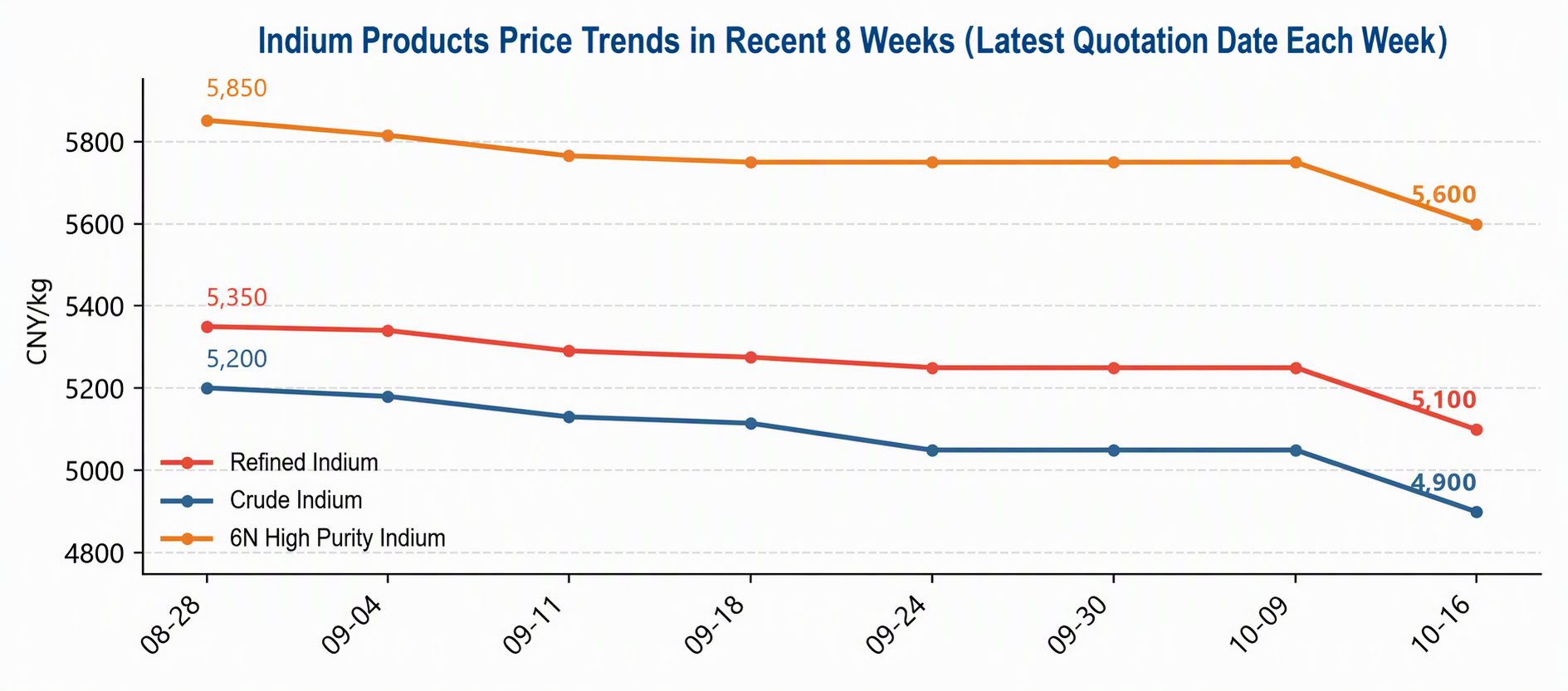
Chart-2: Indium Product Price Trends Over the Past 8 Weeks (Last Quoted Day of Each Week)
II. Supply Dynamics
No notable supply-side disruptions occurred this week. China's primary indium output remained stable, and the release pace of indium by-product from lead-zinc smelting (crude indium) was normal; recycled supply channels (ITO target scrap and ITO etching waste liquid recovery) continued to supplement the spot market, and available supply in traders' hands was not tight.
Against a backdrop of lackluster demand and insufficient downstream purchase willingness, stable supply instead amplified the downward inertia of prices—suppliers, though inclined to hold prices firm, had to make small concessions to close deals. This week's "equal reductions" across the three grades reflect exactly this passive follow-through, rather than any incremental supply shock. The larger decline in crude indium versus refined indium over the past eight weeks indicates that the recycling segment has more ample supply and weaker bargaining power, making it a relatively fragile link in the price chain.
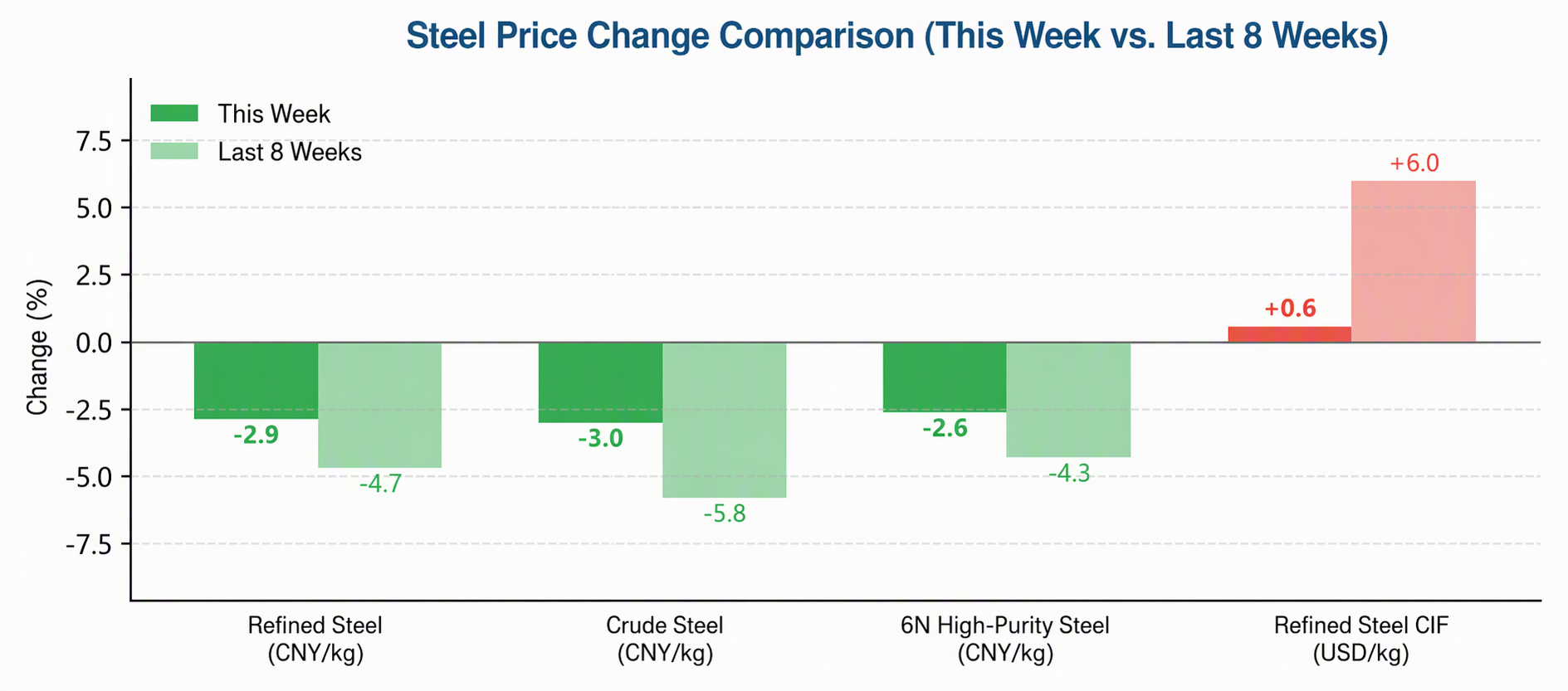
Chart-3: Indium Price Change Comparison (This Week vs. Past 8 Weeks)
III. Trade and Policy
The price spread between Chinese and overseas markets is currently the most noteworthy structural variable in the indium market: the average refined indium price outside China of about $885/kg versus 5,100 yuan/kg in China means quotes in the two currencies have moved in opposite directions for two consecutive months, with the overseas premium continuing to widen. If high overseas prices can be transmitted to China through export orders, there is typically a one-to-two-month lag, making this a potentially important medium-term support factor for domestic prices.
On the trade front, on September 11, the US issued final anti-dumping and countervailing duty determinations on crystalline silicon PV cells imported from India, Indonesia, and Laos, with dumping margins of 123.04% for India, 94.36% for Indonesia, and 65.43% for Laos, effectively closing off the Southeast Asian transshipment route for PV cells into the US market. While the ruling does not directly involve indium, it has weighed on industry chain sentiment for segments such as indium-containing thin-film cells (CIGS).
From a macro perspective, the China-US summit meeting reached an eight-point consensus, including a reciprocal tariff reduction arrangement of $30 billion and the establishment of a trade council mechanism, setting an overall positive tone; if the tariff environment improves going forward, it could provide marginal benefits for PV chain exports and demand for indium-containing materials.
IV. End-Use Demand
ITO targets are the core demand area for indium, accounting for roughly 70%–80% of indium consumption, with downstream demand concentrated in LCD/OLED panels and touch devices. LCD panel demand has entered a phase of stock competition, OLED still has rigid demand for indium-containing materials but with limited growth, and panel makers are mainly purchasing as needed, leaving overall conditions stable but soft. This is the fundamental reason China's indium prices have lacked upward momentum in this cycle.
In the PV sector, CIGS thin-film cells account for a low share of global PV installations and contribute limited indium demand; the September US PV anti-dumping and countervailing duty final determinations were more of a marginal sentiment negative. Traditional segments such as low-melting-point alloys and solder saw stable demand with no highlights; emerging applications such as quantum dots and infrared optics are still in the incubation stage, with volumes too small to alter the demand structure.
The lack of marginal changes in the demand structure defines the nature of this decline as "slowly finding a bottom amid mediocre transactions"—the cumulative 150-yuan adjustment over two days this week is not steep by historical cycle standards, and market sentiment is far from panic selling.
V. Market Outlook
In the short term, China's indium prices are likely to continue a pattern of mild decline coexisting with low-level tug-of-war: supporting factors include no incremental supply pressure, suppliers' continued willingness to hold prices firm, and spillover expectations from persistently strengthening overseas prices; constraining factors include inelastic ITO target demand, panel makers purchasing as needed, and ample supply from the recycling segment.
Whether the price center can stabilize hinges on two points: first, whether panel makers open a stockpiling window in Q4 (routine pre-stocking before year-end and Chinese New Year); second, whether the refined-crude indium price spread can hold—the current 200 yuan/kg spread is still stable, but if low-priced supply from the recycling segment continues to pressure crude indium into breaking down first, it will drag the overall price center lower.
On the price spread between Chinese and overseas markets, if export orders materialize, domestic prices could receive phased support; conversely, if overseas quotes pull back while export channels remain blocked, China will bear the pressure of weak demand on its own. In the medium term, indium demand is highly dependent on the single track of display panels, lacking hedges from growth scenarios such as infrared and satellite applications, so its price elasticity is weaker than that of germanium and antimony, which are also strategic minor metals. The price center is expected to follow demand and drift slowly downward.
Key Watch Points for Next Week
|
Focus Area |
Details |
|
Price Signals |
Transaction validation and room for concessions around refined indium at 5,100 yuan/kg and crude indium at 4,900 yuan/kg |
|
Price Spread Between Chinese and Overseas Markets |
Refined indium CIF quote trends and export order fulfillment |
|
Demand Side |
Panel makers' Q4 stockpiling window and ITO target order changes |
|
Supply Side |
Primary indium output and ITO scrap recycling supply pace |
|
Price Spread Structure |
Whether the refined-crude indium spread and 6N high-purity indium premium remain stable |
|
Macro and Trade |
Impact of follow-up PV trade friction developments on industry chain sentiment |
Note: Price data as of October 16, 2026; October 12–16 was the first full trading week after the National Day holiday.