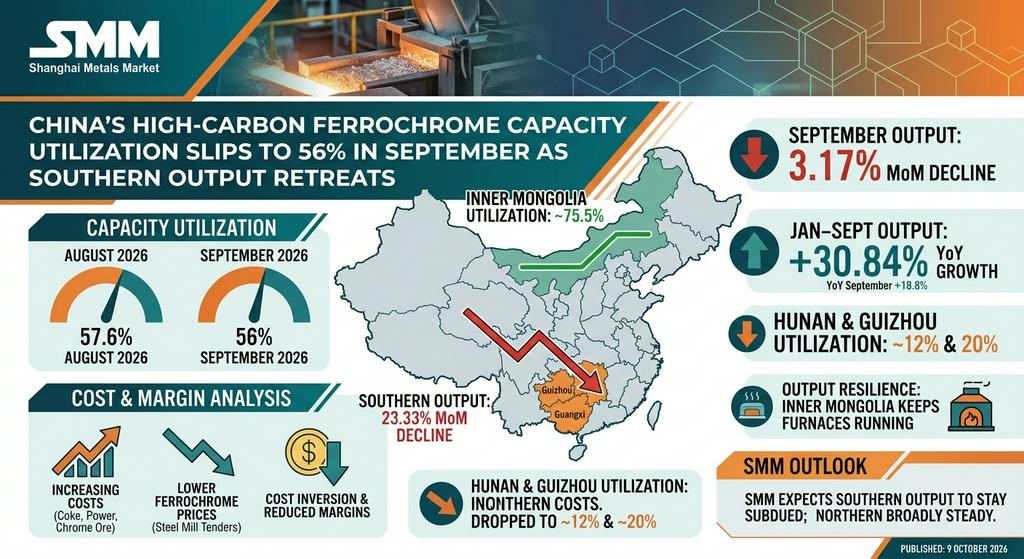
SMM data showed that China’s high-carbon ferrochrome output in September 2026 fell 3.17% MoM but rose 18.8% YoY, with January to September output up 30.84% YoY. Capacity utilization was about 56%, down from about 57.6% in August. Capacity was almost unchanged, down only 0.3% MoM, so the output decline reflects producers choosing to run fewer furnaces rather than losing capacity.
Cost inversion explains the pattern. Firm coke prices, higher power tariffs and slow-moving chrome ore prices raised costs, while lower steel mill tender prices weakened ferrochrome prices, leaving higher-cost plants in the south with little or no margin. Output in Guizhou, Hunan and Guangxi combined fell 23.33% MoM, accounting for nearly 60% of the national decline, and utilization in Hunan and Guizhou dropped to about 12% and 20%. Inner Mongolia, with roughly 81% of national output, dipped only 0.31% MoM at about 75.5% utilization, as its scale and lower costs kept furnaces running. That resilience is why YoY and YTD growth remain strong even though the MoM decline has widened and both growth rates have eased since August.
SMM expects southern output to stay subdued until margins recover, while northern output holds broadly steady.
![[SMM Chromium Flash] Valterra’s Processing Optimization Delivers R203 Million in Annual Savings](https://imgqn.smm.cn/usercenter/QmrGh20251217171725.jpg)
![[SMM Chromium Analysis] South Africa's Ferrochrome Exports Surge 20% in August, Led by North American Demand](https://imgqn.smm.cn/production/admin/votes/imagesxLaEN20261013211045.png)
![[SMM Chromium Analysis] South Africa's Chrome Ore Exports Drop 10.8% in August, China's Share Reaches 70%](https://imgqn.smm.cn/production/admin/votes/imagesZwVxy20261013205705.png)