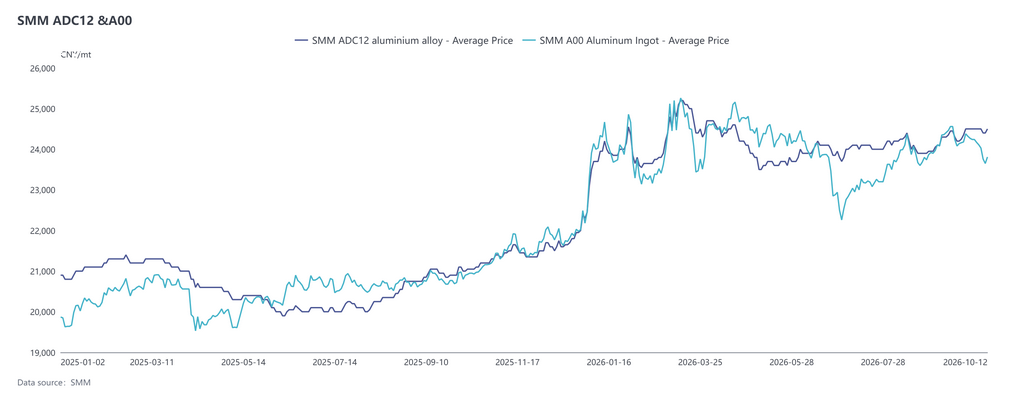
In September, domestic ADC12 prices consolidated on a strong note overall, with the center moving higher. Prices increased continuously in the first two-thirds of the month, driven by costs, before consolidating in the last third as futures pulled back and pre-holiday caution set in. In early October, prices briefly dipped to 24,400 yuan/mt before edging up slightly. As of October 12, SMM's ADC12 quote stood at 24,500 yuan/mt, up a cumulative 400 yuan/mt from early September.
Cost side, SMM data shows that in September 2026, the industry's theoretical total cost for ADC12 rose 1.1% MoM to 23,829 yuan/mt, with major raw material costs broadly higher. Among them, aluminum scrap cost per mt increased 221 yuan from August to 21,507 yuan/mt, with its share pulling back slightly to 90.3%; copper cost rose 20 yuan/mt MoM to 922 yuan/mt, accounting for about 3.9%; silicon cost edged up 11 yuan/mt to 487 yuan/mt, with its share holding at 2.1%.
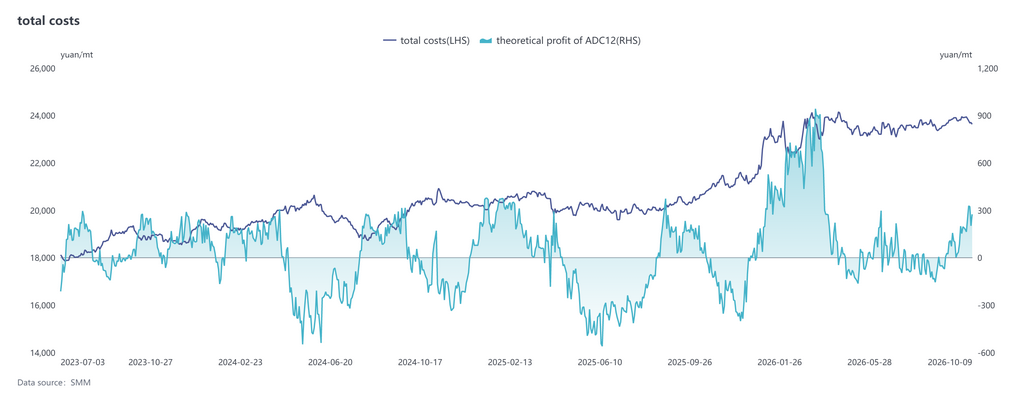
The cost side was the main driver behind the rise in ADC12 prices in September. Firm aluminum prices lifted aluminum scrap prices, and copper prices moved higher in tandem. In addition, stricter reverse invoicing oversight in Henan, Jiangxi, and other regions—with some areas suspending operations or intensifying inspections—tightened compliant aluminum scrap supply and kept invoice-inclusive procurement prices elevated. Enterprises' comprehensive production costs continued to climb, leaving limited room for voluntary price concessions. Finished product price gains outpaced raw materials at certain stages, improving the industry's theoretical profitability, with theoretical per-mt profit at about 133 yuan in September.
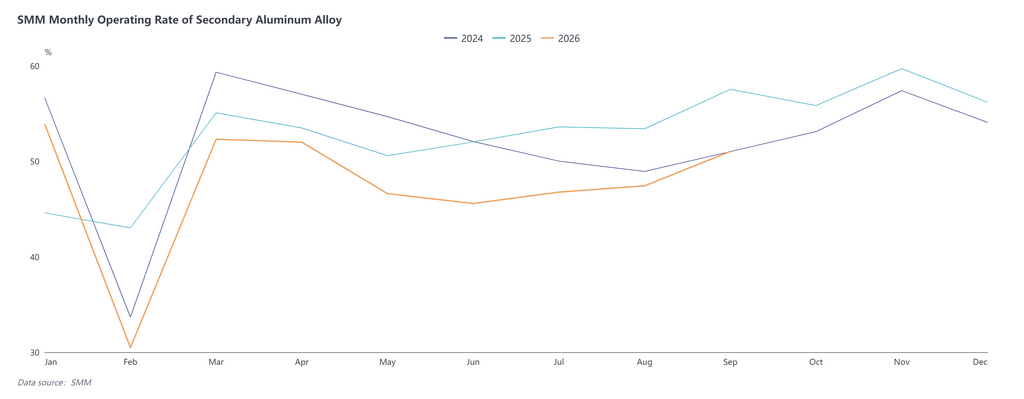
Demand side, September marked the start of the traditional peak consumption season, with downstream orders recovering from August and end-use demand from automobiles and other sectors improving marginally, though peak-season characteristics remained less pronounced. According to CAAM data, automobile production in September reached 2.99 million units, up 11.4% MoM but down 8.7% YoY. NEV production came in at 1.814 million units, up 12.2% YoY. CAAM noted that in the first three quarters, the overall auto market showed a pattern of "weak at home, strong abroad," with the Chinese market remaining under pressure while exports maintained relatively fast growth, and new momentum from NEVs and other segments continued to be released. Looking ahead to Q4, as the trade-in policy becomes more effective and various consumption-promotion activities advance, the decline in domestic auto sales is expected to narrow. Combined with continued export growth, demand along the automotive industry chain will receive some support. However, given that the recovery in domestic end-use demand remains insufficient, ADC12 downstream demand is expected to improve only mildly in the near term, and the actual boost remains to be seen. In terms of supply, the operating rate of the secondary aluminum alloy industry in September was 51.0%, up 3.6 percentage points MoM but down 6.5 percentage points YoY. Production continued its recovery trend, though the operating rate remained below the year-earlier level. Enterprise orders improved from the prior period, providing some support for the operating rate rebound. However, peak-season demand release was generally mild, and downstream purchasing enthusiasm improved only modestly. Meanwhile, affected by stricter implementation of fiscal and tax policies, the issues of tight compliant aluminum scrap supply and high procurement costs remained unresolved, and enterprise production release continued to be constrained by the raw material side. In addition, most enterprises maintained normal production during the Mid-Autumn Festival holiday, with only a few arranging short breaks, resulting in limited impact on the overall monthly operating rate.
The industry operating rate in October is expected to pull back MoM, mainly due to the combined effects of holiday arrangements and continued tightening of fiscal and tax policies. On the holiday arrangement side, large enterprises and direct aluminum liquid suppliers generally maintained production, with some appropriately reducing production loads; other enterprises mostly arranged 3-5 day holidays. On the policy side, stricter fiscal and tax enforcement continued to expose some enterprises to insufficient raw material supply and elevated procurement costs, further limiting production stability and capacity release.
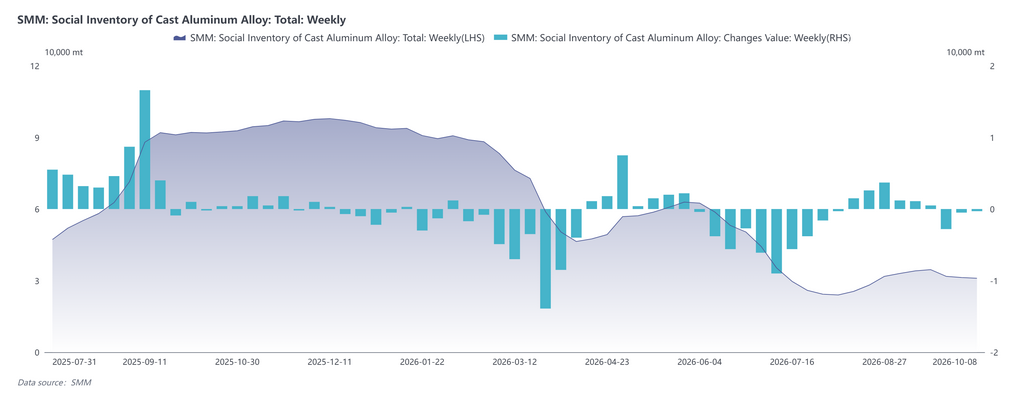
On the inventory side, China's cast aluminum alloy ingot social inventory in September showed a pattern of inventory buildup followed by destocking. From early to mid-month, affected by peak-season demand release falling short of expectations, inventory accumulated continuously; entering late September, as the basis widened and pre-holiday stocking demand was gradually released, social inventory shifted to destocking. As of October 8, social inventory further edged down to 31,000 mt. Looking ahead, if downstream orders improve and purchasing demand is further released, combined with production constraints from tight compliant aluminum scrap supply, social inventory will continue to destock modestly; if demand recovery falls short of expectations while enterprise production resumptions drive supply rebound, inventory may still accumulate again. Close attention should be paid to demand realization and tax invoice policy changes.
Looking ahead to October, the market is expected to continue the tug-of-war between cost support and insufficient demand follow-through, with prices mainly moving sideways and overall performance relatively firm. Cost side, if tax invoice compliance supervision continues to tighten, raw material procurement difficulty and cost pressure will persist, providing strong support below spot prices. Demand side, although downstream purchasing gradually recovers after the holiday, the September-October peak season demand release has fallen short of expectations, and end-user orders and restocking demand have yet to show significant growth. If this state continues, cost support will function more as a floor than a driver of price increases. Supply side, enterprise production resumptions are driving a gradual recovery in operating rates, but tight compliant raw material supply and elevated procurement costs may limit production release. Against a backdrop of weak demand recovery, supply constraints will provide relatively limited boost to prices. Overall, ADC12 prices in October will see strong cost support below and limited upside constrained by demand absorption capacity, and are expected to consolidate on a strong note with limited volatility, with a trading range of 23,800-24,800 yuan/mt. Going forward, close attention should be paid to aluminum price trends, progress in tax invoice policy implementation, changes in compliant aluminum scrap supply, and actual downstream purchasing conditions.

![Alumina inventory buildup pressure persists, SHFE aluminum tug-of-war between longs and shorts maintains consolidation at lows [SMM aluminum futures brief review]](https://imgqn.smm.cn/usercenter/HVmVi20251217171654.jpg)