Three miners cut output in September
On 29 September, CSN Mineração issued a material fact announcing a temporary cut in iron ore output at the dry processing plant of its Pires Complex in Ouro Preto, Minas Gerais, citing current market conditions, low ore prices and high ocean freight. Because of the cut and lower third-party purchases expected in the coming months, it lowered its 2026 guidance for own production plus purchases from 45.0–47.0 Mt to 39.0–41.0 Mt, and raised C1 cash cost guidance from USD 22.0–23.5/t to USD 25.0–26.0/t. CSN said the measure can be reversed at any time if margins for this ore improve, and does not expect a material impact.
CSN Mineração produced and purchased 10.058 Mt in 1Q26 and 10.880 Mt in 2Q26, about 20.94 Mt in the first half. At the new 40 Mt midpoint, the second half comes to about 19.06 Mt: roughly 1.9 Mt below the first half and about 6 Mt below the second-half volume implied by the old guidance. Part of that 6 Mt is lower third-party purchases rather than CSN's own mines. According to its parent company, the ore being cut is lower grade.
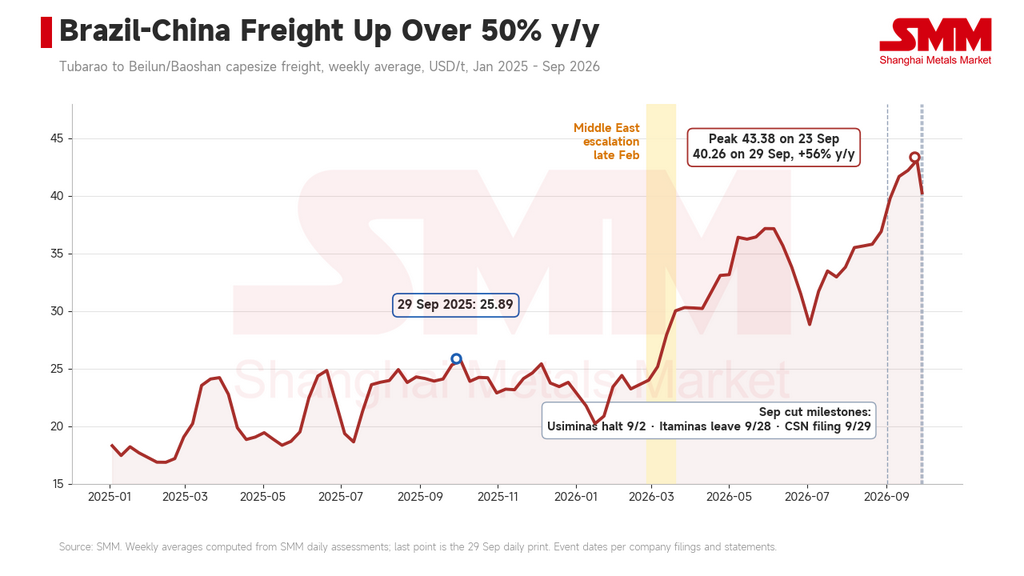
Freight moved higher after the Middle East escalation in late February and reached USD 43.38/t on 23 September; all three cuts fall close to that peak.
Mineração Usiminas (Musa) moved first. It indefinitely suspended its Samambaia plant in Itatiaiuçu from 2 September; the plant accounts for about 30% of Musa's 9 Mt/y capacity. The company said Brazil-China freight had risen from USD 22–23/t to peaks of USD 37–38/t since the Middle East conflict escalated in late February. Private miner Itaminas then said its wet processing plant in Sarzedo will stop in October, with about 300 employees, roughly a third of its direct workforce, on a month of collective leave from 28 September. Itaminas exports about 90% of its output.
Trade backdrop: freight up, supply ample
SMM Tubarao-Beilun/Baoshan freight averaged USD 24.67/t in the first quarter, USD 34.06/t in the second and USD 36.26/t in the third, and reached USD 43.38/t on 23 September, the highest since the series began in October 2023. Fuel is one of the main drivers. Vale reported that its unit maritime freight cost rose USD 3.9/t quarter on quarter in 2Q26, with higher bunker costs contributing USD 2.3/t and spot freight volatility USD 0.8/t.
Simandou is another thread to watch. Rio Tinto reported that its Simandou operation shipped 1.6 Mt to China in the second quarter and 2.2 Mt in the first half, with 2026 sales guidance of 5–10 Mt and full production rates targeted in the second half of 2028. At current volumes Simandou takes up little capesize capacity. Guinea-China is a long-haul trade, however, and as the project ramps up, demand for Atlantic tonnage will grow, so Brazilian miners may face more competition for ships.
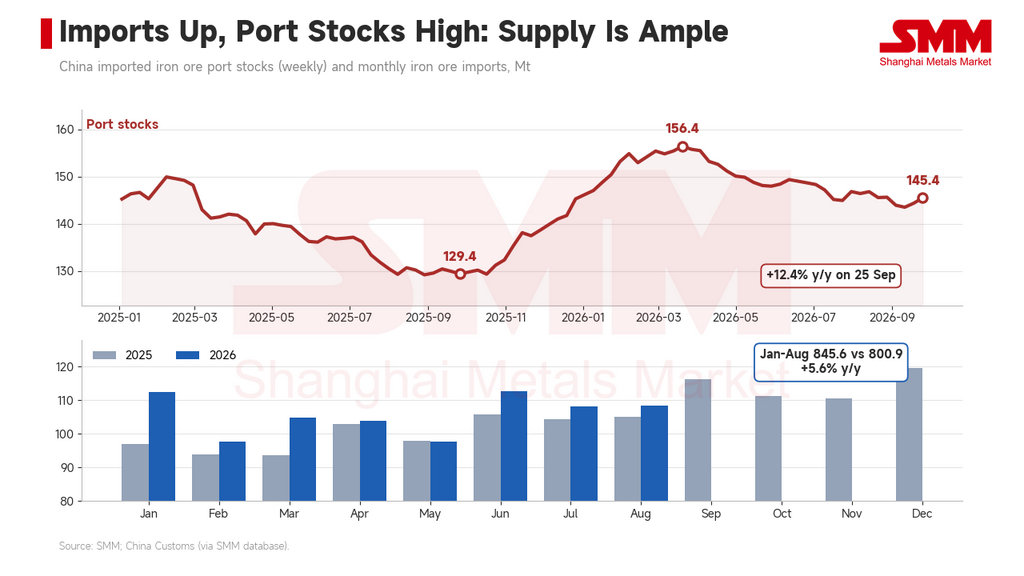
Supply on the Chinese side is not tight. Customs data show China imported 845.6 Mt of iron ore in January-August, up 5.6% year on year. SMM's count of imported ore stocks at Chinese ports was 145.5 Mt on 25 September, up 12.4% year on year, after peaking at 156.4 Mt on 20 March. With imports rising and stocks high, buyers have leverage and sellers struggle to add higher freight to the delivered price.
Freight eats the FOB netback, low grades hit hardest
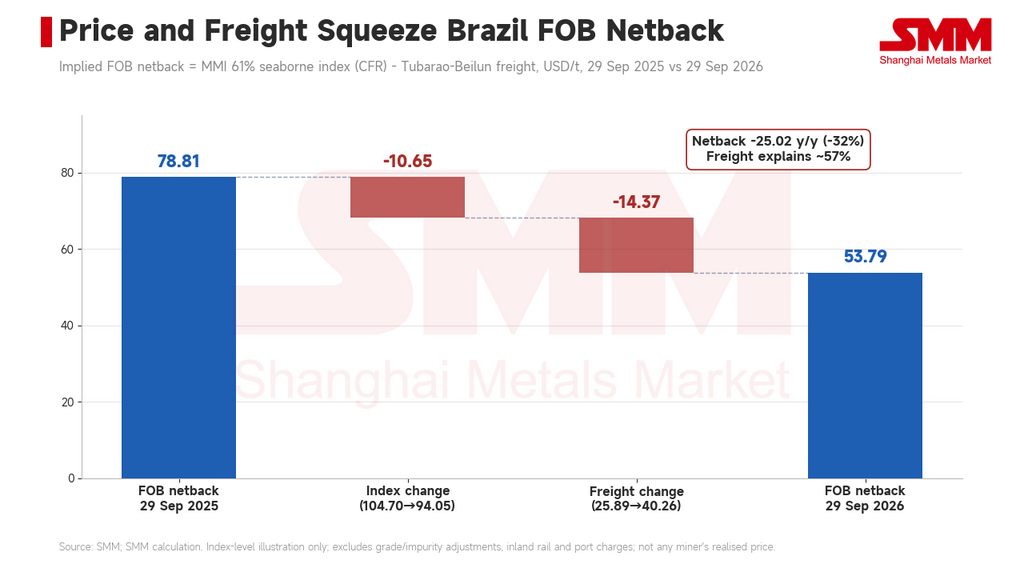
SMM's MMI 61% Fe seaborne index stood at USD 94.05/t on 29 September, down USD 10.65/t year on year; freight on the same day was USD 40.26/t, up USD 14.37/t. Taking the index minus freight as a rough guide, Brazil's FOB netback fell from USD 78.81/t to USD 53.79/t, a drop of USD 25.02/t, about 57% of it from higher freight.
Low-grade ore from the Pires dry plant and Itaminas' products are in a tougher spot than mainstream fines. Freight is charged per wet tonne, so the lower the grade, the higher the freight per unit of Fe, and the market discount on low grades is widening. SMM data show Super Special Fines (56.5%) at Qingdao averaged 539.4 yuan/wmt in the week of 25 September, down 25.3% year on year, while PB fines (60.8%) fell 13.7%. The SSF/PB price ratio dropped from 0.92 a year earlier to 0.79, well below the Fe-content ratio of about 0.93. The high-grade end has barely moved: the spread between SMM's MMi 65% and 61% seaborne indices is about USD 17/t, broadly in line with about USD 18/t a year ago.
Mills: two coke rallies, margins turn negative
SMM's grade-1 met coke national average has rallied twice this year. The first rally took it from 1,390 yuan/t in late March to 1,840 yuan/t in mid-July. After easing to 1,690 yuan/t in mid-to-late August, a second rally began in late August and lifted it to 2,140 yuan/t in late September. Each rally added about 450 yuan/t.
Tighter coking coal supply in Shanxi has been an important driver. After a safety incident at a coal mine in Shanxi in late May, safety inspections were carried out across the province, and about 130 coking coal mines with 125–147 Mt/y of capacity stopped after 23 May. Restarts were slower than expected: 43 mines with about 55.2 Mt/y of capacity had resumed by 1 June, while 51 mines with about 55 Mt/y were still idle on 20 August, and restarted mines were producing about two-thirds of their earlier output on average. The National Bureau of Statistics reported July raw coal output of 340 Mt, down 10.1% year on year, and August output of 360 Mt, down 7.7%, a decline 2.4 percentage points narrower.
SMM's spot margin for large-mill BF-BOF rebar has been negative most of the time since late March, the loss widened past 100 yuan/t after mid-July, and the week of 11 September averaged minus 229 yuan/t. HRC margins were still about 108 yuan/t in late August but turned negative in September, at minus 102 yuan/t in the week of 25 September. Output has adjusted only modestly: average daily hot metal at SMM's 242 sample mills eased from 2.465 Mt/day in mid-June to 2.388 Mt/day at the end of September, down about 3%. On 15 September the steel industry issued an initiative on self-disciplined output control and inventory reduction, calling for strict implementation of output controls and lower stocks.
Higher coke prices have squeezed mill margins and lowered the ore price mills can accept. Chinese ore demand in volume terms has not shrunk much, with hot metal down only about 3%; the change is in price tolerance and in how cautiously mills buy at the margin. That explains the decomposition in Section 3: higher freight cannot be passed into CFR prices, so it falls on the miners' FOB netback. Brazil's smaller miners face freight on one side and mills under cost pressure on the other.
Vale's freight moat
Vale has not followed. Its second-quarter iron ore output was 84.3 Mt, the highest for a second quarter since 2018, and its 2026 production guidance of 335–345 Mt is unchanged. Vale's unit maritime freight cost was USD 22.0/t in 2Q26, which the company said was USD 10.6/t below the C3 route. That gap was USD 4.6/t in 3Q25, USD 5.9/t in 4Q25 and USD 6.7/t in 1Q26, widening each quarter as spot freight rose. Vale credits its long-term chartering strategy, which it says reduces both cost and volatility.
A fuel hedge adds a second layer. Vale has hedged about 70% of its expected 2026 bunker consumption with zero-cost collars that protect above USD 80/bbl Brent; the hedge contributed about USD 100 million, or roughly USD 1.6/t, in 2Q26. The Vale quarterly reports and call materials we reviewed do not show it hedging spot freight with forward freight agreements (FFAs), so its edge is better described as long-term tonnage plus a fuel hedge.
Vale's own costs are rising. On a stronger real and higher diesel and freight, it raised 2026 C1 cash cost guidance from USD 20.0–21.5/t to USD 22.5–23.5/t and all-in cost guidance to USD 58–62/t. Compared with peers that charter in the spot market, however, Vale pays roughly USD 10/t less for freight, and with netbacks this compressed that gap goes a long way to explain why cuts are concentrated among smaller miners.
Limited supply loss; watch the product mix
The announced cuts are modest in volume. CSN's guidance falls by 6 Mt, Samambaia has about 2.7 Mt/y of capacity, and the Itaminas wet plant is down for one month for now. Together that is under 10 Mt annualised, roughly 2% of Brazil's annualised iron ore loadings over January-September 2026 (about 378 Mt). SMM ship-tracking data show Brazilian loadings averaging 7.56 Mt a week in the third quarter, down about 10% year on year, mostly at the northern port of Ponta da Madeira. Cuts that only started in September are not yet fully visible in the loading data.
Stocks of Brazilian-origin ore at China's ten major ports were 32.85 Mt on 24 September, down 23.6% year on year, and BRBF stocks were 0.77 Mt, down 61%. BRBF is Vale's flagship blend, so its drawdown has no direct link to the smaller miners' cuts. Those cuts are concentrated in lower-grade fines and small lump, so the effect is more likely to show up in the marginal supply of low- and mid-grade Brazilian fines than in the overall balance.
Brazilian-origin port stocks are down 23.6% year on year and BRBF by more, but that mainly reflects Vale's flagship supply and has little to do with the smaller miners' cuts.
Itaminas management expects to return to normal in November, and CSN says its measure can be reversed at any time. If freight eases, or if mill margins recover and mills accept higher ore prices, this supply could come back quickly.
SMM believes this round of cuts by Brazil's smaller miners reflects freight and mill margins acting together. Freight up about USD 14/t year on year has directly compressed the FOB netback; two coke rallies have pushed BF-BOF margins negative and limited what mills will pay for ore; and with imports rising and port stocks high, freight cannot be passed into CFR prices. The three cuts came in the same month as the second coke rally and the turn to negative margins, which supports the two-sided squeeze reading. Whether cuts spread to more non-mainstream miners remains to be seen.
Miners that charter in the spot market and sell lower-grade products are carrying most of this pressure, while Vale's long-term tonnage and fuel hedge place it in a stronger position on the cost curve. Announced cuts total under 10 Mt annualised and have limited effect on the global balance; the impact falls mainly on marginal low-grade supply and discounts.
If freight stays near USD 40/t while mills keep up output discipline and margins do not recover, upside for CFR prices in the fourth quarter may be limited, pressure may keep passing to low-grade FOB netbacks, and non-mainstream miners could adjust output further. If freight eases or coke prices soften, the curtailed mines could restart quickly. Key items to watch are Vale's third-quarter production and sales report in October, the pace of coking coal restarts in Shanxi, and the SSF/PB price ratio.
![[ EUROFER Reports 18% Decline in EU Long Product Imports for H1 2026 ]](https://imgqn.smm.cn/usercenter/aPBtI20251217171717.jpg)
![[ Worthington Steel Misses Q1 Earnings Amid High Integration Costs ]](https://imgqn.smm.cn/usercenter/crVox20251217171717.jpg)
![[ Acciaierie d'Italia Processes Blast Furnace Shutdown in Taranto ]](https://imgqn.smm.cn/usercenter/exdqc20251217171717.jpg)