Executive Summary
- The case: On September 15, 2026, the Indonesian Anti-Dumping Committee (Komite Anti-Dumping Indonesia, KADI) opened an anti-dumping investigation into imports of galvanized steel (Baja Lapis Seng, BJLS) from China under Notice No. AD.02/591/KADI/09/2026. The investigation covers nine HS codes. PT Tata Metal Lestari and PT ArcelorMittal Nippon Steel Indonesia filed the petition on behalf of the domestic industry.
- Import dominance: Between 2023 and 2025, China supplied about 81% of Indonesia's BJLS imports (2.08 million mt of 2.56 million mt). By 2025, Chinese material covered around 52% of national consumption.
- Cost-price squeeze: Domestic selling prices fell 21% over 2023–2025, but cost of goods sold fell only 14%. If this continued, this will harm a lot especially in the profit margin for local galvanized steel productions.
- Price undercutting: Chinese material was cheaper than the local product in every year of the review period.
- Current status: No duties apply at this stage. The investigation can last up to 12 months and can be extended to 18 months.
I. Product Background: What Is Galvanized Steel (BJLS)?
Definition and Applications: A Corrosion-Resistant Steel for Diverse Applications
Galvanized steel, known in Indonesia as Baja Lapis Seng (BJLS), is carbon steel coated with zinc (Zn) to protect it from corrosion. Zinc protects steel in two ways:
- Barrier protection: When exposed to the atmosphere, the zinc surface forms a dense layer of zinc oxide, zinc hydroxide and basic zinc carbonate, which slows further corrosion.
- Sacrificial (cathodic) protection: Zinc is more electrochemically active than iron, so it corrodes first at scratches and cut edges and protects the exposed steel underneath.
Depending on coating mass and the service environment, galvanized steel usually resists corrosion for 10–50 years. It is also clean and easy to form and fabricate. That makes it a standard construction material for roof trusses (including light-steel baja ringan framing), roofing, wall cladding and similar uses. It is also used in appliances, ducting and general manufacturing.
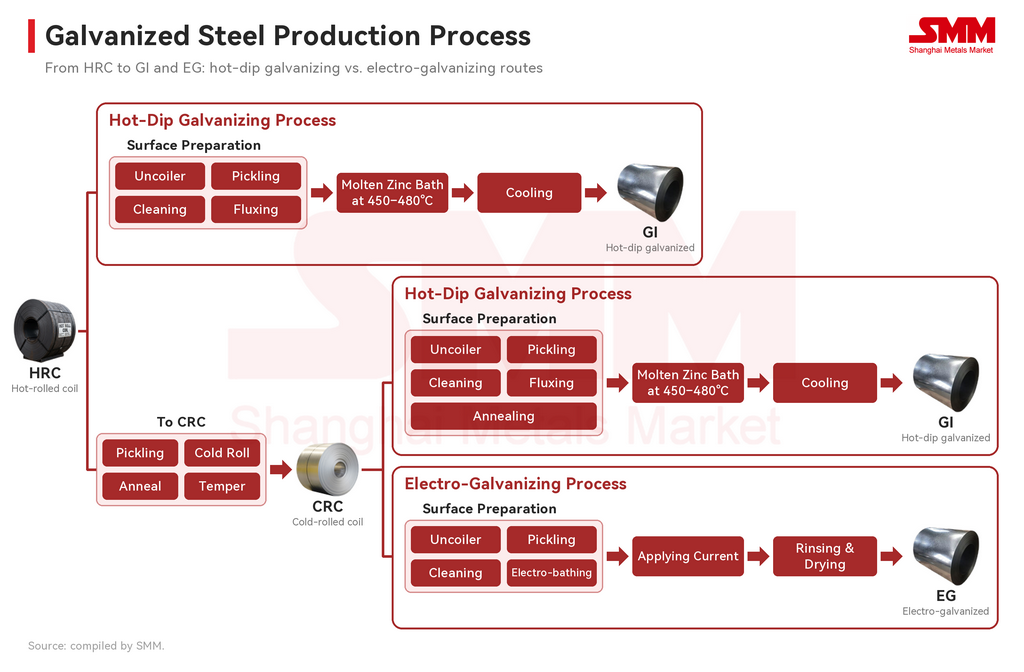
Production Routes: Hot-Dip Galvanizing Is the Most Widely Used Method
The term "galvanizing" comes from the Italian physician and physicist Luigi Galvani. The hot-dip process itself was patented in 1837 by the French engineer Stanislas Sorel. Today, flat steel is coated by two continuous methods:
- Hot-dip galvanizing (HDG): the most widely used route. It lays down a thicker coating at a lower cost per tonne, which suits construction applications.
- Electrogalvanizing (EG): produces a thin, even coating with a better surface finish. It is used mainly for automotive exposed panels and appliances.
Figure below shows both production routes.
II. Legal Framework: How Anti-Dumping Works Under WTO Rules and PP 34/2011
Under the World Trade Organization (WTO) definition, dumping occurs when a company exports a product below its normal value, which is generally the price it charges in its own home market. Dumped imports can flood the importing market and harm local producers. Article VI of GATT 1994 and the WTO Anti-Dumping Agreement allow member states, including Indonesia, to impose duties that offset the dumping margin when dumped imports cause material injury to a domestic industry.
In Indonesia, these rules are implemented through Government Regulation (PP) No. 34 of 2011 on Anti-Dumping, Countervailing and Safeguard Measures. KADI may open an investigation when a petition gives sufficient evidence of:
- dumping of imported goods;
- material injury to the domestic industry; and
- a causal link between the dumped imports and that injury.
Not every producer can file a petition. It must be filed by or on behalf of the "domestic industry" (Industri Dalam Negeri). This is tested against two thresholds under Article 4(3) and Article 6(1) of PP 34/2011 and Article 5.4 of the WTO Anti-Dumping Agreement, and KADI checks both before deciding whether to open a case. If the investigation finds dumping, KADI sends a recommendation to the Minister of Trade. The final anti-dumping duty (Bea Masuk Anti-Dumping, BMAD) is then imposed through a Minister of Finance Regulation (PMK). A provisional duty (BMADS) can also be applied after an affirmative preliminary determination.
III. The Case: Nine HS Codes Under Review, With a Three-Year Injury Period
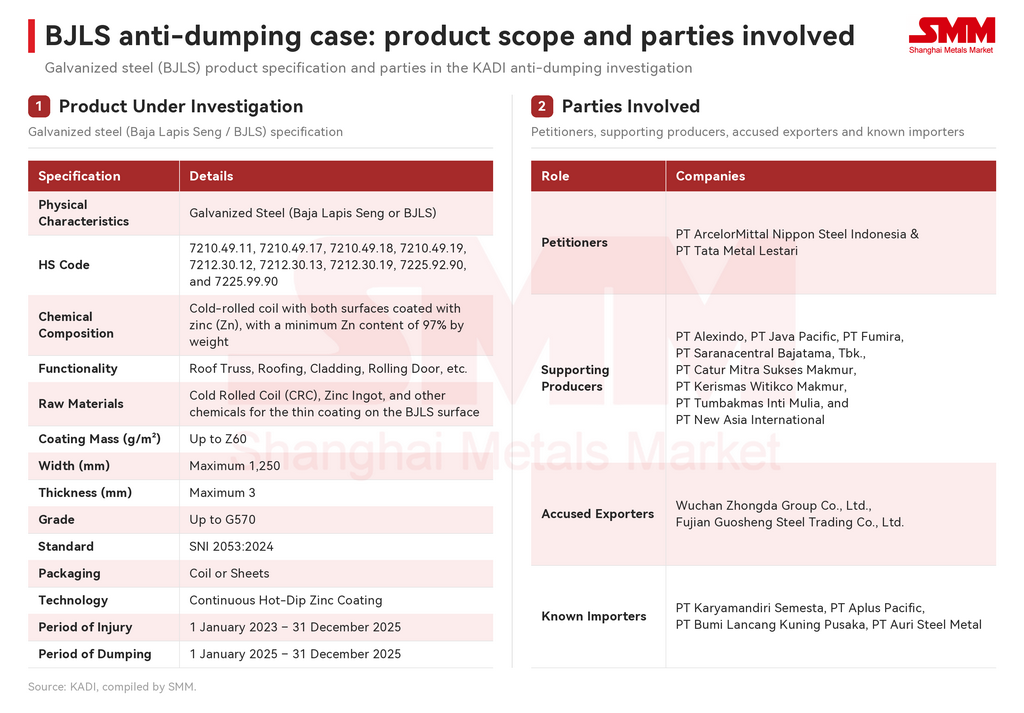
Under Notice No. AD.02/591/KADI/09/2026, the Government of Indonesia, through KADI, has opened an anti-dumping investigation into imports of galvanized steel from China. Indonesian galvanized steel producers brought the case, and KADI decided to proceed after finding evidence of dumping that has caused injury to domestic producers. The table below sets out the product scope, the nine HS codes and the companies involved.
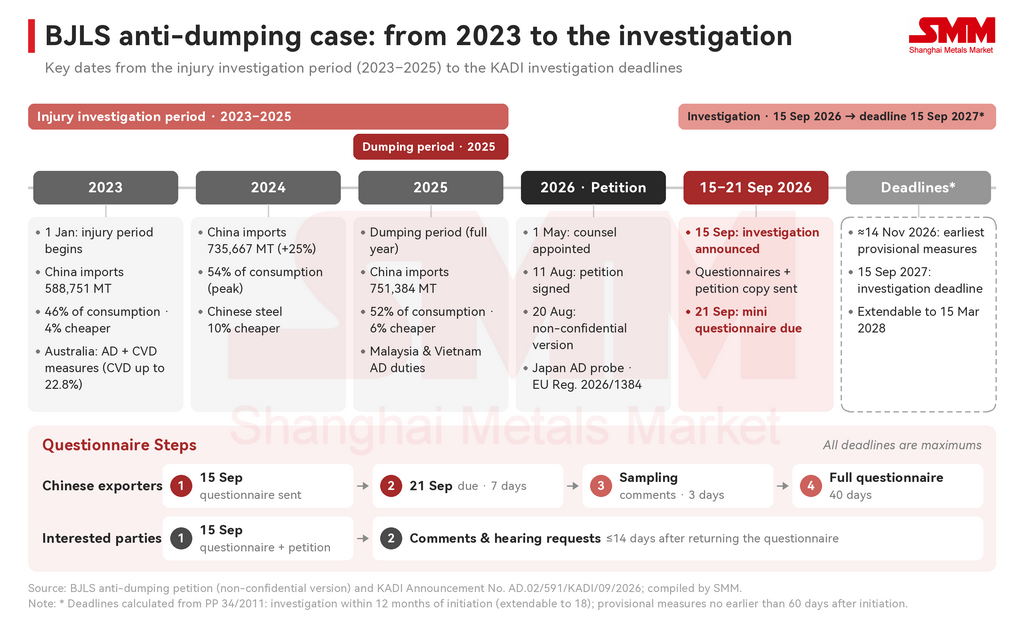
The figure below shows the investigation timeline.
Main Reasons for the Investigation: Industry Standing & The Causalities between Price & Volume Evidences
KADI opened the investigation on two main grounds. First, the petitioners have standing to represent the domestic industry. Second, there is evidence of a causal link between Chinese imports & injury to the domestic industry.
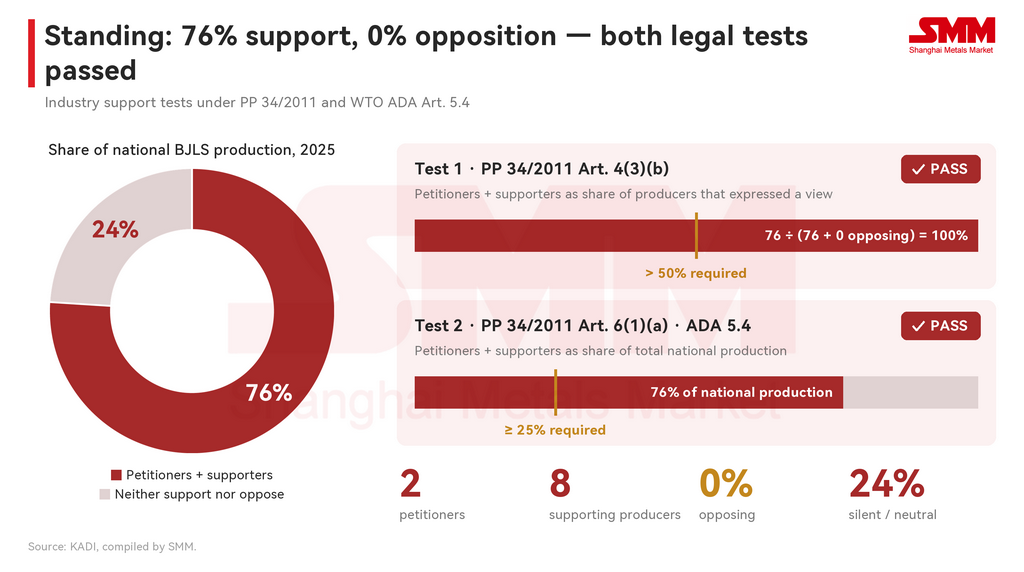
Standing: Petitioners and Supporters Account for ~76% of Domestic Output
PT Tata Metal Lestari and PT ArcelorMittal Nippon Steel Indonesia are two of Indonesia's major galvanized steel producers, and the supporting companies are also established players in the sector. As the chart below shows, no producer opposed the petition, so the group clears both standing thresholds under PP 34/2011 Article 4(3)(b) & Article 6(1)(a). KADI was therefore able to proceed with the investigation.
The Causal Link Shown by Price and Volume Evidence
Price Evidence: Persistent Undercutting and a Cost-Price Squeeze
Price is the main factor in buying commodity-grade galvanized steel, so the petitioners kept lowering their selling prices to stay competitive at home. As the chart below shows, their prices fell faster than the cost of goods sold, so the margin per tonne narrowed every year. Even so, Chinese materials stayed cheaper every year of the period. Undercutting was widest in 2024. That year, China's property downturn deepened and weakened its domestic steel demand, so Chinese mills sold surplus volume into export markets at low prices. The result was a sharp fall in the petitioners' domestic profit margin, dropping around 55% per year between 2023-2025.
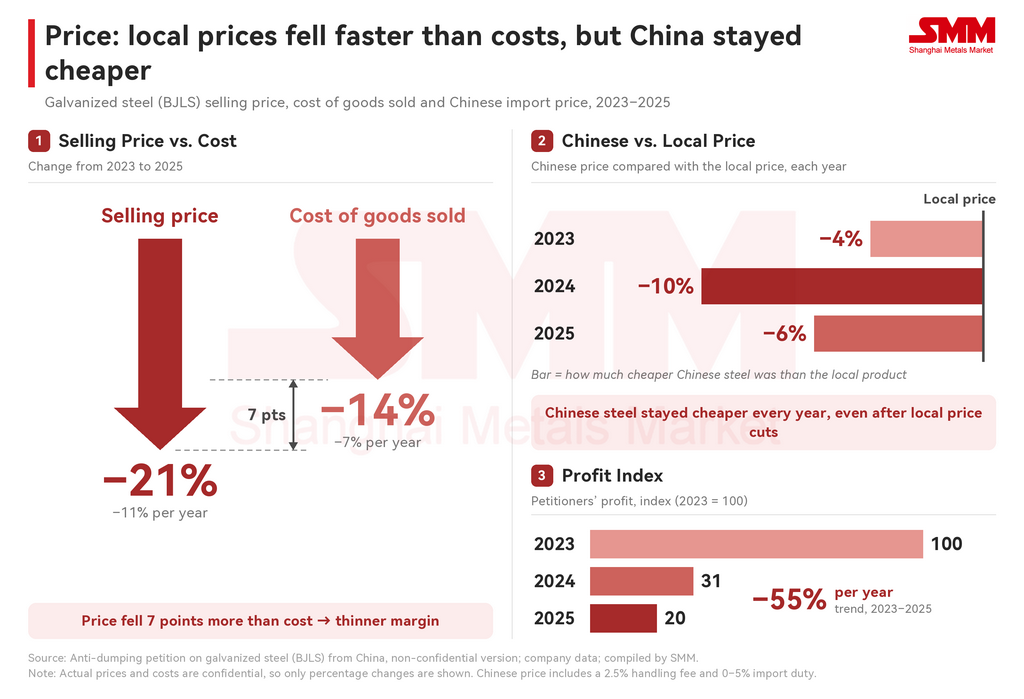
SMM notes that this pattern is price suppression, not just a price decline driven by lower costs. The difference matters under Article 3.2 of the WTO Anti-Dumping Agreement. If prices had fallen only because costs fell, margins would have held steady. Instead, prices fell faster than costs, which shows that domestic producers had lost pricing power. Article 3.2 treats this pattern as evidence of injury.
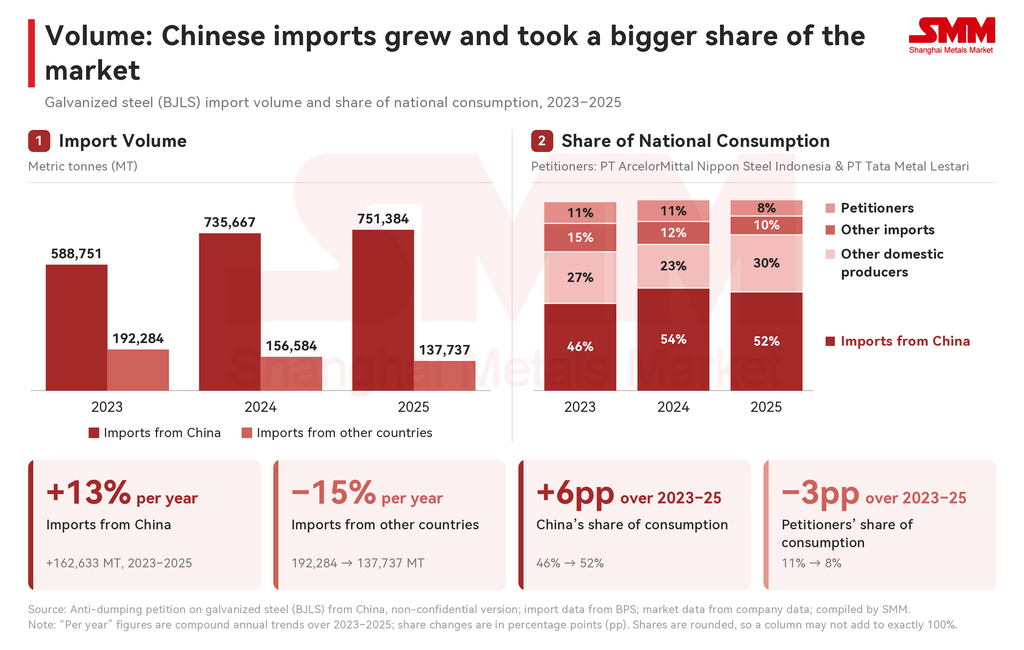
Volume Evidence: China's Share Rises to 52% as the Petitioners' Share Falls to 8%
The chart below shows import volumes and market shares for 2023–2025. Two points stand out:
- China captured the growth in demand. Implied consumption rose by about 165,000 mt over the period, almost exactly matching the rise in Chinese imports. Chinese material absorbed the market's growth and displaced other importers, while the petitioners lost share.
- Other exporters also lost share to China, which points to Chinese pricing rather than import competition in general. However, other domestic producers gained share, so part of the petitioners' loss may come from competition within the domestic industry. KADI will need to separate out that factor in its non-attribution analysis under Article 3.5 of the Anti-Dumping Agreement.
Causal Link: The Price Squeeze Carries the Case
Taken together, the evidence points to a causal link centered on price. Chinese material kept undercutting the petitioners even after they cut prices far enough to squeeze their margins. The volume data support this, since Chinese imports captured the growth in demand and displaced other suppliers. Because other domestic producers gained share, the strongest part of the injury case is the price and margin squeeze, not a loss of market share for the domestic industry as a whole. Based on this initial evidence, the requirements for opening an investigation have been met.
IV. Effect: No Immediate Impact; Trade Flows May Shift Over the Longer Term
For now, the investigation has no direct impact on the market because it is still at an early stage. The key deadlines are shown in the timeline above. Under WTO rules, provisional measures cannot be applied earlier than 60 days after the investigation opens, so any provisional duty could come no sooner than around November 14, 2026.
The effect is expected to build over time, since around 52% of the galvanized steel used in Indonesia comes from China:
- Early stage: Chinese galvanized steel is likely to remain available on the market.
- Longer term: If dumping is proven and anti-dumping duties are imposed, fewer Chinese galvanized products are expected to enter Indonesia, and domestic producers are expected to raise output. This would change trade flows, as Chinese-origin galvanized steel would need to find new markets.
V. SMM View
SMM considers the investigation a positive step for Indonesia's galvanized steel industry. The price and volume evidence set out above, especially China's 52% share of consumption and consistent price undercutting, gives the review a clear basis.
In China, demand for galvanized coil is already very weak. With Indonesia possibly applying anti-dumping duties on hot-dip galvanized coil, Chinese sellers may need to find new markets or other solutions. The galvanized coil is priced at around USD 571/mt FOB Tianjin Port, which is already considered low. Inventories are expected to keep rising as demand stays weak, possibly peaking in the second week after China's National Day holiday. Production has also stayed high as mills try to hold on to market share, with China's galvanized sheet producers averaging a national capacity utilization rate of 64.78% in H1 2026 as mills try to hold on to market share, according to market sources. Sellers are therefore unsure how to place their products, and a possible anti-dumping measure in Indonesia would narrow their market further.
Besides anti-dumping, the most direct form of protection, there are several ways to make the galvanized steel industry, and the steel industry in general, more competitive:
- Trade remedies: Indonesia is one of Southeast Asia's largest steel markets, and trade remedies such as this investigation can play an important role in supporting domestic producers.
- Import quotas: Closer attention to how import quotas are granted, and clearer information on permitted volumes, would support KADI's work. Protection would then come from both anti-dumping measures and careful quota allocation.
- Steel and zinc prices: Galvanized steel prices depend on both steel and zinc, and zinc prices have recently risen. Monitoring steel and zinc prices together would help keep domestic galvanized steel price-competitive.
Data Source Statement: Except for publicly available information, all other data are processed by SMM based on publicly available information, market communication, and relying on SMM's internal database model. They are for reference only and do not constitute decision-making recommendations.
![[Nucor Reports Record Shipments as West Virginia Sheet Mill Nears Commercial Start]](https://imgqn.smm.cn/usercenter/FGavQ20251217171717.jpg)
![[India targets 600 million tonnes steelmaking capacity by 2047 under new policy]](https://imgqn.smm.cn/usercenter/LMnqz20251217171717.jpg)
![[Korean steel stocks surge on Alaska LNG project demand hopes]](https://imgqn.smm.cn/usercenter/ocJKj20251217171717.jpg)