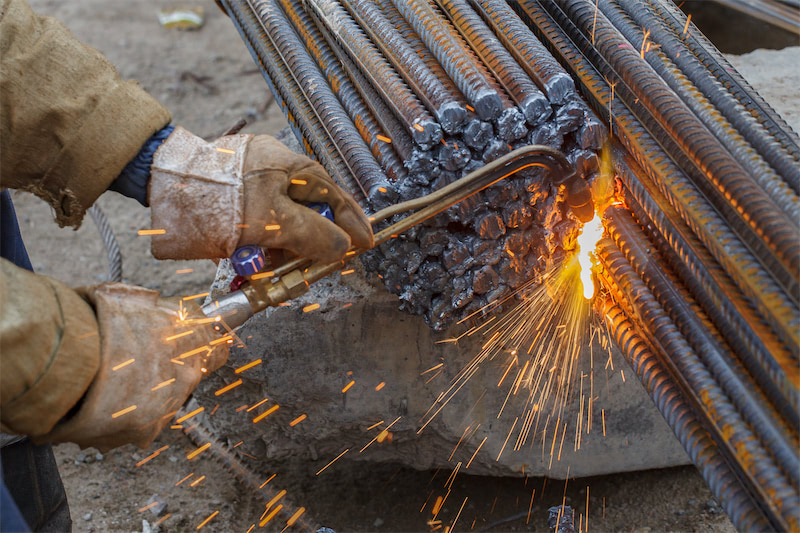
In mid-August, Fortescue announced that the Green Metal Project at its Christmas Creek mine in Western Australia's Pilbara had produced first hot metal, the first successful operation of the project's electric smelting process. According to the company, the first metal was produced from a blended feedstock during commissioning. Commissioning will continue in stages, with the process tested and optimised before any move to larger-scale production. The company has not disclosed what the blend consisted of, or whether green hydrogen was used as the reductant.
The project was approved in November 2023 with an investment of about US$50 million. It was originally due to start production in 2025 and is designed to make more than 1,500 mt of green iron a year. Metso supplies the process, which has two parts. Circored, a hydrogen-based fluidised-bed direct reduction technology, can run on 100% green hydrogen and treats Pilbara fines without pelletising. A DRI smelting furnace then takes the DRI and does the melting a blast furnace would otherwise do. The first Metso equipment went in from September 2025. The on-site green hydrogen plant has been running since 2024, with two 700 kW electrolysers producing about 530 kg of hydrogen a day.
Fortescue CEO Dino Otranto said no one has yet solved green metal production from Pilbara ore at commercial scale. The milestone shows the process can make molten metal, but stable operation on the target Pilbara ore still has to be proven. On what has been disclosed, the smelter can now produce hot metal, but the company has not published data showing the full chain, from Circored reduction to smelting, running continuously on Pilbara fines. The feedstock problem posed by high-impurity fines is still being tested.
Why Pilbara ore struggles to enter DRI-EAF?
The DRI-EAF route can only take DR-grade material with more than 66% Fe and less than 3.5% combined SiO₂ and Al₂O₃, a threshold the Pilbara's mostly hematite and goethite ores generally fail to meet. According to a June 2026 IEEFA briefing note, the reason is that direct reduction cannot remove impurities, while the oxidising atmosphere of an electric arc furnace limits its ability to reduce ore and strip impurities. IEEFA's March report adds that DR-grade material makes up only a small share of global iron ore supply, citing a Midrex projection that the DR-grade shortfall could reach 16.4 million mt a year by 2034.
This is the problem the electric smelting furnace (ESF) is meant to solve. An ESF can handle high-gangue feed, separates slag from iron during melting and produces hot metal close to pig iron, which then goes to a basic oxygen furnace. The route that fits Pilbara ore is therefore more precisely DRI-ESF-BOF. It keeps a mill's existing converters in use, which suits integrated steelmakers.
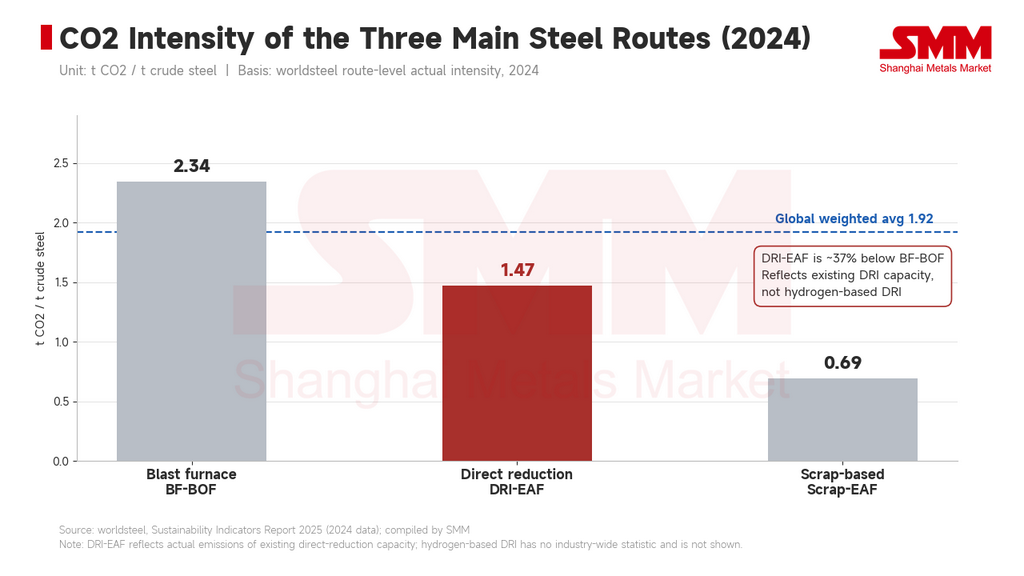
On emissions, worldsteel's latest figures put 2024 CO2 intensity at 2.34 mt per mt of crude steel for BF-BOF and 1.47 mt for DRI-EAF, about 37% lower. Scrap-EAF stood at 0.69 mt and the global weighted average at 1.92 mt. The 1.47 figure reflects actual emissions from existing direct reduction capacity, not hydrogen-based DRI, and there is no industry-wide emissions statistic yet for the DRI-ESF-BOF route.
Smelters take on low-grade ore as the gas-to-hydrogen shift slows
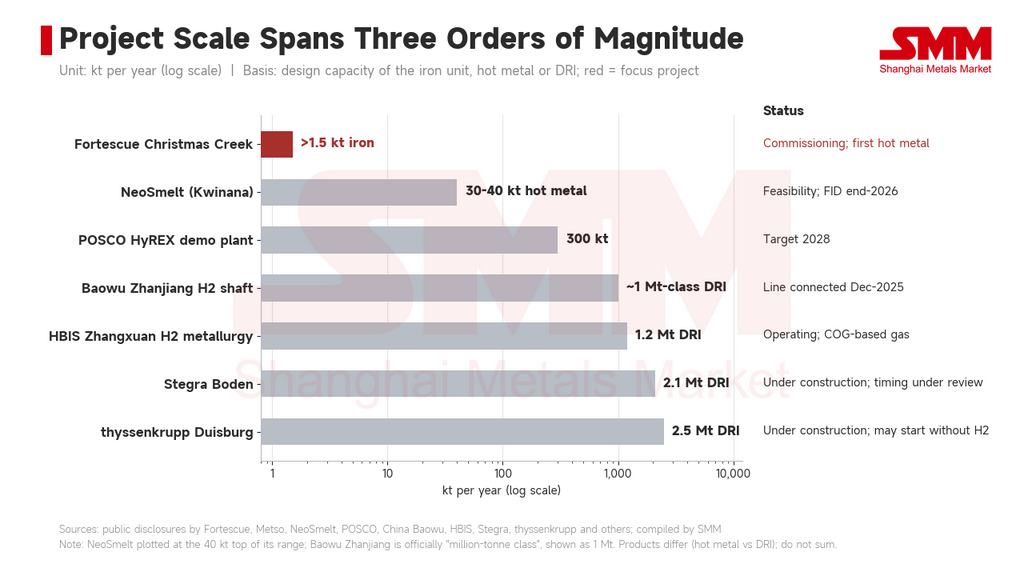
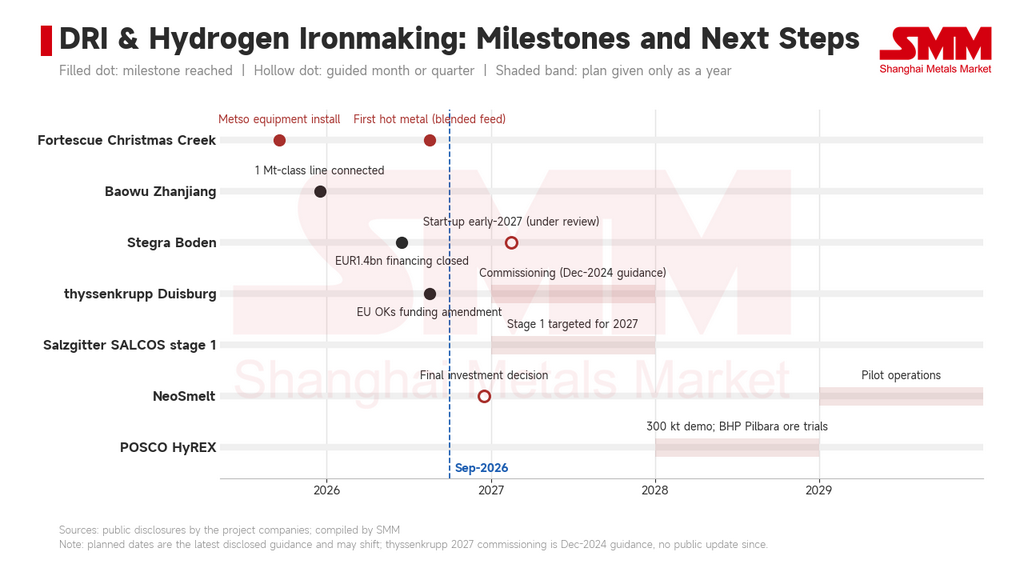
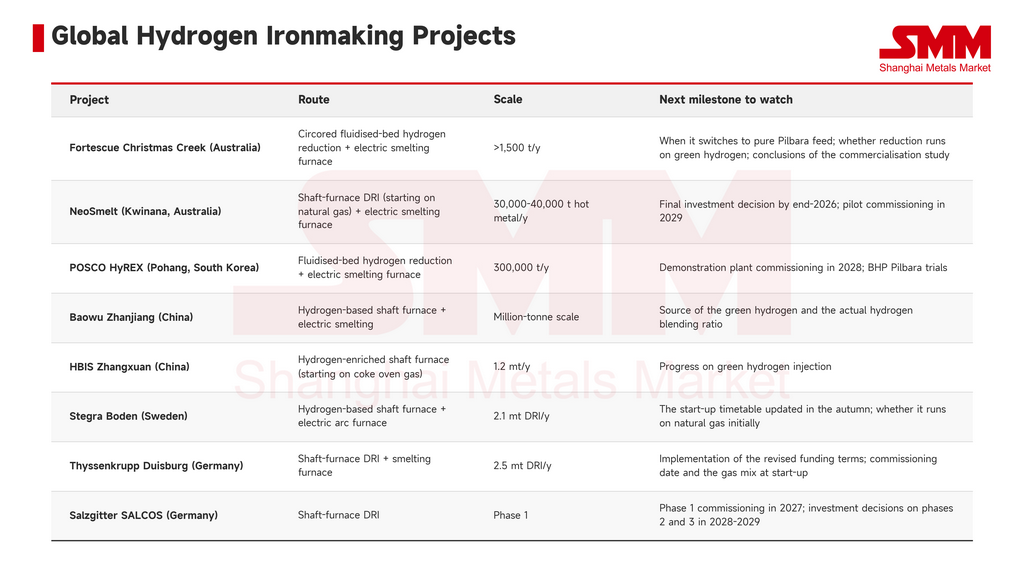
Over the past three years, three electric smelting projects tied directly to Pilbara ore have been built or planned: besides Fortescue's Christmas Creek, they are NeoSmelt in Australia and POSCO's HyREX in South Korea. NeoSmelt, a consortium of BlueScope, BHP, Rio Tinto, Mitsui and Woodside, plans an ESF pilot at Kwinana producing 30,000 to 40,000 mt of hot metal a year, reducing ore with natural gas at first and moving to hydrogen once operating. The consortium said in April that start-up has moved from 2028 to 2029, with a final investment decision expected by end-2026. POSCO's HyREX process also pairs fluidised-bed hydrogen reduction with an ESF and uses fines directly; its 300,000 mt demonstration plant targets commissioning in 2028. BHP signed an MoU with POSCO in November 2025 to trial Pilbara ore at the plant.
On scale, the two projects run by China Baowu and HBIS are both in the million-tonne class. According to China Baowu, its near-zero-carbon line in Zhanjiang was fully connected in December 2025, using a hydrogen reduction and electric smelting process that cuts carbon by 50% to 80% against the conventional route. Baowu has not, however, publicly confirmed the source of its future green hydrogen supply. HBIS Zhangxuan's 1.2 million mt a year hydrogen metallurgy demonstration uses hydrogen-rich coke oven gas as its initial gas source, with the shaft furnace designed to switch to green hydrogen.
In Europe, the hydrogen-based projects of four companies, ArcelorMittal, thyssenkrupp, Salzgitter and Stegra, have each been adjusted on hydrogen conditions or start-up timing. In June 2025, ArcelorMittal dropped hydrogen-based conversions at Bremen and Eisenhüttenstadt despite €1.3 billion in subsidies, saying even natural gas-based DRI was not competitive as a transition option. Around two-thirds of the €3 billion in funding for thyssenkrupp's Duisburg DRI project comes from the German federal government and North Rhine-Westphalia; the aid was originally tied to hydrogen use, and in August the EU approved amended aid rules allowing the plant to start without hydrogen, with the German government still to adjust the funding decisions. Salzgitter is keeping SALCOS stage 1 on course for 2027, while the investment decision on stages 2 and 3 has been pushed to 2028-2029. Stegra's €1.4 billion financing was agreed in principle in April and closed in June, but its early-2027 start-up date remains under review; the company said earlier it would update the timeline in the autumn.
For the iron ore market, a 1,500 mt a year pilot at Christmas Creek will not affect supply and demand in the near term; its value lies in proving the technology. Structurally, if electric smelting works at commercial scale, part of the low-carbon ironmaking demand that would otherwise need DR-grade feed could be met by Pilbara low- and mid-grade ore, easing the scarcity constraint on high-grade material. If performance on pure Pilbara feed disappoints, low-carbon ironmaking will stay reliant on DR-grade resources, and the structural premium for high-grade ore would find firmer support. For now, grade spreads are typically still driven by Chinese mill margins and blending choices; Low-carbon demand is a long-term variable with limited bearing on near-term pricing.
These checkpoints worth tracking are listed below.
![[Indian Railways Approves INR 122 Cr for Doubling Barbil–Bolanikhadan Line in Odisha]](https://imgqn.smm.cn/usercenter/zDUFJ20251217171748.jpg)
![[SMM Iron Ore] Softer spot prices deepen imported iron ore losses](https://imgqn.smm.cn/usercenter/GGaSo20251217171716.jpg)
![[Brazil's CSN Mineração Cuts 2026 Iron Ore Production Guidance to 39–41 Mt and Suspends Low-Grade Ore Output]](https://imgqn.smm.cn/usercenter/exdqc20251217171717.jpg)