SMM, September 24:
As September draws to a close, looking back at China's aluminum billet market this month, "recovery" and "wrestling" stand out as the two defining key words. On one side, supply-side disruptions intensified in phases, and inventory shifted from continuous buildup to destocking, marking marginal improvement. Driven by downstream pre-holiday stockpiling, warehouse withdrawals rebounded for two consecutive weeks during the month. On the other side, processing fees retreated again after a V-shaped recovery, as the tug-of-war between sellers and buyers never ceased. Entering the "double holiday" window, the supply disruption trajectory throughout September and supply variables around the National Day holiday have become the core threads for assessing the market outlook.
1. Aluminum prices retreat after rapid rise; processing fees return to wrestling after V-shaped recovery
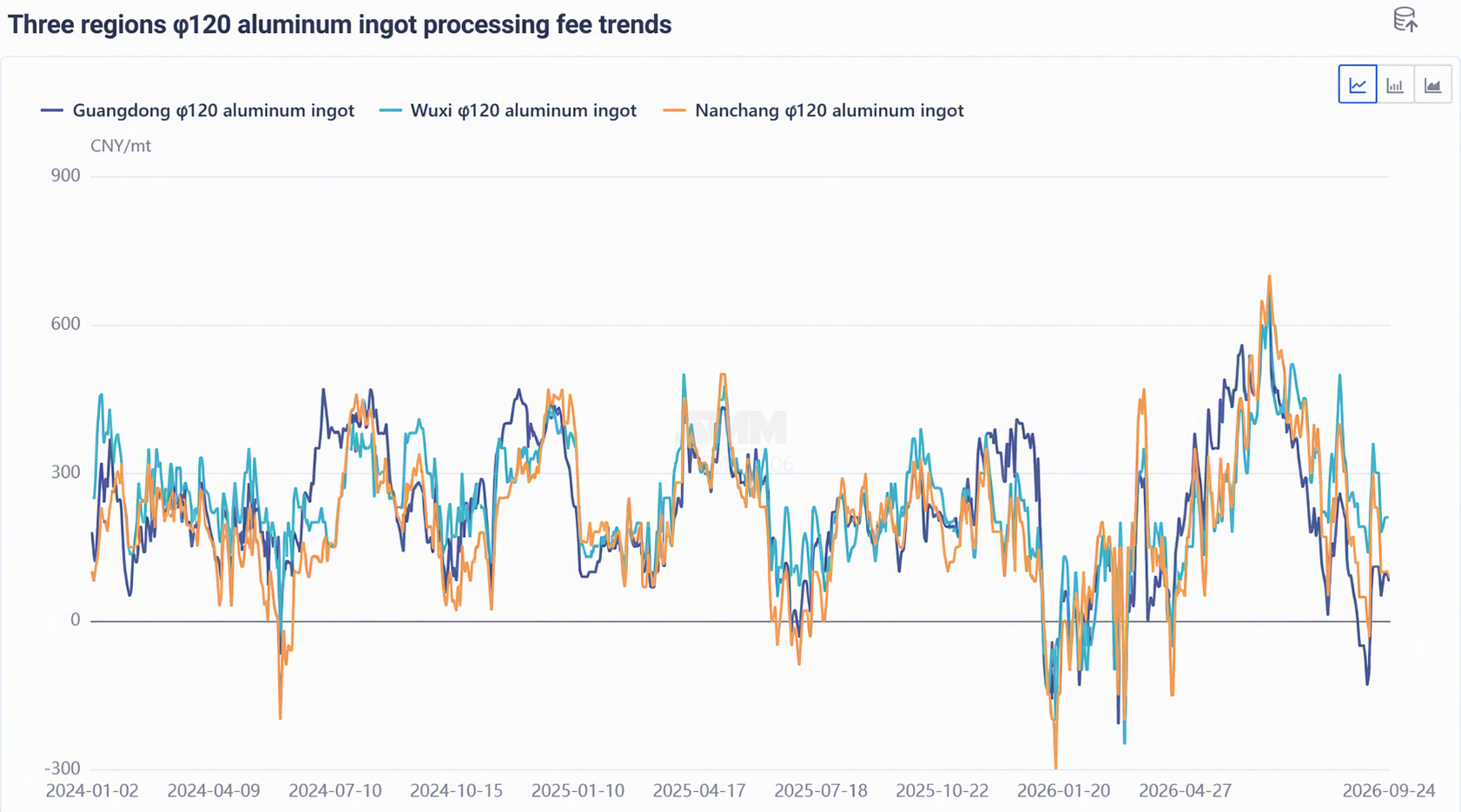
In the first half of September, aluminum prices maintained strong momentum, with SMM A00 aluminum spot prices briefly climbing to a high of 24,800 yuan/mt. Downstream acceptance of high aluminum prices declined noticeably, and combined with inertial supply-side expansion, processing fees for φ120 aluminum billets in Foshan once plunged to a discount of over 100 yuan/mt, making "volume discount" the market norm. Entering mid-month, aluminum prices pulled back from highs, downstream purchase willingness recovered accordingly, and pre-holiday stockpiling gradually commenced. Processing fees rebounded from oversold levels, and by September 17, processing fees across all three regions returned to positive territory. However, the recovery did not last: this week, aluminum prices stabilized around 24,200 yuan/mt, while billet plants in Guangxi and Yunnan that had undergone brief maintenance earlier resumed production. Supply rebounded marginally, and inbound pressure reappeared, sending processing fees across all three regions lower once again, with Nanchang posting the largest decline among all regions.
The pullback in processing fees in the second half of the month was driven by two main factors: first, downstream pre-holiday stockpiling entered its final stage and was dominated by pushing for lower prices and low-level purchases, weakening purchase willingness. In South China, high futures premiums stimulated hedging positions to cash out at elevated levels and sell at lower prices, leaving suppliers unable to hold prices firm and forcing them to passively lower quotes. Second, the overall scale of aluminum billet production cuts in China in September was limited, and last week's oversold rebound in processing fees underwent a rational correction, reflecting that the oversupply landscape has not fundamentally reversed. Notably, the pullback in processing fees indicates insufficient sustainability of the recovery. If holiday-driven inventory buildup occurs as usual, post-holiday stockpiling is overdrawn, and demand stages a pullback, processing fees will remain under downward pressure.
2. Inventory shifts from buildup to destocking; absolute levels remain at highs for the same period in the past three years
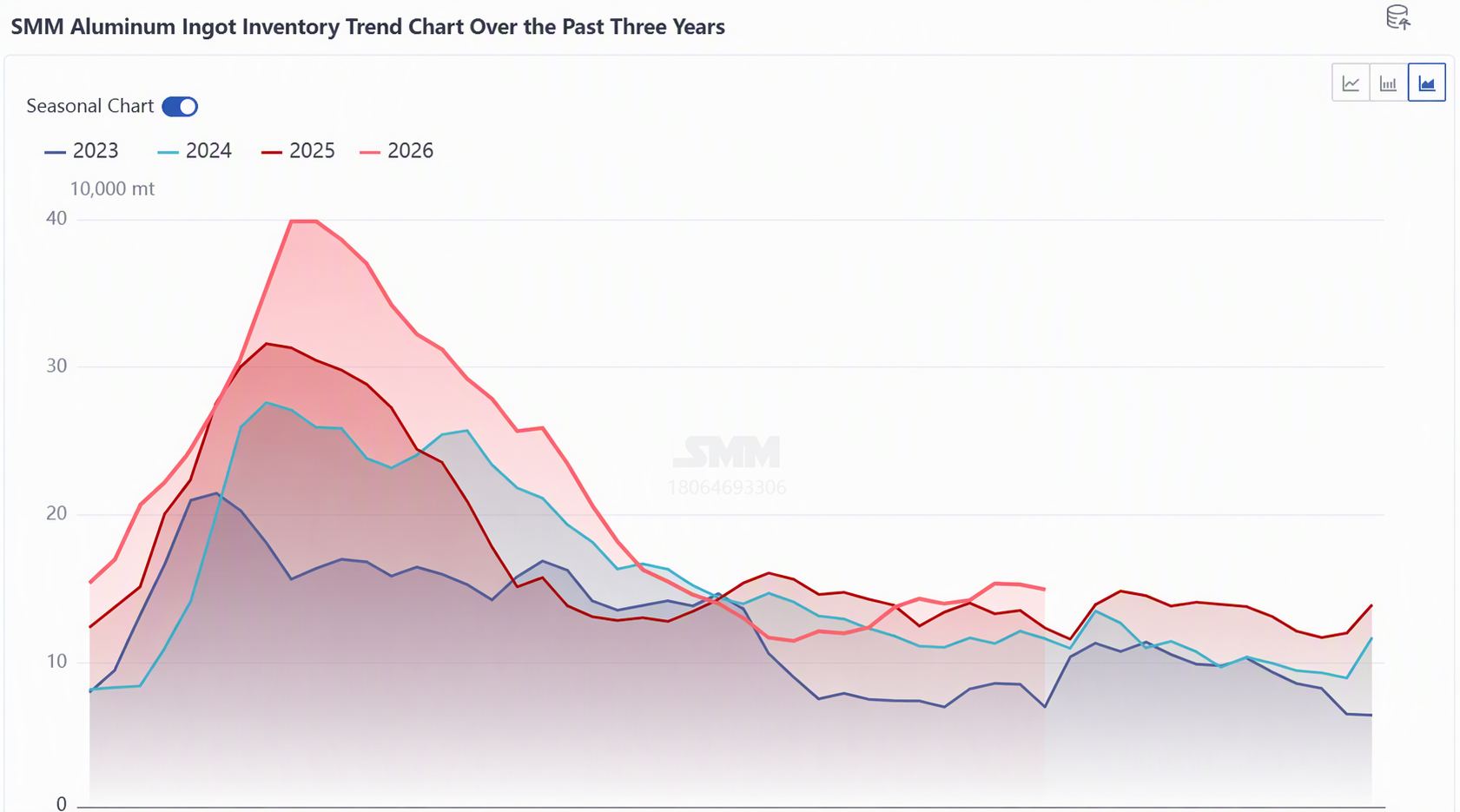
From the inventory perspective, China's aluminum billet inventory in September traced a complete "buildup first, destocking later" pattern. In the first half to mid-September, inertial supply expansion combined with demand underperforming in peak season pushed social inventory of aluminum billets to a phased high. In Foshan, concentrated rail cargo arrivals and passive inbound of direct-delivery truck shipments led to the largest inventory buildup among all consumption regions. The turning point came in mid-to-late September. First, the pullback in aluminum prices stimulated downstream purchase willingness. With the Mid-Autumn Festival and National Day holidays approaching, pre-holiday stockpiling gradually kicked off. From September 15 to 21, China's aluminum billet warehouse withdrawals reached 45,100 mt, up 6,200 mt WoW, marking the second consecutive week of recovery, with Foshan as the main source of the rebound in withdrawals. Second, on the supply side, phased maintenance at billet plants in south-west China and slowing production growth eased inbound pressure at the margin.
As of September 24, aluminum billet inventory in major consumption areas in China stood at 149,000 mt, ending the previous streak of inventory buildup, but still about 26,000 mt higher than the same period in 2025, the highest level for the same period in the past three years. The demand side also showed improvement. This week, the operating rate at leading downstream aluminum processing enterprises in China continued to rebound. Within this, the aluminum extrusion segment recovered relatively notably, boosted by industrial extrusion orders, while construction extrusion remained weak. The front-loading effect of pre-holiday stockpiling on demand cannot be overlooked, and the sustainability of destocking still needs to be verified. Against the backdrop of continued pre-holiday stockpiling and limited supply growth, inventory is expected to maintain its destocking trend next week ahead of the holiday. Attention should be paid to downstream stockpiling intensity, the implementation of production cuts in south-west China, and the pressure from concentrated post-holiday arrivals and the usual holiday-driven inventory buildup.
III. Supply-side panorama: the tug-of-war between high-base inertia and phased contraction
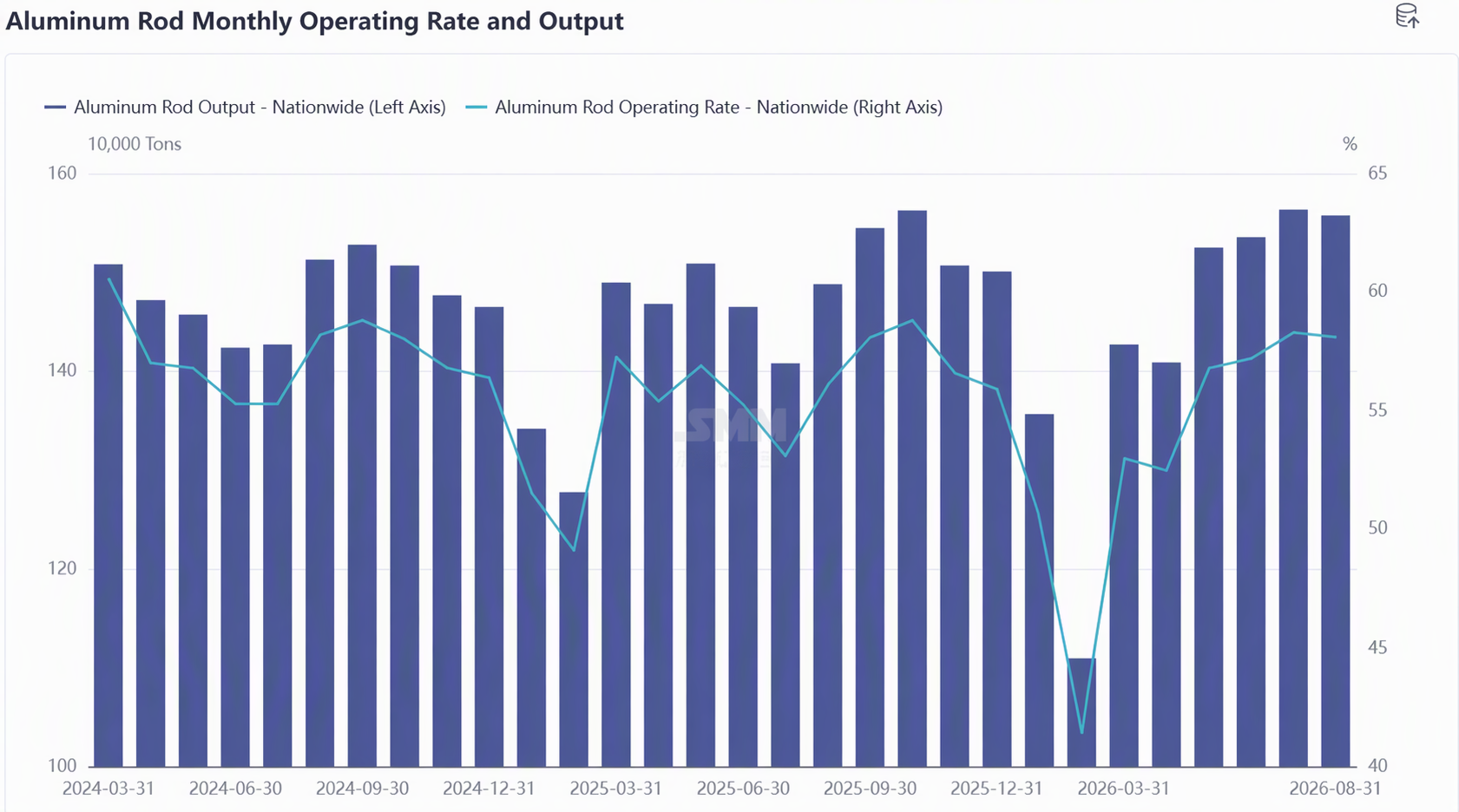
First, the supply base remains elevated. According to SMM statistics, China's total primary aluminum billet production reached 11.487 million mt in January-August 2026, up 0.4% YoY. Thanks to the strong performance of processing fees in Q2, China's aluminum billet supply maintained its upward inertia in July-August, with the operating rate hitting a new high for the year and also the highest level for the same period in the past three years. The lagged nature of supply-side adjustments in the aluminum billet segment meant that production remained in a high-release phase in early September, with the proportion of liquid aluminum at aluminum enterprises staying high and supply-side rigidity remaining strong.
Second, maintenance in south-west China and logistics disruptions constituted the main marginal reductions during the month. In early-to-mid September, news of production cuts and suspensions at billet plants emerged successively in south-west China: in Guangxi, 5-6 billet plants temporarily halted production due to natural gas pipeline repairs and rotating maintenance, while in Yunnan, 1-2 billet plants saw daily output reductions due to furnace cleaning and other reasons. These were mainly construction material billet plants downstream of a few large aluminum enterprises' liquid aluminum operations, with other systems also affected to some extent. Judging from the maintenance cycles, the vast majority were short-term maintenance periods of 5-10 days, representing marginal production cuts. By late September, only a few billet plants had yet to resume production, while the rest had returned to normal production schedules. A few aluminum enterprises saw a slight increase in casting ingot volume due to maintenance at downstream billet plants. In addition, there were disruptions in the outbound logistics segment in south-west China during the month—rising freight costs combined with priority allocation of green-channel vehicles made suitable transport capacity hard to find. Some cargo shipments were blocked, passively stranded, or diverted to warehouses, objectively delaying the concentrated arrival of goods at consumption areas. Overall, SMM expects China's aluminum billet operating rate to retreat from highs to around 56.9% in September, with supply easing mildly. However, due to relatively short maintenance cycles and rapid production resumptions, the monthly supply reduction will be relatively limited, and the oversupply pattern has not been fundamentally reversed.
Third, supply-side variables are emerging around the National Day holiday.According to market feedback, during the National Day holiday, billet plants downstream of some large aluminum smelters in China, especially in south-west China, may expand production cuts. If implemented, this would be the most significant supply contraction variable for October, but it is still in the expectation stage with no impact before the holiday. Meanwhile, liquid aluminum conversion pace at most smelters is expected to remain stable during the holiday. Surveys show some downstream sectors have no holiday shutdown plans and will continue production, while holiday arrangements for direct downstream sectors of aluminum billets such as extrusion remain divergent. If billet plant production schedules are maintained while downstream shutdowns increase, the holiday supply-demand mismatch will amplify inventory buildup pressure.
IV. "Double Festival" and post-holiday outlook: holiday inventory buildup inertia vs supply contraction expectations
Looking ahead to the period around the Double Festival, the pace of supply-side disruptions remains the core variable driving market dynamics. During the holiday, historical seasonal patterns show that China's aluminum billet inventory typically trends toward buildup during the National Day holiday, and this year is unlikely to be an exception: warehouse withdrawals will weaken notably due to downstream holiday shutdowns or production cuts, while arrivals face uncertainty from south-west China shipment disruptions and pre-holiday cargo allocation adjustments. Nevertheless, the overall direction of inventory buildup is relatively clear, and absolute inventory levels may rise further, exerting pressure on the post-holiday spot market.
After the holiday, three key variables will determine market elasticity: First, the implementation of production cuts in south-west China. If the expanded production cuts at billet plants downstream of some large smelters materialize as expected during the National Day holiday, coupled with weakening production willingness at billet plants amid depressed processing margins, supply-side contraction will provide some support for post-holiday processing fees. Second, the pace of post-holiday stockpile digestion. If pre-holiday stockpiling has already absorbed part of peak-season demand, the slope of post-holiday warehouse withdrawal recovery may slow, warranting caution over a second confirmation of "underperformance in peak season." Third, changes in the aluminum price center. Aluminum prices are currently trading around 24,200 yuan/mt. If the aluminum price center moves higher again after the holiday, downstream purchase willingness will remain suppressed, and upside for processing fees will also be constrained.
Overall, the aluminum billet market in September achieved a shift from inventory buildup to destocking and a V-shaped recovery in processing fees, driven by the resonance of supply disruptions and pre-holiday stockpiling. However, the underlying oversupply pattern remains unchanged, with inventory still elevated YoY and processing fees back at low levels. Inventory buildup during the "Double Festival" holiday is almost a foregone conclusion. The key to post-holiday market trends lies in the race between the actual implementation of south-west China production cuts and the pace of end-use demand recovery. We recommend market participants focus on the degree of mismatch between billet plant production schedules and downstream holiday arrangements during the holiday, post-holiday concentrated arrival pressure, and the actual impact of south-west China production cuts on the supply side.
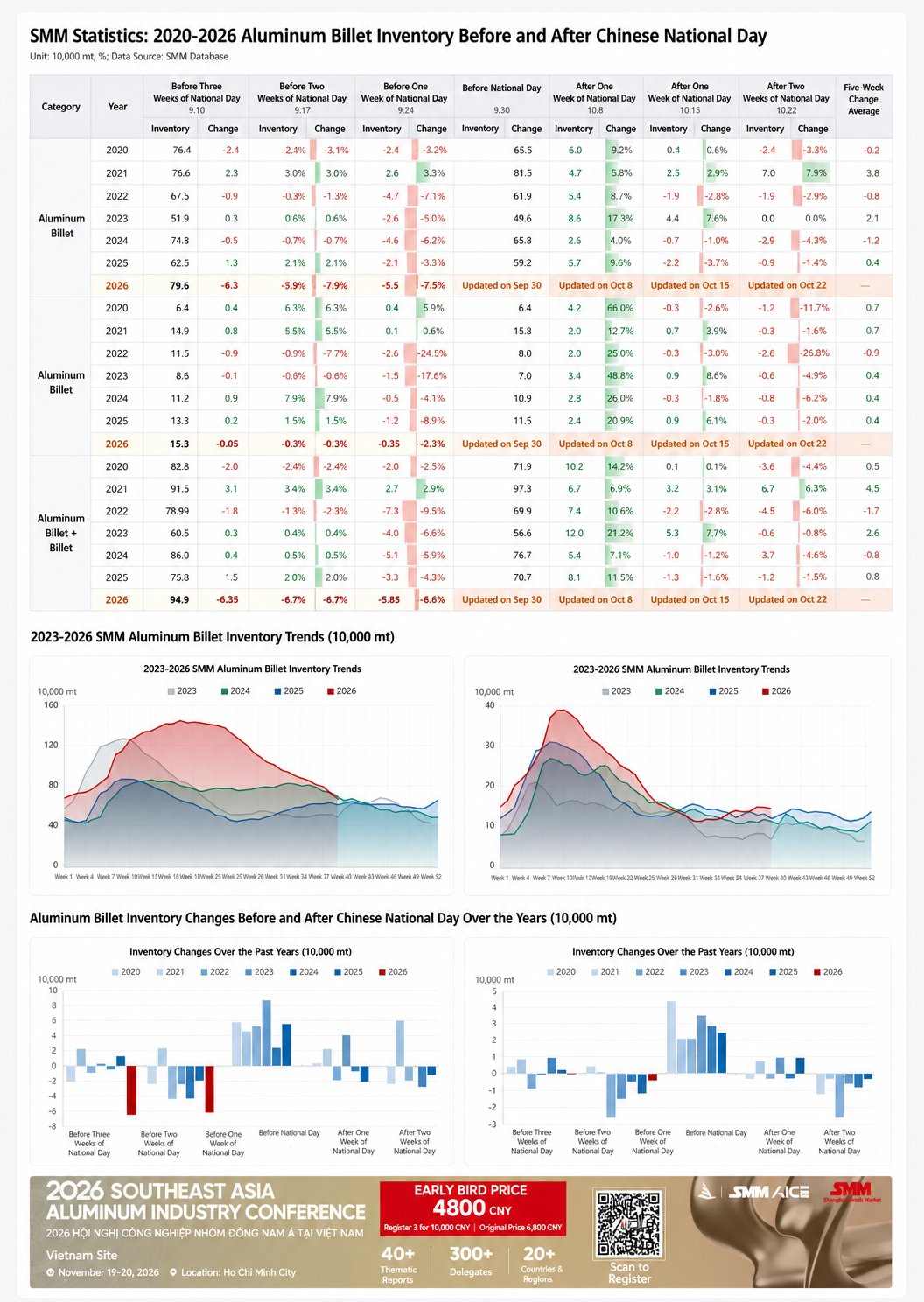
Data source: SMM
![Aluminum Processors Maintain Stable Operations Amid Pre-Holiday Stockpiling [SMM Weekly Survey]](https://imgqn.smm.cn/usercenter/nkdst20251217171652.jpg)