SMM, September 24:
As September draws to a close, "recovery" and "tug-of-war" stand out as the two defining keywords of China's aluminium billet market this month. On one side, supply-side disruptions intensified in stages and inventories shifted from consecutive builds to destocking—a marginal improvement, with outbound volumes rising for two consecutive weeks. On the other, processing fees, after a V-shaped rebound, have slipped back into retreat, and the push-and-pull between supply and demand has never ceased. Heading into the "dual festivals" window, the full-month narrative of September's supply-side disruptions and the supply variables surrounding the National Day holiday have become the core thread for assessing the market ahead.
I. Aluminium prices retreat from highs; processing fees rebound in V-shape before returning to tug-of-war
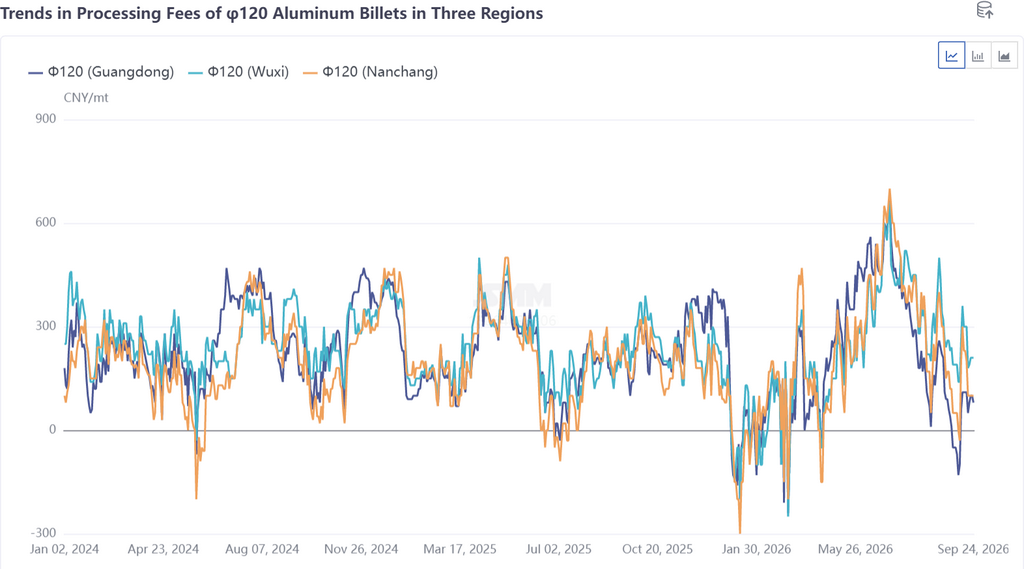
In the first half of September, aluminium prices extended the momentum from late August, with the SMM A00 aluminium spot price briefly probing a high of RMB 24,800/mt. Downstream acceptance of elevated prices weakened markedly, and against the inertia of expanding supply, the processing fee for φ120mm aluminium billet in Foshan at one point fell to discounts of more than RMB 100/mt, making "selling volume at the expense of price" the market norm. Moving into mid-September, aluminium prices pulled back from their highs, downstream buying appetite recovered, and pre-holiday stockpiling gathered pace, allowing processing fees to rebound from oversold levels. By September 17, processing fees across the three major consuming regions had returned to positive territory across the board. The recovery, however, failed to hold: this week, with aluminium prices stabilising around RMB 24,200/mt while rod plants in Guangxi and Yunnan that had undergone maintenance largely resumed production, supply edged higher and warehousing pressure re-emerged. Processing fees in all three regions have since retreated in tandem, with Nanchang posting the steepest decline among regions. Daily spot commentary through the week showed downstream buyers pressing prices throughout, hedging sellers cashing in on rallies and forcing quotes lower, with transactions concluded only through price-for-volume trade—the rebound in processing fees has, under this supply-demand tug-of-war, run its course for now.
II. Inventories shift from build to draw, yet absolute levels remain the highest in three years for the period
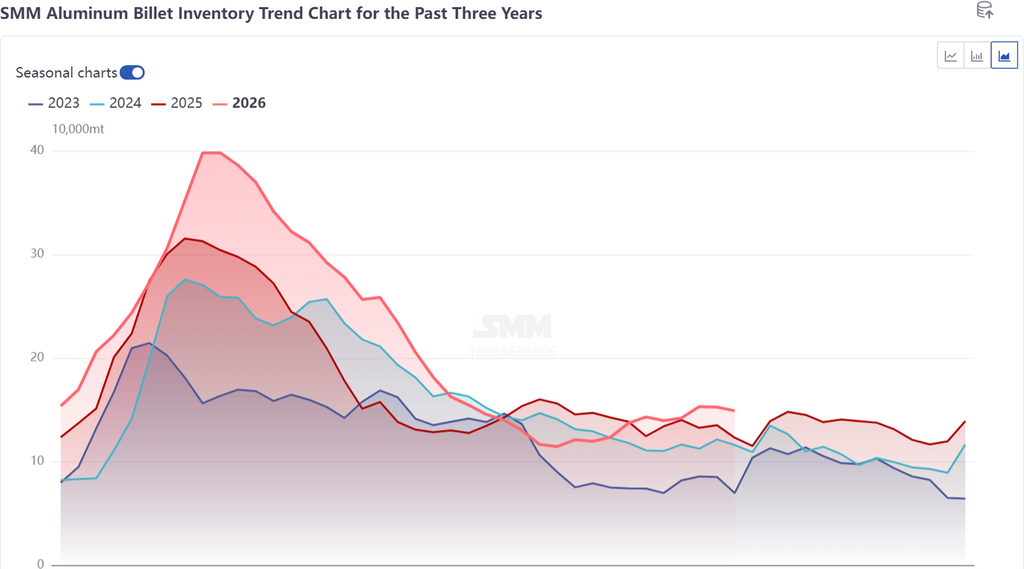
From an inventory perspective, September saw China's aluminium billet stocks complete a full cycle of "build first, draw later". In early-to-mid September, inertial supply expansion combined with a peak season that failed to deliver, and social inventories of aluminium billet climbed steadily to a stage high. Foshan, where railway-sourced cargos concentrated into warehouses and direct-truck deliveries were passively warehoused, led all consuming regions in inventory builds. The turning point came in mid-to-late September. First, falling aluminium prices reignited downstream buying appetite; as the Mid-Autumn Festival and National Day holidays approached, pre-holiday stockpiling gathered pace, and outbound volumes of aluminium billet recorded 45,100 mt over September 15–21, up 6,200 mt WoW and rising for a second consecutive week, with Foshan the main source of the recovery. Second, staged maintenance at rod plants in Southwest China slowed output growth, easing inbound pressure at the margin. As of September 24, aluminium billet inventories across major domestic consuming regions stood at 149,000 mt, ending the previous streak of consecutive builds—yet stocks remained some 26,000 mt above year-ago levels, the highest for the period in three years. The demand side has improved in step: operating rates of leading downstream aluminium processors continued to climb this week, with the aluminium profile segment recovering noticeably on industrial profile orders, even as construction profiles remained weak. The demand-draining effect of pre-holiday stockpiling cannot be ignored, and the sustainability of the destocking trend remains to be verified.
III. Supply-side panorama: high-base inertia wrestling with staged contraction
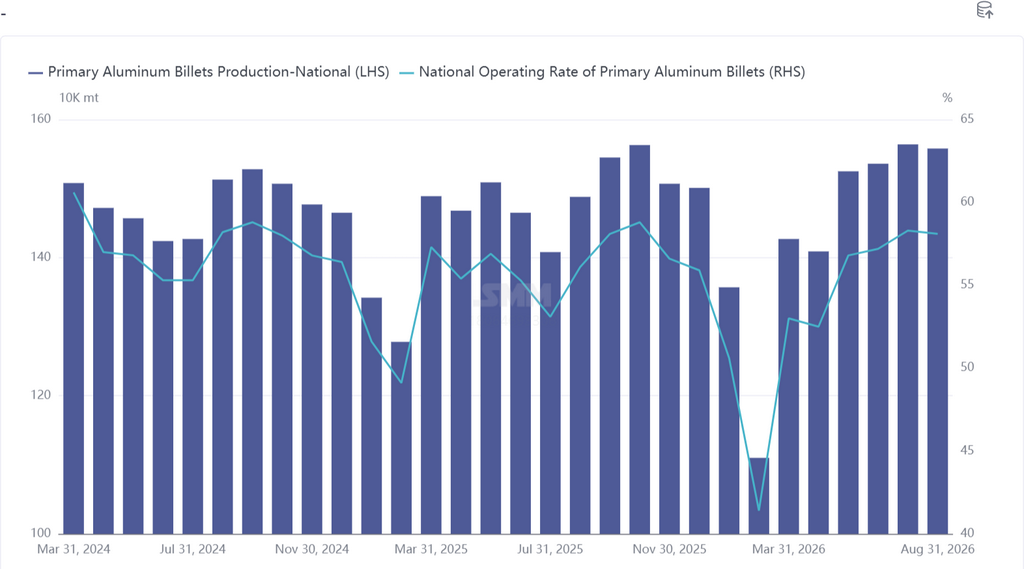
The supply side is the key to understanding September's aluminium billet market, with the month's disruptions defined by the wrestling match between "high-base inertia" and "staged contraction".
First, the supply base remains high. According to SMM statistics, China's total output of molten-aluminium billet reached 11.487 million mt in January–August 2026, up 0.4% YoY. Buoyed by the strong processing fees in Q2, supply-side momentum carried through July–August, with operating rates hitting a year-to-date high—the highest for the period in three years. The lag in the supply-side adjustment mechanism meant output was still being released from elevated levels in early September, and with molten-aluminium ratios at electrolytic aluminium producers remaining high, the supply side has shown little flexibility.
Second, maintenance in Southwest China and freight disruptions formed the main marginal reduction of the month. In early-to-mid September, news of production cuts and shutdowns at rod plants in Southwest China emerged in succession: in Guangxi, five to six rod plants were temporarily shut for reasons including natural gas pipeline maintenance and rotational overhauls; in Yunnan, one to two plants scaled back daily output due to furnace washing. The plants affected were mainly downstream units affiliated with a few large aluminium producers, with other players also marginally impacted. In terms of duration, the vast majority were short-term maintenance of within 5–10 days—marginal cuts in nature. By late September, only isolated plants had yet to resume operations, with all others back to normal scheduling, and only a small number of producers saw slightly higher ingot output as their affiliated rod plants underwent maintenance. In addition, freight in Southwest China was also disrupted—rising freight rates, compounded by green-channel vehicles being given priority, made suitable trucking capacity hard to find; some cargos were held up in transit or diverted into warehouses, objectively delaying concentrated deliveries to consuming regions. On balance, SMM expects domestic aluminium billet operating rates to retreat from their highs to around 56.9% in September—a mild loosening of supply—but given the short maintenance cycles and the heavier weight of restarts, the full-month reduction in supply is relatively limited, and the pattern of oversupply has yet to be fundamentally reversed.
Third, supply-side variables are emerging around the National Day holiday. According to market feedback, during the holiday some large downstream rod plants affiliated with major aluminium producers in Southwest China in particular may expand production cuts. If realised, this would constitute the single largest contractionary variable on the supply side in October, though it remains at the expectation stage for now with no impact evident before the holiday. Meanwhile, most aluminium producers are expected to keep their molten-aluminium conversion schedules steady through the holiday. Surveys indicate that some downstream segments have no holiday shutdown plans and will maintain production, while holiday arrangements among aluminium billet's direct downstream—profile and extrusion enterprises—remain divergent. Should rod plants maintain scheduling while downstream firms suspend operations, the holiday supply-demand mismatch would amplify inventory-build pressure.
IV. Outlook through the "dual festivals" and beyond: holiday restocking inertia vs. supply contraction expectations
Looking ahead to the holidays and beyond, the rhythm of supply-side disruptions remains the core variable. Over the holiday period, historical seasonality shows aluminium billet inventories in China typically build during the National Day break, and this year is unlikely to be an exception: outbound volumes will weaken markedly as downstream firms suspend operations or cut output, while arrivals—though uncertain given freight disruptions in Southwest China and the pace of pre-holiday cargo transfers—will keep flowing. The overall direction of inventory builds is clear, and absolute stock levels may climb further, pressuring the spot market after the holiday.
Three variables will determine the market's elasticity after the holiday. First, the implementation of Southwest China's production cuts: if the expanded cuts at some large downstream rod plants materialise during the holiday, combined with rod producers' weakened willingness to run at current processing margins, the supply contraction would lend some support to post-holiday processing fees. Second, the pace of digestion of pre-holiday stockpiles: if pre-holiday buying has already front-loaded part of peak-season demand, the slope of post-holiday outbound recovery may flatten, warranting vigilance against a second test of "peak season without a peak". Third, the shift in the aluminium price centre: with prices currently running around RMB 24,200/mt, any renewed rise after the holiday would continue to suppress downstream buying appetite and cap the upside for processing fees.
All told, September's aluminium billet market achieved inventory destocking and a V-shaped recovery in processing fees on the resonance of supply disruptions and pre-holiday stockpiling. Yet the underlying pattern of oversupply is unchanged, and the realities of above-year-ago inventories and processing fees back at low levels remain plainly in view. Inventory builds over the "dual festivals" are all but certain, and the key to the post-holiday market lies in the race between the delivery of Southwest China's production cuts and the pace of end-demand recovery. The market is advised to focus on the degree of mismatch between rod-plant scheduling and downstream holiday shutdowns, the pressure of concentrated post-holiday arrivals, and the substantive impact of the Southwest production cuts on the supply side.
Data source: SMM
!["Double Festival" approaching: Aluminum billet supply disruptions intensify in phases; processing fees return to a tug-of-war after a V-shaped recovery [SMM analysis]](https://imgqn.smm.cn/usercenter/IOKIL20251217171652.jpg)
![Aluminum Processors Maintain Stable Operations Amid Pre-Holiday Stockpiling [SMM Weekly Survey]](https://imgqn.smm.cn/usercenter/nkdst20251217171652.jpg)