SMM, September 24:
This week, the molybdenum market saw a phased shift in the pattern between Chinese and overseas markets, with the previously widening price spread between Chinese and overseas markets showing signs of narrowing. On Wednesday, a stainless steel producer in Europe purchased 3 truckloads of molybdenum oxide briquettes (approximately 75 mt in total) at a transaction price of $33.65-33.8/lb Mo (DDP delivered duty paid). After deducting freight and miscellaneous charges, the raw material equivalent was approximately $33.2/lb Mo. International molybdenum oxide closed at $33.55-33.65/lb Mo, narrowing the price spread between Chinese and overseas markets. In China, ferromolybdenum transactions showed panic-driven selling sentiment. On Wednesday, some steel mills in east China and other regions entered the market for tenders, with tender prices pulling back to the range of 340,800-320,000 yuan/mt. Spot molybdenum concentrates transactions were mainly characterized by shrinking volumes, with market circulation still tight. Suppliers held firm on quotes and were not yet affected by the loosening of overseas molybdenum oxide prices.
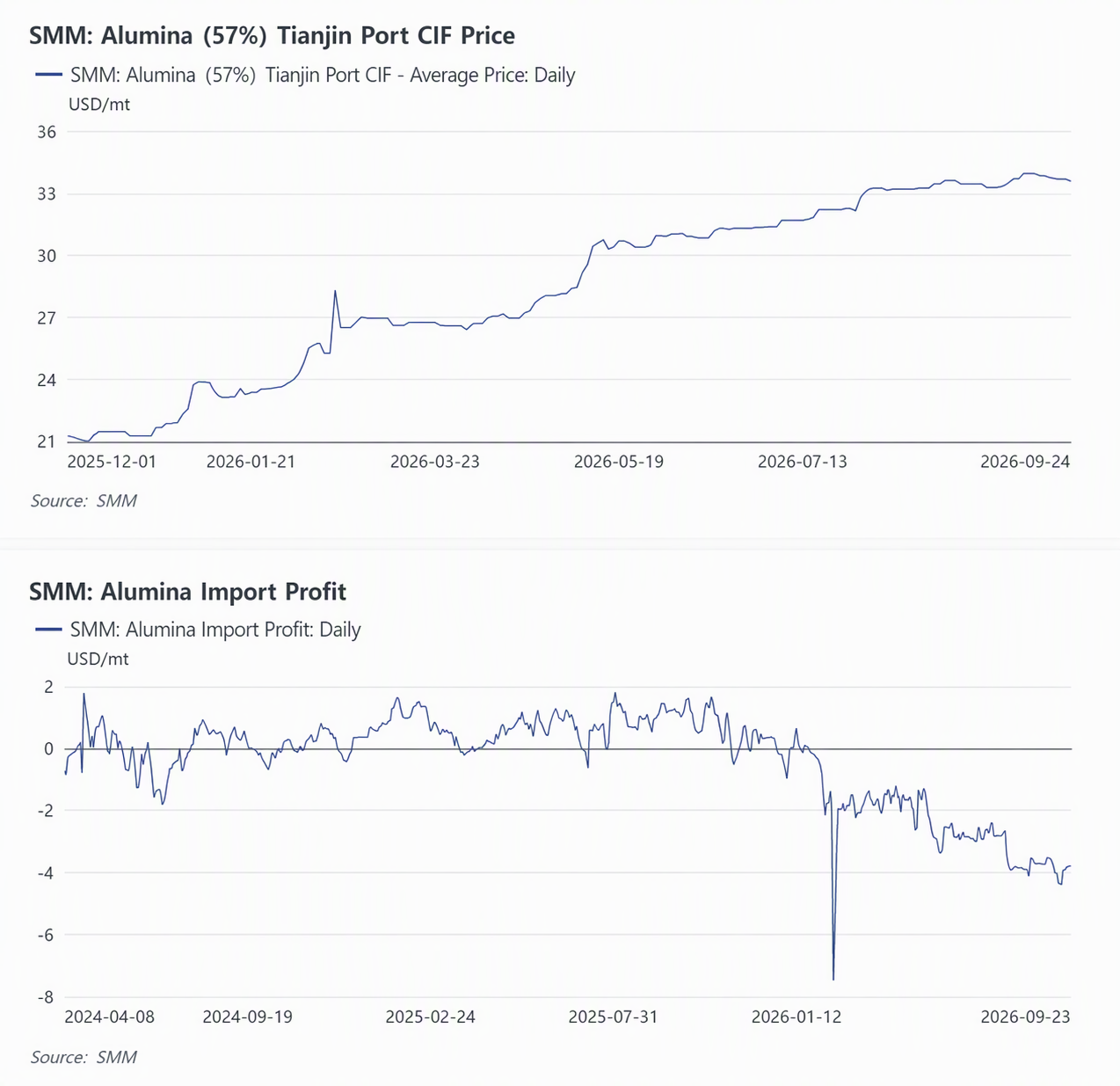
During the week, molybdenum concentrate producers in Henan that had previously cut production remained in a state of reduced output, further reinforcing the supply reduction logic on the domestic side. The comprehensive remediation campaign for the Luanchuan molybdenum (tungsten) mines continued to advance, with only some large open-pit molybdenum mines in the area maintaining normal extraction, while all underground molybdenum mining operations had been halted. Regional supply contracted significantly, with monthly production affected by approximately 1,800 mt. In the first three quarters of 2026, Henan's molybdenum concentrate production declined notably, and Q4 is likely to maintain low operating rates. Globally, molybdenum resources are primarily associated with copper mines, with extremely low supply elasticity and limited near-term new capacity release. Earlier, copper-molybdenum mines in core producing regions such as Chile and Peru were affected by extreme weather, declining ore grades, and energy and logistics constraints, leading to production cuts that supported the overseas market's surge. However, this week, sentiment in markets outside China weakened, suppliers' willingness to sell increased, molybdenum oxide quotes loosened, and low-priced orders gradually emerged. The pullback in overseas prices narrowed the price spread between Chinese and overseas markets, improving import profitability for molybdenum oxide. During the week, suppliers held firm on quotes, and a mine in Jiangxi sold via auction at high prices, with 45% molybdenum concentrate transaction prices consolidating at highs of 5,460-5,490 yuan/mtu.
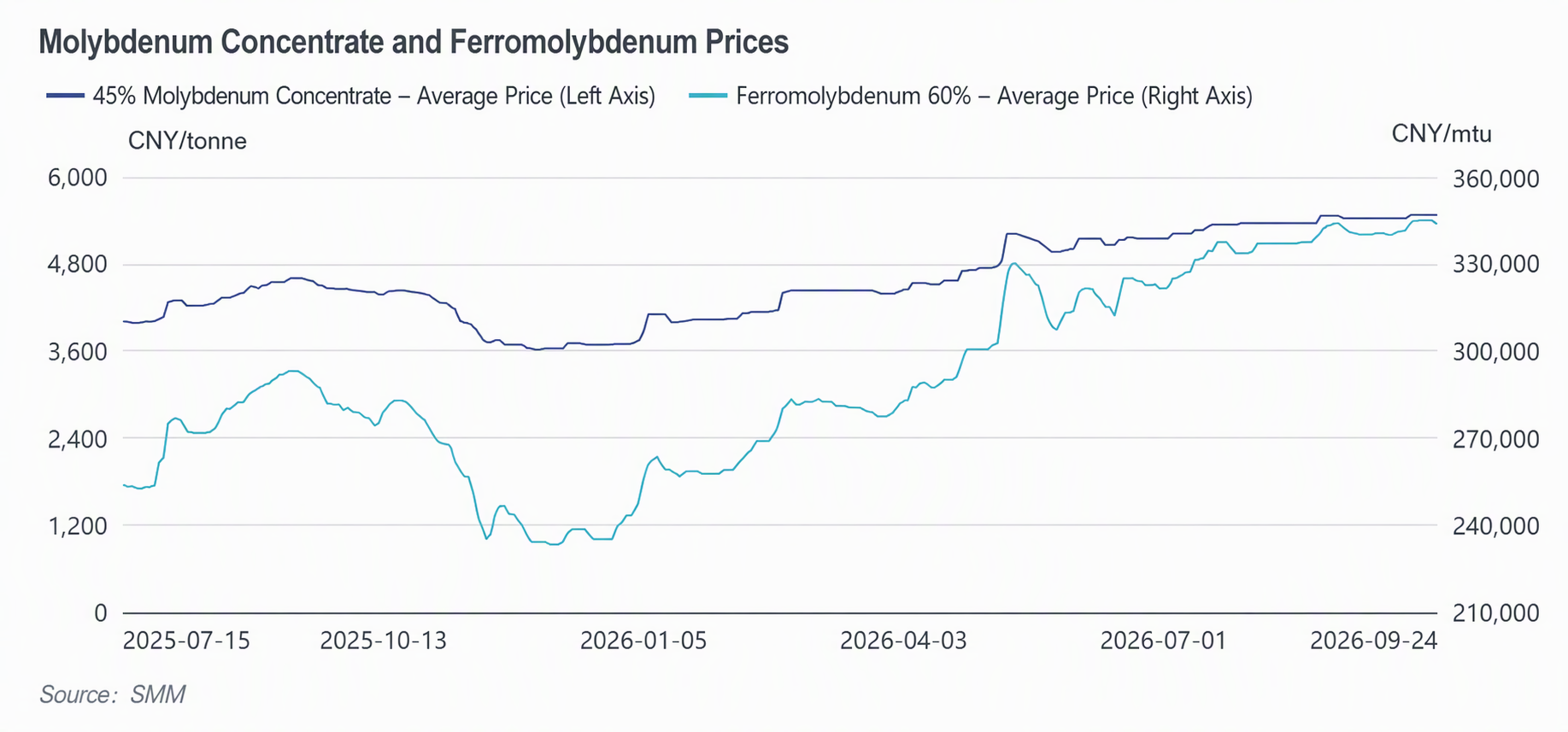
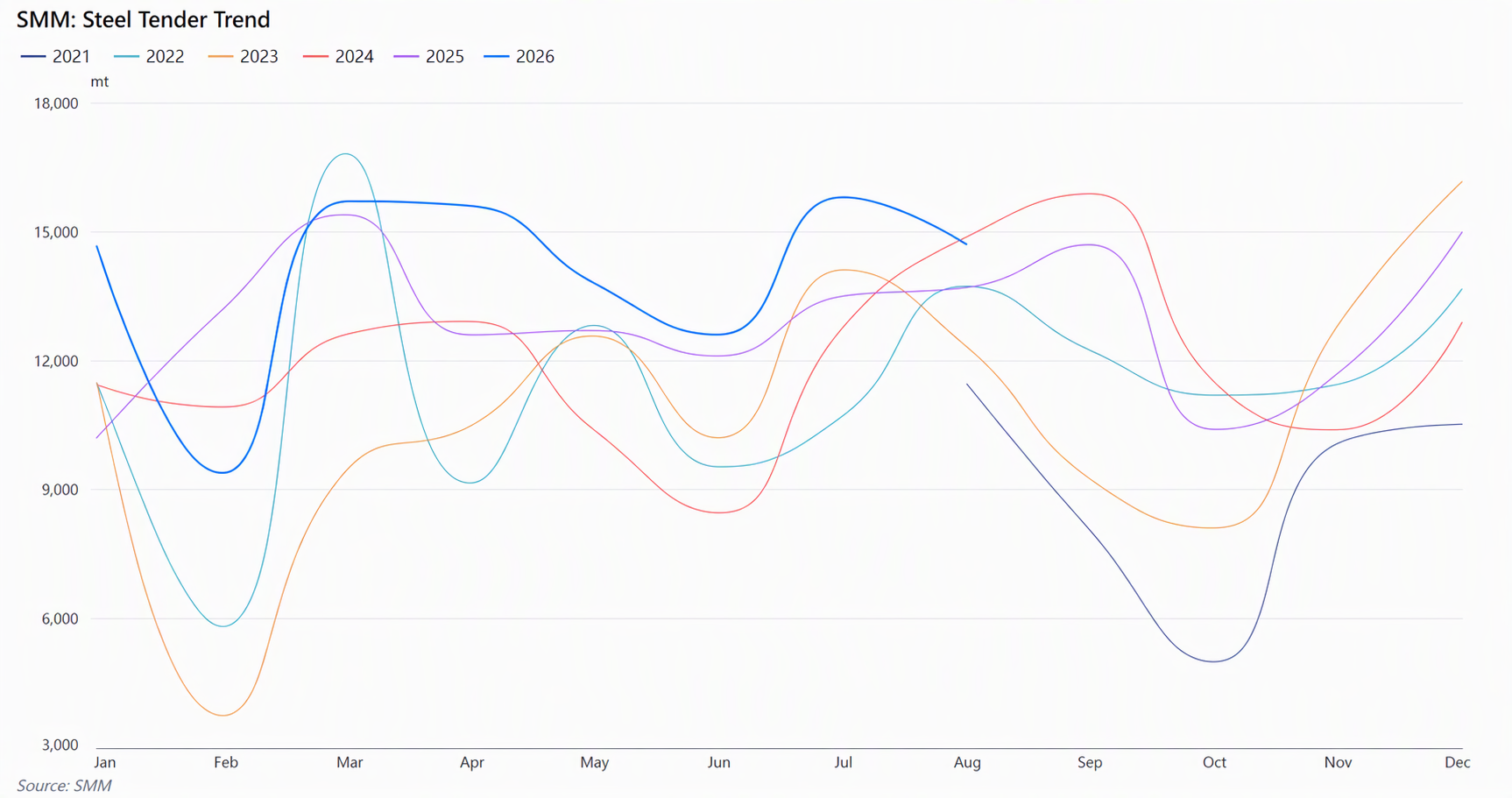
This week, the ferromolybdenum market showed a pattern of sufficient steel mill tender volumes but weak spot retail transactions. The mainstream cash price range for 60# ferromolybdenum including tax was 344,000-344,000 yuan/mt, with few transactions above 344,000 yuan/mt. This week, multiple domestic steel mills opened bids in a concentrated manner, with tender prices pulling back slightly from earlier highs. Steel mills' desire to bargain down prices increased, while raw material molybdenum concentrate supply remained tight and producers held back from selling at low prices, intensifying the tug-of-war between sellers and buyers. Downstream 300-series stainless steel market prices consolidated on a weak note, with some steel mills entering production cuts and maintenance phases. Special steel enterprises mostly produced to order with restocking for essential needs as the main driver. Most ferromolybdenum tendered by steel mills was scheduled for delivery in late October. As of now, total domestic ferromolybdenum tender volume in September is around 11,800 mt, with the full-month estimate expected to reach approximately 12,500 mt, down about 15% YoY, which to some extent reflects that high prices are dampening downstream steel mills' willingness to enter the market.
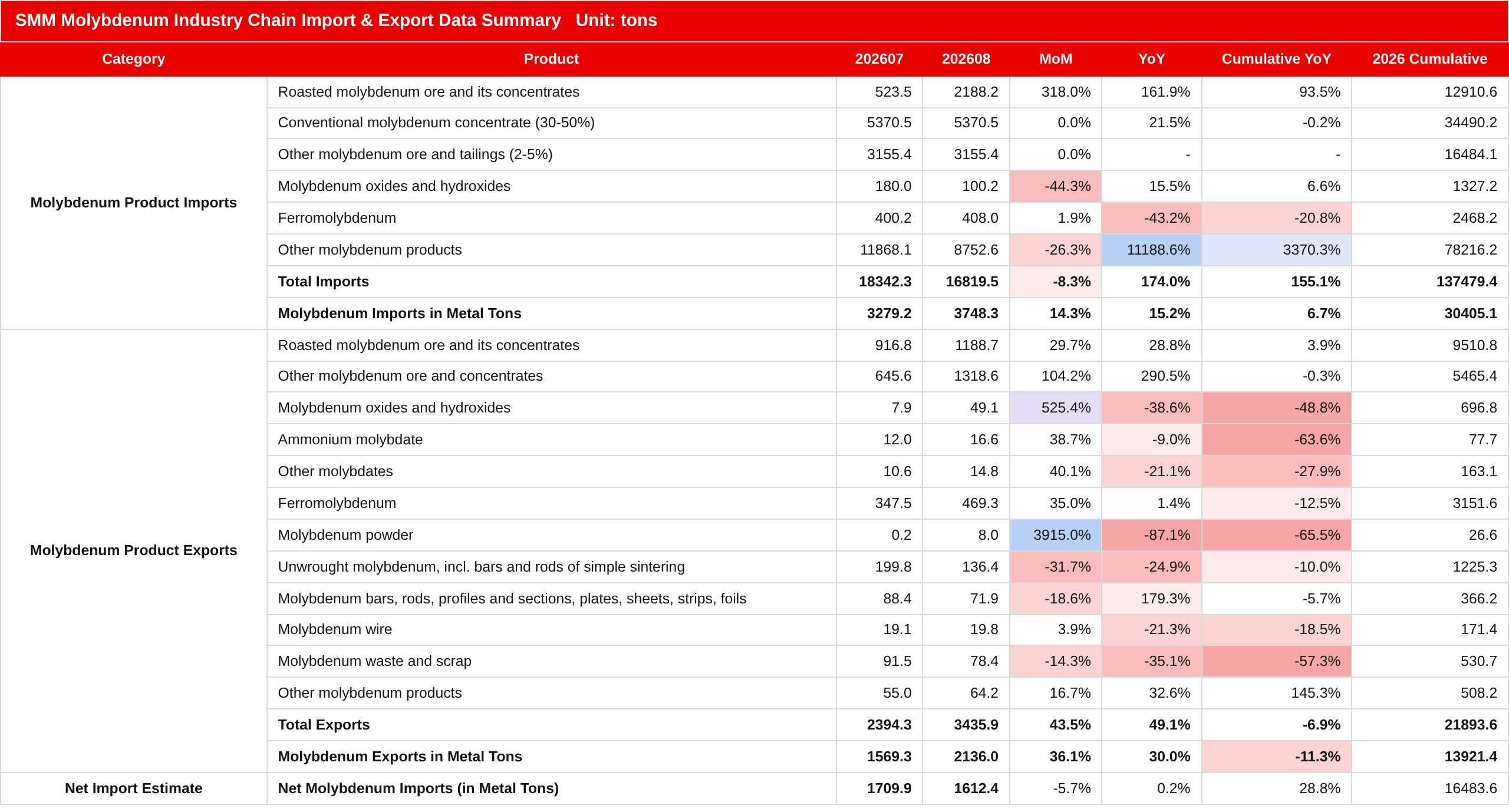
During the week, the General Administration of Customs released August import and export data. In August, molybdenum product imports were 16,819.5 mt, down 8.3% MoM but up 174.0% YoY, with cumulative imports of 137,479 mt in January-August, up 155.1% YoY. In August, China's molybdenum product exports were 3,435.9 mt, up 43.5% MoM and up 49.1% YoY, with cumulative exports of 21,894 mt in January-August, down 6.9% YoY. Net imports in metal content were 1,612.4 mt, down 5.7% MoM and basically flat YoY, with cumulative net imports of 16,484 mt in January-August, up 28.8% YoY. In terms of structure, on the import side, roasted molybdenum ore and its concentrates were 2,188.2 mt, surging 318.0% MoM and up 161.9% YoY, while conventional molybdenum concentrates were 5,370.5 mt, flat MoM and up 21.5% YoY, remaining at high levels. Ferromolybdenum imports were 408.0 mt, up only 1.1% MoM but down 43.2% YoY, with cumulative January-August imports down 20.8% YoY, indicating that the import substitution effect persists and domestic ferromolybdenum is regaining market share. On the export side, concentrate products (roasted molybdenum ore and other molybdenum ores) totaled 2,507 mt, up 56.7% MoM and up 93.6% YoY, serving as the core driver of this month's export surge, consistent with this week's high international molybdenum oxide price of $34/lb and the widening price spread between Chinese and overseas markets. Ferromolybdenum exports were 469.3 mt, up 35.0% MoM and up 1.4% YoY, remaining stable amid the price spread between domestic prices of 341,000-345,000 yuan and European prices of $77/kg. Meanwhile, exports of deep-processing products such as molybdenum powder, molybdenum wire, and molybdenum scrap mostly pulled back MoM.
In the short term, domestic molybdenum prices are likely to move sideways in a narrow range before the National Day holiday. Based on China's short-term fundamentals, supply in Henan is unlikely to recover, mainstream mines are selling relatively small volumes, the market lacks liquidity, and ferromolybdenum enterprises have essentially exhausted their earlier low-cost raw materials, intensifying the inverted price situation. If steel mill tenders see more failed bids, ferromolybdenum may also have expectations of catching up on price increases. The overseas molybdenum raw material market may see reduced activity due to lower holiday demand from the Chinese market, with fewer inquiries leading to lower activity. Some suppliers may sell to avoid risk, driving prices slightly lower. The price spread between Chinese and overseas markets needs to narrow further to stimulate additional import replenishment. However, with the dual support of mine-side hold back from selling and low inventories, the probability of a deep decline is relatively small. Focus on tracking the pace of mine production resumptions and the restart of post-holiday steel mill tenders.
![Price recovery with weak raw materials; stainless steel mill profits marginally recover [SMM Analysis]](https://imgqn.smm.cn/usercenter/CrEsY20251217171716.jpg)
![SS futures recovery unlikely to change steel mill production cut expectations, narrowing economic advantages keep stainless steel scrap prices stable [SMM Stainless Steel Scrap Market Weekly Review]](https://imgqn.smm.cn/usercenter/aPBtI20251217171717.jpg)
![[SMM Analysis] Macro Headwinds Materialize, Futures Recover; Pre-Holiday Essential Demand Release Drives Stainless Steel Inventory Destocking](https://imgqn.smm.cn/usercenter/XUnxM20251217171723.jpeg)