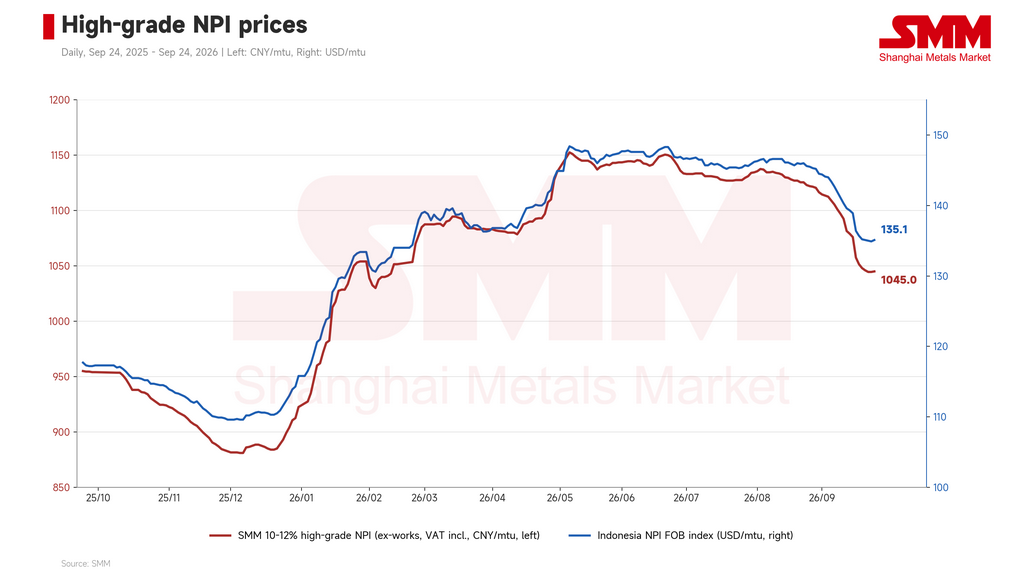
The weekly average SMM 10–12% NPI price fell RMB 17.4 per nickel point to RMB 1,045.0 per nickel point, ex-works including tax. The Indonesia NPI FOB Index averaged $135.03 per nickel point, down $2.05 week on week. The decline in NPI prices slowed markedly: the ex-works price stayed within RMB 1,044.5–1,046 per nickel point during the week and stood at RMB 1,045 on September 24, just RMB 3 below last Friday. The Indonesia NPI FOB Index held at $134.9–135.1 per nickel point. The market shifted from a sustained decline to a standoff between buyers and sellers.
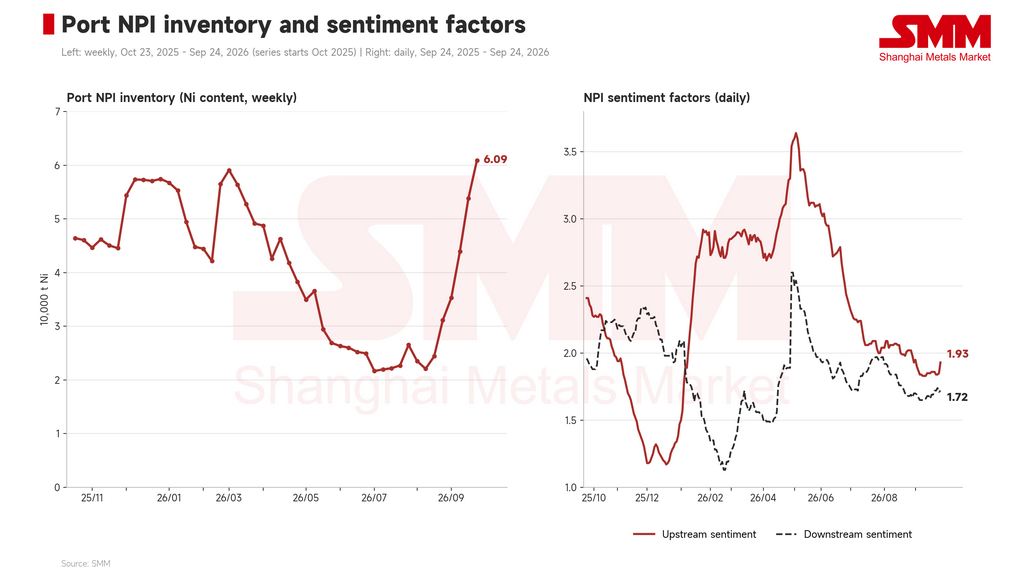
On the supply side, RKEF NPI plants at Indonesia's IMIP began cutting production on September 22 because of water shortages, reducing operating loads by around 30–40% from previous levels. If the cuts last half a month, they are estimated to affect 50,000–70,000 tonnes of physical NPI output, equivalent to around 5,500–7,700 tonnes of contained nickel. The news improved seller sentiment: SMM’s upstream NPI sentiment indicator rose from 1.84 at the start of the week to 1.93 on September 24. Some traders tested higher offers, while some smelters suspended small spot sales because prices were low.
Domestic port inventories, however, continued to rise. NPI stocks reached 60,900 tonnes of contained nickel on September 24, up 7,100 tonnes, or 13.2%, week on week and 25,600 tonnes since September 3. This inventory provides a buffer against the near-term production cuts. Downstream mills remained cautious, purchasing small volumes mainly through tenders at low prices. Some large mills planned to draw down existing stocks ahead of the holiday and had no plans for additional purchases. Some market participants viewed a major mill’s tender price as a short-term floor, and isolated orders of around 10,000 tonnes emerged at low prices. These deals are not yet enough to confirm a rise in the prevailing transaction price.
Meanwhile, domestic production of 300-series stainless steel is expected to fall by more than 100,000 tonnes month on month in October, reducing NPI consumption. SMM’s downstream sentiment indicator remained low at 1.71–1.74. Production cuts and a reference price near the market bottom have supported expectations, but weak demand continues to limit buyers’ willingness to accept higher prices. The standoff is likely to continue. After the holiday, the key factors to watch are the restoration of water supply at IMIP, the pace of port inventory drawdown and mill restocking.
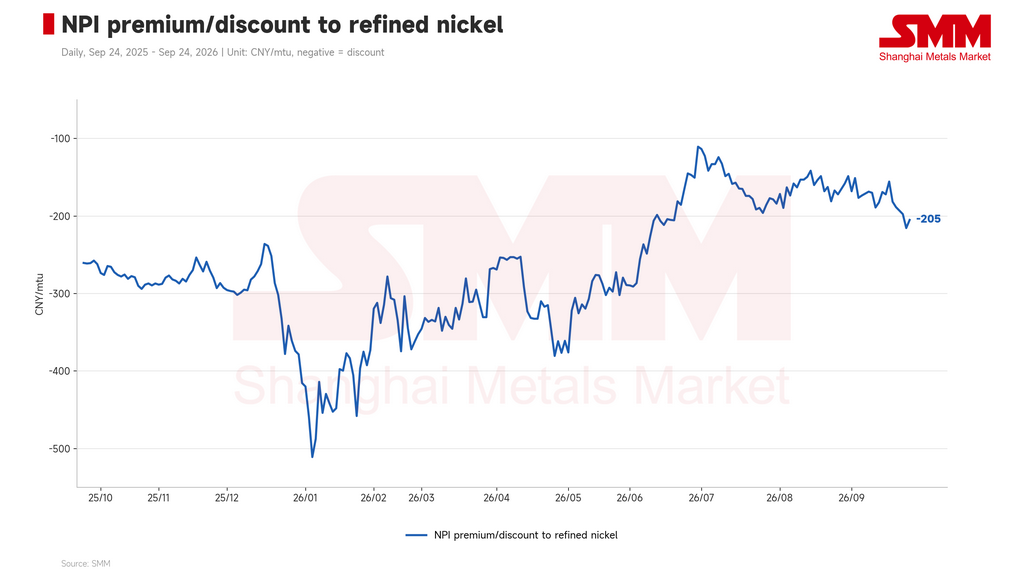
From the perspective of converting NPI to high grade nickel matte, NPI’s discount to refined nickel averaged 202.8 this week, widening by 29.5 from last week. News of the IMIP cuts and some short covering ahead of the holiday lifted nickel prices. SMM’s 1# refined nickel price rose from RMB 125,800 per tonne last Friday to RMB 127,900 on September 23, before easing to RMB 126,900 on September 24, a gain of RMB 1,150 per tonne over the period. NPI spot prices were broadly flat, widening the discount, which reached 215.5 on September 23.
In Indonesia, the high grade matte nickel payable remained at 93.5%, while its FOB price rose with nickel from $15,017 per tonne of contained nickel last Friday to $15,077. Indonesia NPI FOB prices were broadly unchanged over the same period, widening the matte–NPI spread by around $70 per tonne of contained nickel and marginally improving the economics of conversion. As of September 18, however, SMM estimated that converting Indonesian NPI to high grade matte was still around $256 per tonne of contained nickel less profitable than selling NPI directly. This week’s modest widening of the spread is insufficient to reverse that position, while the durability of the nickel price rebound remains uncertain. If the discount holds near current levels next week, the conversion profit disadvantage may narrow further, but direct NPI sales are still likely to remain more attractive than large-scale conversion.
Prices of nickel ore, coke and other inputs used by domestic NPI smelters were broadly stable this week, leaving raw material costs little changed. As the decline in NPI prices slowed, the contraction in smelting margins also eased markedly. On a full-cost basis, the profit margin for Shandong RKEF production stood at −2.91% on September 24, improving slightly from −3.42% last Friday but remaining in loss. Profit margins at Indonesia’s IMIP and IWIP stood at 5.33% and 1.45%, respectively, with IWIP close to break-even.
![[SMM Analysis] Downstream Demand Shows No Improvement as Nickel Intermediate Prices Diverge](https://imgqn.smm.cn/usercenter/OjGlE20251217171734.jpg)
![[SMM Analysis] Nickel Prices Rebound and Hold Up Well Amid Indonesian NPI Production Cuts and China-US Meeting](https://imgqn.smm.cn/usercenter/KFwsY20251217171734.jpg)
![[SMM Analysis] China's stainless futures close the pre-holiday week higher as the raw material slide finally halts](https://imgqn.smm.cn/usercenter/PuSOO20251217171732.jpeg)