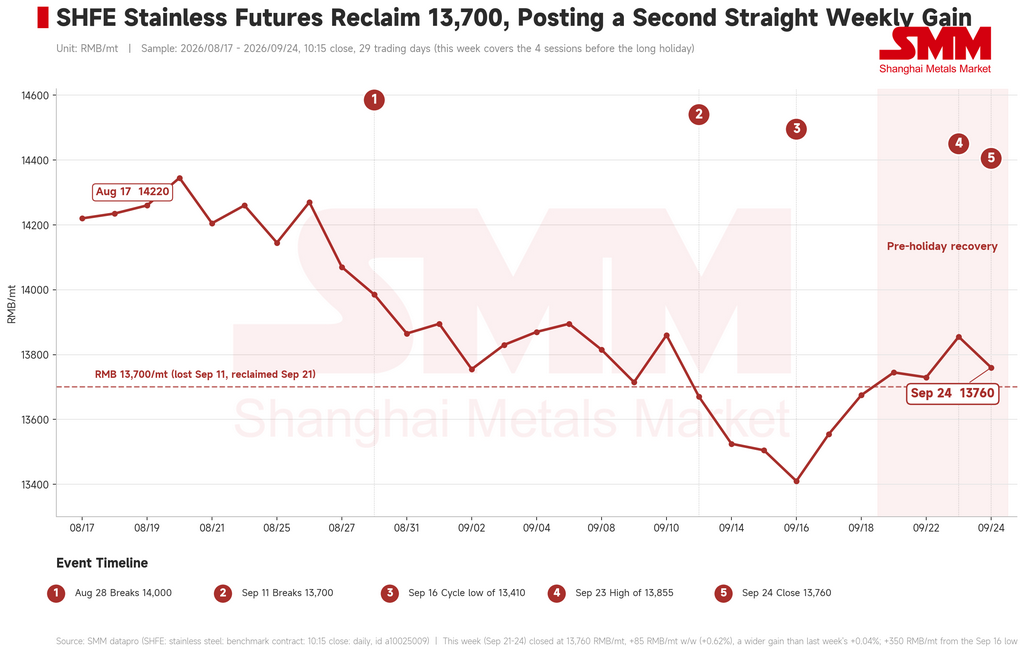
China's stainless steel futures extended their recovery into the long holiday, and for the first time this cycle the move was not built on collapsing input costs. The benchmark SHFE contract closed at RMB 13,760/mt (about $2,049/mt) on Thursday, up RMB 85/mt (roughly $13/mt), or 0.62%, from the prior Friday — a second consecutive weekly gain, and a wider one than last week's 0.04%. More significantly, Nickel Pig Iron (NPI) stopped falling. The cost floor that had been sliding lower for six weeks held its position.
A four-session week that reclaimed a broken level
Chinese markets close from Friday for the long holiday, so this week ran Monday through Thursday. The contract opened at RMB 13,745/mt (about $2,047/mt) on Monday, immediately reclaiming the RMB 13,700/mt level lost on September 11. It eased to RMB 13,730/mt (about $2,045/mt) on Tuesday, rose to a weekly high of RMB 13,855/mt (about $2,063/mt) on Wednesday, then gave back part of that into Thursday's pre-holiday close. From the September 16 cycle low of RMB 13,410/mt (about $1,997/mt), the contract has now recovered RMB 350/mt (roughly $52/mt).
China–US trade dialogue underpinned domestic sentiment
The dominant macro support for Chinese risk assets this week came from the bilateral track. China–US trade consultations opened in New York, and China's foreign ministry confirmed the two sides remain in contact on senior-level engagement this year. A tactical easing in the relationship matters directly for valuations across Chinese commodities, and it is a large part of why market participants were willing to carry positions into a long holiday.
Two domestic policy items deserve attention. The State Administration for Market Regulation announced a coordinated push against "involutionary" competition, specifically targeting malicious below-cost pricing. Stainless steel is a chronically oversupplied product where price wars are structural, so if enforcement actually lands, the medium-term implications for pricing discipline are material. Separately, the Politburo set the Fifth Plenum of the 20th Central Committee for October 26–29, where recommendations for the 15th Five-Year Plan will be reviewed — making post-holiday policy expectations the next trading theme. Elsewhere, August power consumption again topped one trillion kWh with load at a record high, and the housing ministry stated plainly that Chinese real estate has entered a stock-market era.
The Fed stayed hawkish; the Middle East opened a door
Fed commentary ran in one direction. Minneapolis Fed President Neel Kashkari said inflation remains too high and is not merely an oil-price phenomenon. Chicago's Austan Goolsbee said clear action to hike would be needed if inflation fails to retreat. St. Louis Fed President Alberto Musalem was the most direct, saying further hikes may be required and that moving now beats moving late. The valuation pressure on dollar-denominated base metals persists, but it did not interrupt this week's repair.
The Middle East, by contrast, produced the most substantive de-escalation signal since the conflict began. US officials held a three-hour meeting with Iranian representatives, which Trump described as productive, with further talks scheduled and a deal he believes is achievable after the midterms. Iran confirmed the meeting and — for the first time — set out explicit conditions for reopening the Strait of Hormuz: lifting the naval blockade, unfreezing Iranian assets, and ending hostilities on all fronts. Qatar's prime minister attended most of the session. Trump separately said Yemen's Houthi forces have agreed not to engage US forces, and US media reported the military will not conduct offensive strikes against them.
Reversals persist — a tanker entering the Strait was hit by shellfire, injuring two crew, and armed groups shut valve No. 7 on Libya's Sharara crude pipeline, sharply cutting field output. But if transit genuinely normalises, the risk premium embedded in energy and shipping costs should unwind systematically. That is medium-term bearish for nickel prices and therefore for the stainless cost base — the single most important thing to track over the holiday.
Europe's energy problem is getting worse, not better
This deserves separating out, because it hits overseas stainless capacity directly rather than through sentiment. The Eurogroup president is weighing an emergency meeting on surging energy costs. French President Macron will convene a G7 energy meeting and is considering releasing strategic energy reserves. Saudi Arabia has told European refiners no crude will be available next month. Trump is simultaneously pushing a diesel export ban. Power and gas cost pressure on European stainless producers is not easing in the near term, and its effect on European operating rates and offer prices is worth watching closely.
Fundamentals: rational pre-holiday buying, no peak-season restocking
SMM's weekly inventory print for this period had not been published at the time of writing. The most recent reading remains 578,000 mt of 300-series social inventory on September 17, down 7,000 mt, or 1.20%, from the prior week — back inside the August range and just 1,000 mt above the August low.
Last week's drawdown came from mill production cuts landing alongside improved transactions at low absolute prices, not from concentrated peak-season restocking, which has still not appeared. Into the holiday this week, downstream buyers largely purchased to cover production needs through the break, while traders kept pre-holiday inventory exposure controlled. Trading was rational rather than aggressive — not enough to call a trend recovery in demand.
Raw materials stopped falling — the week's most important change
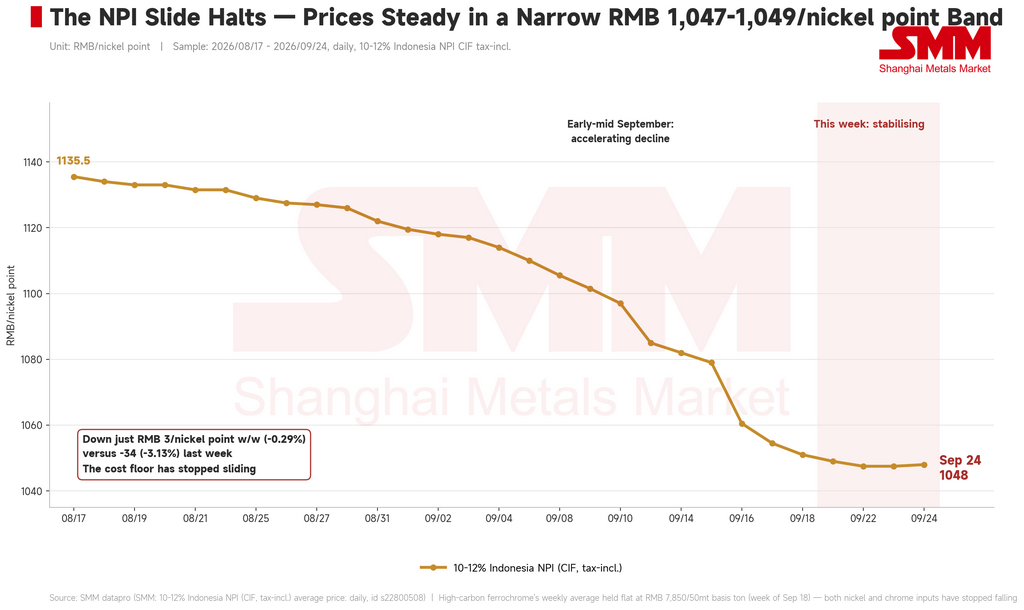
NPI opened the week at RMB 1,049/nickel point (about $156) and traded in a narrow RMB 1,047.5–1,049 band, closing Thursday at RMB 1,048/nickel point (about $156). That is a decline of just RMB 3, or 0.29%, week-on-week, against RMB 34 and 3.13% the week before. High-carbon ferrochrome's weekly average, most recently published for the week of September 18, held flat at RMB 7,850 per 50mt basis ton (about $1,169), ending its own run of consecutive cuts.
Both nickel and chrome inputs steadying means the cost support line that has been descending since August has, at least temporarily, held its level — precisely the risk flagged in the past two reviews.
Margins kept repairing, and the driver changed
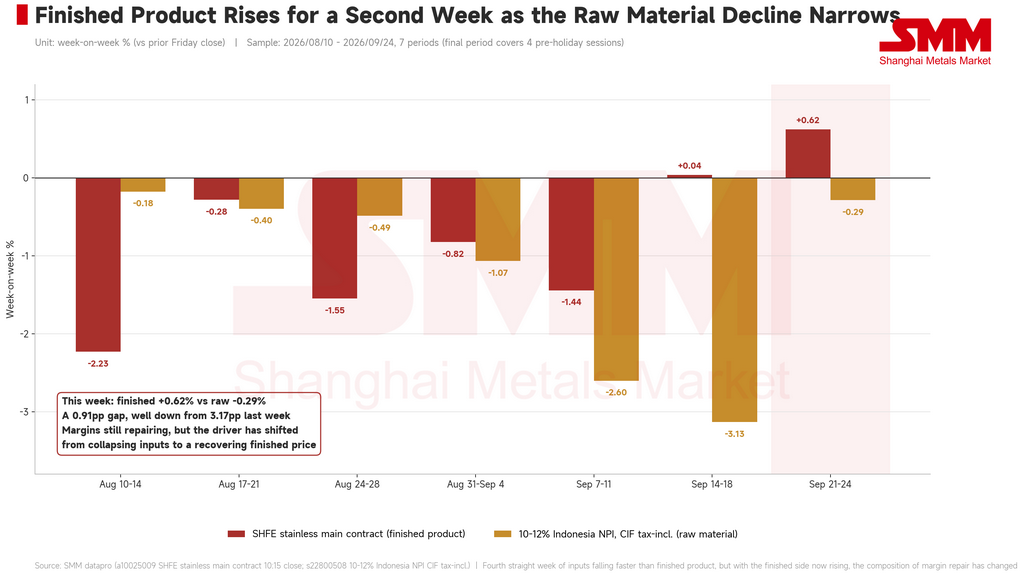
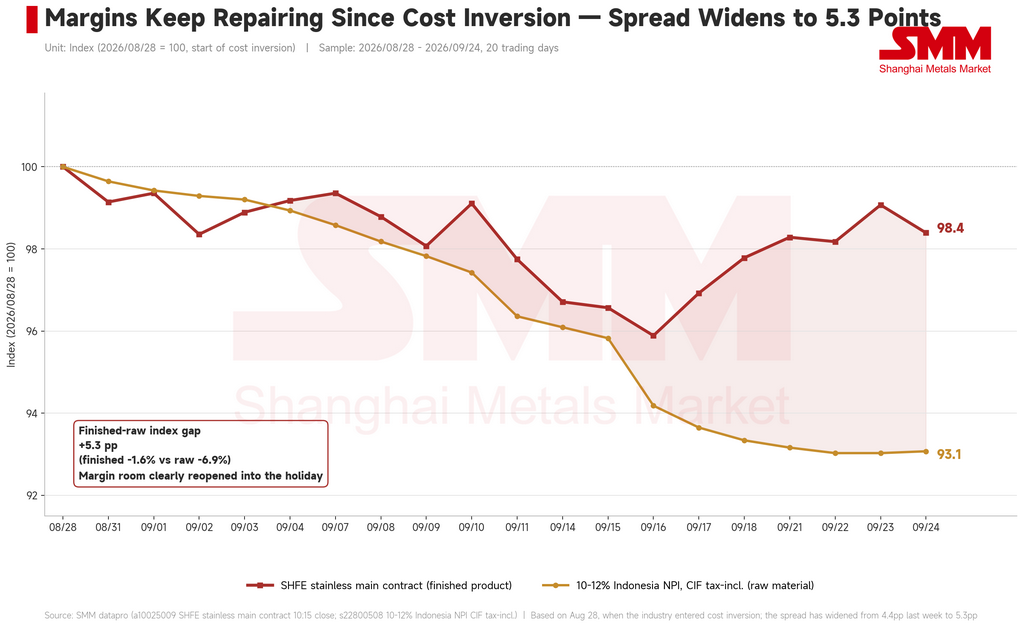
Finished product rose 0.62% while inputs fell 0.29%, a 0.91 percentage point gap. That is much narrower than last week's 3.17 points, but still running in the mills' favour. The composition matters more than the magnitude: margin repair over the previous three weeks was driven by collapsing inputs, whereas this week it came from a recovering finished price — a considerably more durable mechanism.
Indexed to August 28, when the industry formally entered cost inversion, finished product now stands at 98.4 and inputs at 93.1, a spread of 5.3 percentage points, up from 4.4 last week. Margin room has clearly reopened heading into the break.
Outlook
The market structure going into the holiday is materially better than it was in mid-September. Three changes are worth recording: the contract posted two consecutive weekly gains and reclaimed RMB 13,700/mt, so the price centre has begun to stabilise; nickel and chrome inputs steadied together, halting the slide in the cost floor and removing — for now — the risk that support kept descending alongside prices; and the driver of margin repair shifted from falling inputs to a rising finished price, improving its quality.
The honest reading is that this recovery rests on an oversold bounce, cost repricing and improved sentiment from the easing in China–US trade relations. Demand has supplied no trend evidence at all. Peak-season restocking never materialised, and this week's transactions were mostly pre-holiday coverage.
Overseas markets keep trading through the break, so moves in LME nickel, crude and the dollar index will be absorbed into the first post-holiday session all at once. If the US–Iran talks progress and the Middle East risk premium unwinds, nickel faces downward pressure, which would pull the stainless cost base lower with it. Worth tracking on return: developments in overseas markets and the Iran negotiations over the holiday; whether October demand picks up the baton, which is the only hard test of whether this repair continues; mill production schedules after the break, since restored margins could bring back the output that was cut; the Fifth Plenum's signals on medium-term demand; and how the anti-involution enforcement campaign lands in the steel sector.
![[SMM Analysis] Indonesian Production Cuts and Pre-Holiday Caution Slow the Decline in NPI Prices](https://imgqn.smm.cn/usercenter/Btmsv20251217171733.jpg)
![[SMM Analysis] Downstream Demand Shows No Improvement as Nickel Intermediate Prices Diverge](https://imgqn.smm.cn/usercenter/OjGlE20251217171734.jpg)
![[SMM Analysis] Nickel Prices Rebound and Hold Up Well Amid Indonesian NPI Production Cuts and China-US Meeting](https://imgqn.smm.cn/usercenter/KFwsY20251217171734.jpg)