Zambia is known for copper, yet a copper mine is also the anchor of its reported gold output. Beyond the large mine is a smaller scale gold trade that is difficult to measure and much harder to bring into a reliable buying system. The Ministry of Mines and Minerals Development reports 3,141.81 kilograms of gold production in 2024, about 40% above its 2,237 kilograms for 2023. These are production figures, rather than exports or central bank purchases. But two government series disagree for every overlapping year from 2020 to 2024. The sharpest difference is 2022: the minister told Parliament 2,683 kg while the ministry’s later statistical bulletin gives 4,598 kg. The reason remains unpublished in the material reviewed. [1, 22]
New attention has fallen on a possible cut to the standard 16% value added tax on domestic gold transactions, a large gap between Zambia's and the United Arab Emirates' trade reports, and plans to list a gold investment fund in Lusaka. These developments are connected by demand for a better functioning market, but they measure different things. [9–14, 19]
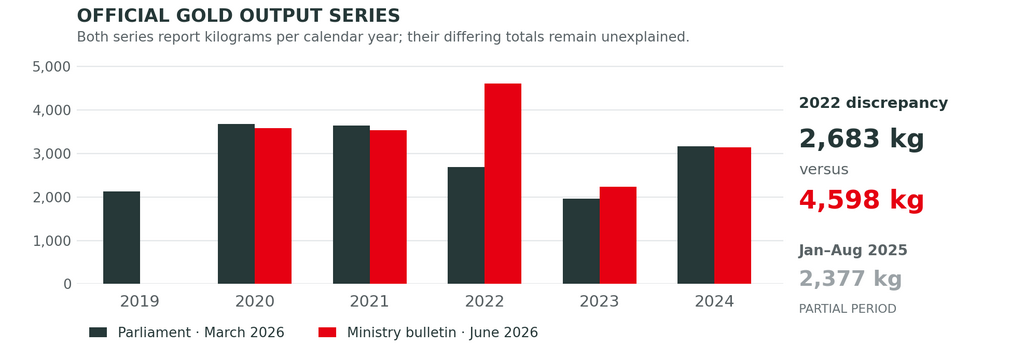
Figure 1. The minister’s March 2026 parliamentary reply [22] and the ministry’s June 2026 bulletin [1] differ for every shared year. The 2025 value covers January–August only and is set apart.
First Quantum Minerals' Kansanshi operation near Solwezi produced about 105,000 ounces of gold in 2024 and 116,000 ounces in 2025. The 2025 figure is for Kansanshi, not First Quantum's worldwide gold total of 152,000 ounces. The mine recovered more gold after selectively mining richer areas early in 2025 and improving throughput and recovery later in the year. [2]
Kansanshi cannot simply increase gold output whenever the gold price rises. Gold comes out of ore being mined for copper. Production depends on where the mine works, the gold content of the ore and how much the processing plant recovers. More rock through a new circuit does not guarantee more gold per tonne.
In the first half of 2026, Kansanshi produced 49,941 ounces, compared with 57,632 ounces a year earlier, calculated from the company's quarterly results. Its S3 circuit handled high volumes of lower grade stockpiled ore. First Quantum retained full-year 2026 guidance of 110,000–120,000 ounces. Meeting that range would require about 60,000–70,000 ounces in the second half as fresher ore becomes available. Guidance remains a forecast. [3]
What small miners need from a formal buyer
The government issued 519 gold-related artisanal and small scale licences in 2024. A licence is an entry point, not a measure of production. Zambia EITI says many small miners do not file production returns and an aggregate output figure for this part of the market is unavailable. [4, 5]
Zambia Gold Company purchased 13.9 kilograms of material from miners in Mumbwa and Rufunsa by 30 June 2025, according to EITI, at an average reported purity of 84%. That is purchased material rather than 13.9 kilograms of refined gold, and it covers only transactions at those centres. A ZNBC report from May 2025 had put recent aggregation at about seven kilograms and quoted buying prices of K2,400–K2,600 per gram against a quoted market price of about K2,800. These were prices reported on that date, not current prices. Without matching purity, the exact time of sale and any processing costs, the difference is not a reliable measure of what miners lose. [5, 6]
The Mines Minister reported a further 3.65 kilograms bought at Rufunsa, Mumbwa and Lusangazi in the first quarter of 2026, according to Zambia Monitor. That is a quarterly purchasing figure for three locations, not a count of all gold mined by small producers. [21]
This is where formalisation will be won or lost. A miner must be able to see how gold content is tested, understand the final price and receive payment promptly. Zambia Gold Company says its purchases from small miners are sold under separate offtake agreements, while gold from its Kasenseli mine is sold to the Bank of Zambia. The two routes should not be combined into one central bank buying figure. [7]
Parliament separately reported Zambia Gold Company’s contribution to gold production: 19.8 kg in 2022, 28.44 kg in 2023 and 16.30 kg in 2024. It reported 8.63 kg for January–August 2025. This is a production series, not a count of the gold that the company bought from small miners. [22]
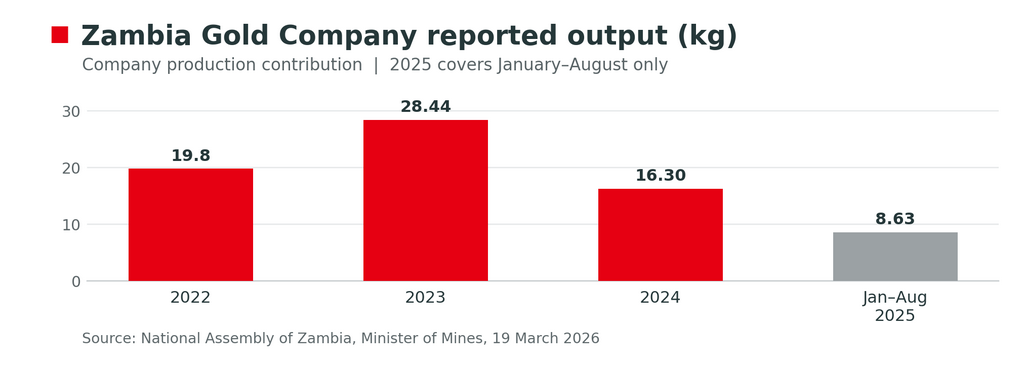
Figure 2. Gold production attributed to Zambia Gold Company in the minister’s parliamentary reply [22]. January–August 2025 is a partial period, shown in grey.
Responsible processing belongs in the same discussion. In March 2026, ZCCM-IH and the planetGOLD Zambia project signed an agreement to arrange purchases from mercury-free processing pilot sites. The agreement provides a route to market; it is not proof of how many kilograms have already been bought. Tracking metal, miner payments and cleaner processing together would give a fuller picture of whether the formal route works. [8]
What the UAE trade gap does and does not say
Use the same product definition on both sides of the 2023 UAE comparison. For all non-monetary gold under HS 7108, Zambia reported US$3.06 million in exports to the UAE, while the UAE reported US$1.788 billion in imports attributed to Zambia. Zambia’s figure is the sum of three disclosed subheadings: semi-manufactured, unwrought and powder. The widely repeated US$61,800 is only the unwrought export entry (HS 710812), while semi-manufactured exports alone were US$2.946 million. This is a difference between customs reports, not a measured loss of money or tax. The 2024 Zambian entry for unwrought exports to the UAE is already higher, at US$5.21 million; Figure 3 remains a matched 2023 comparison. [9–11, 23–26]
The UAE reported 29.1 tonnes of 2023 imports attributed to Zambia under the broad HS 7108 heading, more than 13 times the ministry bulletin’s 2.237 tonnes of domestic production that year. A March 2026 ministerial reply to Parliament gave a different 2023 production figure of 1,962 kg. The size of the discrepancy calls for a shipment-level explanation. UN Comtrade notes that bilateral records can differ because of origin-versus-destination reporting, transit routes, timing, valuation and classification. However, the gap also raises the credible possibility that some gold moved through undeclared exports, smuggling, misdeclaration or off-book side deals involving miners, traders or intermediaries. The available figures do not prove any one explanation, nor do they establish that Zambia mined 29 tonnes of unreported gold or lost US$1.8 billion. The UAE did record the imports, but their precise origin and route have not been publicly reconciled. [1, 12, 22, 23]
There is a second reporting problem closer to home. For 2024 gold exports, the ministry's statistical bulletin gives 1,391 kilograms and Zambia EITI reports 106,670 troy ounces, or about 3,318 kilograms. Their published coverage and methods do not reconcile the two. A public bridge between mine returns, export permits, customs declarations, bullion purity and changes in stock would be more useful than turning either mismatch into a smuggling estimate. [1, 5]
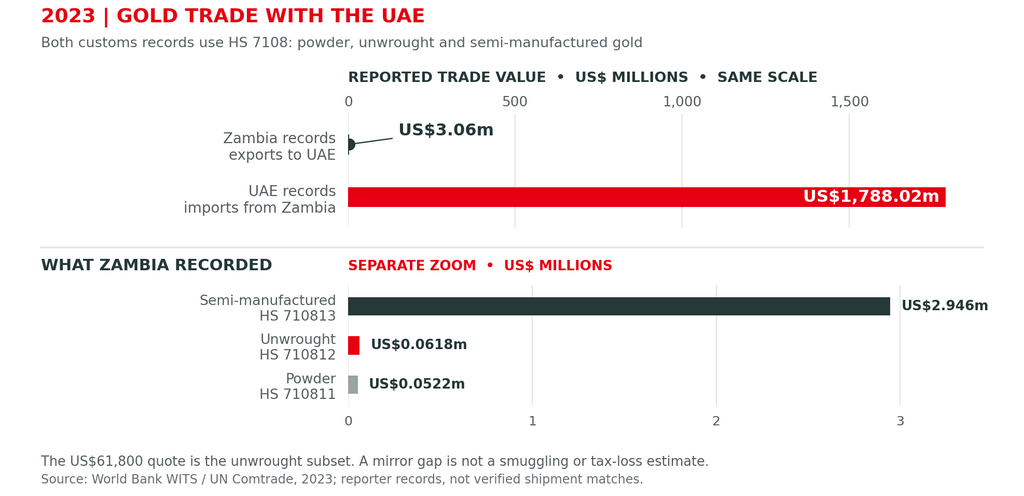
Figure 3. WITS / UN Comtrade records for HS 7108 in 2023 [9–11, 23–25]. The upper comparison uses one zero-based scale; the lower panel is a separately labelled zoom of Zambia’s three reported export forms. Different reporters’ customs values do not establish origin or illegality for individual shipments.
A tax cut is still only a proposal
After a September 2026 meeting with a representative of the World Gold Council, Ministry of Mines Permanent Secretary Hapenga Kabeta said the government was considering reducing VAT on gold to make formal trade easier for smaller miners. No new rate or start date has been announced in the material reviewed. The council representative estimated that US$80 million–US$240 million a year in royalties might be missed because gold is traded informally; this is an attributed estimate, not a measured tax loss established by the mirror-trade figures. [14]
VAT and mineral royalty also do different jobs. Zambia Revenue Authority describes the standard VAT rate as 16% and the royalty on precious metals as 6% of their norm value. VAT-registered businesses can offset qualifying VAT paid on purchases against VAT charged on sales. It would be misleading to treat the full 16% as a permanent deduction from every miner's pay, or to add the two rates and call that the tax on a gram of gold. Actual incentives depend on who sells to whom, registration, deductions and payment timing. [13]
In 2025 the government suspended a proposed 15% export duty on precious metals and gemstones. The finance minister told Parliament that the expected K250 million in revenue might not materialise if the duty reduced production or encouraged stockpiling. This shows officials have weighed tax receipts against activity before; it does not prove that a VAT cut by itself will bring informal gold into licensed channels. Published centre-level volumes, assay results and receipts would provide a way to test the policy if it proceeds. [15]
Reserves and a gold fund serve different markets
The Bank of Zambia's monetary gold holdings rose from 85,600 ounces at the end of 2024 to 101,828.55 ounces at the end of 2025. Its annual report records 16,228.55 ounces of purchases in 2025. The physical reserve grew by about 19%, while its reported dollar value rose from US$220.9 million to US$438.7 million. Higher gold prices made existing holdings more valuable; the near doubling in dollar value does not mean production or public cash receipts doubled. [16, 17]
An earlier parliamentary series tracks new gold procured and added to those reserves each year: the amount rose to 861 kg in 2022, then fell to 450 kg in 2024. These are annual additions, not year-end holdings, so a fall in additions does not establish a fall in the stock of gold. [22]
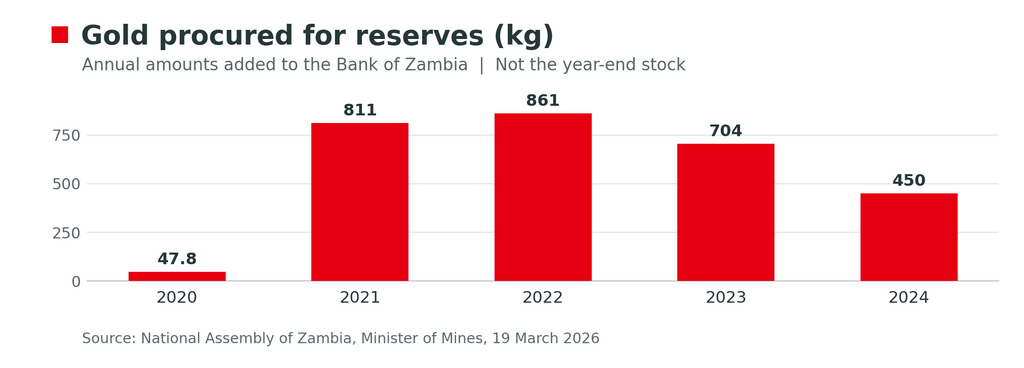
Figure 4. Annual gold procured and added to Bank of Zambia reserves, as reported to Parliament [22]. These amounts are separate from the bank’s reported reserve holdings [16, 17].
Nor does all money associated with mine gold reach the state. In August 2025, First Quantum agreed to receive US$1 billion up front from Royal Gold in return for future deliveries linked to Kansanshi copper output. That was financing for the company against future metal, not a US$1 billion treasury payment. [18]
The Lusaka Securities Exchange also plans its first gold exchange traded fund before the end of October 2026, according to its chief executive as reported by Bloomberg. The reported plan is to introduce an existing Absa product from the Johannesburg market. Absa describes its NewGold units as backed by bullion held with an independent custodian. A Lusaka listing would give investors exposure to the gold price; on the stated structure, it would not itself require the fund to buy gold from Zambian miners. The planned listing and local gold formalisation are separate tests of market development. [19, 20]
Three results would tell us whether Zambia’s gold market is becoming stronger. First, Kansanshi must deliver enough gold in the second half of 2026 to support its full-year guidance. Second, licensed buying centres need to show repeat purchases that miners regard as fairly tested and fairly paid, alongside progress on safe processing. Third, the authorities need to reconcile their own production totals and explain trade-record differences with common product definitions and shipment data.
The VAT review may help the second task, and a gold fund may widen investor choice. Neither settles where the UAE-recorded metal came from or how much gold small miners actually produce. Those are questions for traceable purchases and reconciled records. That is most likely where the market's lasting value will be made visible.
[1] Ministry of Mines and Minerals Development, Annual Mining Statistical Bulletin 2024
[2] First Quantum Minerals, 2025 preliminary production and 2026-2028 guidance
[3] First Quantum Minerals, second quarter 2026 results
[4] Ministry of Mines and Minerals Development, 2024 mining performance statement
[5] Zambia Extractive Industries Transparency Initiative, 2023 and 2024 report
[6] ZNBC Today, Zambia Gold Company buying prices, 28 May 2025, republished by the Zambian Observer
[7] Zambia Gold Company, gold trading
[8] planetGOLD, ZCCM-IH mercury-free gold offtake memorandum, 17 March 2026
[9] World Bank WITS, Zambia exports to the UAE, HS 710812, 2023
[10] World Bank WITS, UAE imports from Zambia, HS 710812, 2023
[11] World Bank WITS, Zambia exports to the UAE, full HS 7108 heading, 2023
[12] UN Comtrade, explanation of bilateral trade asymmetries
[13] Zambia Revenue Authority, tax information including VAT and mineral royalty
[14] News Diggers, ministry comments on proposed gold VAT review, 17 September 2026
[15] National Assembly of Zambia, finance minister on 2025 export duty, 27 February 2025
[16] Bank of Zambia, annual report 2024
[17] Bank of Zambia, annual report 2025
[18] First Quantum Minerals, August 2025 gold streaming agreement
[19] Bloomberg, Lusaka Securities Exchange plans an Absa gold ETF cross-listing, 16 September 2026
[20] Absa Index and Structured Solutions, NewGold ETF product description
[21] Zambia Monitor, mining minister reports first quarter 2026 gold-centre purchases, 13 May 2026
[22] National Assembly of Zambia, mining minister on annual gold production, 19 March 2026
[23] World Bank WITS, UAE imports from Zambia, all HS 7108 gold forms, 2023
[24] World Bank WITS, Zambia exports to the UAE, semi-manufactured gold, HS 710813, 2023
[25] World Bank WITS, Zambia exports to the UAE, gold powder, HS 710811, 2023
[26] World Bank WITS, Zambia exports to the UAE, unwrought gold, HS 710812, 2024