SMM, September 23:
In the metals market:
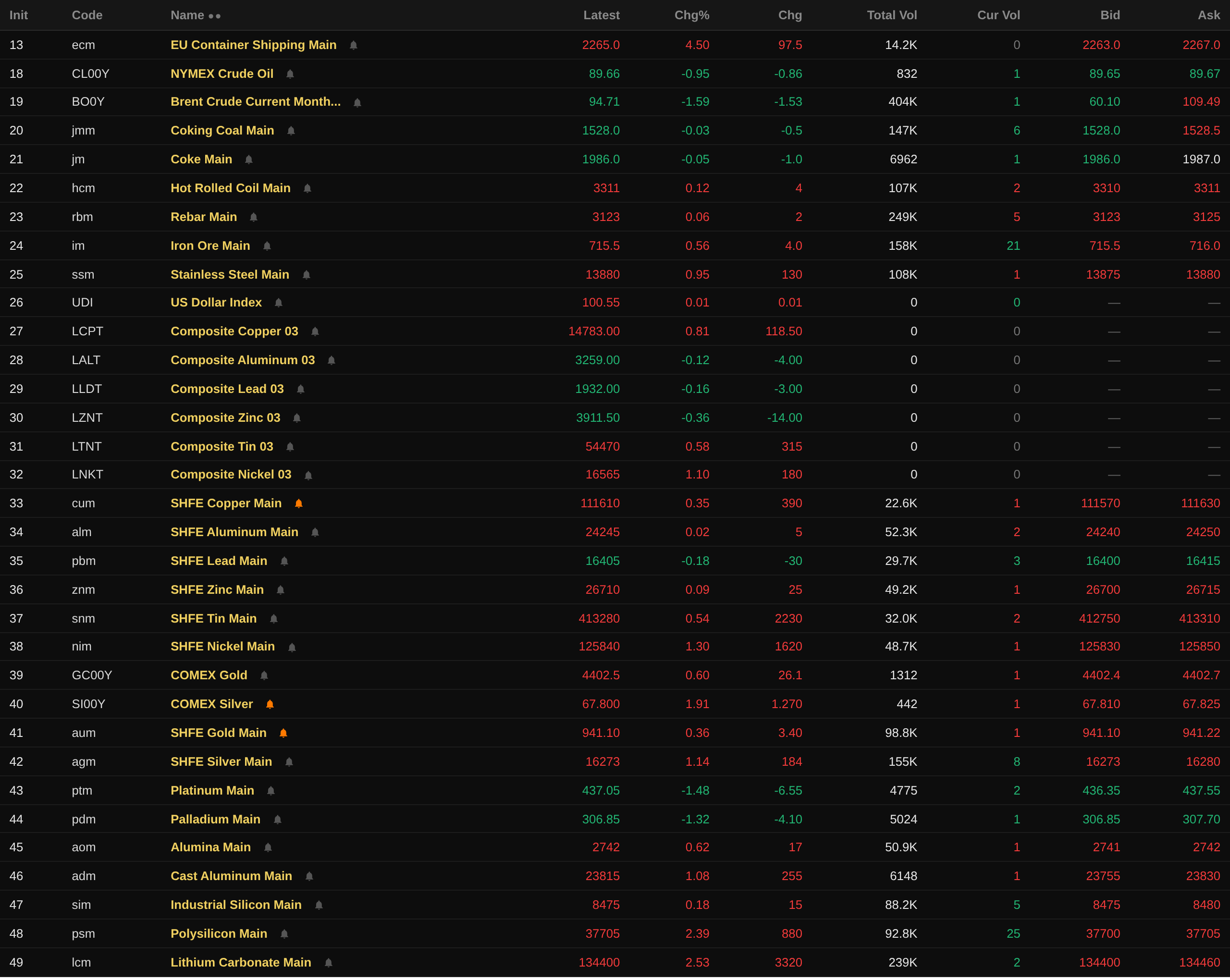
Overnight, base metals broadly rose in both domestic and overseas markets. In the domestic market, only SHFE lead fell, down 0.18%. In the overseas market, LME zinc led declines with a 0.36% drop, LME lead fell 0.16%, and LME aluminum fell 0.12%. All other metals rose, with LME nickel up 1.1% and SHFE nickel up 1.3%, while gains in the rest were within 1%. The alumina main contract rose 0.62%, and the cast aluminum main contract rose 1.08%.
Overnight, ferrous metals broadly rose. Stainless steel gained 0.95%, iron ore rose 0.56%, and rebar and hot-rolled coil fluctuated mildly. For coking coal and coke, coking coal fell 0.03% and coke fell 0.05%.
Overnight in precious metals, as of the overnight close, COMEX gold rose 0.28% and COMEX silver rose 1.8%. Domestically, SHFE gold rose 0.36% and SHFE silver rose 1.14%.
Overnight closing prices as of 6:42 on September 23:
Macro front
Domestically:
[China's national electricity market traded volume rose 19.2% YoY in January-August 2026] In August 2026, electricity trading institutions across China completed 754.8 billion kWh of traded electricity, up 15.2% YoY. By trading scope, intra-provincial traded volume was 563.8 billion kWh, up 16.0% YoY; cross-province and cross-region traded volume was 191 billion kWh, up 11.4% YoY. By product type, medium and long-term traded volume was 681.9 billion kWh, and spot traded volume was 72.9 billion kWh. Green electricity traded volume was 26.4 billion kWh, up 7.7% YoY. Market-based proxy power purchases by grid enterprises totaled 78.2 billion kWh. (National Energy Administration) (Jin10 Data APP)
[Chengdu's industrial value-added above designated size rose 6.3% YoY in January-August] According to the Chengdu Statistics Bureau's official WeChat account, from January to August, the city's industrial value-added above designated size rose 6.3% YoY. By sector, 26 of 37 major industrial categories posted growth. Among them, electrical machinery and equipment manufacturing rose 19.1% YoY, special-purpose equipment manufacturing grew 14.5%, petroleum, coal and other fuel processing grew 14.1%, and computer, communications and other electronic equipment manufacturing grew 12.6%. In terms of major industrial product output, lithium-ion batteries rose 152.7% YoY, smart TVs grew 45.5%, and industrial robots grew 16.3%. From January to August, the product sales rate of industrial enterprises above designated size was 96.0%. (Chengdu Statistics)
US dollar:
As of the overnight close, the US dollar index rose 0.11% to 100.54. Fed's Williams on Tuesday defended the system through which the US Fed implements monetary policy, while noting that the system can be adjusted and optimized as financial markets evolve. Williams said that using the current set of tools to manage short-term interest rates and provide "ample" reserves to the financial system "has proven to be very effective at achieving interest rate control and supporting smooth functioning of core financial markets." Williams' remarks that day did not touch on monetary policy or the rate outlook, and he was not scheduled to take questions after his speech. The New York Fed president said that while the Fed's rate-control framework works well, it is not set in stone and can be adjusted as market conditions change. Williams said: "As markets continue to evolve, we must ensure that our policy tools can meet their objectives and perform their necessary functions. Simply put, the evolution of financial market structure will also drive the evolution of how we effectively implement monetary policy." (Jin10 Data APP)
Fed's Barkin warned that inflation shocks may take some time to ease, and there is a risk that inflation pressures stay high and become entrenched. Barkin said the Fed's rate hike last week will help slow inflation, but he did not explicitly say whether further tightening is needed. Instead, the Fed official stressed that supply shocks are no longer just sporadic or temporary phenomena, but persistent price pressures affecting the entire economy. "These conditions may fade over time, but I expect it will still take some time," Barkin said. "During this period, the current elevated inflation could influence future inflation." Barkin noted, "What do we do next? We are committed to sustainably bringing inflation down to our 2% target. Last week's rate hike will help with that. Whether further hikes are needed, and how many? We will see." The Fed official also laid out two inflation scenarios: the first is that recent shocks gradually fade and price pressures cool quickly; the second is that inflation pressures persist. "I am open to the possibility that inflation could come down soon. Some of the recent shocks may reverse," Barkin said, adding that consumers may "hit their limits," investment growth may slow, and employment may also "fluctuate." "On the other hand, inflation may prove harder to tame than expected. Temporary shocks could persist," he said. "New cost pressures could emerge. Stronger demand could feed through to prices, and the impact of today's inflation could do the same." (Jin10 Data APP)
Boston Fed President Collins said she supported the Fed's decision to raise rates last week, saying the move will help bring inflation back down to the central bank's 2% target. Collins wrote: "A modest increase in the federal funds rate will help ensure inflation returns durably to target. As labour market conditions improve, monetary policy can focus on restoring price stability in a timely manner—especially after five and a half years of elevated inflation." Collins, who does not have a vote on monetary policy decisions this year, said the "probability has increased" that inflation will remain "significantly above 2%" on a sustained basis. (Jin10 Data APP)
According to CME "FedWatch": The probability that the Fed keeps rates unchanged at 3.75%-4.00% at the October meeting is 45.8%, and the probability of a 25bp hike is 54.2%. The probability that the Fed keeps rates unchanged at 3.75%-4.00% by December is 10.8%, the probability of a cumulative 25bp hike is 47.8%, and the probability of a cumulative 50bp hike is 41.4%. (Jin10 Data APP)
Other currencies:
ECB Governing Council member and Bundesbank President Nagel said the ECB may have to raise rates to levels that restrain economic growth. He said: "If high energy prices stay high, we cannot rule out having to enter mildly restrictive monetary policy territory." But he added that it is too early to judge. Nagel worries that upcoming wage negotiations in countries including Germany could trigger second-round effects. "The longer this persists, the more likely we are to see second-round effects." Therefore, "we must remain vigilant." Asked about the Transmission Protection Instrument (TPI), Nagel said the tool can only be activated when there are problems in monetary policy transmission, and is "unrelated to fiscal challenges in any euro area country." (Jin10 Data APP)
Macro front:
Today will see the release of the US September S&P Global manufacturing PMI flash reading, US September S&P Global services PMI flash reading, France September manufacturing PMI flash reading, Germany September manufacturing PMI flash reading, eurozone September manufacturing PMI flash reading, UK September manufacturing PMI flash reading, and UK September services PMI flash reading, among other data.
In addition, President Xi Jinping will pay a state visit to the US from September 23 to 25. 2027 FOMC voter and Richmond Fed President Barkin will deliver remarks, and Fed Governor Barr will speak on the theme of "housing." In France, the OECD will release its interim Global Economic Outlook report. Vice Premier He Lifeng will lead a delegation to the US from September 19-23 for economic and trade consultations with the US side, and Iranian President Pezeshkian will address the UN General Assembly. Due to contract rollover, the NYMEX WTI crude oil October futures will complete their final floor trading at 2:30 on September 23 and final electronic trading at 5:00 a.m. Please pay attention to exchange notices on contract expiration and rollover to manage risk. In addition, some trading platforms' US oil contract expiration is typically one day earlier than the official NYMEX date, so please take note.
Crude oil:
As of the overnight close, oil prices fell in both markets, with WTI down 2.73% and Brent down 1.59%, both posting a fifth consecutive daily decline. In news, reports said Iran proposed opening the Strait of Hormuz "within 7 days" after the US lifts the blockade. (Jin10 Data APP)
Crude oil traders are piling into options betting on a decline in Brent crude, with bearish wagers surging to unprecedented levels as investors reposition after a recent sharp rebound.
According to preliminary data from the Intercontinental Exchange (ICE) European futures market, Brent put option trading volume surged to approximately 764,000 contracts on Tuesday, marking the highest level on record. Most of the activity was concentrated in narrow put spreads, which are sometimes used as hedges for over-the-counter binary trades. Meanwhile, Saudi Arabia is working to restore flows on a key crude pipeline, and there are signs of diplomatic progress that could reopen the Strait of Hormuz. (From Wallstreetcn APP)
Russian crude oil exports declined in the most recent week, just as new US sanctions took effect and supplies from Saudi Arabia's west coast gradually recovered, intensifying competitive pressure on Moscow's key markets. According to vessel-tracking data compiled by Bloomberg, Russia's four-week average crude oil exports stood at 3.53 million barrels per day. That was slightly lower than the revised 3.55 million barrels per day for the week ended September 13. For the week ended September 20, Russia's weekly crude oil exports fell by about 320,000 barrels per day to 3.57 million barrels per day. (From Wallstreetcn APP)
Bank of America raised its H2 2026 Brent crude oil price forecast from $83 per barrel to $95. (From Wallstreetcn APP)
American Petroleum Institute (API) data showed that last week, US API crude oil inventories rose by 1.786 million barrels, following a gain of 7.144 million barrels the prior week. Last week, API crude oil inventories at Cushing increased by 2.082 million barrels, compared with a decline of 246,000 barrels previously. Last week, API gasoline inventories fell by 2.16 million barrels (versus a prior gain of 1.462 million barrels), while distillate inventories dropped by 2.164 million barrels (versus a prior gain of 1.607 million barrels). (From Wallstreetcn APP)
![SHFE tin holds the 410,000 level, inventory drops on both fronts + semiconductor surge continues to confirm tight balance [SMM Tin Morning News]](https://imgqn.smm.cn/usercenter/BBJUa20251217171751.jpg)
![The most-traded SHFE tin contract closed at 413,080 in the night session, climbing above 413,000. With the September rate hike finalized, ore-side hard constraints support consolidation at highs. [SMM Tin Morning Meeting Summary]](https://imgqn.smm.cn/usercenter/nyMyJ20251217171751.jpg)
![Lead Price Rally Slows, Spot Premiums Ease & Downstream Turns Cautious [SMM Lead Morning Meeting Minutes]](https://imgqn.smm.cn/usercenter/riosq20251217171722.jpg)