SMM September 22 news:
In the metals market:
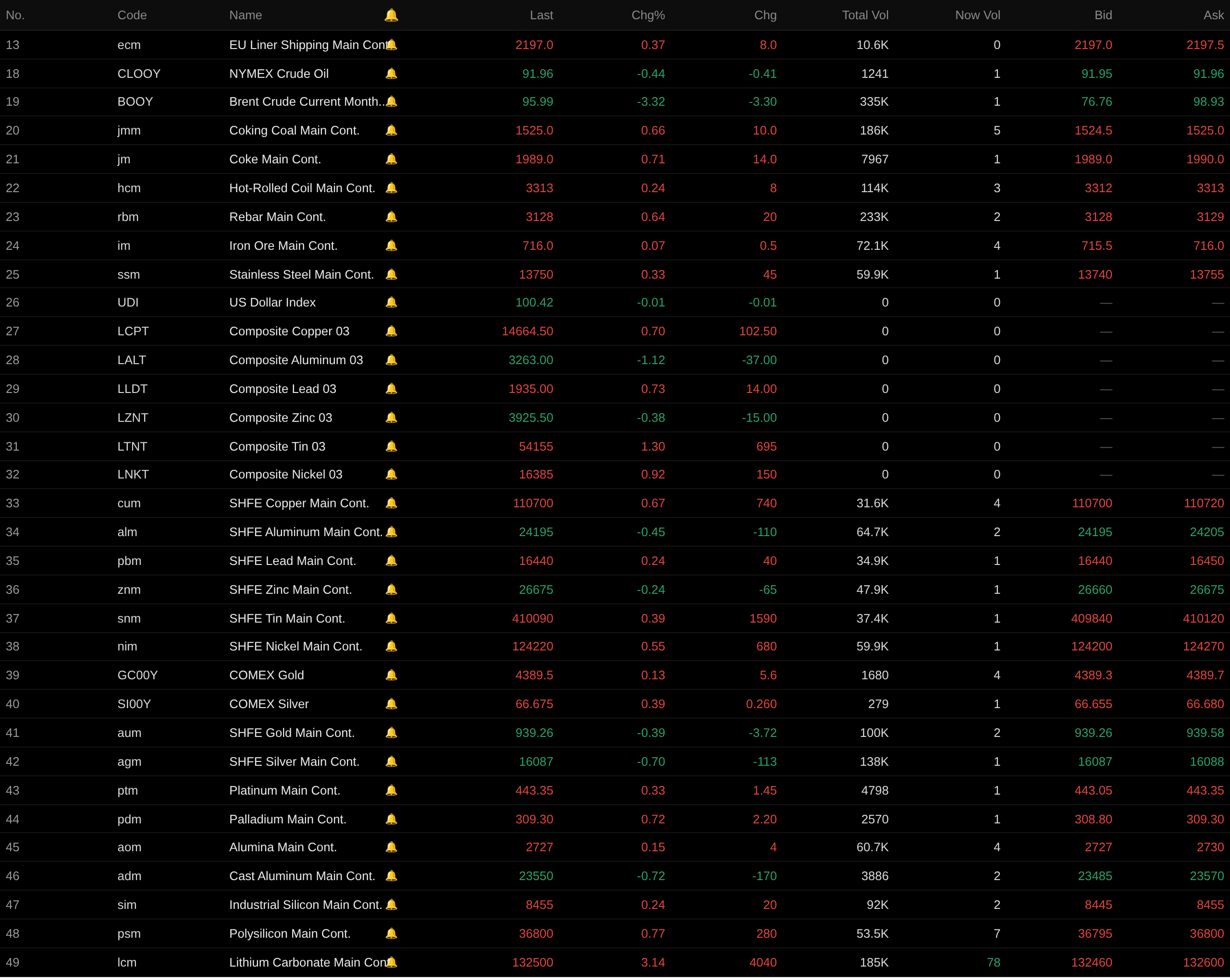
Overnight, base metals on both domestic and overseas markets showed mixed performance. LME aluminum led the decline with a drop of 1.12%, LME tin rose 1.3%, LME nickel gained 0.92%, and the % changes of other metals were relatively small. The alumina main contract rose 0.15%, while the cast aluminum main contract fell 0.72%.
Overnight, ferrous metals generally rose. Rebar gained 0.64%, stainless steel rose 0.33%, and in the coking coal and coke segment, coking coal rose 0.66% and coke gained 0.71%.
Overnight in precious metals, as of the overnight close, COMEX gold fell 0.99% and COMEX silver dropped 0.92%. In China, SHFE gold fell 0.39% and SHFE silver dropped 0.7%.
Overnight closing prices as of 6:42 on September 22:
Macro front
In China:
[The central bank held a symposium for foreign-funded financial institutions: steadily expanding two-way opening of financial markets] On September 21, the People's Bank of China held a symposium for foreign-funded financial institutions to hear their opinions and suggestions, and to study further optimizing the business environment and promoting high-level opening-up of the financial sector. At the symposium, Pan Gongsheng introduced the current economic and financial situation in China and the implementation of monetary policy, listened to opinions and suggestions, and responded to issues of concern to the institutions. Pan Gongsheng said that China's economy is generally stable and improving, the structure continues to be optimized, and new progress has been made in high-quality development. The People's Bank of China will earnestly implement the decisions and arrangements of the CPC Central Committee and the State Council, implement a moderately loose monetary policy, and create a favorable monetary and financial environment for stable economic growth and the smooth operation of financial markets. It will continue to promote high-level financial opening-up, continuously improve policy supply, steadily expand two-way opening of financial markets, continuously optimize cross-border payment services, and further facilitate the international use of the yuan. The foreign-funded financial institutions believe that since the beginning of this year, the People's Bank of China has made positive progress in a series of measures to deepen financial reform and opening-up, optimize the business environment, and facilitate the international use of the yuan. They hope to continue optimizing relevant policies and strengthen communication with the market.
On the US dollar:
As of the overnight close, the US dollar index rose 0.21% to 100.43. Fed's Musalem said on Monday that due to strong demand and commodity price shocks that have extended beyond the oil sector, the Fed may need to further raise interest rates to reduce inflation. He also stressed that the Fed should act sooner rather than later. Musalem said: "Persistent demand and recurring supply pressures are still exacerbating inflation risks. I believe that without further policy measures to curb inflation, inflation in 18 months is likely to be significantly above our 2% target rather than at the target level."I believe policy must exert meaningful restraint on inflation. Only then can the US Fed achieve its inflation target within about a year and a half, leaving time for tightening policy to affect the economy." He also said, "Earlier, gradual policy tightening is more appropriate and causes less shock to the economy than larger and potentially more abrupt policy moves later." Musalem noted that inflation "is not a risk, it is already here," and even after stripping out the impact of oil and other supply-related factors, underlying inflation could still be several percentage points above the US Fed's target and is "moving in the wrong direction." (Jin10 Data APP)
According to CME "FedWatch": The probability of the US Fed keeping rates unchanged at 3.75%-4.00% at its October meeting is 43.5%, and the probability of a 25-basis-point hike is 56.5%. The probability of the US Fed keeping rates unchanged at 3.75%-4.00% by December is 9.7%, the probability of a cumulative 25-basis-point hike is 46.4%, and the probability of a cumulative 50-basis-point hike is 43.9%. (Jin10 Data APP)
Chicago Fed President Goolsbee (2027 FOMC voting member) warned that the US Fed cannot ignore recurring and long-lasting supply shocks, and that responding to them could bring pain to the economy. Supply shocks are becoming more frequent, more severe, and longer-lasting. Once the impact of supply shocks on inflation becomes persistent, part of the old logic of "looking through" them no longer holds. While the US Fed does not need to respond to these shocks and the inflation they trigger as aggressively as it would to overheated demand, the process will still inevitably come at a cost. This is precisely the painful trade-off that stagflationary shocks always impose on central banks — the trade-off between employment and inflation. Unfortunately, in such an environment, getting back on track can only be achieved through a difficult path. (From Wall Street News APP)
In other currencies:
RBA Assistant Governor Hunter reiterated in a podcast on Tuesday that a fourth rate hike this year may be necessary to ensure inflation is contained, underscoring market bets on a hike as early as next week. Hunter said the central bank's policy board is concerned that inflation has been too high for too long and could become entrenched in pricing behavior. She said, "We can see many reasons why inflation could be slightly higher than we currently think." She pointed to rising energy costs from the Middle East conflict and signs that domestic demand is outstripping supply. The board may feel they have to raise the cash rate again to slow the economy a little more to really address these pressures. (Jin10 Data APP)
On the macro front:
Data due today include the weekly change in US ADP employment for the week ending September 5, the US Richmond Fed manufacturing index for September, the eurozone consumer confidence index flash estimate for September, UK public sector net borrowing for August, and the UK CBI industrial order balance for September.
In addition, Vice Premier He Lifeng will lead a delegation to the US from September 19 to 23 for economic and trade consultations. RBA Governor Bullock will deliver a speech, ECB President Lagarde will deliver a pre-recorded speech at a conference on how central banks should address future challenges, FOMC permanent voter and New York Fed President Williams will speak at the 2026 US Treasury market conference, Fed Vice Chair Jefferson will speak at the 2026 US Treasury market conference, and US President Trump will meet with Ukrainian President Zelensky, UK Prime Minister Burnham, and Japanese Prime Minister Takaichi Sanae in the US.
On the crude oil front:
As of the overnight close, oil prices fell across both benchmarks, with WTI down 4.28% and Brent down 3.32%, marking a four-day losing streak. The market is pinning hopes on a diplomatic breakthrough in the Iran war.
Buoyed by optimism that Saudi Arabia's damaged East-West pipeline may resume oil shipments soon and that US-Iran efforts to restart negotiations are making progress, crude oil futures prices fell for a fourth consecutive trading day. US Central Command Vice Admiral Cooper said over the weekend that the volume of oil and goods transported through the Strait of Hormuz over the past two weeks hit a six-month high. (Jin10 Data APP)
According to data from TankerTrackers.com, Saudi Aramco loaded 14 million barrels of crude oil onto seven very large crude carriers from Gulf coast terminals on Sunday to step up exports via the Strait of Hormuz. Satellite imagery showed seven tankers located near the port of Ras Tanura on Sunday. (Jin10 Data APP)
Over the weekend, monitoring showed a sharp increase in Saudi Arabia's oil loadings within the Persian Gulf, the clearest sign yet that the country is shifting its export center back to the Strait of Hormuz after a key cross-country pipeline was shut down. According to Sentinel 2 satellite data from the EU, very large crude carriers with a combined loading capacity of 14 million barrels of crude oil were spotted near Saudi export facilities along the Persian Gulf coast over the weekend, the highest level since at least June. Earlier this month, Saudi Arabia's critical East-West pipeline was attacked and forced to shut down, and traders are scrambling to obtain information on Saudi crude exports. Saudi Arabia had been using the pipeline to bypass the Strait of Hormuz, but after the pipeline was shut down, the country has sought to resume oil shipments through the strait. (Jin10 Data APP)
![Fundamentals show both bullish and bearish factors, SHFE zinc consolidates at highs [SMM Zinc Futures Brief]](https://imgqn.smm.cn/usercenter/TeRBO20251217171754.jpg)
![Dollar weakens, metals broadly rise; SHFE copper and coking coal up over 1%, lithium carbonate and polysilicon up over 2% [SMM midday comment]](https://imgqn.smm.cn/usercenter/JYbQQ20251217171736.jpg)