Overview
Valterra Platinum began operating under its current name in 2025, when Anglo American Platinum changed its name and completed its demerger from Anglo American. Its operating history stretches back through decades of Anglo-American Platinum reporting. It remains an integrated producer: ore is mined in South Africa and Zimbabwe, then concentrated, smelted, refined and sold through the same wider group system, mostly in South Africa.
That integration is important when reading the numbers. A mine can continue producing ore while a converter or refinery is unavailable. Metal then accumulates as work in progress instead of becoming a finished product. When the plant returns, refined output can rise sharply even if the mines have not produced much more. Annual production can therefore tell us as much about processing and inventories as it does about mining.
This analysis covers the calendar years 2010 to 2025. It uses company-reported refined production for platinum, palladium and rhodium and annual prices achieved for those three metals, ruthenium and iridium. Separate US Geological Survey benchmarks provide market context for ruthenium and iridium. The figures are group totals and include Valterra's Zimbabwean operation, Unki.
The main finding is that Valterra's history contains two related but different cycles. Refined output was shaped by strikes, plant interruptions, accumulated inventory and changes in reporting definitions. Metal prices moved much more sharply and often in a different direction. Understanding the business will require both sides of the record.
Refined Production and Reporting Basis
The production series changes definition during the period. From 2010 to 2018, it reports total refined production including toll-refined metal. Toll refining means processing material for another owner, normally for a fee. The metal passes through Valterra's plants but does not belong to the company in the same way as its own production. The series excludes tolling in 2019 and 2020. From 2021 to 2025, it reports owned refined production excluding tolling. These definition changes create breaks in the historical line.
Reported platinum, palladium and rhodium output totalled about 4.35 million ounces in 2010 and remained above 4 million ounces through 2013. It dropped by about 18% to 3.34 million ounces in 2014, the year of the prolonged strike across South Africa's platinum belt. Output rebounded to 4.36 million ounces in 2015 and reached 4.50 million ounces in 2017, the highest three-metal total in the dataset.
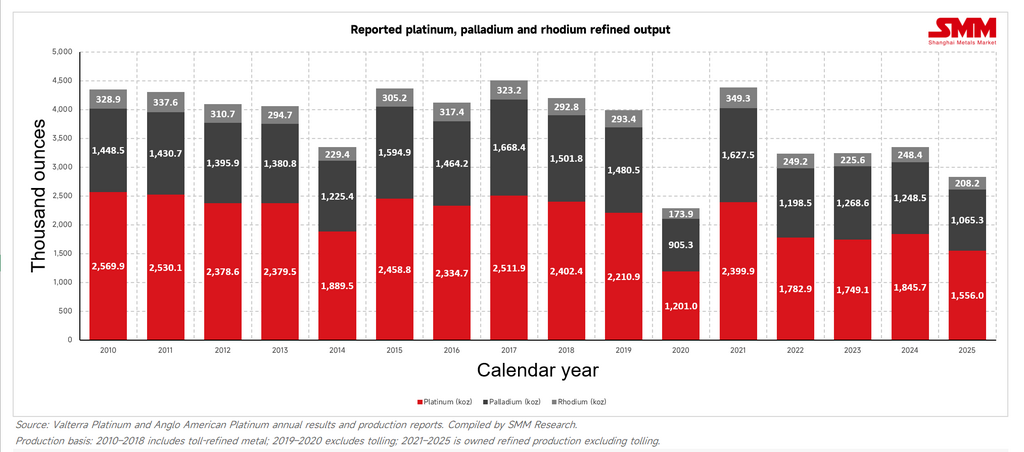
The exclusion of toll-refined metal from 2019 means that the later figures are not directly comparable with the earlier peak. Even within the newer basis, the path was uneven. The clearest break came in 2020. Three-metal refined output fell by about 43% from 3.98 million ounces in 2019 to 2.28 million ounces. The company reported that Covid-19 restrictions affected mining in both South Africa and Zimbabwe, while temporary shutdowns of the Anglo Converter Plant constrained refining. Total PGM production from mining and concentrate fell by 14%, but refined production excluding tolling fell by 42%. Around 1 million PGM ounces accumulated as work in progress for later release.
This difference shows why refined output cannot be read as mine output. A 42% fall in refined output did not mean that mining fell by the same amount. The bottleneck sat further along the processing chain. When the converter returned, reported platinum, palladium and rhodium output rose to 4.38 million ounces in 2021, almost twice the 2020 level. Part of that recovery represented previously mined metal moving through the plants. The reporting basis also changed again to owned refined production, so the jump should not be read as a simple doubling of mine performance.
Output settled at roughly 3.23 million ounces in both 2022 and 2023, then increased to 3.34 million ounces in 2024. In 2025 it fell by about 15% to 2.83 million ounces: 1.56 million ounces of platinum, 1.07 million ounces of palladium and 208,200 ounces of rhodium. On the company's broader measure, which includes other metals, owned refined PGM production was 3.41 million ounces and was 13% lower than in 2024. The February flooding at Amandelbult affected mine supply, while the first quarter recorded unusually low refined output. Production recovered later in the year as Amandelbult returned to steady operations and the processing system released work-in-progress inventory.
The word "owned" also needs care. It does not mean that every ounce came from a Valterra mine. In 2025 the company reported 2.06 million ounces of own-mined PGM production and 1.14 million ounces from purchased concentrate. Once concentrate is purchased, the resulting metal belongs to Valterra, but it is not own-mined. Refined output therefore reflects the company's mines, purchased feed, plant performance and changes in inventory. It is a measure of finished-metal delivery, not a stand-alone measure of underground productivity.
Metal Mix and Achieved Price Cycles
Platinum remained the largest of the three separately reported metals. In 2025 it represented 55.0% of disclosed platinum, palladium and rhodium output. Palladium accounted for 37.6% and rhodium only 7.4%. The physical mix changes gradually because the metals occur together in the ore. Valterra cannot simply switch the mine to whichever metal has the highest price.
Prices were far less stable than volumes. The dataset uses annual company averages in US dollars per troy ounce. These are prices achieved over the year, not the highest spot quotation and not a complete measure of revenue. The wording and treatment vary slightly between company reports, including the exclusion of trading from some later figures, so the series is best read as the company's annual market exposure rather than a perfectly standardised transaction price.
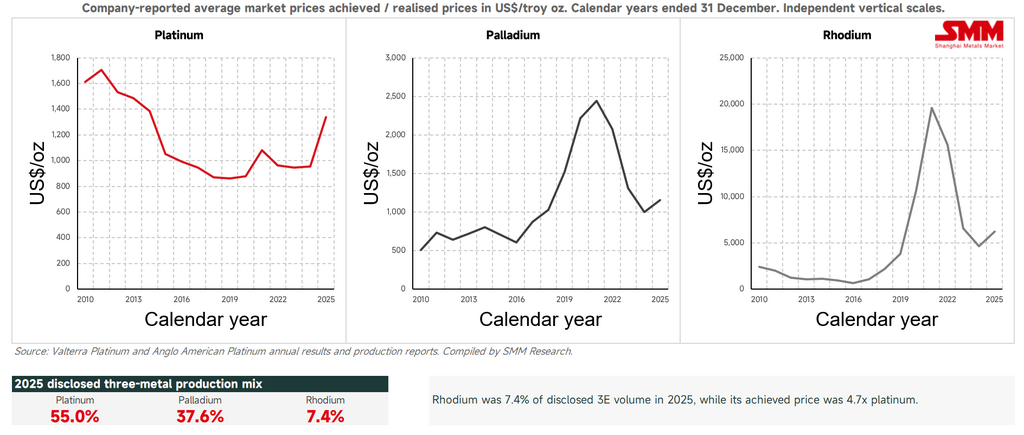
Platinum's achieved price reached US$1,707 an ounce in 2011, then declined for most of the decade and bottomed at US$861 in 2019. It was still only US$955 in 2024 before rising by about 40% to US$1,338 in 2025. That was a strong recovery, but the 2025 average remained about 22% below the 2011 level.
Palladium followed a different course. Its achieved price rose from US$507 in 2010 to US$2,439 in 2021. It then fell to US$1,003 in 2024 before recovering to US$1,157 in 2025. Even after that increase, the 2025 average was about 53% below the 2021 peak.
Rhodium produced the largest swing. Its achieved price fell to US$680 in 2016, then climbed to US$19,613 in 2021. By 2024 it had dropped to US$4,637. The 2025 recovery took it to US$6,236, about 34% higher than in 2024 but still 68% below the 2021 average.
Rhodium's small physical share can therefore hide its financial importance. In 2025 its achieved price was about 4.7 times the platinum price. At the 2021 peak it was more than 18 times the platinum price. A change in rhodium can materially alter the value of the basket even though it contributes far fewer ounces. The reverse is also true: a steep rhodium decline can weaken the basket without a comparable change in production.
The 2025 figures illustrate the separation between price and volume. Three-metal refined output fell by about 15%, yet achieved prices rose for platinum, palladium and rhodium. Valterra reported that its full-year realised US dollar PGM basket price increased by 26%. This does not mean that prices fully cancelled the volume decline or that profit can be calculated by multiplying the charted prices by refined output. Production, sales timing, purchased concentrate, tolling, inventory movements, exchange rates and costs all affect the final result.
Ruthenium and Iridium Data Limits
Ruthenium and iridium are commercially important, but the public record is less complete. Valterra disclosed annual achieved prices for both metals from 2014 to 2025. It did not provide a matching 2010-2025 series of individual ruthenium and iridium production volumes. These ounces sit within broader other-metal totals, so their separate contribution to sales or revenue cannot be calculated from the dataset.
The achieved-price series still shows sizeable movements. Ruthenium fell to US$40 an ounce in 2016 and rose to US$687 in 2025. Iridium was US$526 in 2015, reached US$4,765 in 2021 and remained at US$4,227 in 2025. These cycles did not simply copy platinum, palladium or rhodium.
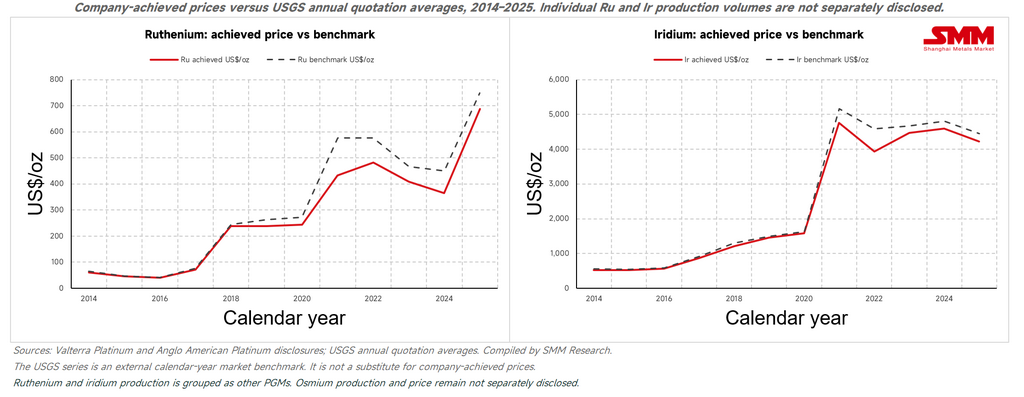
The US Geological Survey benchmarks provide an external comparison. In 2025 the annual ruthenium benchmark was approximately US$749 an ounce, compared with Valterra's achieved price of US$687. The iridium benchmark was about US$4,448, compared with US$4,227 achieved by the company. Valterra's annual averages were below the USGS benchmark in every overlapping year, but this should not automatically be called a discount or weak selling performance. Company prices and market quotations can differ because of contract terms, delivery dates, averaging periods and the timing of sales.
Osmium is a clearer data gap. The reviewed company disclosures did not provide a separate annual osmium production or achieved-price series. A missing value must not be treated as zero. Nor should an unexplained balance within a broader metal total be assigned to osmium, ruthenium or iridium without company disclosure.
Terminology creates another boundary. Valterra's reported PGM total comprises platinum, palladium, rhodium, ruthenium and iridium plus gold. Gold is not a platinum-group metal, while osmium is not included. The company total therefore cannot be read as production of all six PGMs.
South African customs data were also excluded from the company series. Customs statistics measure cross-border trade, not Valterra's production or achieved prices. The same ounce can appear first in mine output, later in refinery output and again in exports. Combining those measures would risk double counting, while the trade record does not reliably identify the company responsible for each shipment. These limits reduce false precision and keep the comparisons tied to what Valterra actually disclosed.
Conclusion and Outlook
Valterra's 2010-2025 record shows why refined production needs context. The 2014 strike reduced supply. The converter interruptions and pandemic restrictions in 2020 created a large processing backlog. The 2021 rebound reflected the release of work in progress as well as current output. Later changes in tolling and ownership definitions altered the measurement itself. The chart is valuable, but it is not a continuous measure of mine productivity on one unchanged basis.
The price record carries a different message. Palladium and rhodium delivered extraordinary gains up to 2021, then gave much of them back. Platinum recovered strongly in 2025 after years of weaker prices. The 2025 basket benefited even as refined volumes fell. This is the economic advantage and risk of a multi-metal orebody: the producer receives several metals together, but their prices do not move together.
Valterra's first-half 2026 results extend the story beyond the historical dataset. Own-mined production increased by 9% to about 1 million PGM ounces, while refined production rose by 25% to 1.7 million ounces and sales volumes increased by 18% to 1.7 million ounces. The company said the refining increase benefited from higher mine output, inventory optimisation and the deferral of some processing maintenance into the third quarter. Once again, finished output moved for several reasons at the same time.
Higher metal prices made a major contribution. The realised dollar basket price increased by 85% to US$2,801 an ounce. Revenue rose by 93% to R82 billion and adjusted EBITDA increased by 404% to R33.4 billion. Net cash reached R23.7 billion and all-in sustaining costs declined by 21% to US$996 per three-metal ounce sold. These are half-year group measures on a broader metal basis and should not be compared directly with the annual platinum, palladium and rhodium charts.
The improvement does not remove the operating risks. Three employees died in work-related incidents during the first half of 2026, leading to company-wide safety stoppages and further interventions. Valterra kept its full-year guidance at 3.0-3.4 million PGM ounces for both metal in concentrate and refined production. It also retained unit-cost guidance of R19,000-R20,000 per PGM ounce, all-in sustaining cost guidance of US$1,050 per three-metal ounce sold and capital expenditure of R17-R18 billion. These are company targets, not assured outcomes.
Beyond 2026, the Sandsloot Underground Project at Mogalakwena is the main decision to watch. Valterra expects to complete the feasibility study and make an investment decision in the first half of 2027. The project could support the long-term mine plan, but its value will depend on capital discipline and the future metal basket rather than resource size alone.
The immediate outlook is stronger than the 2025 production chart might suggest. Prices have recovered, Amandelbult has returned to steadier production and processing performance has improved. The durability of that improvement will depend on whether Valterra can maintain safe mine output, complete deferred maintenance without another inventory build-up and hold costs when metal prices are less supportive. Its first year as an independent company has left it with a strong net cash position. Long-term performance will depend on how carefully that financial capacity is used.
References
- Valterra Platinum company profile.
- Anglo American Platinum 2014 annual results presentation, Anglo American Platinum 2018 annual results.
- Anglo American Platinum 2020 annual results.
- Valterra Platinum fourth-quarter 2025 production report.
- Anglo American Platinum historical price tables, Valterra Platinum fourth-quarter 2025 production report.
- Anglo American Platinum fourth-quarter 2022 production report, Anglo American Platinum 2024 integrated annual report.
- USGS 2018 platinum-group metals yearbook, USGS December 2025 platinum-group metals report.
- Valterra Platinum first-half 2026 results.
![[SMM Flash] Jubilee Reviews Interest in Undeveloped Tjate PGM Project](https://imgqn.smm.cn/usercenter/fNuSg20251217171735.jpg)
![[SMM Flash] Sylvania Reviews Thaba Plan After Lower Feed-Grade Estimates](https://imgqn.smm.cn/usercenter/VCNvX20251217171735.jpeg)
![[SMM Flash] Northam Invites Parties into Strategic Transaction Process](https://imgqn.smm.cn/usercenter/wDeWQ20251217171734.jpeg)