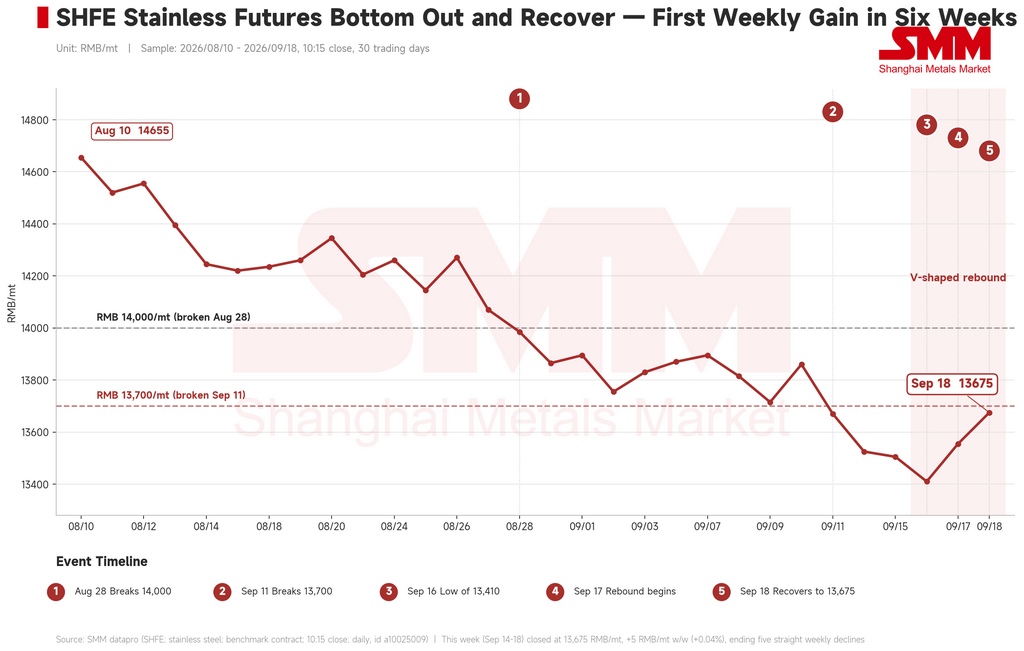
China's stainless steel futures broke their five-week losing streak this week, though the more consequential story sits on the cost side. The benchmark SHFE contract traced a V: down to RMB 13,410/mt (about $1,995/mt) on Wednesday — the low of the current adjustment — then recovering across Thursday and Friday to close at RMB 13,675/mt (about $2,035/mt), up RMB 5/mt (roughly $0.7/mt), or 0.04%, from the prior Friday. The gain is negligible in isolation. What matters is that it stopped, and that it stopped while nickel inputs were falling at their fastest pace of the cycle.
Hot US inflation pushed hike pricing to 90%, and the White House pushed back
The week's dominant macro variable was a sharp upside surprise in US inflation. August unadjusted CPI rose 0.4% month-on-month, the highest since June and well above the prior 0.1%; seasonally adjusted core CPI rose 0.3%, the strongest since May and above both consensus and the prior 0.2%. Market pricing for a Fed hike at this week's meeting jumped to roughly 90%, and investment banks that had held out for no hike this year capitulated.
The political response ran the other way. President Trump said publicly that the US should have the world's lowest interest rates, and White House economic adviser Kevin Hassett said there is no reason to hike — leaving a visible gap between the administration's position and what markets were pricing. Rising rate expectations compress valuations across dollar-denominated base metals, and this was the core external driver of the contract's continued slide through Wednesday.
Middle East risk shifted from the Strait to Saudi infrastructure
The geopolitical focus moved onshore. Saudi Arabia said its East-West pipeline had been struck repeatedly and took preventive shutdown measures; sources estimated the disruption could remove roughly 4% of global oil supply, and AP reported the damaged pipeline would remain largely offline for weeks of repairs. Houthi forces formally claimed "large-scale, high-quality military operations" against Saudi Arabia and an attack on Khamis Mushait air base, while stating that Bab el-Mandeb transit remains largely normal.
Diplomacy made little headway. A Gulf regional meeting scheduled for September 14 was postponed after Saudi Arabia requested amendments, the US Energy Secretary said not to expect a quick breakthrough on the Strait of Hormuz, and Iranian officials reiterated they will not negotiate until their conditions are met. Offsetting signals did emerge: Saudi Arabia is seeking to increase oil flows through the Strait, the US will begin refilling its Strategic Petroleum Reserve in coming months, and Trump said Russia and Ukraine have agreed not to strike each other's energy targets. ECB Governing Council member Kocher warned that high oil prices could force further ECB tightening — a live cost issue for European stainless producers.
Chinese liquidity stayed accommodative; a consumption policy targets a stainless end-use
The People's Bank of China conducted a RMB 500 billion (about $74.4 billion) six-month outright reverse repo on September 15. August M2 stood at RMB 356.81 trillion, up 7.5% year-on-year, while aggregate social financing over the first eight months reached RMB 23.91 trillion — RMB 2.64 trillion less than a year earlier, indicating credit expansion remains measured.
On policy, MOFCOM and seven other ministries issued an action plan to promote smart home consumption. Smart home appliances are a meaningful downstream outlet for stainless steel, so this supports medium-term demand, though transmission takes time and none of it showed up in spot transactions this week. The Ministry of Industry and Information Technology separately convened provincial meetings on industrial performance, elevating the priority of stabilising industrial output.
Inventory posted its most substantive drawdown of the cycle
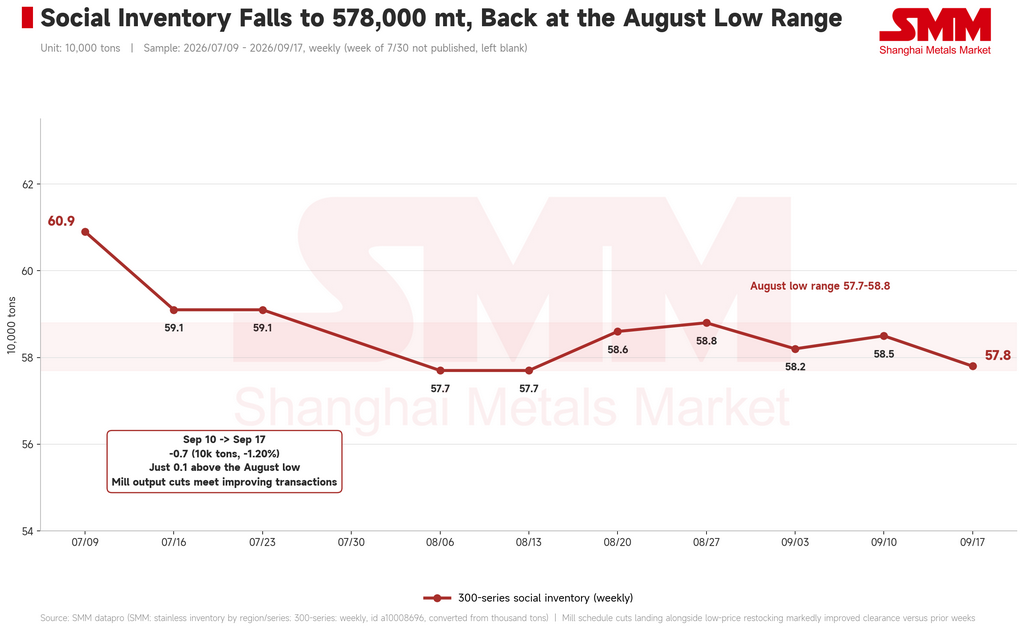
SMM's weekly data put 300-series social inventory at 578,000 mt on September 17, down 7,000 mt from 585,000 mt a week earlier — a 1.20% decline that leaves it just 1,000 mt above the August low of 577,000 mt, back inside the August range.
The composition is better than the early-September drawdown, which came from warrant outflow rather than consumption. This one rests on two firmer legs: the production cuts mills announced earlier are now landing, easing incremental supply, and prices at these absolute levels have drawn enough downstream interest to improve clearance versus the thin trading of prior weeks.
The caveat matters. The concentrated "Golden September" restocking has still not appeared. This drawdown reflects supply contraction meeting low-price buying, not a trend recovery in end-user demand, and its durability needs another few weeks of data to confirm.
The cost side reversed — and mills got their margins back
NPI fell hard and fast. It opened the week at RMB 1,082/nickel point (about $161), broke below RMB 1,060 by Wednesday, and closed Friday at RMB 1,051/nickel point (about $156) — down RMB 34, or 3.13%, week-on-week. From the August 10 high of RMB 1,138.5/nickel point, NPI has now shed RMB 87.5, or 7.7%, with this single week contributing more than a third of that decline. High-carbon ferrochrome's weekly average, last published for the week ended September 11, was RMB 7,850 per 50mt basis ton (about $1,168), down RMB 50 from RMB 7,900 (about $1,176).
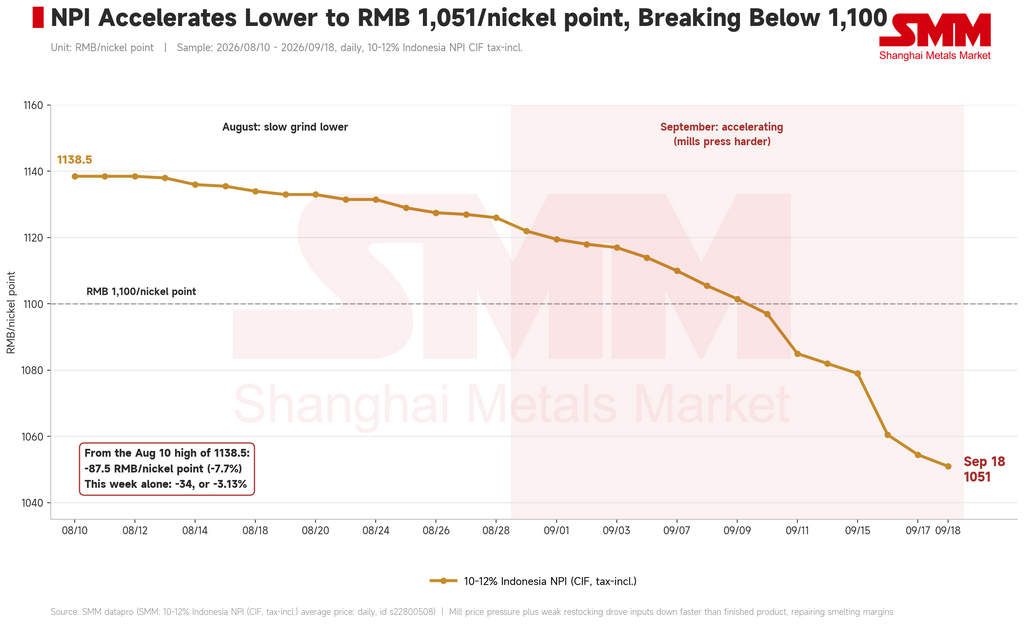
The relative move is the point. Finished product rose 0.04% while inputs fell 3.13% — a 3.17 percentage point gap, the widest of this adjustment and the third consecutive week in which raw materials fell faster than the finished product. Indexed to August 28, when the industry formally entered cost inversion, finished product now sits at 97.8 and inputs at 93.3, a 4.4 point spread. Margin room is reopening.
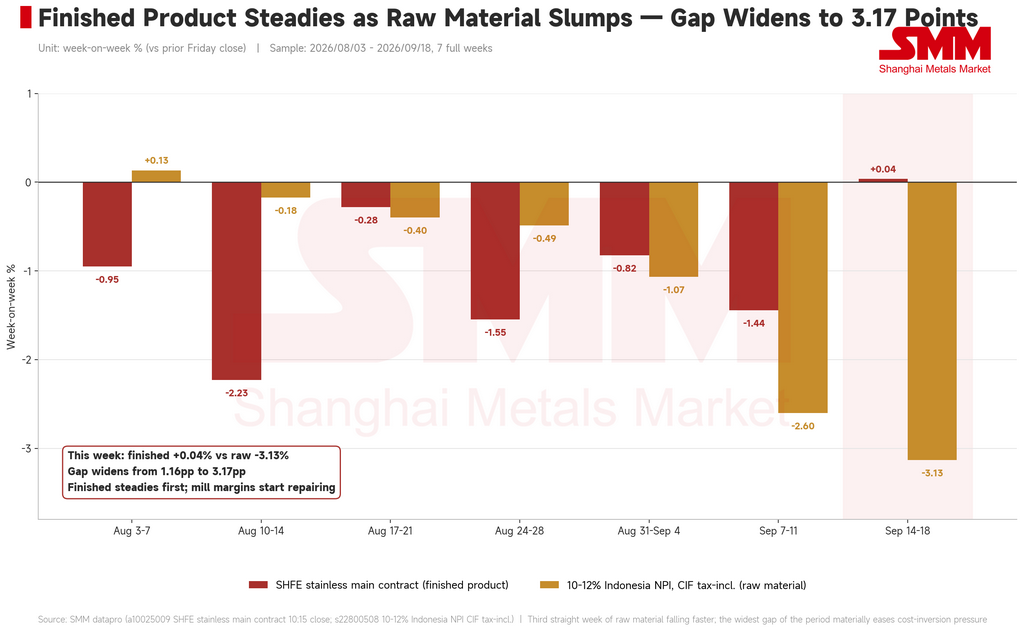
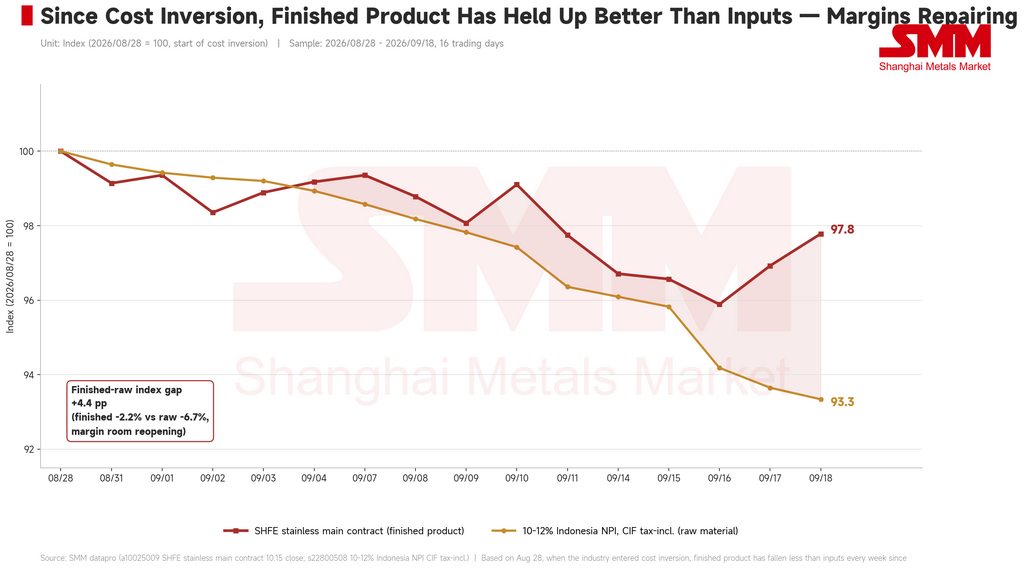
That resolves, at least for now, the risk flagged in the past two reviews: that the cost floor was sliding down in step with prices and so offering weaker support than in previous cycles. Finished product steadied first this week, which broke that dynamic. But the absolute cost level does keep falling, and if the finished product resumes its decline, the next inversion will simply form at a lower price level.
Outlook
Three marginal changes define this week against the five that preceded it: the contract found support near RMB 13,400/mt and rebounded for two sessions, posting its first weekly gain in six; social inventory returned to the August low range on supply cuts rather than warrant outflow, making it a higher-quality drawdown than early September; and raw materials fell faster than finished product for a third straight week by the widest margin yet, materially easing cost inversion.
Support is accumulating, but the conditions for a reversal are not yet in place. Concentrated peak-season restocking never materialised, evidence of a trend recovery in end-user demand is still absent, and this repair owes more to an oversold bounce and cost repricing than to demand. If low-price restocking proves to be a one-off release, the upward momentum could fade quickly.
Worth tracking from here: the Fed's September policy guidance and its transmission into base metals valuations; how firmly and durably mills execute their production cuts; whether low-price-driven destocking carries into October; whether the NPI decline stabilises — a sustained fall helps margins near term but drags the whole price structure lower over the medium term; and the pace of Saudi pipeline repairs and their feed-through into energy costs.
![[SMM Analysis] Europe Protects the Stainless Rolling Mill, Not the Furnace](https://imgqn.smm.cn/usercenter/UpZsx20251217171731.jpeg)