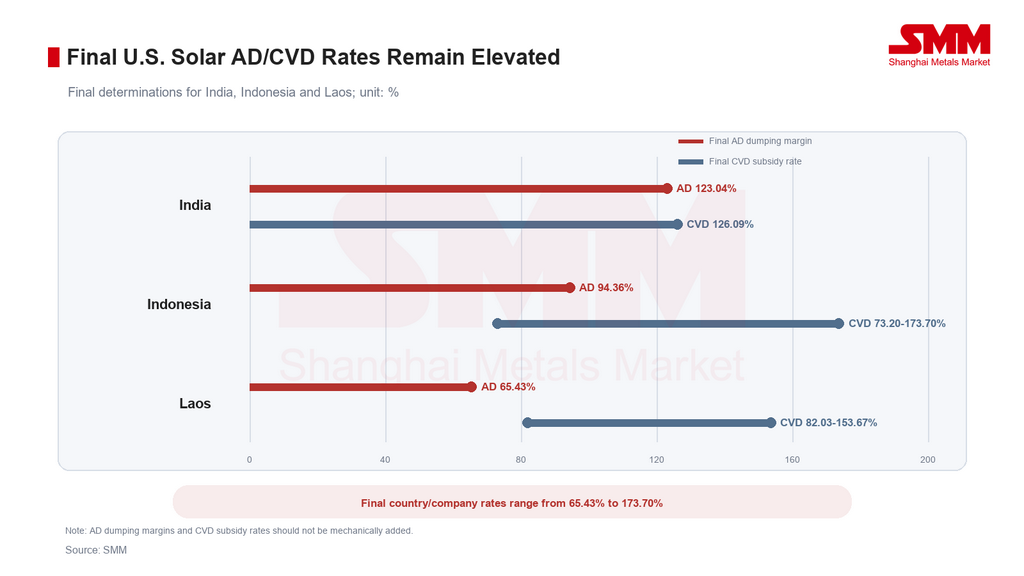
On September 11, the U.S. Department of Commerce announced its final affirmative anti-dumping and countervailing duty determinations covering crystalline-silicon photovoltaic cells, whether or not assembled into modules, from India, Indonesia and Laos. The final dumping margins were set at 123.04% for India, 94.36% for Indonesia and 65.43% for Laos. Final subsidy rates reached 126.09% for India, ranged from 73.20% to 173.70% for Indonesia, and ranged from 82.03% to 153.67% for Laos.
The determinations extend the reach of U.S. solar trade remedies. After AD/CVD orders were imposed on Cambodia, Malaysia, Thailand and Vietnam in 2025, the United States has now brought three newer production hubs into a similar framework. The supply-chain migration path from China to the original four Southeast Asian countries, and subsequently to India, Indonesia and Laos, is being progressively narrowed.
The Commerce determinations are not the same as formal duty orders. The U.S. International Trade Commission is scheduled to make its final injury determination on October 14. Affirmative findings would allow Commerce to issue AD/CVD orders; negative findings would terminate the investigations, with cash deposits handled under the applicable procedures. September 11 fixed the final margins and subsidy rates, but October 14 remains the decisive market-access date.
Final rates are high, but AD and CVD figures should not be mechanically added
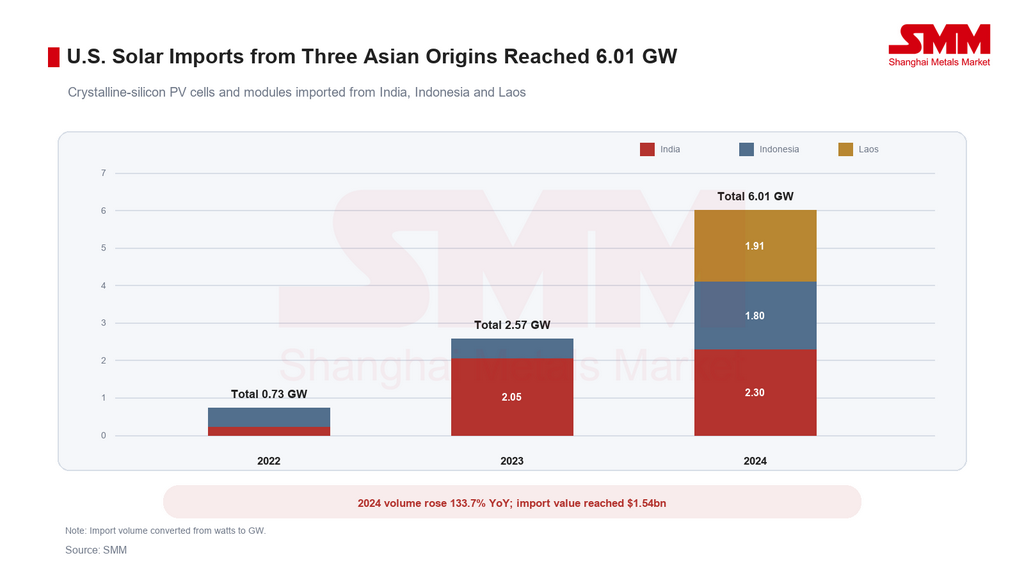
India's final results changed only marginally. Its dumping margin remained at 123.04%, while the subsidy rate edged up from 125.87% at the preliminary stage to 126.09%. After the subsidy offset, the adjusted AD cash-deposit rate was 107.17%, below the final dumping margin.
Indonesia saw the largest change in its all-others dumping rate, which rose from 35.17% at the preliminary stage to 94.36%, an increase of 59.19 percentage points. The CVD results diverged by producer: Blue Sky Solar's subsidy rate increased from 143.30% to 173.70%, while PT REC Solar Indonesia and the all-others category received final rates of 73.20%, below their respective preliminary levels.
Laos' dumping margin increased from 33.57% to 65.43%, a rise of 31.86 percentage points. Its adjusted AD cash-deposit rate was 65.03%. Solarspace and the all-others category received final subsidy rates of 82.03%, up from 80.67%, while Vietnam Sunergy's rate increased from 80.67% to 153.67%.
Dumping margins, adjusted AD cash-deposit rates and CVD subsidy rates are distinct measures. The amount collected at entry and the eventual duty liability depend on the producer-exporter combination, subsidy offsets, customs instructions and subsequent administrative reviews. The two headline rates should therefore not be added and presented as a uniform effective tariff. Even without such addition, the final rates are high enough to materially weaken the competitiveness of the covered origins in the U.S. market.
Rapid import growth explains why the investigation widened
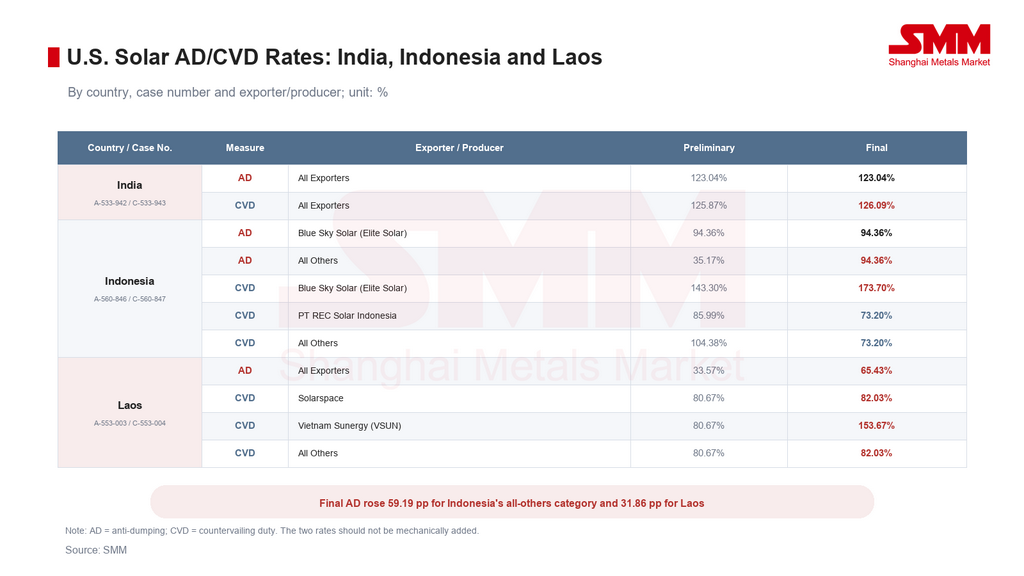
U.S. imports of crystalline-silicon PV cells and modules from India, Indonesia and Laos increased from a combined 0.73 GW in 2022 to 2.57 GW in 2023 and 6.01 GW in 2024. The 2024 volume was 133.7% higher year on year and 721.5% above 2022. The corresponding import value rose from $261 million in 2022 to $1.54 billion in 2024.
India supplied approximately 2.30 GW worth $793 million in 2024, with volume up 12.1% year on year. Indonesia supplied about 1.80 GW worth $415 million, with volume rising 245.7%. Shipments from Laos reached approximately 1.91 GW and $336 million after remaining close to zero in 2023. The sharp increases from Indonesia and Laos show how U.S. sourcing had begun moving toward new Asian production nodes after the original Southeast Asian supply routes came under investigation.
For scale, the import statistics used in the earlier four-country case showed approximately 36.38 GW of U.S. imports from Cambodia, Malaysia, Thailand and Vietnam in 2023. The 6.01 GW supplied by the three newer origins in 2024 was equivalent to only about 16.5% of that earlier volume. Although the comparison covers different years, it shows that India, Indonesia and Laos served as supplementary and emerging supply routes rather than a full replacement for the original four countries.
The direction of travel matters more than the absolute volume. After the United States launched the four-country investigations in April 2024, investment, trade flows and orders began shifting toward other manufacturing locations. New cases against India, Indonesia and Laos followed in July 2025. The final determinations demonstrate that U.S. enforcement is following changes in trade flows: once shipments from a new origin expand rapidly, that origin may soon face additional scrutiny.
U.S. controls are expanding from four origins to seven
U.S. solar trade controls have evolved from individual country actions into a layered framework. Chinese cells and modules have long been subject to AD/CVD measures. Cambodia, Malaysia, Thailand and Vietnam entered a new set of orders in June 2025. India, Indonesia and Laos reached the Commerce final-determination stage in September 2026 and are awaiting the ITC's October 14 decision.
Separately, Section 232 measures covering polysilicon and its derivatives are scheduled to take effect on December 4, 2026. The measures set minimum import prices of $0.22/W for solar cells and $0.38/W for modules, together with a 15% additional ad valorem tariff on covered derivative products. Section 232 and country-specific AD/CVD cases are different policy instruments, but together they can raise import costs and reshape market access.
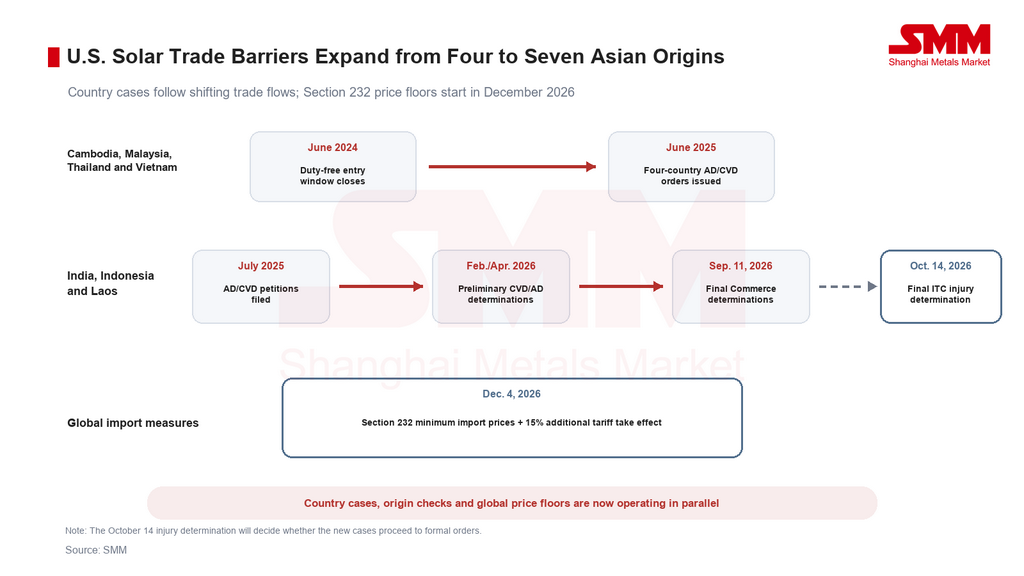
The U.S. framework is consequently shifting from country-specific duties toward the simultaneous use of AD/CVD cases, origin verification and global price floors. The compliance value of a plant will no longer depend only on its physical location. Cell origin, actual manufacturing steps, supply-chain traceability, company-specific rates and eligibility under new U.S. price and investment arrangements will also matter.
The scope of the latest cases places particular weight on where the cells are produced. Modules assembled in a third country using cells produced in India, Indonesia or Laos may remain within scope. Conversely, modules assembled in one of the three countries using cells produced elsewhere are generally outside the scope of these investigations. This distinction makes substantive manufacturing and documented cell origin more important than the final country of shipment.
The Philippines remains outside the two seven-country case groups, but it should not be treated as an automatic tariff safe harbour. According to SMM's market survey, the Philippines currently plays a larger role in regional trading, warehousing, transshipment and project delivery than in integrated cell and module manufacturing.
Simple transshipment, document switching or limited processing does not change cell origin. Modules assembled in the Philippines with cells from a covered origin may still fall within the relevant scope. A sudden increase in Philippine shipments to the United States could also trigger closer examination of trade flows, manufacturing processes and origin documentation, and may increase the risk of another investigation.
The Philippines is therefore better viewed as a regional logistics and delivery hub than as a substitute U.S. export route. Any manufacturer considering additional production there would first need to verify cell sourcing, substantial-transformation requirements, supporting supply-chain evidence and the applicable U.S. rate.
Without the U.S. premium, Asian manufacturing bases face direct competition with China
The original commercial logic for some manufacturing investments outside China was to accept higher production costs in exchange for U.S. market access and higher selling prices. That logic is weakening as seven Asian origins come under AD/CVD scrutiny and the Section 232 minimum import prices approach implementation.
Outside the United States, China-based modules can still reach Europe, Latin America, the Middle East, Africa and most of Asia. Chinese producers retain advantages in supply-chain depth, scale, product development and delivery capability. SMM data showed standard TOPCon modules at $0.104-0.110/W FOB China port on September 10. The Section 232 module minimum import price of $0.38/W is approximately 3.5 times the midpoint of that FOB range. The trade terms are not directly comparable, but the gap illustrates the increasingly distinct pricing structures of the U.S. and non-U.S. markets.
When manufacturing bases outside China can no longer secure the U.S. premium, their competitive benchmark shifts from U.S. project pricing back to China FOB prices. These plants often face higher inbound material costs, thinner local supplier networks, higher unit manufacturing expenses and more volatile utilisation rates. Without local-content protection, tariff advantages or materially shorter delivery times, profitability will come under pressure.
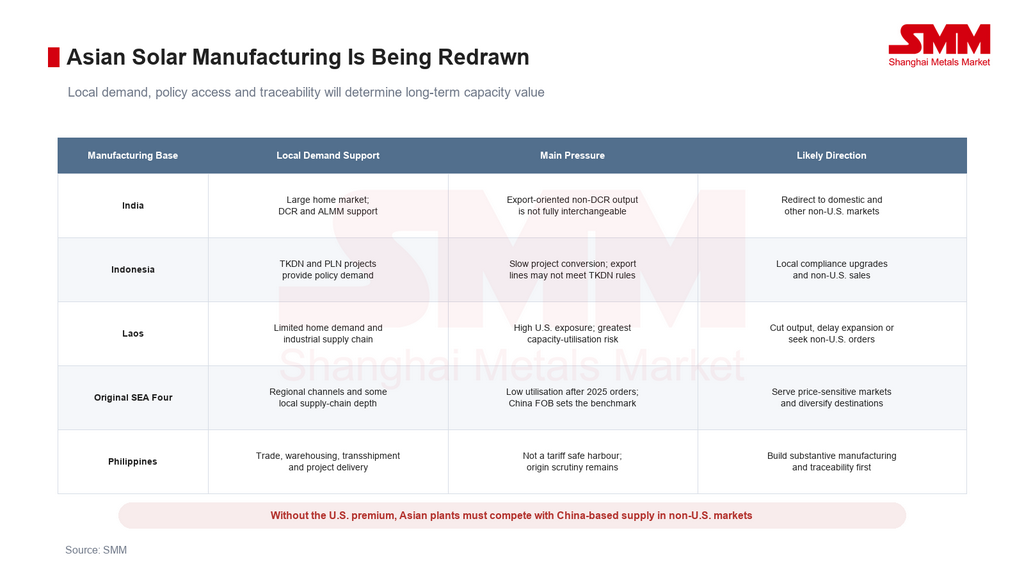
The impact will vary by country. India has a large home market, while the Approved List of Models and Manufacturers and Domestic Content Requirement policies provide some support for local production. However, non-DCR products originally made for the United States cannot automatically be redirected into DCR projects. Certification, input sourcing and end-use requirements differ. If U.S. sales become uneconomic, non-DCR lines may turn toward the Middle East, Europe and other Asian markets, where they will compete directly with China-based supply.
Indonesia has potential demand from TKDN-compliant projects and procurement by state-owned utility PLN, while its longer-term 100 GW solar ambition could support local manufacturing. Actual absorption will nevertheless depend on project awards, financing, storage deployment and grid investment. Export-oriented lines built for the United States may not automatically comply with TKDN rules and could face short-term order gaps and lower utilisation.
Laos has a smaller home market and a less developed industrial supply chain, leaving its newer factories more dependent on export orders. Shipments to the United States increased from nearly zero to 1.91 GW in 2024, showing that the U.S. market was a major destination for its capacity expansion. If orders are imposed, Laos has the least room to redirect output domestically and faces a higher risk of production cuts, delayed expansion or aggressive pricing in non-U.S. markets.
Cambodia, Malaysia, Thailand and Vietnam are undergoing a similar reassessment. After the 2025 orders reduced access to their original U.S. customer base, SMM's market survey indicates that operating rates at some cell and module plants in the four countries fell to low levels. Producers have increasingly adopted make-to-order production, reduced shifts, scheduled maintenance or delayed restarts to control inventories and cash flow. Malaysia retains lower rates for some companies, while Vietnam and Thailand have deeper industrial supply chains and some regional demand. Facilities in Cambodia and other markets with limited domestic absorption face greater utilisation risk.
Sales from the original four Southeast Asian origins are no longer focused exclusively on the United States. Some output has been redirected toward price-sensitive markets in Latin America, the Middle East, South Asia and Africa. In parts of South Asia and on selected Middle Eastern and African routes, Southeast Asian plants may gain relative advantages from transit times, delivery cycles, established customer channels or specific trading arrangements. Any advantage in Latin America depends more heavily on the destination port, route and freight market and is not universal.
Most of these non-U.S. markets can also purchase directly from China. The deciding question has therefore shifted from whether a plant can enter the United States to whether its landed cost can compete with China-based modules. When China FOB prices remain low, any logistics advantage may be insufficient to offset higher manufacturing costs and the unit-cost burden created by weak utilisation.
Looking to 2027, if efficiency and other requirements under China's new PV module standard raise export prices, the addressable markets for China-based and offshore production may become more segmented. Supported by an integrated supply chain, stronger R&D and multiple technology platforms, Chinese producers can focus more heavily on projects with demanding efficiency, power, reliability, bankability and certification requirements. These include premium distributed-generation applications in Europe, utility-scale projects in the Middle East, and certification-intensive segments in Japan, South Korea and Australia. High-power TOPCon, back-contact, heterojunction and application-specific products could support greater technology and brand premiums.
Some plants in the original four Southeast Asian countries may find it harder to match Chinese suppliers across technology upgrades, product breadth and supply-chain depth. If China export prices rise and the cost gap narrows, those facilities may increasingly target price-sensitive demand in Latin America, Africa, South Asia and selected Middle Eastern markets. They could compete through route-specific freight advantages, shorter delivery cycles, regional warehousing, established customer relationships and small-batch responsiveness. They may also become part of supply-chain diversification strategies in selected markets.
This division is not guaranteed. It will depend on the actual increase in China FOB prices, freight costs, offshore plant utilisation and local supply-chain support. If China-based modules retain a clear cost advantage and the logistics benefits of offshore plants remain too small to support broader restarts, many facilities may continue operating at low loads and only against confirmed orders.
The U.S. market has a near-term buffer, but procurement costs may rise
Existing inventories, contracts and U.S. module manufacturing capacity should provide some near-term supply protection. The Commerce determinations alone will not cause an immediate shortage. Some suppliers may also seek to maintain deliveries by changing cell sourcing, extending the life of existing product configurations or working with producers subject to lower rates.
If the ITC issues affirmative injury determinations on October 14 and formal orders follow, however, the high rates would sharply reduce the commercial viability of continued shipments from the three origins. The December 4 implementation of Section 232 minimum import prices and the additional 15% tariff would add another layer of cost pressure.
U.S. cell manufacturing capacity will require time to build and ramp. A temporary mismatch may emerge between a shrinking pool of import sources and domestic supply that has not yet reached full scale. That could lift module quotations, lengthen procurement lead times and prompt some developers to recalculate project returns or delay construction.
Outlook: capacity strategies must shift from tariff-driven access to market-policy fit
SMM's assessment is that the central impact of these final determinations is not simply the volume of U.S. orders that India, Indonesia and Laos may lose. The investment logic for solar manufacturing outside China is being redefined.
Future manufacturing projects will need to answer five questions:
- Does the target market provide enough local installation demand?
- Can the facility qualify for DCR, TKDN or other local-content procurement?
- Do cell and critical-input sourcing meet origin and traceability requirements?
- Can manufacturing costs compete with China-based export supply after the U.S. premium disappears?
- Can the plant switch products, customers and destination markets if trade policy changes?
The effective policy life of a strategy based on replicating Chinese production in another low-cost country and exporting primarily to the United States is becoming shorter. Manufacturing bases with lasting value are more likely to combine local end-market demand, access to local-content projects, substantive production processes, clear origin evidence and the ability to sell across multiple regions.
Key developments to watch include the October 14 ITC injury determination, any resulting duty orders and cash-deposit instructions, detailed implementation of the December 4 Section 232 measures, changes in U.S. imports from the Philippines and other Asian markets, the ramp-up of U.S. cell capacity, and the ability of Indian and Indonesian domestic projects to absorb export-oriented production.
Note: The AD figures in this article are final dumping margins, while the CVD figures are final subsidy rates. They should not be added together and treated as the effective import duty. Applicable rates and cash deposits depend on the producer-exporter combination, formal orders and customs instructions.
Written by:
Ryan Tey Tze Yang | SMM PV Analyst
+60 127179370 | ryan.tey@metal.com
![[Solar: Massachusetts Imposes Clean Power Rules on Large Data Centers]](https://imgqn.smm.cn/usercenter/QFClV20251217171738.jpg)
![[Energy Storage: Tesla Signs ~3 GWh Storage Deal in Italy]](https://imgqn.smm.cn/usercenter/CaHKo20251217171738.jpg)
![[Solar: U.S. DOE Doubles Down on Space Solar Cell Manufacturing R&D]](https://imgqn.smm.cn/usercenter/FmBvY20251217171737.jpg)