Why the Market Is Watching Bayan
Ownership uncertainty around PT Bayan Resources Tbk (BYAN) has moved beyond a simple corporate rumor because of Bayan’s scale and relevance in Indonesia’s coal market. Market reports have linked Indonesian businessman Andi Syamsuddin Arsyad, widely known as Haji Isam, to a possible change of control at the company.
For the coal market, the key issue is not whether the rumored transaction is positive or negative for BYAN’s share price. The more relevant question is whether a new controlling shareholder could eventually influence Bayan’s RKAB positioning, production strategy, sales allocation, logistics coordination, and role in the ongoing consolidation of Indonesia’s coal sector.
At this stage, there is no immediate supply-disruption signal. Existing offtake agreements, mining licenses, and operating plans remain with the operating entities. However, if a transaction is confirmed and later followed by regulatory approval, RKAB revisions, or changes to Bayan’s production and marketing strategy, the implications for Indonesia’s coal supply outlook would become more material.
Bayan’s Position in Indonesia’s Coal Market
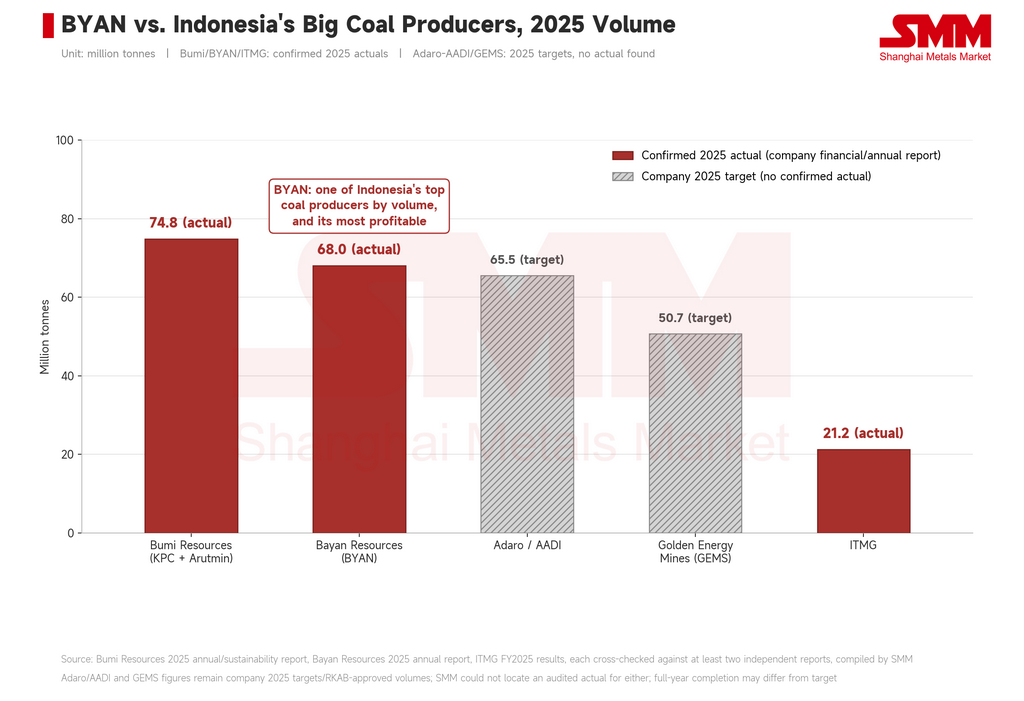
Bayan Resources produced 68.0 million tonnes of coal in 2025, according to the company’s annual report. This places Bayan among Indonesia’s largest coal producers by volume, although still below Bumi Resources’ confirmed 2025 output of 74.8 million tonnes.
Bayan’s importance comes not only from its size, but also from its relatively concentrated coal exposure. While several major Indonesian resource groups have diversified into metals, power, infrastructure, gold, aluminium, or other commodities, Bayan remains one of the clearer pure-play coal platforms among the country’s large producers. Its Tabang project has also been central to the company’s growth, making Bayan relevant to Indonesia’s medium-term coal supply balance.
That is why a potential ownership change matters. A shareholder change would not automatically alter coal supply, but the identity of the controlling shareholder could influence future production discipline, capital allocation, marketing policy, and RKAB strategy.
Ownership Structure and Reported Transaction Scope
The current uncertainty traces back to mid-August, when a photograph circulated showing Haji Isam visiting Bayan’s mining operations in Kutai Kartanegara, East Kalimantan, together with Bayan founder Low Tuck Kwong and Norman Joesoef, owner of Republik Korpora Indonesia.
The Indonesia Stock Exchange sought formal clarification on 18 August. Bayan and PT Jhonlin Agro Raya Tbk (JARR), a Jhonlin-linked listed company, later filed clarifications stating that they were unaware of, or had no plan for, such a transaction. Those denials remain the official public position.
Subsequent media reports described possible negotiations and a reported cash offer of around US$3 billion for a controlling stake of roughly 62%. Neither Bayan nor Jhonlin has confirmed a transaction.
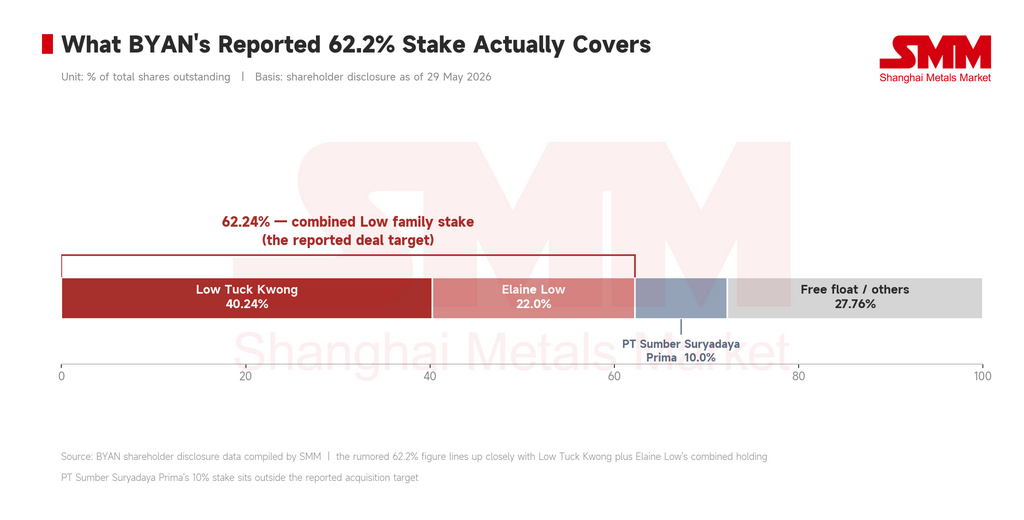
Based on the reported scope, the potential target appears to be the Low family’s controlling block. Low Tuck Kwong holds 40.24% of BYAN, while Elaine Low holds 22%, bringing the combined family stake to around 62.2%. This is the stake referred to in market reports about a possible controlling-share transaction. Separately, PT Sumber Suryadaya Prima holds around 10% and does not appear to be part of the reported target. In other words, the rumored transaction would concern control over the Low family’s majority block, not a full acquisition of Bayan or all major shareholders.
What It Could Mean for Supply and Market Structure
A possible combination involving Haji Isam would be notable because Jhonlin Group is already active in coal through Jhonlin Baratama. Market reports have linked Jhonlin Baratama with a production quota request of around 60 million tonnes for this year.
This figure should be treated carefully. Bayan’s 68.0 million tonnes is confirmed realized production for 2025, while Jhonlin’s reported 60 million tonnes is a quota-related figure. A requested RKAB quota is not the same as approved production, actual output, or exportable supply.
Even so, the two figures explain why the market is paying attention. If Jhonlin’s production ambitions are approved and realized, and if Bayan were eventually brought under the same controlling umbrella, the resulting platform could become one of the most influential coal groups in Indonesia by production base and bargaining position.
However, ownership consolidation does not automatically mean higher supply. Indonesia’s coal output is shaped by RKAB approvals, Domestic Market Obligation requirements, export policy, mine sequencing, logistics capacity, and price considerations. In this environment, a larger ownership platform could lead either to higher production ambitions or to more coordinated production discipline.
For the physical coal market, the more meaningful signal would be any change in Bayan’s approved RKAB volume, Tabang expansion path, sales allocation, logistics strategy, or export marketing behavior. These factors would matter more than movement in BYAN or JARR share prices.
Regulatory Checkpoint
A potential transaction would also face a regulatory dimension. Bayan’s operating subsidiaries hold mining licenses, including IUPK-linked assets. Under Indonesia’s mining regulatory framework, changes in shareholding composition at the license-holder level generally require approval from the Ministry of Energy and Mineral Resources.
This means any transaction affecting control over licensed operating entities would not be purely a private matter between buyer and seller. Regulatory review would be an important checkpoint before the ownership change becomes fully effective from a mining-sector perspective.
Until there is a confirmed transaction, a clear regulatory filing, or an update tied to Bayan’s RKAB and operating plans, the issue remains an ownership watch item rather than a confirmed supply-side event.
Implications for Buyers and the Broader Coal Market
For Bayan’s customers, the near-term question is supply continuity. Based on current information, there is no evidence that a shareholder-level ownership change would immediately disrupt existing shipments, mine operations, or contracted supply. Coal offtake agreements, operational planning, and license obligations remain with the operating entities.
The medium-term question is whether new control would eventually lead to changes in Bayan’s production targets, sales channels, domestic allocation, export strategy, or investment pace at Tabang. Given Bayan’s scale, even modest strategic adjustments could matter for Indonesia’s export availability and domestic supply balance.
The case also fits a broader consolidation theme in Indonesia’s coal sector. Producers are operating under tighter RKAB scrutiny, DMO obligations, weaker long-term coal financing, and uneven energy-transition pressure. Some groups are diversifying away from coal, while others may choose to consolidate coal assets while cash flow remains strong. A completed Bayan transaction would therefore matter less as an immediate supply event and more as a possible step toward a more concentrated producer structure.
SMM View
At this stage, Bayan’s near-term production and existing supply commitments are not at risk from the ownership rumor itself. A change of shareholder control would not automatically change mine output, contracts, license obligations, or approved production plans.
The more important question is whether a confirmed transaction later influences Bayan’s RKAB strategy, Tabang expansion path, sales allocation, export marketing, or capital allocation. These are the channels through which ownership change could become relevant to Indonesia’s coal supply balance.
SMM will watch for more meaningful signals, including a formal MEMR or Minerba filing, regulatory approval related to ownership change, revised Bayan RKAB volume, updated production guidance, changes in Tabang development plans, or evidence of altered sales allocation between domestic commitments, term contracts, and export spot supply.
Until those signals appear, this remains a market-structure watch item rather than a confirmed supply disruption.