According to SMM's cold-rolling spot cost and profit data, since 2021, the cost center of the cold-rolling industry has continued to shift downward, and the room for profit fluctuations has kept shrinking, with the industry entering a long cycle of thin-margin operations. From 2023 to 2025, the industry still had periodic profit windows, with profits seeing phased recovery along with seasonal and raw material fluctuations. However, in 2026, the contradictions in the cold-rolling sector are concentrated in the cost side consolidating at lows and drifting higher, while the demand side constrains profit realization.
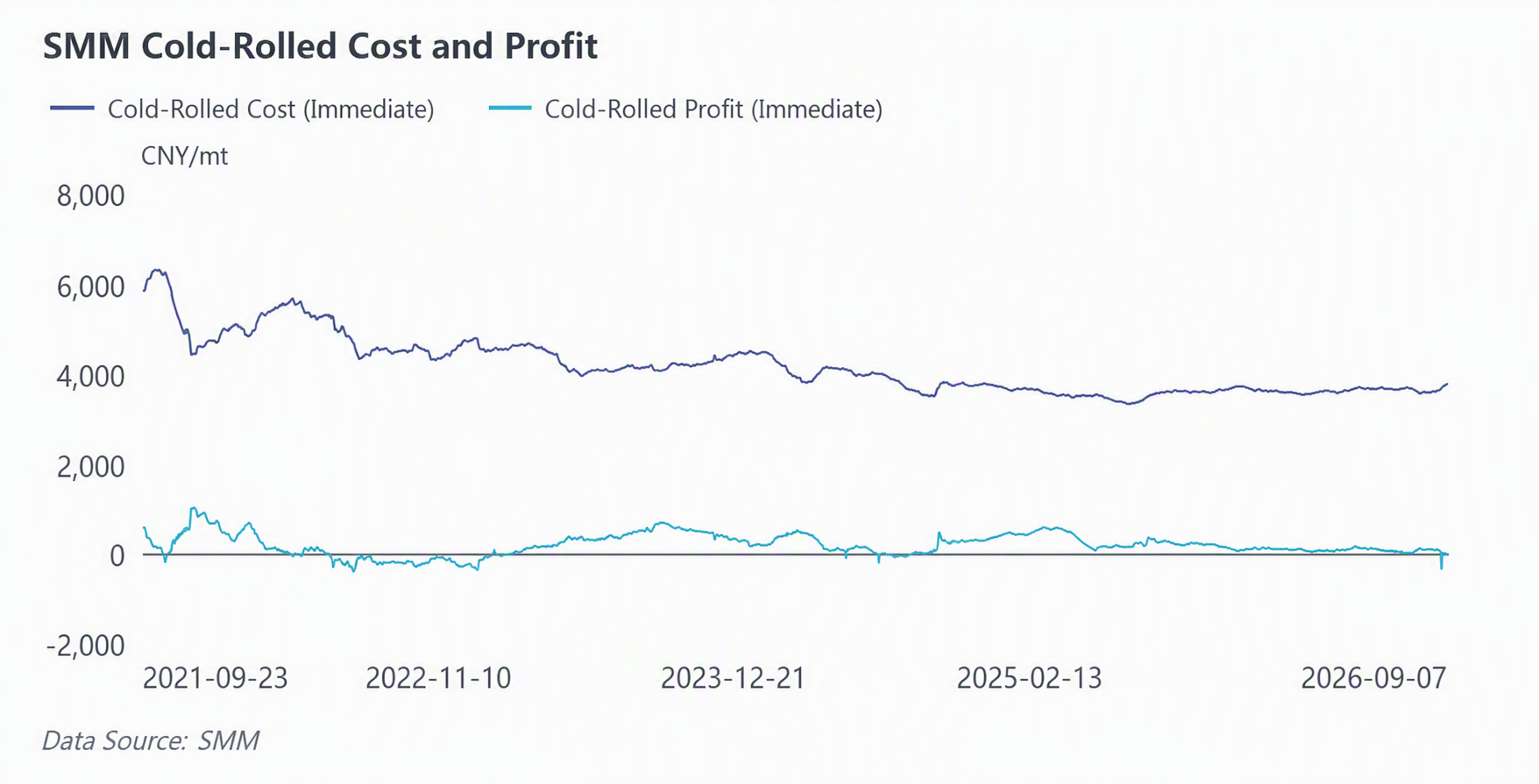
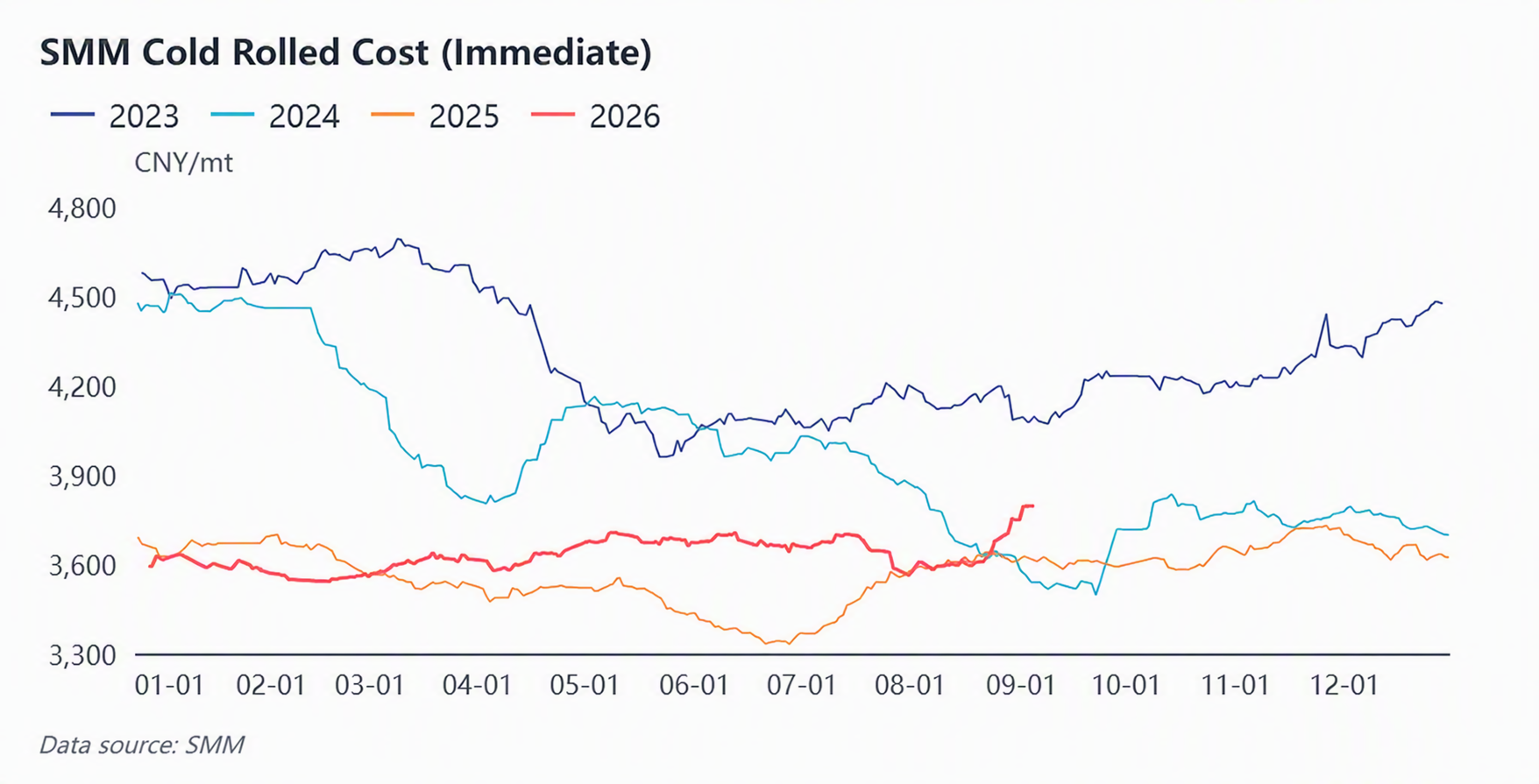
In 2026, the overall operating range of cold-rolling spot costs is roughly 3,600-3,850 yuan/mt. Compared with the high costs of 4,000-4,700 yuan/mt often seen in 2023, the cost pressure from raw materials this year has clearly eased. The cost trend during the year showed a pattern of fluctuating upward movement, with a relatively low base at the start of the year. In the middle of the year, costs edged up following the war and domestic supply pushing up upstream raw material prices, but overall they remained at a relatively low percentile over the past four years, without any sharp surge.From the cost side, steel mills' cold-rolling profits this year should be in a fairly favorable range.
However, the dividend of lower costs has not been effectively converted into tangible processing profits for cold-rolling enterprises. Looking back at the 2026 profit curve, for most of the year, cold-rolling spot profits hovered narrowly around the breakeven line, with very limited profit thickness, making it difficult to see the substantial profits of several hundred yuan seen in previous years. In the middle of the year, profits quickly fell below the zero axis, resulting in phased losses. Even though there was some rebound later, it only returned to marginal profit levels, with the recovery notably weaker than the same periods in 2024 and 2025.
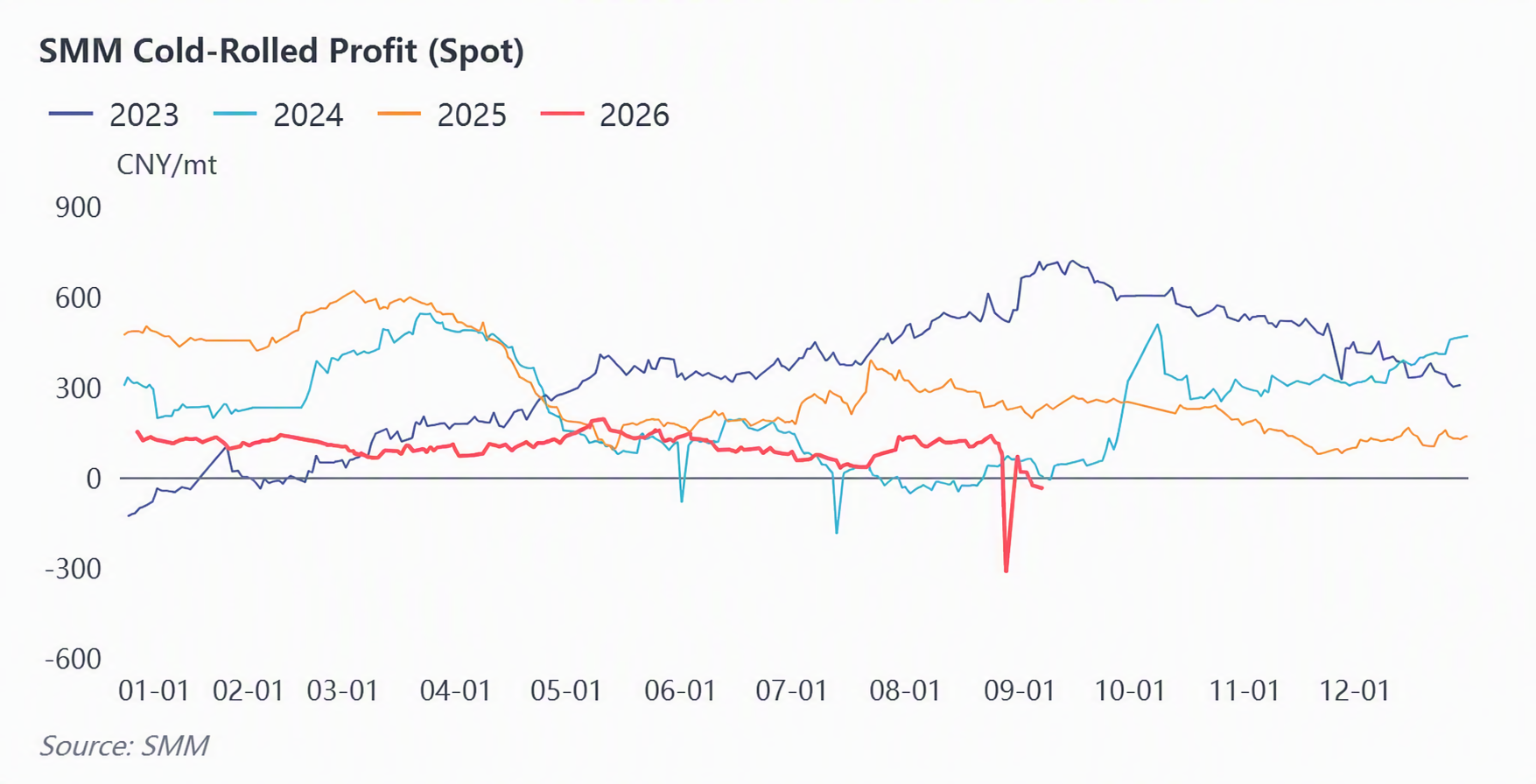
Comparing historical years, in 2023, driven by phased downstream recovery, cold rolling enjoyed a relatively long profit window; in 2024 and 2025, there were also clear profit recoveries accompanying the arrival of downstream peak seasons. In contrast, in 2026, even though raw material costs were not high, actual demand release from core downstream consumer industries such as automobiles and home appliances remained mild, finished product market transactions were weak, and cold-rolling prices lacked sufficient upward transmission capacity. Changes in raw material costs can improve the cost floor, but end-use demand determines finished product selling prices.The potential gains from low cost levels have been continuously eroded by sluggish demand and low finished product quotes.
From the current standpoint, it is difficult for the cold-rolling industry to achieve sustained profit improvement by relying solely on lower raw material costs. The industry has fully demonstrated this point in 2026: cost conditions were moderate, but under the weak demand pattern, steel mills could only maintain thin profits or even phased losses. For cold-rolling profits to see substantial improvement going forward, the key still lies in a substantive recovery in downstream end-use demand, driving cold-rolling product prices higher and opening up room for processing profit recovery.
Data source statement:
(Except for public information, all other data in this report are derived from public information (including but not limited to industry news, seminars, exhibitions, corporate financial reports, broker reports, National Bureau of Statistics (NBS) data, customs import and export data, and various data published by major associations and institutions), market communication, and SMM's internal database models, and are obtained through comprehensive analysis and reasonable inference by the research team. They are for reference only and do not constitute decision-making advice.
Shanghai Metals Market reserves the right of final interpretation of this statement and reserves the right to adjust and modify the content of the statement based on actual circumstances.
![[SMM Steel] Billet prices in Indonesia remain stable, but shipments are experiencing delays](https://imgqn.smm.cn/usercenter/VhIgs20251217171719.jpg)
![[SMM Analysis] 2026 Cold Rolling Profits: Low Costs but Weak Demand Limits Recovery](https://imgqn.smm.cn/usercenter/rBCZR20251217171716.jpg)
![[Corinth Pipeworks Lands $200-250 Million Rovuma LNG Line Pipe Deal]](https://imgqn.smm.cn/usercenter/LSkpO20251217171720.jpg)