I. H1 Review: Supply-demand shifted from loose to tight balance, with energy storage becoming a key marginal growth driver
In H1 2026, China's lithium carbonate market experienced notable wild swings, with the monthly average price center roughly ranging between 149,600 and 177,000 yuan/mt. The price increase was not driven solely by supply contraction, but rather resulted from the combined effect of supply disruptions and demand growth: maintenance at salt lakes and lithium chemical plants, along with mine-side disruptions, periodically affected supply, while downstream demand for EV and ESS batteries continued to expand, gradually shifting the market's supply-demand relationship from the previously relatively loose state to a tight balance.
From the demand source perspective, EV remained the fundamental base of lithium carbonate consumption, but energy storage was the more noteworthy marginal growth driver in H1. In H1 2026, global NEV sales reached approximately 10.25 million units, up 14% YoY, with domestic sales at approximately 7.4 million units, up 7% YoY. During the same period, China's power battery production reached approximately 790 Gwh, up 43% YoY, with LFP power battery cells' share further rising from 66% in H1 2025 to 76%. Meanwhile, global ESS battery cell cumulative shipments reached 486 Gwh in H1, with Q2 shipments at 263 Gwh, up 17.9% QoQ from Q1, and monthly shipments rising from 71 Gwh in January to 86 Gwh in June. The combination of EV demand growth and continued ESS volume expansion jointly kept LFP production schedules at high levels, ultimately transmitting upstream to lithium carbonate demand. Inventory also shifted from the trend-based destocking of 2025 to structural fluctuations under high price sensitivity, with significantly intensified bargaining between upstream and downstream players over inventory and procurement pace.
II. Current Market: Supply has recovered, but demand is also rising, and the short-term deficit remains unresolved
Entering Q3, the market logic has shifted. The earlier maintenance and supply disruptions are gradually easing, and the industry's real contradiction is no longer "whether there is supply,"but whether the pace of supply recovery can catch up with the pace of demand growth.
The supply-side recovery is relatively clear. SMM data shows that China's lithium carbonate production in August was approximately 116,400 mt, up 7% MoM. As maintenance at some spodumene, lepidolite, and salt lake operations gradually concludes, September production is expected to rise further to 128,500 mt, up 11% MoM. Imports are also providing a supplement, with China's lithium carbonate imports reaching 26,800 mt in July, up 30% MoM and 93% YoY. September net imports are expected to increase further to approximately 29,300 mt. As a result, China's total lithium carbonate supply in September is expected to rise from 142,900 mt in August to 157,900 mt.
At the same time, however, the demand side has not visibly weakened due to lithium prices remaining at elevated levels, and the transmission chain is relatively clear.
On the end-use side, the NEV market pulled back in July before showing a MoM recovery in August. September marks the traditional peak season, and with the concentrated delivery of new car models, EV demand is expected to continue improving. However, this round of auto demand leans more towardseasonal recovery rather than a return to a high-growth cycle.In contrast, ESS demand remains relatively resilient. SMM expects September ESS battery cell production to reach 94.47 Gwh, with power generation and grid side as well as commercial and industrial energy storage remaining the primary demand sources.
End-use demand is further transmitted to the battery and cathode segments. In August, China's battery cell production continued to rise, with LFP power battery cells contributing the main growth. On the cathode side, LFP production rose 7.8% MoM in August,and is expected to further increase to above 610,000 mt in September.This means the current strength of LFP is not driven solely by automobiles,but rather by the combined push of EV peak-season recovery and sustained high energy storage prosperity, with energy storage contributing a stronger marginal increment.
Ultimately reflected in the lithium carbonate balance sheet, China's total demand in August was approximately 169,400 mt, notably higher than the total supply of 142,900 mt, corresponding to a deficit of approximately 26,600 mt. In September, even as supply grows rapidly to 157,900 mt, demand is still expected to rise further to 177,400 mt, leaving a supply-demand gap of approximately 19,600 mt.
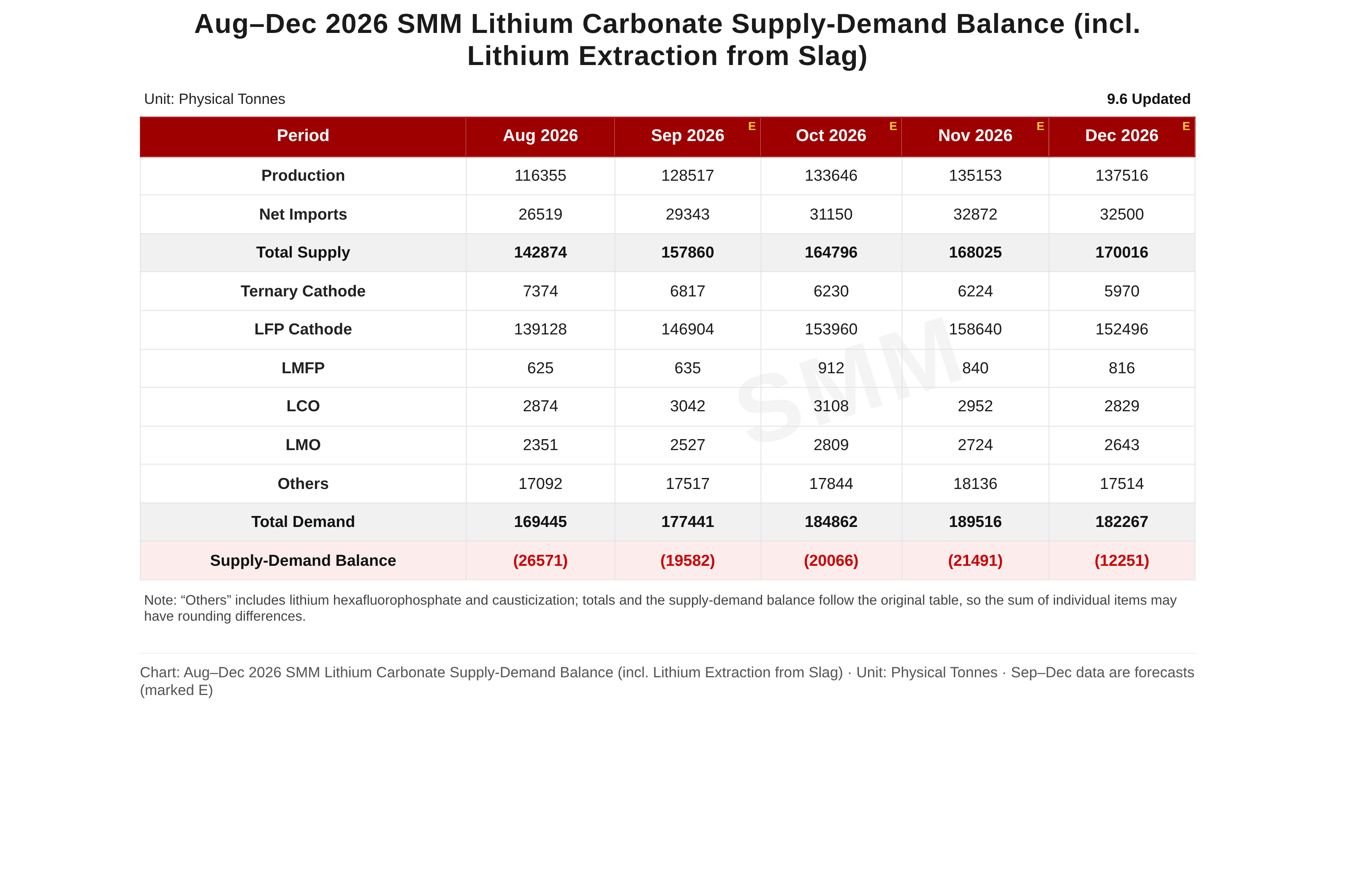
This also explains the current state of the spot market: in August, lithium carbonate prices generally consolidated with a slight downward shift in the center, with the monthly average price down approximately 2% MoM, but prices did not show a trend-based decline. Upstream players maintained a hold-back-from-selling sentiment due to maintenance at some production lines and limited spot circulation, while downstream players significantly increased their price sensitivity,with relatively high procurement enthusiasm below 150,000 yuan/mt.
III. H2 Outlook: From end-use to lithium chemicals, demand growth will still transmit mainly along the LFP chain
Looking ahead to H2, supply-demand should be assessed from end-use demand rather than solely from lithium chemical production.
On the EV sector side, China's NEV market is expected to show a pattern ofstabilization in Q3 and peak-season recovery in Q4. In the Chinese market, as the demand overdraw effect from 2025 gradually digests, domestic demand pressure is expected to narrow. Markets outside China remain supported by growth in emerging markets such as Southeast Asia, Latin America, and the Middle East, as well as dealer restocking, with exports expected to maintain relatively high prosperity. Power battery installations in H2 are expected to be notably higher than in H1, with passenger vehicles providing the base and commercial vehicles providing incremental elasticity.
The ESS sector remains a stronger source of growth. In H2, global ESS battery cell demand is expected to maintain relatively rapid growth, with power generation and grid side as well as commercial and industrial energy storage still constituting the main support. Meanwhile,large-capacity cells above 500Ah are gradually completing client validation and entering the phase of mass delivery. Therefore, the core driver of LFP demand in H2 remains "EV recovery + energy storage growth," rather than reliance on NEVs alone.
This demand will continue to transmit upstream along the "end-use—battery—cathode—lithium carbonate" chain. According to SMM's current forecasts, monthly lithium carbonate demand for LFP cathode will rise from 139,100 mt in August to 146,900 mt in September and 154,000 mt in October, reaching approximately 158,600 mt in November.This item already accounts for more than 80% of total lithium carbonate demandand is the core variable determining the lithium carbonate supply-demand balance in H2.
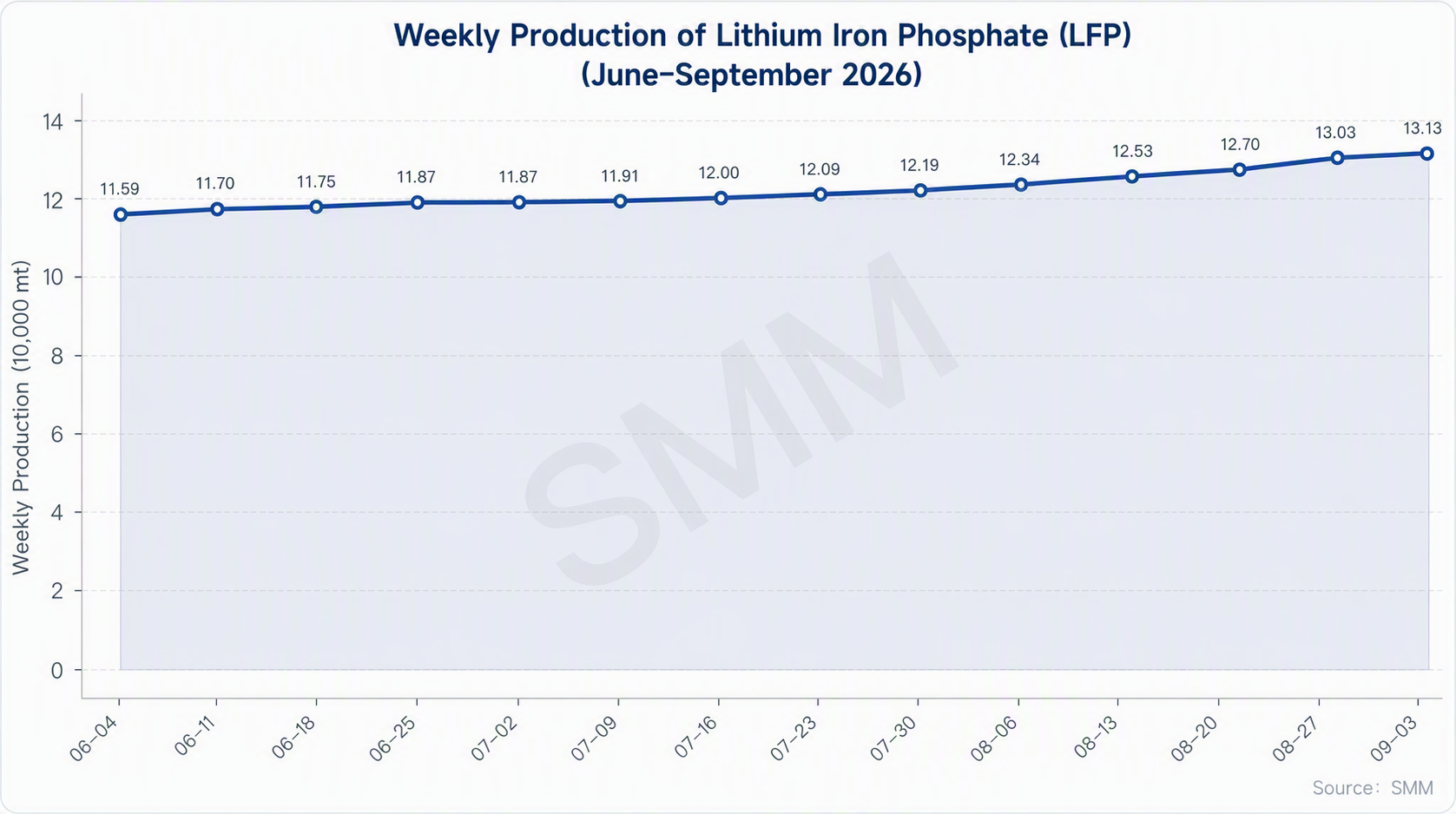
The supply side will also grow in tandem. SMM expects China's lithium carbonate production to gradually rise from 116,400 mt in August to 137,500 mt in December, with net imports increasing from around 26,500 mt to approximately 32,500 mt, and total supply rising from 142,900 mt to 170,000 mt. However, based on current end-use and material production schedule projections, total demand from October to December is expected to reach 184,900 mt, 189,500 mt, and 182,300 mt, respectively,corresponding to supply-demand gaps of approximately 20,100 mt, 21,500 mt, and 12,300 mt.
Therefore, the core contradiction in the lithium carbonate industry in H2 is very clear:it is not that supply is not growing, but whether LFP demand, jointly boosted by EV and energy storage, can continue to outpace supply recovery. According to SMM's current forecasts, China's lithium carbonate market will remain in a supply-demand deficit from August to December, with inventory subject to further destocking.
Risk Warning
The forecast data presented in this article are based on SMM's current judgments on supply, demand, and inventory, and are subject to adjustment due to actual supply-demand changes. This article does not constitute investment advice. Markets involve risk, and decisions should be made with caution.
![[SMM Cobalt Morning Meeting Summary] Weak Demand in the Metal Materials Chain, Falling Costs Intensify Price Pressure](https://imgqn.smm.cn/usercenter/HBsPu20251217171723.jpeg)